Geodes are among the most popular mineral specimens sold globally. However, rising demand for vibrant home decor has made Natural vs. Dyed Geodes debate more common.
Walk into gift shops, boardwalk boutiques, or online marketplaces, and you will find shelves stocked with electric neon pink geodes. These colours can be visually striking, but they are rarely natural. Many buyers unknowingly purchase dyed specimens, believing they were mined from the Earth in those hues, Natural vs. Dyed Geodes.
For collectors and crystal enthusiasts who value natural geological authenticity, this guide covers Natural vs. Dyed Geodes. It helps you spot artificial colour treatments, explains why geodes are dyed, the chemical processes used, and visual tests. You’ll learn how to tell natural specimens apart from artificially enhanced ones.
1. Why Are Geodes Dyed?
The vast majority of quartz and agate geodes mined worldwide—particularly from massive commercial deposits in Brazil, Uruguay, and Madagascar—are naturally grey, milky white, tan, or muted beige.
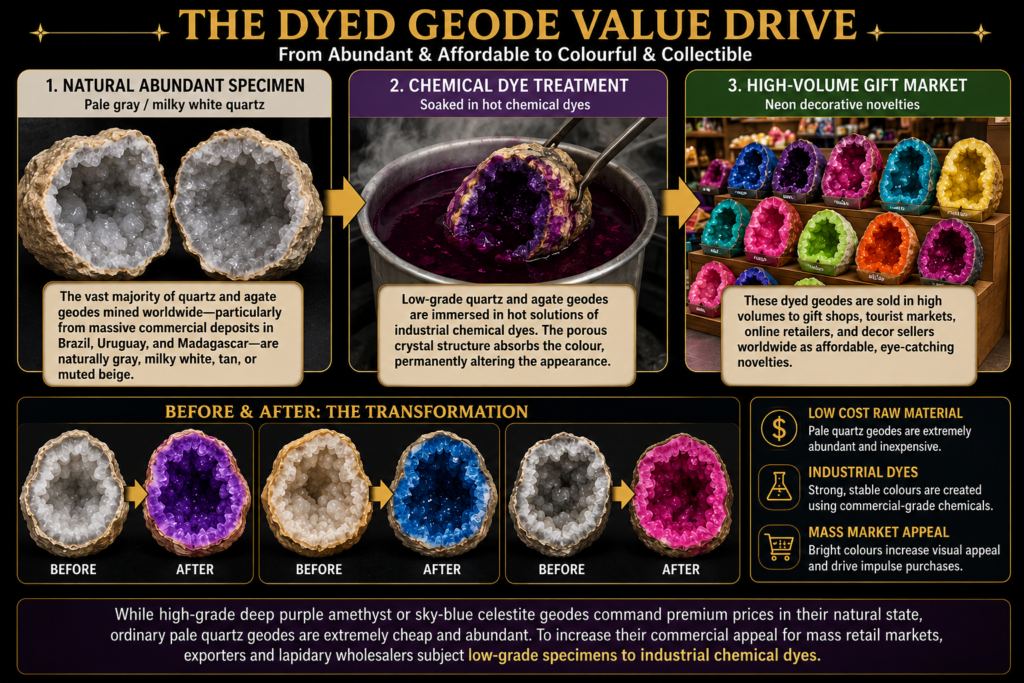
While high-grade deep purple amethyst or sky-blue celestite geodes command premium prices in their natural state, ordinary pale quartz geodes are extremely cheap and abundant. To increase their commercial appeal for mass retail markets, exporters and lapidary wholesalers subject low-grade quartz and agate specimens to industrial chemical dyes.
By transforming a plain grey agate slice or pale quartz geode into a neon pink or royal blue decorative piece, sellers can markup the price significantly to impulse buyers drawn to saturated colours.
2. How Geodes Are Dyed: The Chemical Process
Geodes can be dyed because chalcedony and microcrystalline agate are porous. While macrocrystalline quartz points are dense and impervious, the cryptocrystalline chalcedony shell surrounding the geode cavity contains microscopic channels and pores capable of absorbing liquid solutions through capillary action.
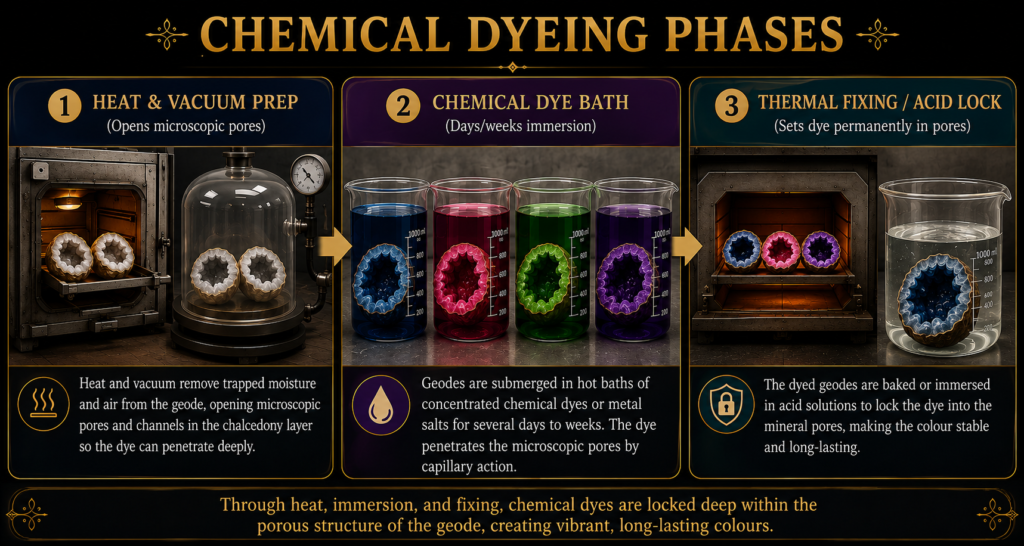
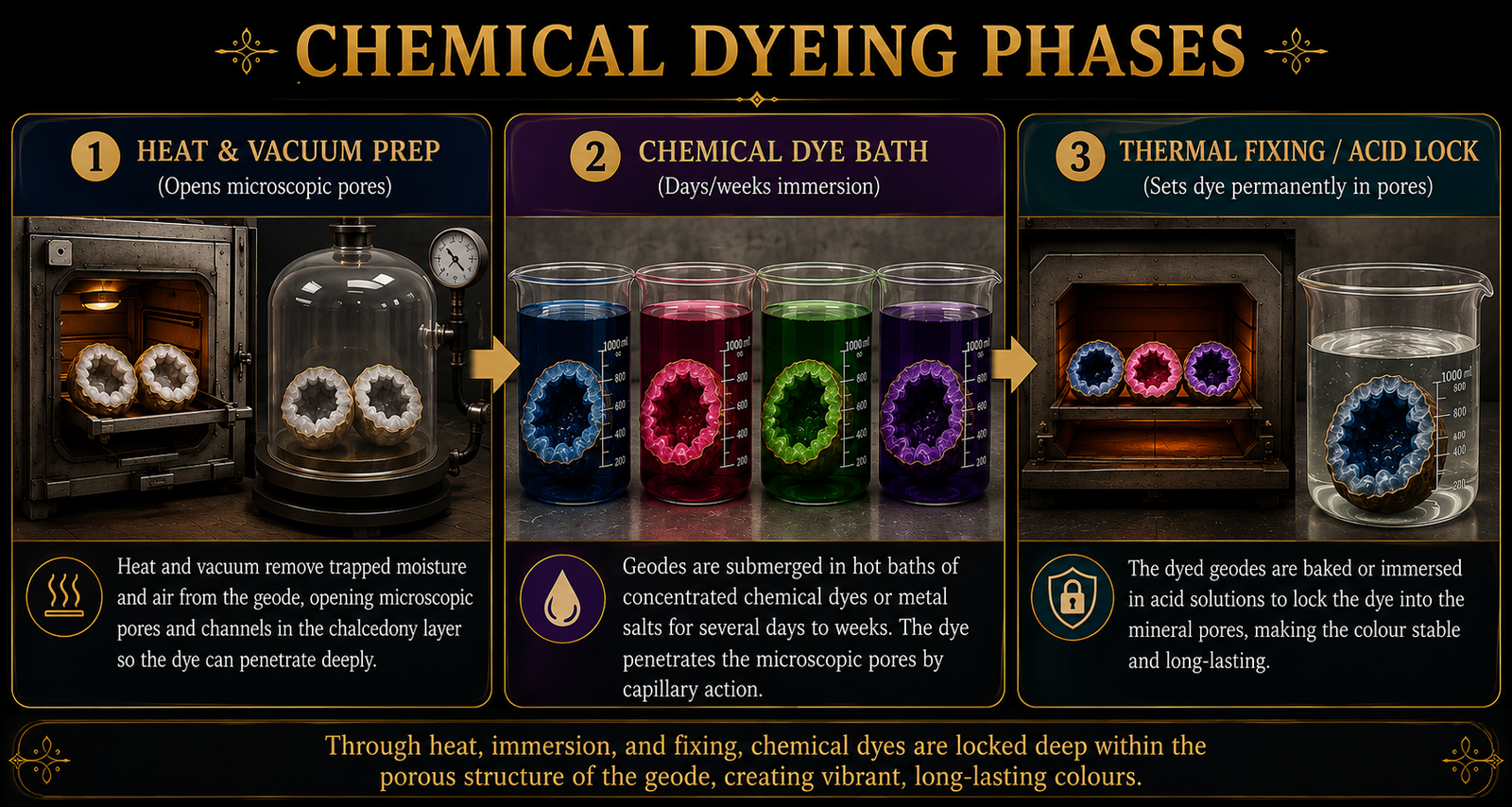
- Preparation: The geode or agate slab is sliced, cleaned, and often heated or placed in a vacuum chamber to drive out trapped moisture and open the micro-pores of the chalcedony layer.
- Soaking: Specimens are submerged in hot baths of concentrated chemical dyes or metal salts for several days to weeks:
- Blue Hues: Created using potassium ferrocyanide followed by ferric sulphate (forming Prussian blue dye) or aniline blue.
- Pink & Magenta Hues: Created using Dramamine, magenta, or aniline red dyes.
- Green Hues: Created using chromium salts (chromic acid) or copper nitrate solutions.
- Purple Hues: Created using purple aniline dyes to mimic natural amethyst.
- Fixing & Sealing: The specimens are baked or washed in acid solutions to fix the dye inside the mineral pores, preventing the dye from rubbing off immediately onto hands or display surfaces.
3. Diagnostic Tests: How to Spot a Dyed Geode
Identifying an artificially dyed geode does not require expensive laboratory equipment. By examining the specimen under good lighting with a 10x jeweller’s loupe or magnifying glass, you can quickly spot several dead giveaways.
A. Fracture and Crack Pooling (The “Bleed” Test)
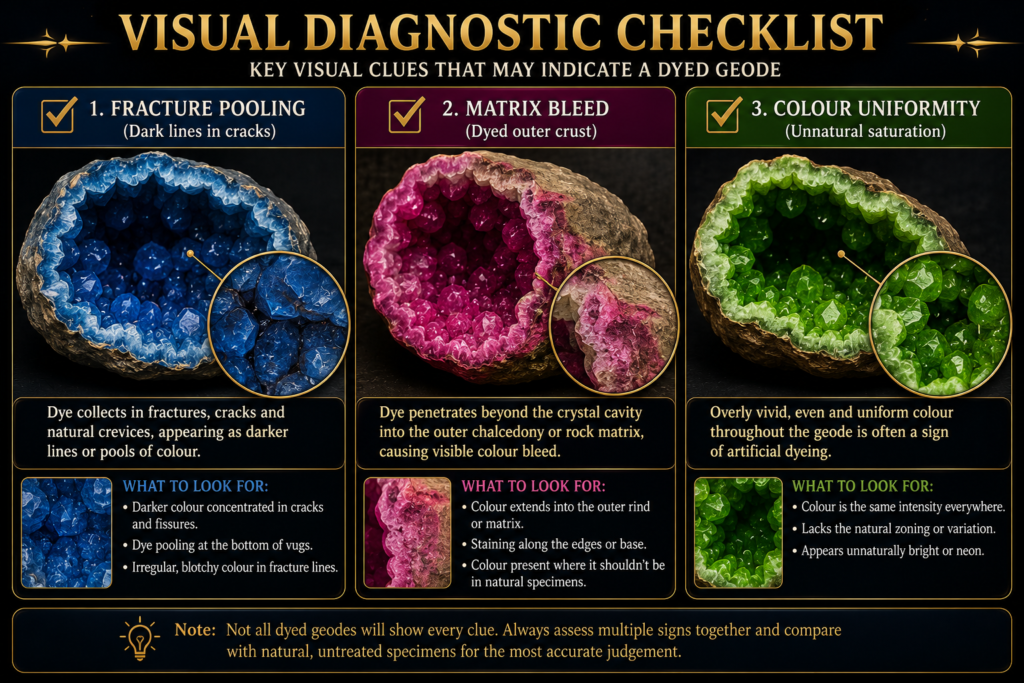
When a geode is soaked in dye, the liquid solution pools heavily inside internal fractures, micro-cracks, and cleavage planes.
- Natural Geodes: Cracks inside a natural quartz point or agate band are usually clear, white, or filled with brown iron oxidation.
- Dyed Geodes: Cracks show concentrated, dark lines of intense colour where the dye pooled and dried. If you see deep neon-blue or magenta spiderweb lines running through the rock, it is artificially dyed.
B. Colour Concentration along Band Boundaries
In natural agate, colour changes occur smoothly between concentric growth layers. In dyed geodes, the dye penetrates different chalcedony layers at varying rates based on porosity:
- Porous, fibrous chalcedony layers absorb massive amounts of dye, turning intensely dark.
- Non-porous, crystalline quartz layers absorb very little dye, remaining pale or cloudy.This creates harsh, unnatural colour contrast where porous bands look bleed-saturated next to pale zones.
C. The Outer Crust Test
Natural geodes typically have a dull, weathered brown, grey, or dark green basalt/limestone outer skin.
- Natural Geodes: The exterior crust looks like ordinary, earthy rock.
- Dyed Geodes: Because the entire rock is submerged in a dye bath, the porous outer limestone or basalt crust absorbs the dye as well. If the rough exterior of a geode shows splotches of neon blue, pink, or purple, the piece has been submerged in dye.
D. Unnatural “Neon” Colour Palette
Nature produces vibrant mineral colours, but they conform to specific chemical palettes:
- Natural Blues: Found in celestite (pale sky-blue), azurite (deep indigo), or chrysocolla (turquoise-blue). Nature never produces neon cobalt or electric cyan quartz geodes.
- Natural Pinks/Reds: Found in rhodochrosite or iron-stained quartz (rusty pink/red). Electric hot magenta or neon pink quartz points do not exist in nature.
- Natural Purples: Amethyst produces soft lavender to deep royal grape purple, but never harsh violet-pink with dyed cracks.
4. Quick Reference: Natural vs. Dyed Comparison
| Visual Feature | Natural Geode | Artificially Dyed Geode |
| Colour Saturation | Earthy, subtle, or natural gem tones (soft blues, deep violets, warm ambers) | Loud, screaming “neon” colours (hot pink, cobalt blue, electric teal) |
| Colour Distribution | Follows natural mineral growth zones; gradual colour transitions | Concentrated in internal cracks, fractures, and porous rock boundaries |
| Cracks & Fractures | Clear, white, or rusty brown iron staining | Filled with dark, concentrated spiderweb lines of dye |
| Outer Rock Rind | Dull grey, brown, tan, or weathered green basalt | Shows splotches or deep penetration of the internal dye colour |
| Acetone / Alcohol Test | Completely unaffected | Rubbing with a cotton swab dipped in acetone/nail polish remover often yields dye residue |
5. The Acetone Test: A Simple Field Test
If you suspect a geode or agate slice is dyed and want definitive proof:
- Take a cotton swab or Q-tip.
- Dip it in 100% pure acetone (or heavy-duty nail polish remover).
- Firmly rub the cotton swab along a dark crack, a porous agate band, or the rough outer crust for 10–15 seconds.
Results: If the cotton swab turns blue, pink, green, or purple, the geode is artificially dyed. A natural mineral will leave no colour residue on the swab whatsoever. (Note: High-quality modern synthetic dyes that have been thermally fixed may not dissolve in acetone, but cheap commercial dyes will transfer immediately).
Summary Checklist for Collectors
- Rule 1: Be sceptical of neon colours—electric blue, hot pink, and lime green quartz geodes are virtually always artificial.
- Rule 2: Look closely at cracks—dark, saturated colour lines inside internal fractures are the #1 sign of dye pooling.
- Rule 3: Inspect the outer skin—if the rough rock crust is stained the same colour as the interior crystals, it was submerged in a chemical bath.
Frequently Asked Questions
How can I tell if a geode has been artificially dyed?
You can look for several signs: concentrated colour pooling in internal cracks, pores, or fractures; colour penetration that is stronger at porous bands and lighter on non-porous layers; an outer crust that shows splotches or deep colour penetration; unnaturally neon or uniform colours that do not occur in nature; and a possible colour transfer when performing the acetone test. A quick acetone test can confirm by checking for dye residue on a cotton swab after rubbing a suspected area.
Why are geodes dyed and how is the dyeing process performed?
Geodes are dyed to increase their commercial appeal in mass retail markets because pale, low-grade quartz and agate geodes are cheap and abundant. The dyeing process involves preparing the geode by drying and opening its micro-pores, soaking it in hot baths of concentrated chemical dyes or metal salts, and then fixing the colour through heating or acid treatment to lock the dye in place.
What visual cues help distinguish natural geodes from dyed ones?
Natural geodes typically show earth-toned colours that follow natural growth layers, with cracks that are clear, white, or rust-stained. Dyed geodes often display bright, uniform or concentrated colours, dye pooling in fractures, and harsh colour contrasts between porous and non-porous layers, along with splotchy outer crusts.
What is the acetone test and how do I perform it?
Take a cotton swab and dip it in pure acetone. Rub it along a dark crack, a porous band, or the rough outer crust for 10–15 seconds. If the swab picks up blue, pink, green, or purple dye, the geode has been artificially dyed; if no colour transfers, the mineral is natural, though some modern synthetic dyes may resist acetone.
What quick reference checklist can collectors use to spot dyed geodes?
Rule 1: Be sceptical of neon colours such as electric blue or hot pink. Rule 2: Look at cracks for dark, saturated lines indicating dye pooling. Rule 3: Inspect the outer skin; staining on the rough crust suggests dye in the bath. These guidelines help distinguish natural geodes from artificially dyed ones.