From the outside, a geode appears to be nothing more than an ordinary, weathered nodule of volcanic rock or limestone. However, when you break one open, however, and you reveal a hidden pocket of intricate mineral architecture. It reveals a subterranean cavern lined with concentric agate bands, botryoidal chalcedony or razor-sharp quartz points. The breathtaking crystalline formations inside geodes are n the physical record of millions of years of fluid dynamics, temperature gradients and chemical precipitation.
At the heart of this transformation is the precise science of silica deposition. Groundwater saturated with dissolved silicon dioxide ($\text{SiO}_2$) infiltrates gas bubbles in cooling lava or dissolution cavities in sedimentary strata. Subtle changes in pH, pressure, and evaporation trigger a slow crystallisation process. Understanding how these hollow pockets transition from barren voids into mineral-rich vaults reveals the mechanism shaping Earth’s most captivating micro-environments.
1. The Starting Material: Dissolved Silica in Hydrothermal Fluids
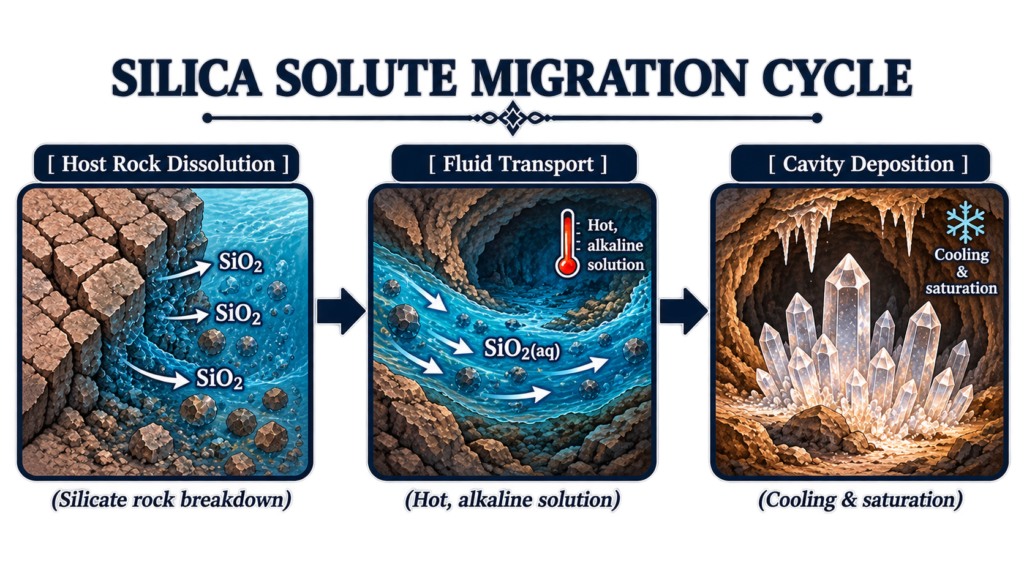
Silica is the most abundant structural component of the Earth’s crust. However, for silica to migrate into an isolated geode cavity (whether a volcanic vesicle or a sedimentary dissolution void), it must first dissolve into circulating fluids—typically meteoric groundwater or geothermal hydrothermal solutions.
Monosilicic Acid ($\text{H}_4\text{SiO}_4$)
Silica dissolves in water primarily as monosilicic acid ($\text{H}_4\text{SiO}_4$), a non-ionic, monomeric solute. The dissolution rate of quartz and silicate minerals increases dramatically under two conditions:
- Elevated Temperature: super heated hydrothermal fluids (100°C–300°C) can hold significantly higher concentrations of dissolved silica than ambient groundwater.
- High pH (Alkaline Conditions): Water with a pH greater than 9.0 causes silicic acid to ionise into silicate anions ($\text{H}_3\text{SiO}_4^-$), exponentially increasing silica solubility.
As these hot, alkaline, silica-saturated fluids migrate through porous host rocks (such as cooling basalt or permeable limestone beds), they eventually seep through the outer walls of a geode cavity.
2. Supersaturation: The Catalyst for crystallisation
Once silica-rich fluid enters a geode cavity, it experiences a sharp change in physical and chemical conditions. The fluid must reach a state of supersaturation where the concentration of dissolved silica exceeds its chemical equilibrium limit.
Supersaturation inside a geode cavity is triggered by three primary environmental mechanisms:
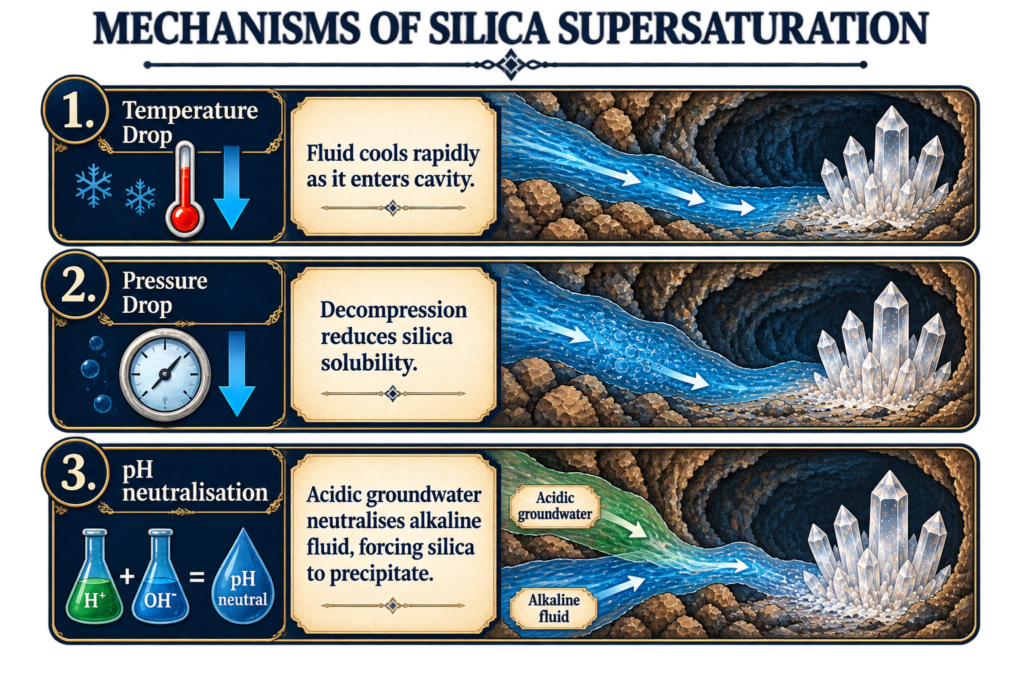
When supersaturation occurs, monosilicic acid molecules begin bonding together through a process called polymerisation.
3. The polymerisation Process: Monomer to Polymer to Gel
The transition from dissolved silicic acid monomers to solid crystals occurs through a multi-stage chemical polymerisation cascade:
$$\text{H}_4\text{SiO}_4 + \text{H}_4\text{SiO}_4 \longrightarrow (\text{HO})_3\text{Si}-\text{O}-\text{Si}(\text{OH})_3 + \text{H}_2\text{O}$$
- Dimer & Oligomer Formation: Monosilicic acid molecules react with one another, splitting off water molecules ($\text{H}_2\text{O}$) and forming siloxane bonds ($\text{Si}-\text{O}-\text{Si}$).
- Nanoparticle Nucleation: These oligomers condense further into spherical, sub-microscopic silica nanoparticles (1–100 nanometres in diameter).
- Colloidal Silica Solution (Sol): Millions of these nanoparticles remain suspended in the fluid, forming a colloidal suspension (a silica sol).
- Silica Gel Aggregation: If supersaturation levels remain high, the nanoparticles cluster together into a porous, three-dimensional network trapped in water—forming a silica gel.
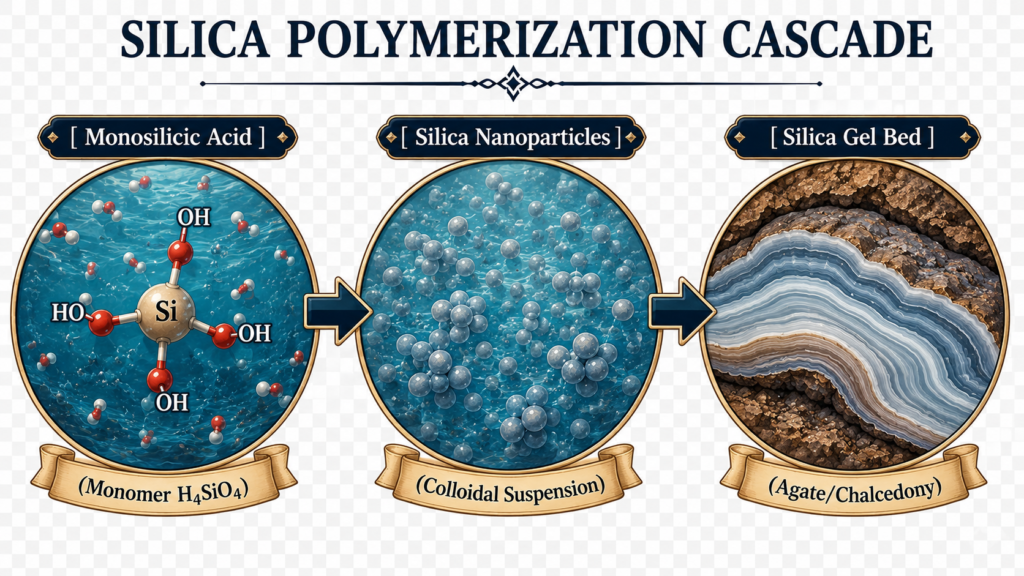
This silica gel layer coats the interior cavity wall, establishing the foundational chalcedony lining or agate shell characteristic of true geodes.
4. Chalcedony vs. Quartz Points: Fluid Chemistry Controls
One of the most striking aspects of geode chemistry is why some geodes contain smooth, banded chalcedony/agate, while others feature distinct, sharply faceted macrocrystalline quartz points.
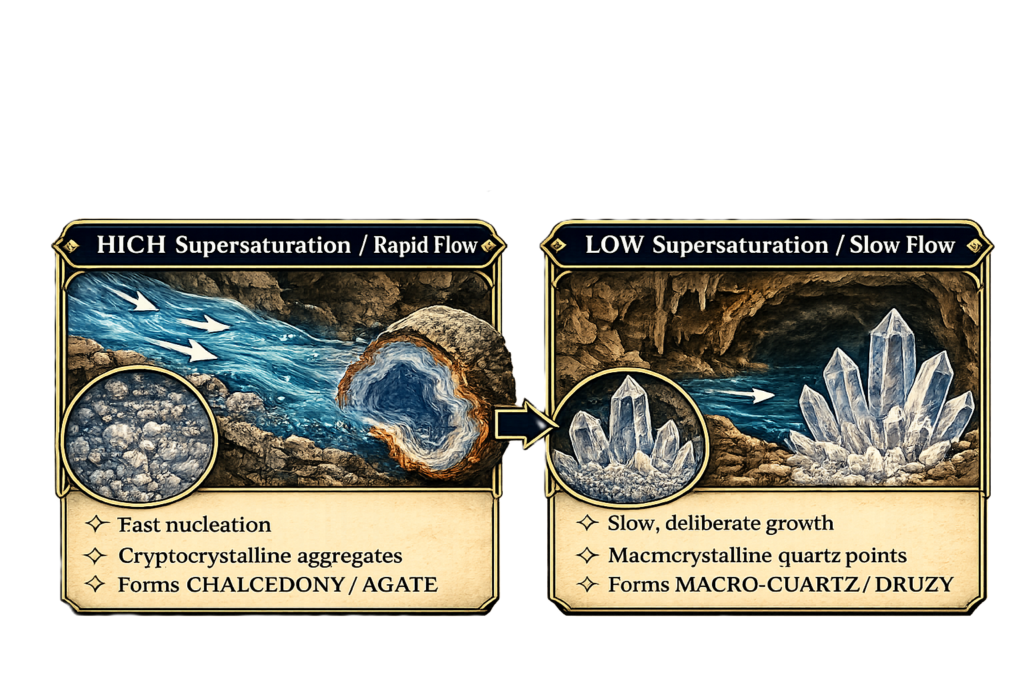
The structural outcome depends directly on the degree of supersaturation and the rate of fluid flow:
Cryptocrystalline Silica (Chalcedony / Agate)
- Conditions: High silica supersaturation, high fluid viscosity, lower temperatures.
- Mechanism: Rapid nucleation produces millions of microscopic silica crystals simultaneously. Because space and time are limited, these crystals cannot grow into visible points; instead, they lock together into fibrous, microcrystalline intergrowths of quartz and moganite (a monoclinic polymorph of silica).
- Agate Banding: Periodic changes in fluid chemistry, trace metal concentrations, or supply pulses create distinct colour-banded layers along the gel bed.
Macrocrystalline Quartz Points
- Conditions: Low to moderate supersaturation, steady temperature, slow fluid movement over long periods.
- Mechanism: Individual silica molecules slowly attach to existing crystal lattice points. Because growth occurs gradually without chaotic nucleation, quartz molecules build well-defined hexagonal prisms terminated by six-sided rhombohedrons ($\alpha\text{-quartz}$).
5. Chromophores: The Chemistry of Geode colours
Pure quartz ($\text{SiO}_2$) is completely colourless and transparent. The brilliant array of colours seen inside geode cavities is caused by trace impurities (chromosomes) incorporated into the silica lattice during crystallisation, often modified by natural background radiation.
| Geode Variety | Primary Chromophore / Chemical Agent | Chemical Mechanism & Radiation Effects |
| Amethyst | Ferric Iron ($\text{Fe}^{3+}$) | $\text{Fe}^{3+}$ substitutes for $\text{Si}^{4+}$ in the lattice; exposure to natural gamma radiation oxidises iron to $\text{Fe}^{4+}$, absorbing yellow-green light and imparting a purple hue. |
| Citrine | Hydrated Iron Oxides / Colloidal $\text{Fe}_{2}\text{O}_{3}$ | Sub-microscopic iron hydroxide or oxide particles trapped within structural channels impart yellow-to-golden hues. |
| Smoky Quartz | Aluminium ($\text{Al}^{3+}$) | $\text{Al}^{3+}$ replaces $\text{Si}^{4+}$ in the lattice, neutralised by $\text{H}^+$ or $\text{Li}^+$; natural radiation creates colour centres that absorb visible light uniformly. |
| Green Agate / Celadonite | Iron(II) & Magnesium Silicates | Inclusions of green celadonite or chlorite clays trapped inside microcrystalline chalcedony layers. |
| Red / Brown Agate | Hematite ($\text{Fe}_2\text{O}_3$) | Finely dispersed ferric oxide particles trapped within the silica gel during layer formation. |
Summary Checklist: The Life Cycle of Geode Chemistry
To recap the chemical journey inside a geode:
- Dissolution: Hot, alkaline water dissolves rock silica into monomeric silicic acid ($\text{H}_4\text{SiO}_4$).
- Cooling & neutralisation: Fluid enters a rock void, experiences temperature and pH drops, and becomes supersaturated.
- polymerisation: Silicic acid monomers link into siloxane bonds ($\text{Si}-\text{O}-\text{Si}$), forming colloidal silica sol and silica gel.
- Shell & Crystal Growth: High supersaturation deposits a cryptocrystalline chalcedony shell; slower, low-saturation flow builds macrocrystalline quartz points inside the remaining space.
- Colouration: Trace metal ion substitutions ($\text{Fe}^{3+}$, $\text{Al}^{3+}$) combined with natural background radiation produce distinct colour varieties like amethyst and smoky quartz.
Frequently Asked Questions
What is the starting material for geode formation and how does silica travel into cavities?
Silica enters geode cavities as dissolved monosilicic acid (H4SiO4) in hot, alkaline fluids. This silica-rich solution migrates through circulating groundwater or geothermal hydrothermal solutions and seeps through the outer walls of a geode cavity, where it can begin to crystallise.
What triggers supersaturation inside geodes?
Supersaturation inside a geode cavity is triggered by a sharp change in physical and chemical conditions, notably cooling and pressure changes as the fluid enters the cavity and experiences pH neutralisation, allowing the concentration of dissolved silica to exceed its chemical equilibrium limit.
How does polymerisation lead to gel and shell inside geodes?
Monosilicic acid molecules polymerise by forming siloxane bonds to create dimers, oligomers, and silica nanoparticles. These particles remain suspended as a silica sol, and when supersaturation persists, they cluster into a porous silica gel that coats the cavity wall, establishing the chalcedony lining or agate shell.
Why do geodes have chalcedony/agate versus macrocrystalline quartz points?
The outcome depends on the degree of supersaturation and the rate of fluid flow. High silica supersaturation and higher viscosity with lower temperatures favour cryptocrystalline silica (chalcedony/agate) formed by rapid nucleation, while lower supersaturation and slower, steadier growth produce macro crystalline quartz points.
What creates the colour varieties seen in geodes?
colour in geodes is produced by trace impurities (chromophores) incorporated into the silica lattice during crystallisation and modified by natural background radiation. Examples include amethyst from ferric iron (Fe3+) and radiation, smoky quartz from aluminium (Al3+), citrine from hydrated iron oxides, and other hues from various iron and mineral inclusions.