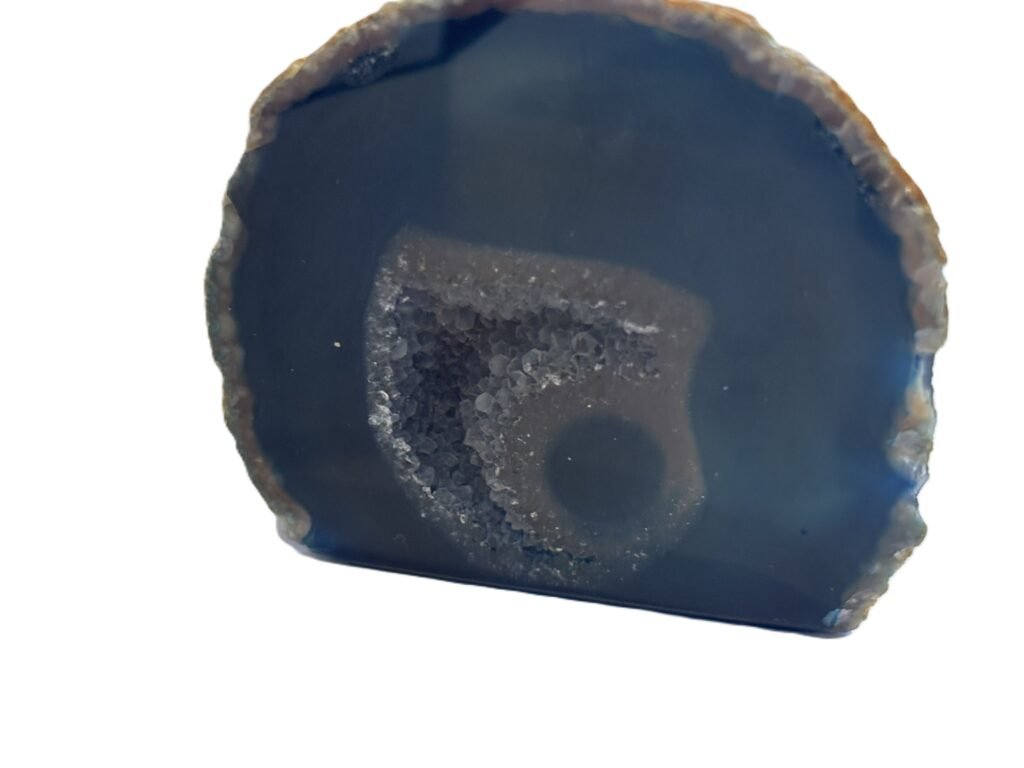
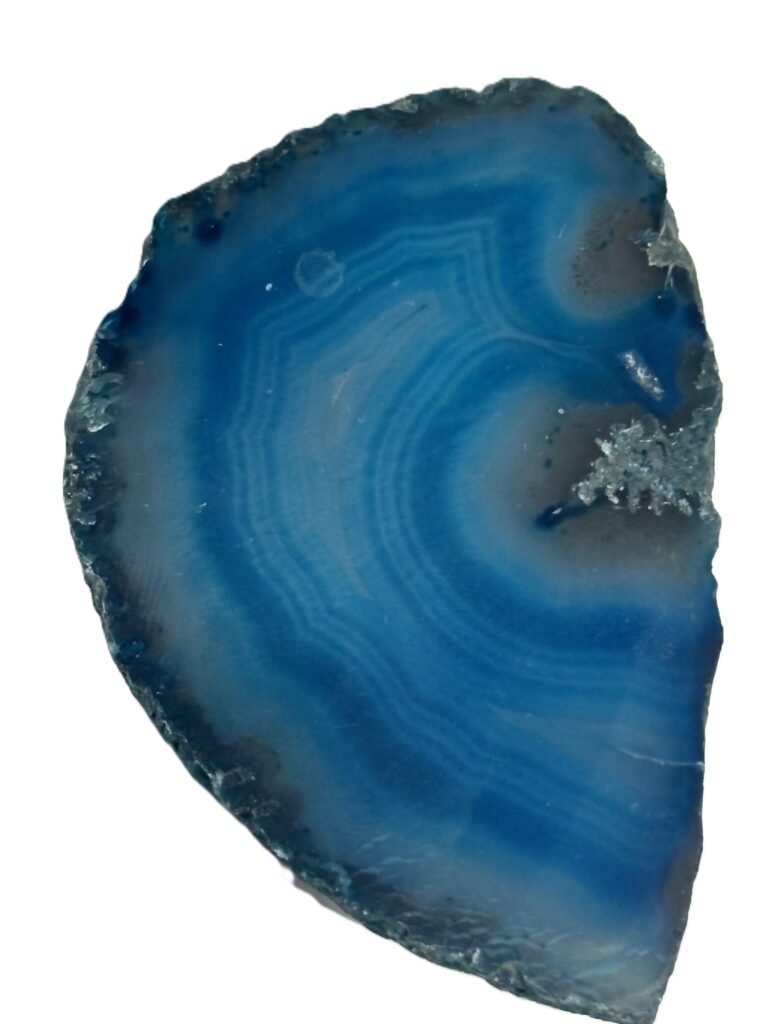
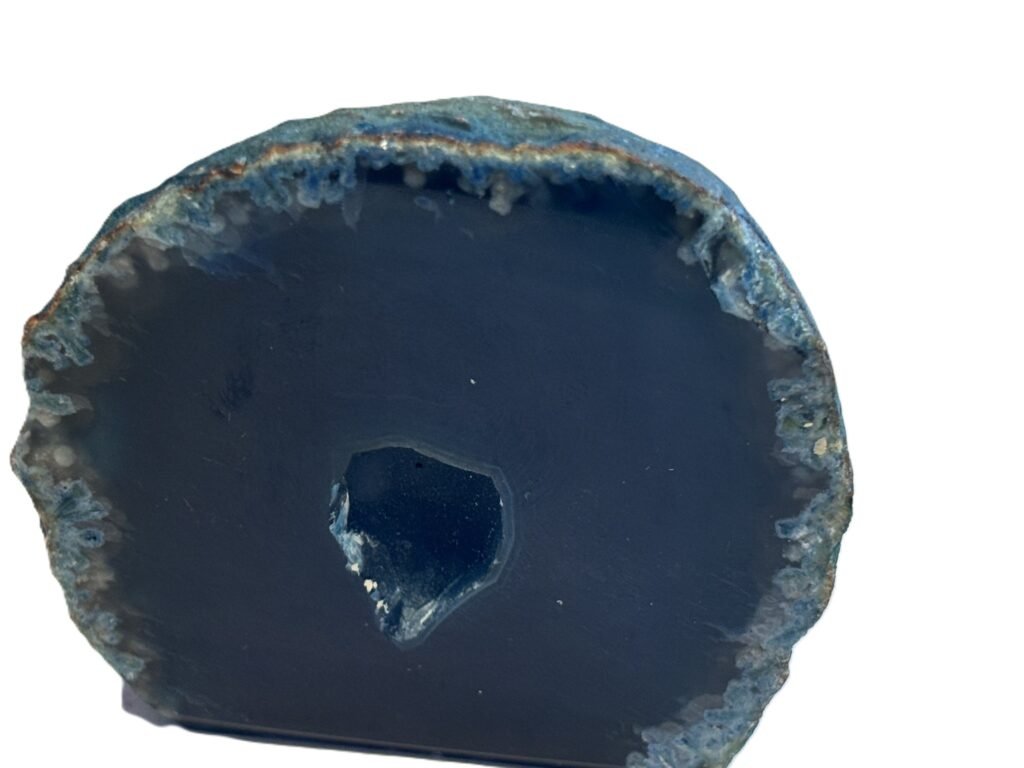
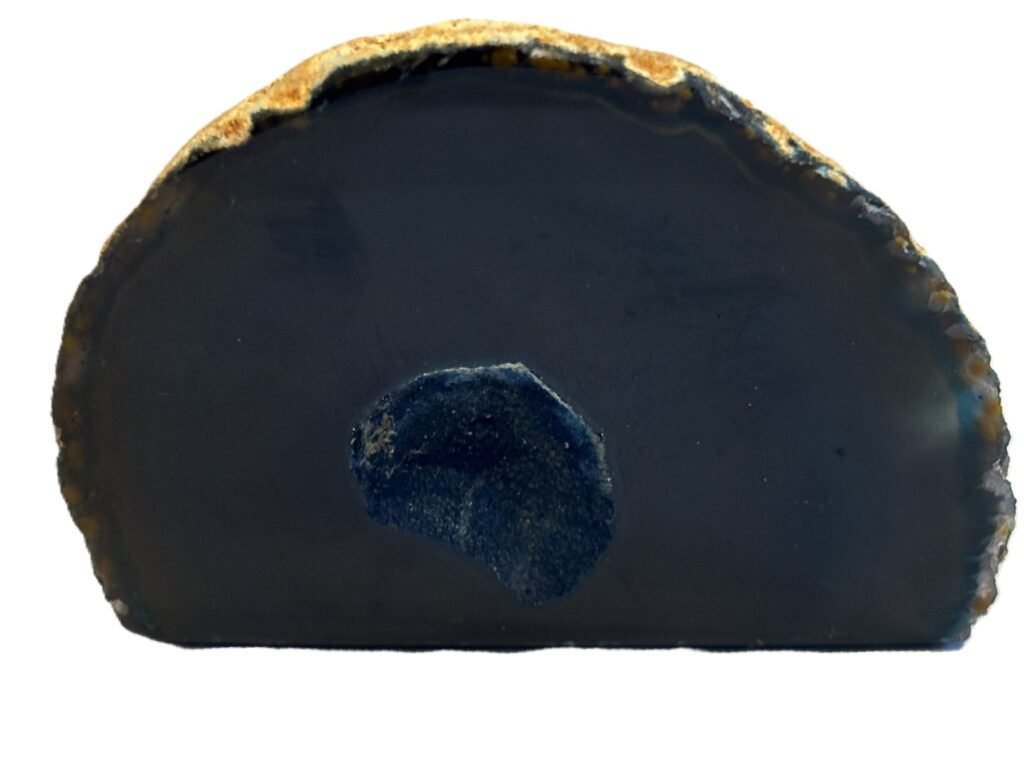
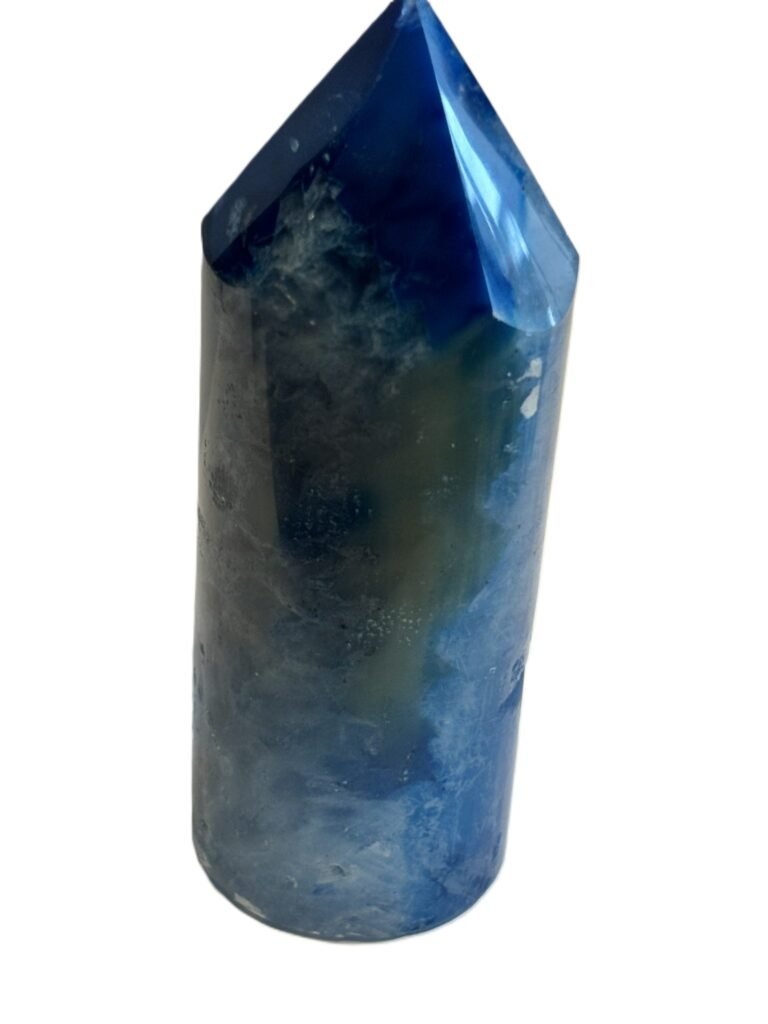
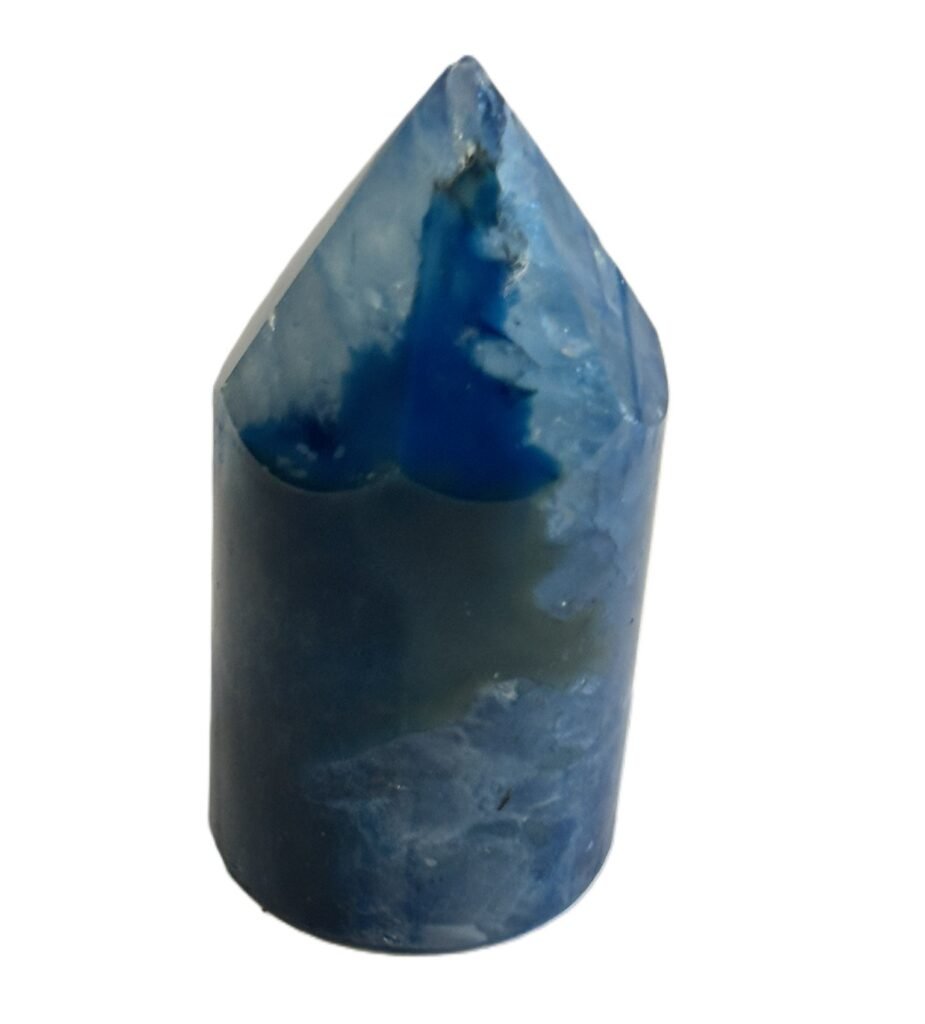
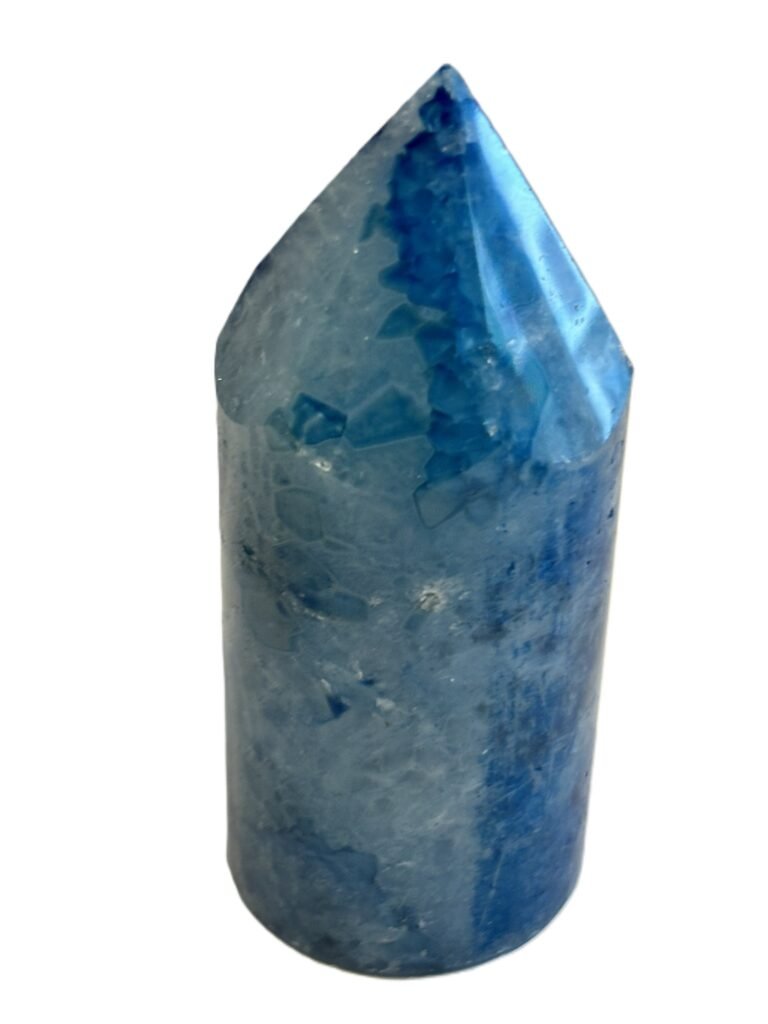
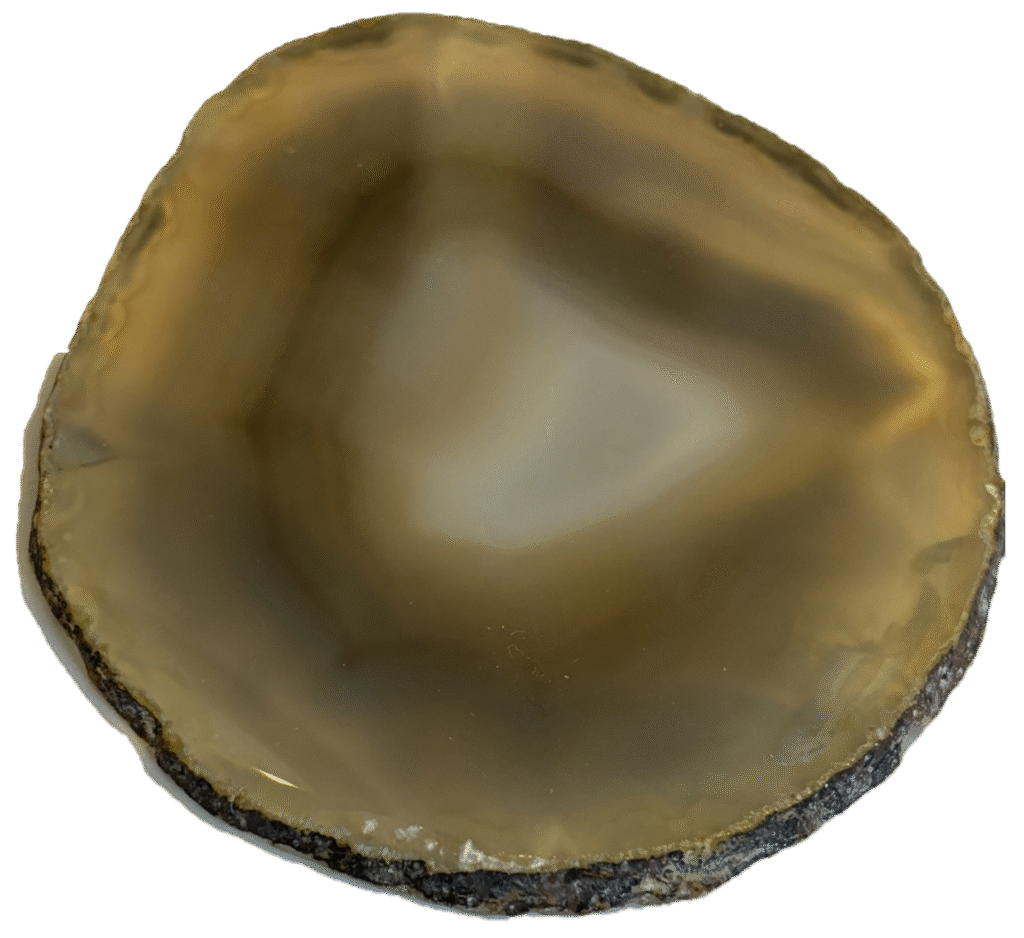
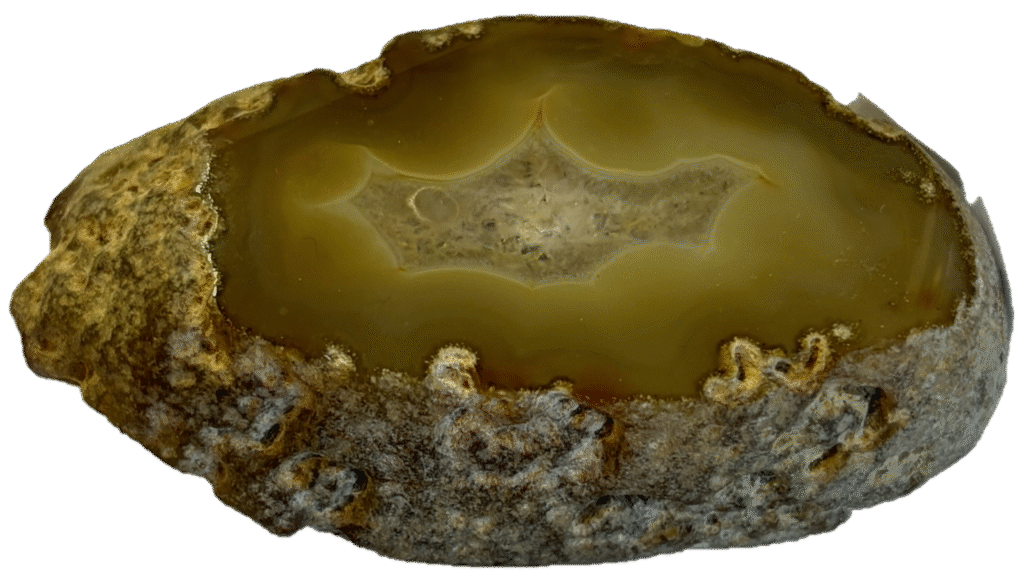
Quartz and Agate & Quartz Geodes represent the quintessential classic geode. Additionally, they occur across riverbeds, desert washes, and volcanic strata worldwide. These silica-rich rock formations are the most abundant, durable, and structurally diverse geodes on Earth.
From smooth, ribbon-banded agate shells to shimmering, sugar-like druzy coatings and bold, sharply faceted macrocrystalline quartz points, Agate & Quartz Geodes showcase an extraordinary variety of textures and visual formations.
This comprehensive guide explores the geology, formation mechanics, structural layers, and visual variations of agate and quartz geodes.
1. The Silica Spectrum: Cryptocrystalline vs. Macrocrystalline Quartz
All quartz and agate geodes are made of silicon dioxide (SiO2). However, their internal appearance varies greatly depending on how their silica crystals form as they precipitate from mineral-rich fluids.
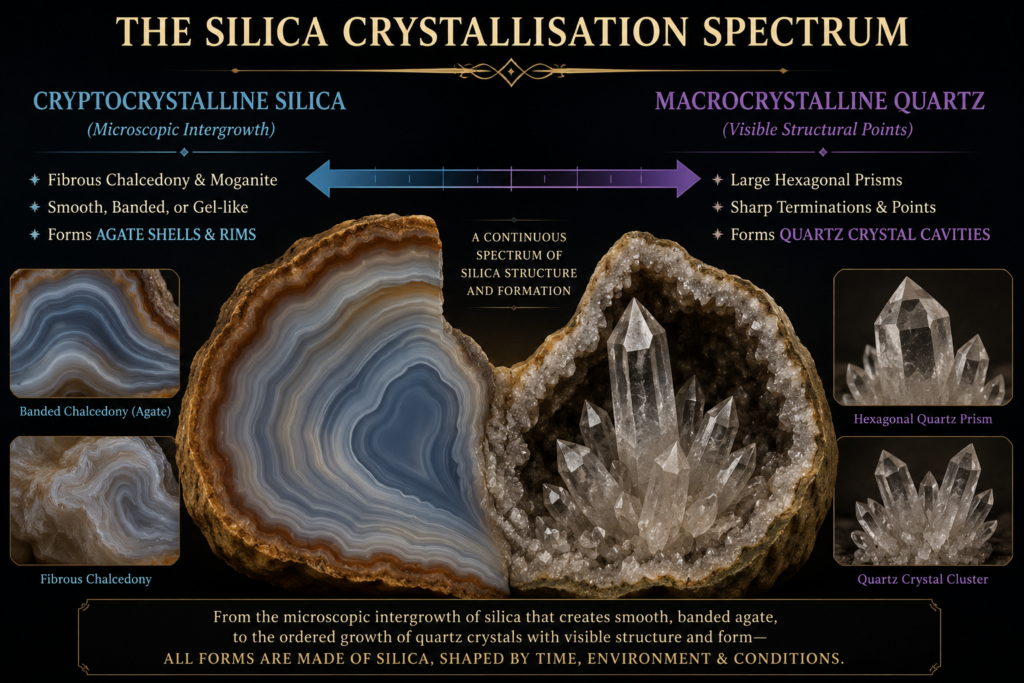
Cryptocrystalline Silica (Chalcedony & Agate)
When silica-saturated fluids enter a cavity under high supersaturation and rapid cooling conditions, millions of microscopic silica crystals nucleate simultaneously. Because space and time are limited, these crystals cannot form visible points. Instead, they lock together into fibrous, microscopic inter-growths of quartz and moganite, creating dense, smooth, and translucent layers known as chalcedony. When this chalcedony features distinct colour banding or mineral inclusions, it is classified as agate.
Macrocrystalline Quartz (Clear & Milky Quartz Points)
When fluid supersaturation levels drop, mineral-rich waters flow slowly over extended geological periods. Individual silica molecules gradually attach to growing crystal lattices. This slow growth allows quartz to build visible, six-sided hexagonal prisms terminated by six-sided rhombohedral points (α-quartz).
2. Anatomical Anatomy of an Agate & Quartz Geode
When cut in cross-section, a fully developed Agate & Quartz Geodes reveals a distinct multi-layered internal anatomy.
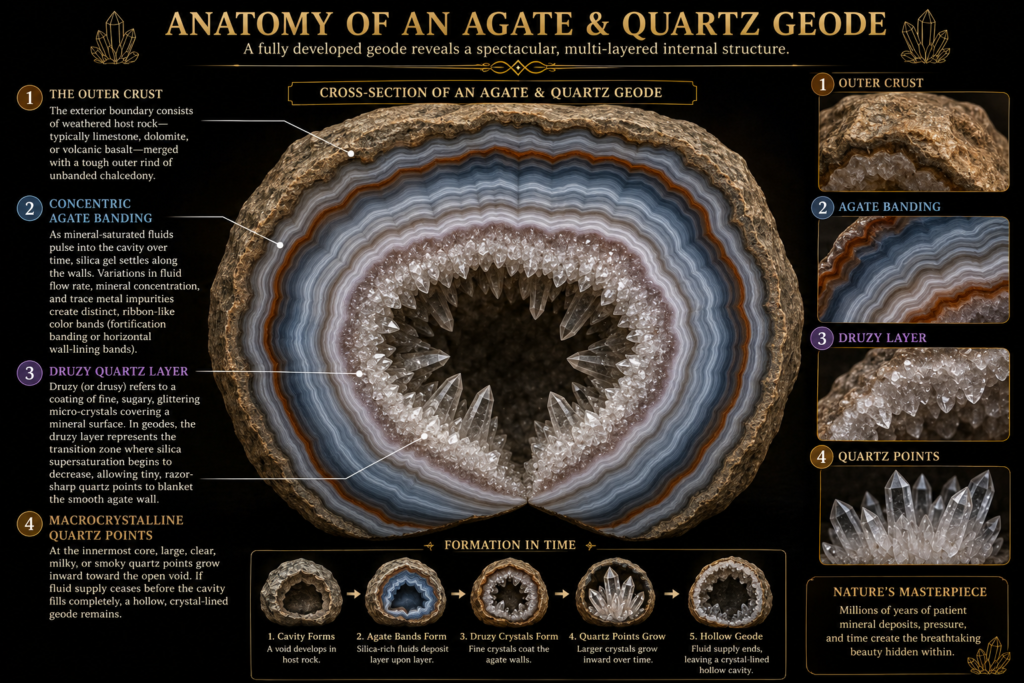
Layer 1: The Outer Crust
The exterior boundary consists of weathered host rock—typically limestone, dolomite, or volcanic basalt merged with a tough outer rind of unbanded chalcedony.
Layer 2: Concentric Agate Banding
As mineral-saturated fluids pulse into the cavity over time, silica gel settles along the walls. Variations in fluid flow rate, mineral concentration, and trace metal impurities create distinct, ribbon-like colour bands (fortification banding or horizontal wall-lining bands).
Layer 3: Druzy Quartz Layer
Druzy (or drusy) refers to a coating of fine, sugary, glittering micro-crystals covering a mineral surface. In geodes, the druzy layer represents the transition zone where silica supersaturation begins to decrease, allowing tiny, razor sharp quartz points to blanket the smooth agate wall.
Layer 4: Macrocrystalline Quartz Points
At the innermost core, large, clear, milky, or smoky quartz points grow inward toward the open void. If fluid supply ceases before the cavity fills completely, a hollow, crystal-lined geode remains.
3. Types of Banding and Internal Textures
Agate geodes display several distinct internal banding patterns depending on how silica-rich fluids filled the cavity:
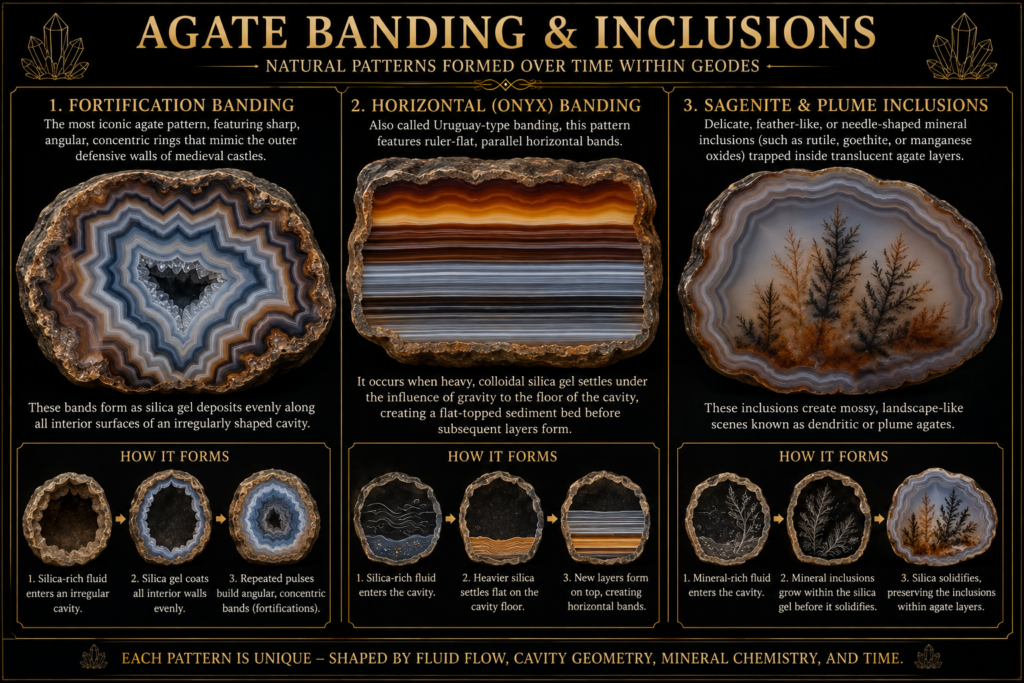
- Fortification Banding: The most iconic agate pattern, featuring sharp, angular, concentric rings that mimic the outer defensive walls of medieval castles. These bands form as silica gel deposits evenly along all interior surfaces of an irregularly shaped cavity.
- Horizontal (Onyx) Banding: Also called Uruguay-type banding, this pattern features ruler-flat, parallel horizontal bands. It occurs when heavy, colloidal silica gel settles under the influence of gravity to the floor of the cavity, creating a flat-topped sediment bed before subsequent layers form.
- Sagenite & Plume Inclusions: Delicate, feather-like, or needle-shaped mineral inclusions (such as rutile, goethite, or manganese oxides) trapped inside translucent agate layers, creating mossy or tree-like internal landscapes.
4. Popular Varieties of Quartz & Agate Geodes
Because quartz incorporates various trace elements and structural variations, quartz and agate geodes occur in several distinct visual styles:
| Variety | Visual Features | Primary Mineral / Cause |
| Clear Quartz Geodes | Colourless, glass-like, transparent points over white chalcedony. | Pure Silicon Dioxide ($\text{SiO}_2$) without impurities. |
| Milky Quartz Geodes | Opaque white, porcelain-like crystal points. | Microscopic fluid inclusions (water/gas bubbles) trapped within the quartz lattice. |
| Smoky Quartz Geodes | Translucent grey, brown, or near-black crystal points. | Trace aluminium ($\text{Al}^{3+}$) inclusions exposed to natural background gamma radiation. |
| Druzy Agate Geodes | Ribbon-banded agate shells lined with a glittering coating of sugar-like crystal points. | Micro-quartz crystallisation over colloidal silica gel beds. |
| Iris Agate Geodes | Rare agate slices that break light into brilliant rainbow spectral colours when back-lit. | Microscopic, ultra-thin chalcedony bands acting as a natural diffraction grating. |
5. Field Identification and Value Indicators
When evaluating agate and quartz geodes as a collector or lapidary enthusiast, consider these key quality factors:
- Banding Contrast: High visual separation between dark and light agate bands significantly increases specimen value.
- Druzy Coverage: A uniform, undamaged layer of sparkling druzy crystals across the entire cavity creates high aesthetic appeal.
- Point Clarity: In macrocrystalline quartz geodes, sharp, transparent crystal points free of severe fractures carry higher value than dull, opaque points.
- Natural Colour vs. Dyed Agate: Be cautious of neon-pink, bright teal, or deep purple agate geodes sold in tourist gift shops. These are typically pale grey quartz geodes soaked in chemical dyes. Natural agate colours tend to be earthy tans, warm ambers, greys, soft blues, and rusty reds.
Summary Checklist
- Composition: Silicon Dioxide ($\text{SiO}_2$); Mohs hardness of 7.0 (exceptionally durable).
- Agate Layer: Cryptocrystalline chalcedony deposited in concentric or horizontal bands.
- Druzy Layer: A sparkling, sugar-like coating of micro-quartz points lining the agate shell.
- Quartz Points: Macrocrystalline points growing inward toward the hollow core.
Frequently Asked Questions
What are agate and quartz geodes and where are they commonly found?
Agate and quartz geodes are silica-based rock formations that form hollow or partially hollow cavities lined with crystal structures. They are among the most abundant, durable, and visually diverse geodes, commonly found in riverbeds, desert washes, and volcanic strata around the world.
How do cryptocrystalline silica geodes differ from macrocrystalline quartz geodes?
Cryptocrystalline silica, including chalcedony and agate, forms when very small silica crystals nucleate and inter-grow, creating dense, smooth, banded interiors. Macrocrystalline quartz geodes develop when silica molecules attach slowly to growing lattices, forming visible six‑sided quartz crystals with clear, milky, or smoky points.
What is the internal anatomy of an agate and quartz geode?
A geode in cross-section typically presents four layers: an outer crust of weathered host rock and chalcedony, concentric agate banding, a druzy quartz layer of tiny crystals, and the innermost hollow cavity lined with macrocrystalline quartz points.
What types of internal banding and textures can be found in agate geodes?
Agate geodes exhibit several banding patterns, including fortification banding with sharp angular rings, horizontal onyx banding formed by gravity-driven sediment beds, and delicate sagenite or plume inclusions that create mossy or tree-like interiors.
Which features indicate higher quality or value in agate and quartz geodes?
Higher quality geodes typically show strong banding contrast, uniform and undamaged druzy coverage, sharp and transparent quartz points, and natural colours rather than dyed agate, with natural earth tones preferred in valued specimens.
These are my personally curated and selected Agates and Quartz
Products by Category

Blue Agate Half Geode 10
£10.00
Blue Agate Half Geode no 7
£10.00Blue Agate Half Geode no 8
£10.00Blue Agate Half Geode no 9
£10.00Blue Agate Polished Crystal Point Tower 15
£20.00
Blue Agate Polished Crystal Point Tower 18
£15.00Blue Agate Polished Point 16
£18.00
Brown Agate Slice AGR
£12.00
Brown Agate Slice AGS
£10.00