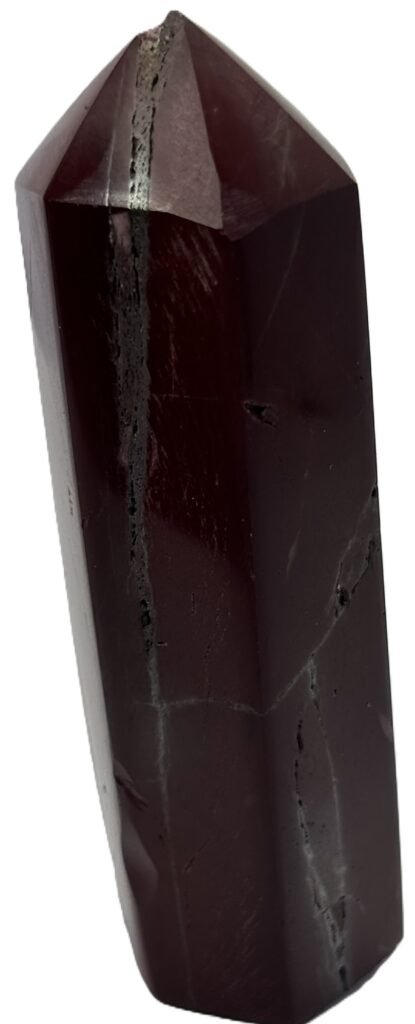
Mookaite jasper is an Australian gemstone renowned for its bold, warm hues and striking banded patterns. Mined near the Kennedy Ranges in Western Australia, this silicified sedimentary stone is prized for its swirls of mustard yellow, deep burgundy, and ivory cream. Geologically, it represents an ancient ocean bed formed from the fossilised remains of microscopic marine organisms. Metaphysically, mookaite serves as an earth-grounding stone that promotes resilience, vitality, and emotional equilibrium during times of major life transitions.
Alternate Names
- Mookite / Moukaite / Moakite (common spelling variations)
- Windalia Radiolarite (formal geological name)
- Australian Jasper
- Mooka Chert
- Australian Porcelain Jasper
The name derives from Mooka Creek, located on the edge of the Kennedy Range. In the local Aboriginal Wajarri Yamatji language, the root word Mooka translates to “running waters,” referencing the freshwater springs that emerge in the area.
The Stone’s Science and Composition
Geologically, mookaite is not a classic igneous jasper. It is technically classified as a silicified radiolarite—a biogenic sedimentary chert.
During the Lower Cretaceous period (roughly 110 to 125 million years ago), a shallow epicontinental sea covered much of Western Australia. Billions of radiolarians—single-celled planktonic protozoa with microscopic skeletons composed of amorphous silica ($SiO_2$)—accumulated on the ancient seabed as fine ooze. Over geological epochs, groundwaters rich in dissolved silica percolated through these sediment layers, replacing and cementing the radiolarian tests with microcrystalline quartz, chalcedony, and minor opal-CT.
The vivid colours are the result of chemical zoning and trace impurities:
- Haematite ($\text{Fe}_2\text{O}_3$): Produces deep burgundies, maroons, reds, and pinks.
- Goethite and Limonite ($\text{FeO(OH)}\cdot n\text{H}_2\text{O}$): Yield ochres, tans, and mustard yellows.
- Silica Purity: Sections devoid of heavy iron pigmentation produce milky creams, porcelain whites, and pale mauves.
Key Physical Characteristics
| Property | Specification |
| Chemical Formula | $\text{SiO}_2$ (Silicon Dioxide with iron oxide inclusions) |
| Crystal System | Trigonal (Microcrystalline aggregate) |
| Mohs Hardness | 6.5 – 7.0 |
| Specific Gravity | 2.58 – 2.65 |
| Lustre | Vitreous, waxy, to porcelain-like when polished |
| Transparency | Opaque to faintly translucent along thin edges |
| Fracture | Conchoidal to splintery |
| Streak | White to pale yellow/reddish-brown |
Common Geologic Varieties
- Porcelain Mookaite: Fine-grained, pure-silica nodules that fracture with a smooth, porcelain-like texture, usually pale cream, blush, or soft mauve.
- Banded/Zoned Mookaite: The classic commercial grade displaying sharp boundaries between mustard yellow and deep crimson.
- Dendritic Mookaite: Varieties displaying black or dark brown tree-like manganese oxide dendrites creeping through lighter zones.
- Brecciated Mookaite: Formations where structural faulting shattered the original rock, with fissures subsequently filled by white chalcedony or clear quartz veining.
Global Mining and Volcanic Sources
Mookaite is found in only one primary deposit on Earth. It is mined on Mooka Station, a working pastoral lease near Gascoyne Junction in the Carnarvon Basin / Kennedy Range of Western Australia.
Unlike true jaspers linked to basaltic volcanism or hydrothermal venting, mookaite is entirely non-volcanic. It occurs strictly as flat-lying nodular seams and stratified beds within the weathered zone of the Windalia Radiolarite Formation. Extraction is performed via small-scale open-pit excavation. Because access is limited to dry periods and heavy earth-moving equipment must avoid breaking brittle nodules, commercial sourcing remains limited and ethical.
Crystal Pairings: What to Combine and Avoid
Optimal Crystal Pairings
- Red Jasper: Accentuates grounding energy and reinforces physical endurance through the root chakra.
- Carnelian: Complements mookaite’s sacral chakra tones, stimulating creativity, motivation, and forward momentum.
- Tiger’s Eye: Pairs well with the golden-yellow goethite bands to sharpen focus, mental grit, and solar plexus confidence.
- Smoky Quartz: Helps clear heavy, anxious mental chatter, anchoring mookaite’s earth energy.
Crystal Pairings to Avoid
- High-Frequency Crown Stones (Moldavite, Phenakite, Scolecite): The intense, ethereal frequencies of tektites or crown-activation stones can directly clash with mookaite’s dense, physical earth energy, leaving the user feeling ungrounded or overstimulated.
- Extreme Calming Stones (Blue Lace Agate, Celestite): Pairings with stones used purely for slowing heart rates or inducing sleep can neutralise mookaite’s encouraging, action-oriented vibration.
Archaeology, Art and Ancient History
For tens of thousands of years, the Wajarri Yamatji people and neighbouring Indigenous groups utilised the hard radiolarite chert deposits of the Kennedy Range. Because mookaite flakes with sharp conchoidal edges similar to flint, it served as an essential material for crafting stone knives, spear points (leech-shaped flakes), scrapers, and hide processors. Pieces were often traded along inland songlines across the desert. In Aboriginal culture, songlines (also called Dreaming tracks) function as a spiritual, cultural, and physical map. By singing the songs in a specific sequence, travellers can navigate vast distances across the inland deserts, finding waterholes, food sources, and safe pathways.
In contemporary lapidary art, mookaite is cut into cabochons, polished freeform sculptures, spheres, and tumbled stones. Its fine grain takes an exceptional polish that resists undercut pitting.
Folklore, Legends and Sacred Tales
According to Indigenous Australian traditions, the land retains its own living memory and spiritual resonance. Red and yellow ochres—the primary pigments found in mookaite—are sacred substances used in ceremonial body painting and rock art to invoke connection with ancestral Dreamtime beings.
Outback lore recounts that travellers kept smooth mookaite pebbles in their kits as protective amulets when traversing barren stretches of the Gascoyne region. It was held to sharpen an individual’s instinct for underground water sources and signal environmental changes before danger arose.
Metaphysical and Mystical Healing Properties
- Decision-Making Support: Known as the “Stone of the Present Moment,” it assists individuals struggling between multiple paths by anchoring attention to immediate instincts.
- Anti-ageing and Cellular Vitality: Metaphysical lore suggests mookaite slows cellular ageing by encouraging regeneration and supporting tissue health.
- Emotional Resilience: Calms internal panic, helping individuals remain steady while confronting sudden life transitions, career pivots, or grief.
- Immune Fortification: Practising energy healers often place mookaite along the lower abdomen to support fluid balance and the lymphatic system.
Astrological Connections
- Taurus: Resonates directly with Taurus’s ruling element of Earth, providing steady anchoring, patience, and a tangible connection to physical reality.
- Capricorn: Enhances perseverance, pragmatic ambition, and determination when organising complex projects.
- Scorpio: Aligns with mookaite’s crimson haematite frequencies, balancing emotional intensity with instinctual clarity.
The Chakra System
- Root Chakra (Muladhara): Stimulated by the rich iron oxides and reds, rooting physical vitality to the earth and dispelling survival anxieties.
- Sacral Chakra (Svadhisthana): Activated by the peach and ochre tones, unlocking creative flow, adaptability, and personal sensuality.
- Solar Plexus Chakra (Manipura): Influenced by the rich mustard yellows, promoting boundary-setting, gut intuition, and self-confidence.
Interesting Facts
- It is a Micro fossil Bed: Under petrographic magnification, polished thin slices of mookaite reveal preserved spherical tests of ancient radiolarian plankton.
- Single Location on the Globe: Genuine mookaite comes solely from Mooka Station in Western Australia; stones marketed from elsewhere are mislabelled jaspers.
- Porcelain Sound: Striking two polished slabs of porcelain mookaite together produces a crisp, glass-like chime rather than the dull clatter of common rock.
Modern Milestones: Birthstones and Anniversaries
- Alternative Birthstone: Serves as a modern seasonal birthstone for late autumn and early spring, particularly complementing April and October alignments.
- Wedding Anniversaries: Frequently gifted on the 18th and 28th wedding anniversaries as an alternative to traditional stones, symbolising enduring love, adaptability, and stability through life’s changes.
Mookaite Frequently Asked Questions
Is mookaite a true jasper?
Geologically, no. True jasper is an opaque, microcrystalline variety of quartz associated with igneous conditions. Mookaite is a silicified sedimentary radiolarite (a chert), though lapidary trades categorise it as jasper due to its hardness, density, and polish.
Can mookaite go in water?
Yes. With a Mohs hardness of 6.5 to 7.0 and a non-porous silica composition, mookaite is safe for short-term rinses in cool, clean water. Avoid prolonged soaking in salt water to preserve the surface lustre.
How can I tell if my mookaite is real?
Genuine mookaite feels cold, heavy, and glass-smooth. It features earthy tones (mustard, maroon, cream) rather than synthetic neon colours. If it bubbles or shows trapped air pockets, it is dyed resin or glass.
How do I energetically cleanse and charge mookaite?
Bury it in natural soil overnight to restore its earth connection. Alternatively, smudge it with white sage or place it on a slab of selenite for 4 to 6 hours.
These are my personally selected and curated Mookaite products