When exploring gravel bars, limestone quarries, or volcanic rock fields, collectors and amateur geologists frequently encounter rounded, knobby, or cavity-bearing rocks that look intriguingly distinct from the surrounding matrix. However, telling these formations apart can be challenging. Terms like geodes, nodules, vugs, thundereggs and concretions are often used interchangeably in casual conversation, yet they represent fundamentally different geological processes, growth mechanics, and internal structures.
Understanding these key geological differences not only sharpens your field identification skills, but also helps collector and metaphysical enthusiasts recognise the exact environmental history stored within each specimen. In this guide, we break down the formation, structural characteristics, and diagnostic traits of these five common geological features.
The Geological Spectrum at a Glance
While all five formations represent localised mineral concentrations or cavity fillings, their primary differences lie in two main criteria:
- Cavity Presence vs. Solid Mass: Is the formation hollow, crystal-lined, or entirely solid?
- Growth Direction & Host Rock Relationship: Did the mineral grow from the outside inward, from the centre outward, or simply line a pre-existing pocket without forming a distinct outer skin?
| Formation Type | Internal State | Primary Growth Direction | Outer Shell Separation | Common Host Rocks |
| Geode | Hollow / Crystal-Lined | Outside-In (Centripetal) | Yes (Weathers out cleanly) | Limestone, Basalt, Rhyolite |
| Nodule | Completely Solid | Outside-In (Centripetal) | Yes (Weathers out cleanly) | Chert, Flint, Chalk, Shale |
| Vug | Open Cavity | Outside-In (Centripetal) | No (Integral to host rock) | Hydrothermal Veins, Marble |
| Concretion | Solid Aggregate | Inside-Out (Centrifugal) | No / Moderate | Sandstone, Shale, Mudstone |
| Thunderegg | Solid / Near-Solid | Centripetal / Infilling | Yes (Rough lithophysae core) | Volcanic Ash, Rhyolite |
1. Geodes: Hollow, Crystal-Lined Cavities
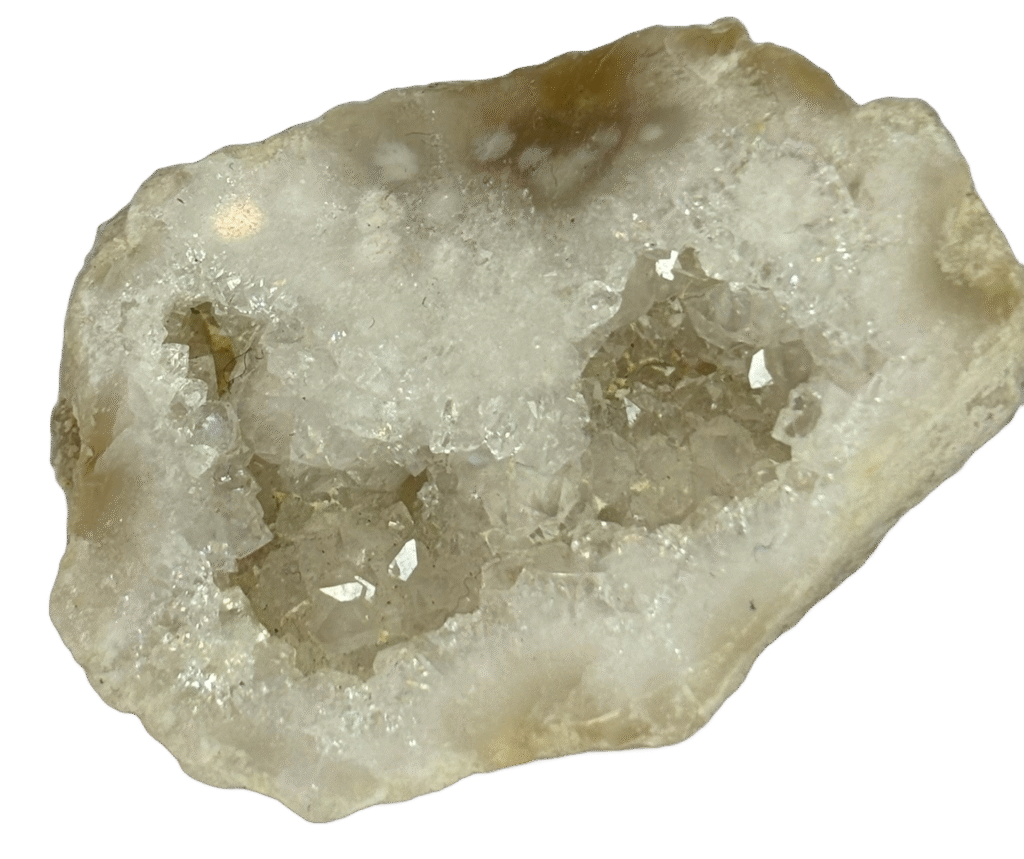
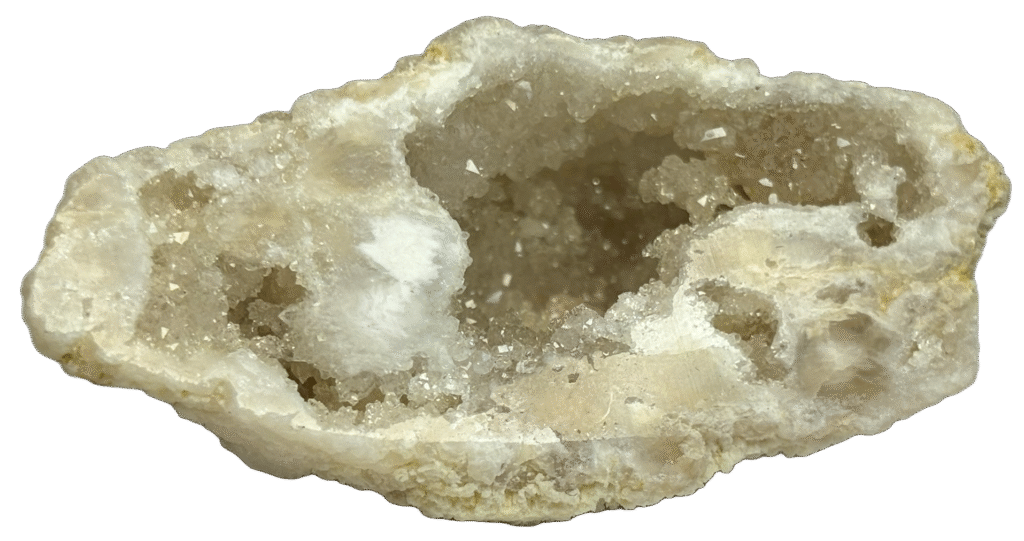
A geode is a sub-spherical to oblong rock structure containing a hollow cavity lined with inward-growing mineral crystals. The defining feature of a true geode is its durable, weather-resistant outer shell—typically composed of dense chalcedony or microcrystalline silica—which allows the formation to separate intact from its surrounding matrix as the softer host rock weathers away.
Formation Mechanics
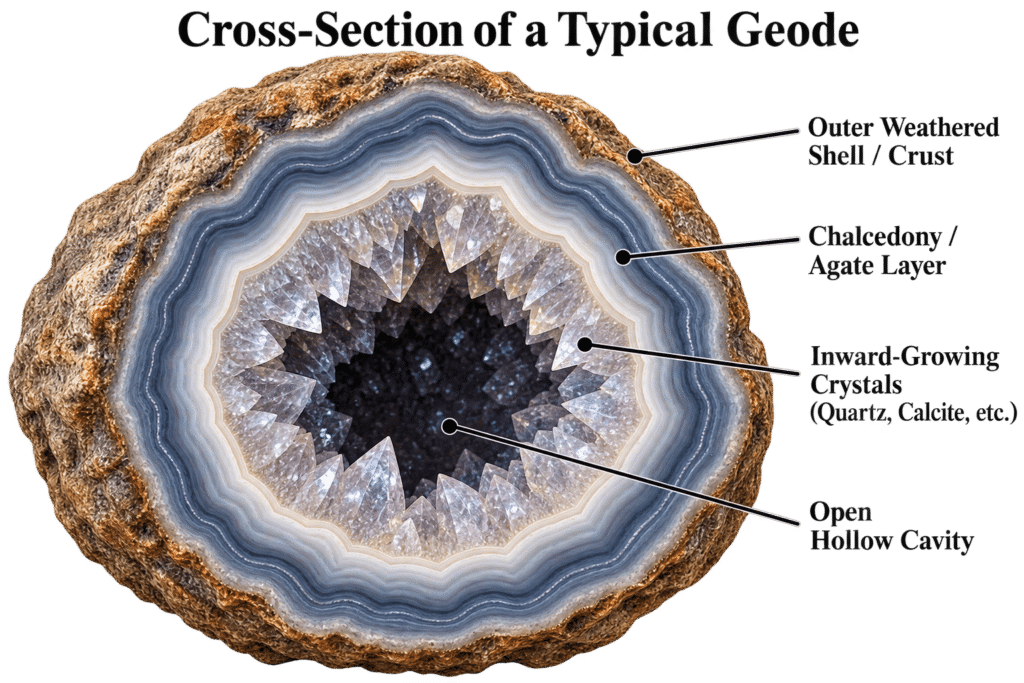
- Step 1 (Vesicle Creation): Geodes begin as open cavities. In volcanic environments, these voids are created by trapped gas bubbles (vesicles) in cooling lava. In sedimentary rocks like limestone or dolomite, cavities form when organic material, mud balls, or anhydrite nodules dissolve over time.
- Step 2 (Impermeable Lining): Silica-rich groundwater percolates into the void, precipitating a tough, non-porous outer layer of chalcedony.
- Step 3 (Centripetal Growth): Over thousands or millions of years, mineral-rich thermal fluids continuously deposit solute layers onto the inner walls. Crystals—such as quartz, amethyst, calcite, or celestite—grow centripetally (inward toward the open centre), leaving a hollow interior space.
2. Nodules: Solid Mineral Masses
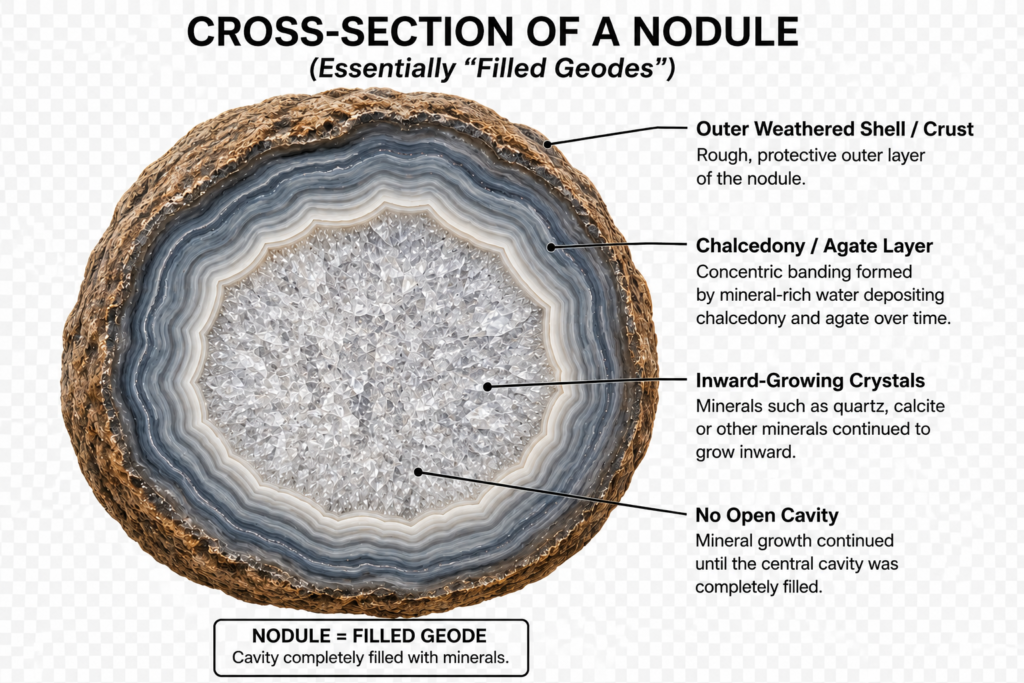
A nodule is a solid, compact mass of mineral material that exists as a discrete entity within a host rock matrix. Like geodes, nodules possess a well-defined boundary that allows them to weather out cleanly from the surrounding rock. However, nodules are completely solid (or nearly solid) and lack the hollow, crystal-lined central void characteristic of geodes.
How Nodules Form
Many nodules are essentially “filled geodes” or formations where mineral precipitation continued until the central cavity was completely choked off by mineral growth.
Chert & Flint Nodules: Frequently found in chalk and limestone strata, chert nodules form during diagenesis (rock compaction and cementation). Silica derived from sponge spicules and microscopic marine organisms dissolves in pore water and precipitates in localised pockets, replacing the host limestone with microcrystalline quartz.
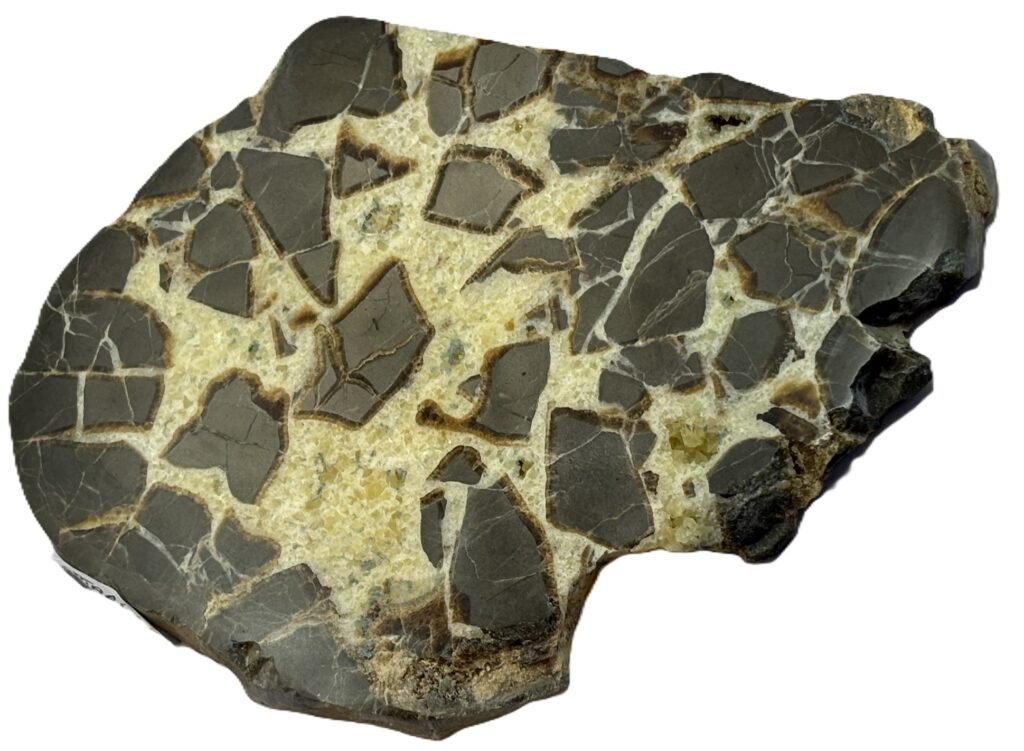
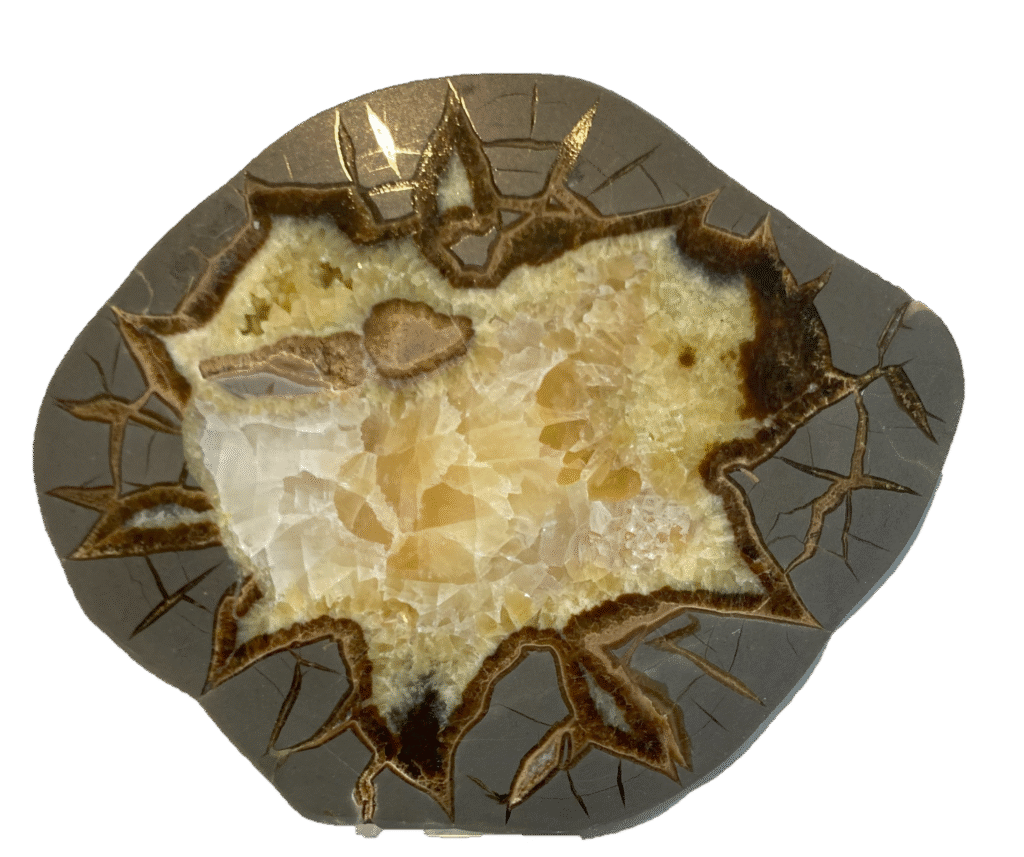
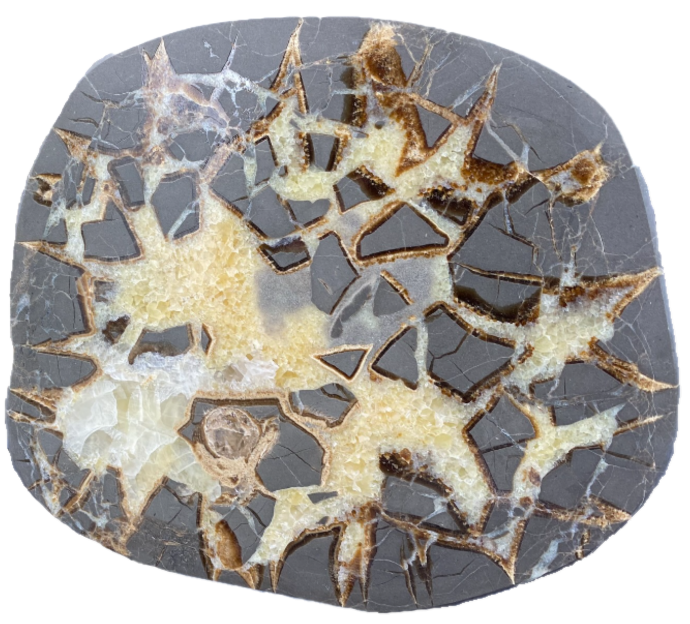
Septarian Nodules (Madagascar Dragoneggs): These unique nodules experience internal cracking due to dehydration or gas expansion, after which secondary minerals like calcite or aragonite fill the internal fissures, producing striking turtle-shell patterns.
3. Vugs: Irregular Cavities in Host Rock
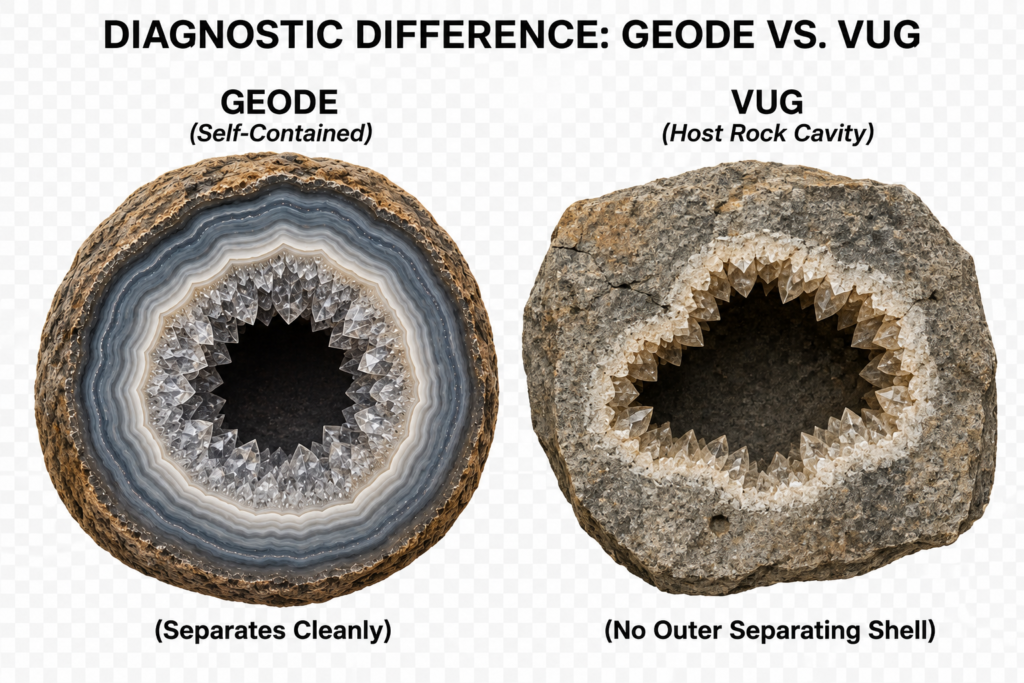
A vug (derived from the Cornish mining term vugg, meaning a cavity or small cave) is a void or pore space within a rock, frequently lined with mineral crystals growing inward. While a vug may look identical to the interior of a geode when broken open, it lacks a self-contained, protective outer shell.
Key Differences Between Vugs and Geodes
- Absence of a Shell: Vugs do not possess an impermeable chalcedony lining. The crystals grow directly onto the walls of the host rock (such as granite, limestone, or hydrothermal vein walls).
- Weathering behaviour: Because a vug is simply a pocket within a larger rock unit, it cannot weather out as an independent, spherical rock. When the host rock erodes, the vug and its contents are destroyed simultaneously.
- Morphology: While geodes tend toward rounded or spherical shapes due to fluid pressure and gas bubble physics, vugs take on highly irregular, jagged, or angular shapes determined by fractures, faulting, or partial rock dissolution.
4. Concretions: Centrifugal Outward Aggregates
Often mistaken for geodes due to their spherical, egg-like, or alien-looking shapes, concretions are formed through an entirely inverse geological process. Rather than filling a pre-existing hollow cavity from the outside in, a concretion grows centrifugally (from the inside out).
Formation Mechanics
Concretions form in sedimentary layers (such as shale, sandstone, or mudstone) shortly after deposition:
- Nucleation: Mineral-rich pore fluids interact with an organic or mineral core—such as a fossil leaf, shell fragment, fish bone, or grain of pyrite.
- Precipitation: As chemical conditions (such as pH or oxygenation) change around the core, minerals (most commonly calcite, siderite, iron oxides, or barite) begin to precipitate out of solution.
- Outward Accumulation: Additional mineral cement binds adjacent sediment grains together, building concentric layers outward around the nucleus over time.
5. Thundereggs: Volcanic Lithophysae Infillings
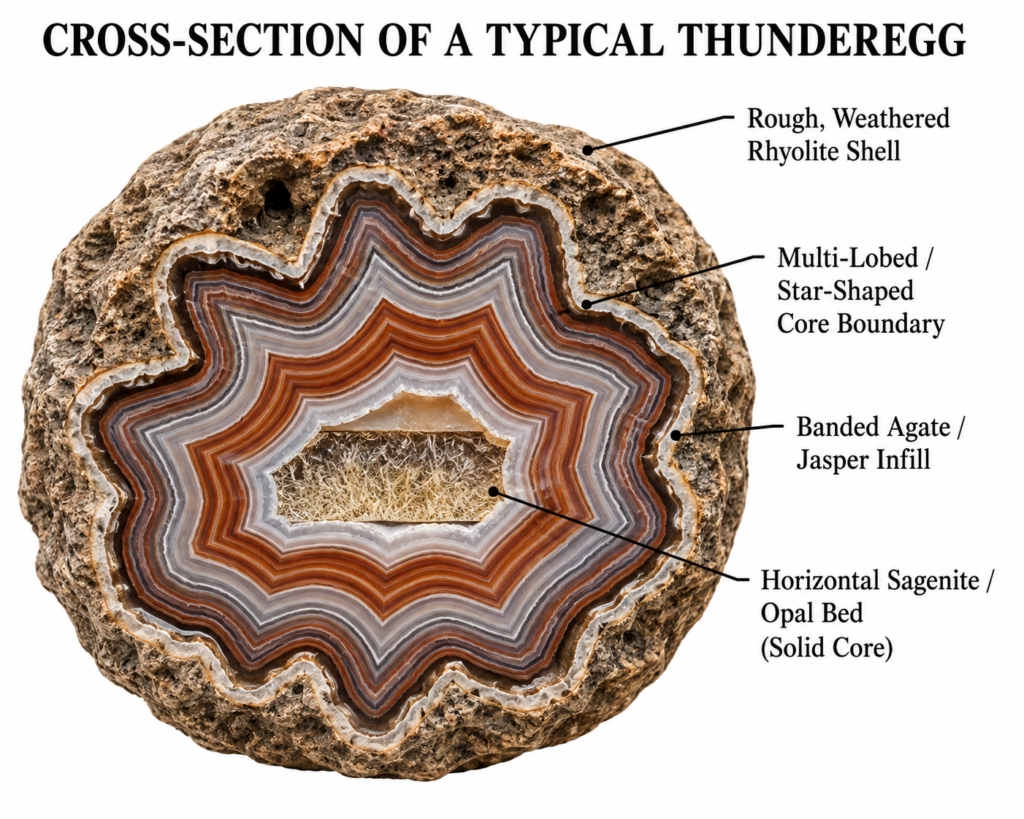
A thunderegg (or thunder egg) is a specific type of agate-filled nodule formed within layers of rhyolitic volcanic ash. While often grouped alongside geodes by hobbyists, thundereggs have a distinct developmental history tied to cooling volcanic flows.
How Thundereggs Differ
- Lithophysae Origin: As hot rhyolitic lava or ash settles, steam and gas expand to form “light bubbles” or star-shaped cracks within the cooling rock mass.
- Internal Expansion: Unlike smooth, round geode vesicles, the interior of a lithophysa expands along stress lines, creating a characteristic star-shaped or multi-lobed cavity.
- Infilling: Subsequent hydrothermal fluids carry dissolved silica into the cavity, filling it completely with layered chalcedony, agate, jasper, or opal.
- Rarity of Cavities: Thundereggs are almost always solid throughout. Open central voids lined with crystal points are rare compared to the solid agate infills seen in specimens from Oregon, USA.
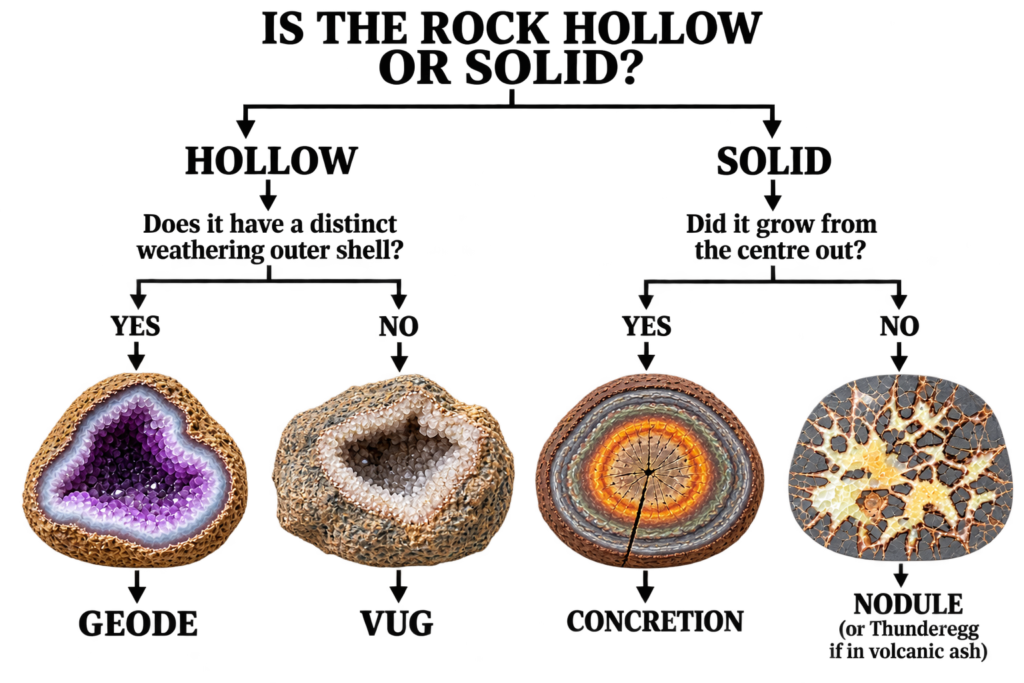
Field Identification Flowchart
If you are holding an unidentified rounded or cavity-bearing stone in the field, ask these three diagnostic questions to classify it:
Summary Checklist
To quickly summarise the core distinctions:
- Geodes: Hollow, outside-in growth, distinct shell, crystal-lined interior.
- Nodules: Solid, outside-in growth, distinct shell, uniform mineral interior.
- Vugs: Open cavity in host rock, outside-in growth, no distinct shell.
- Concretions: Solid aggregate, inside-out growth around a central core, incorporates surrounding sediment.
- Thundereggs: Solid rhyolitic nodules with star-shaped agate or opal infilling.
Frequently Asked Questions
What are the main differences between geodes, nodules, vugs, concretions, and thundereggs?
Geodes are hollow and crystal‑lined with outside‑in growth and a distinct shell; nodules are solid with outside‑in growth and a weathered shell; vugs are open cavities in the host rock with no self-contained shell; concretions are solid aggregates that grow inside‑out around a core; thundereggs are solid rhyolitic nodules with agate or opal infilling and a star‑shaped interior.
How do geodes form?
Geodes begin as open cavities in volcanic or sedimentary rocks, receive an impermeable outer lining of chalcedony, and then grow inward with mineral‑rich fluids that deposit crystals, creating a hollow interior.
How do nodules form, and how are they different from geodes?
Nodules form as solid mineral masses within a host rock, often weathering out cleanly with a defined boundary; unlike geodes, nodules lack a hollow interior and crystal lining, being completely solid or nearly so.
What distinguishes vugs from geodes in terms of structure and weathering?
Vugs are voids within a rock that may be crystal-lined but lack a self-contained outer shell; they cannot weather out as independent spheres because they are integral to the host rock, and their shapes are irregular rather than rounded.
What makes thundereggs different from geodes, and what is their typical interior infill?
Thundereggs are solid rhyolitic nodules with lithophysae origins and interior infilling of layered chalcedony, agate, jasper, or opal; unlike geodes, they are not always hollow and their interior often lacks a central cavity.
These are my personally selected and curated products
Products by Category

Natural quartz geode
£3.50
Septarian Freeform 5
£20.00
Septarian Specimen
£38.00
Small Natural quartz Geode
£1.50