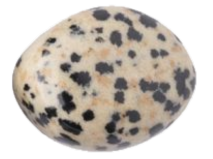
In the world of gemstones, a trade name is often just a very successful marketing ploy—and “Dalmatian Jasper” might be the most enduring example on the market. One glance at its speckled, canine-like patterning explains the name, but place a specimen under a 10x loupe and the illusion of chalcedony immediately falls away. When examining Dalmatian Stone vs True Jasper, you are not comparing variations of quartz, but contrasting two entirely separate rock-forming realms. Where true jasper is tough, uniform, and saturated with microcrystalline silica, this spotted interloper from Chihuahua, Mexico, is a complex igneous rock composed of feldspars, quartz, and an amphibole long mistaken for tourmaline. Unravelling the science behind this “spotted imposter” not only clears up decades of trade confusion, but also reveals why understanding its true composition matters for collectors, lapidarists, and bench jewellers alike.
Why Isn’t It a Jasper?
To understand why Dalmatian Stone is an “imposter,” it helps to look at how genuine jasper forms:
- True Jasper is an interlocking quartz variety (technically a cryptocrystalline quartz). It forms slowly in low-temperature watery environments, where silica settles into an ultra fine, solid mass. Because it is essentially dense, micro-grained quartz, true jasper has a uniform texture, fractures smoothly like thick glass, and achieves a mirror polish with ease.
- Dalmatian Stone, on the other hand, is an igneous rock known to geologists as aplite—a fine-grained cousin of granite. It didn’t form from calm, mineral-rich water; it formed deep underground as molten magma squeezed into cracks in the Earth’s crust and cooled.
Almost all commercial Dalmatian Stone comes from Chihuahua, Mexico. Because it crystallised from magma, it is an aggregate of distinct interlocking mineral grains—predominantly feldspar and quartz—rather than a smooth block of silica.
At a Glance: Dalmatian Stone vs. True Jasper
| Feature | True Jasper | Dalmatian Stone |
| Rock Type | Sedimentary / Hydrothermal | Intrusive Igneous (Aplite) |
| Main Base | Pure silica quartz ($\text{SiO}_2$) | Microcline feldspar & quartz |
| Hardness (Mohs) | 6.5 to 7.0 (Hard & scratch-resistant) | 5.5 to 6.0 (Moderate hardness) |
| Internal Texture | Submicroscopic, smooth quartz gel | Grainy, crystalline “sugary” aggregate |
| Break Pattern | Smooth, shell-like curves (conchoidal) | Rough, crumbly along grain edges |
| Typical Polish | Glassy, mirror-like finish | Soft satin sheen; prone to dimpling |
The Black Spots: Debunking the “Tourmaline” Myth
If you search online or read metaphysical guides, you will frequently see claims that the black spots are Black Tourmaline (Schorl).
This is a myth.
Lab analyses, including X-ray diffraction tests, have confirmed that tourmaline is completely absent from Dalmatian Stone. The black-to-dark-blue speckles are actually rare iron-rich minerals from the amphibole group, mainly:
- Arfvedsonite: A complex sodium-iron mineral that forms radiating sprays of dark crystals.
- Riebeckite: A closely related iron-rich alkali mineral.
How to Spot the Difference
If you examine the dark spots under a jeweller’s 10x loupe or a bright fibre-optic flashlight, you will notice they do not look like hexagonal, ridged tourmaline needles. Instead, they feature fibrous needle clusters and distinct diagonal cleavage lines. Under strong pinpoint light, these spots often flash subtle deep-blue or teal-green undertones.
Why Lapidaries and Cutters Notice the Difference
Jewellers and rock polishers learn quickly that Dalmatian Stone behaves nothing like jasper on the grinding wheel:
- Grain “Plucking”: Because Dalmatian Stone is a collection of mixed mineral grains rather than a solid mass of quartz, coarse grinding wheels can rip the brittle amphibole needles right out of the softer feldspar base, leaving pitted surfaces.
- The “Orange Peel” Texture: Feldspar, quartz, and amphibole have different levels of hardness. Using soft polishing pads can wear away the feldspar faster than the quartz, giving the stone a bumpy, dimpled surface resembling an orange peel.
- The Polish: Quartz-based jaspers polish to a mirror finish using cerium oxide. Dalmatian Stone responds best to aluminium oxide on a firm, flat lap, producing a soft, satiny glow.
Buyer Beware: Spotting Dyed Imitations
Natural Dalmatian Stone is naturally white, cream, or light greyish-buff, sometimes accented with soft yellow or pale green patches. However, because the feldspar matrix has tiny microscopic spaces between its grain boundaries, it absorbs dye easily.
If you see strands of “Dalmatian Stone” in neon pink, electric blue, bright turquoise, or vivid purple with black spots, they are natural Mexican stones that have undergone chemical dyeing.
Quick Authenticity Test: Moisten a cotton swab with standard nail polish remover (pure acetone) and gently rub an unsealed edge or inside a bead hole. If the swab picks up colour, the stone has been artificially dyed. Natural Dalmatian Stone will not bleed.
The Bottom Line
Calling it “Dalmatian Jasper” might make for simple catalogue labelling, but calling it Dalmatian Stone does justice to what it truly is: a fascinating piece of volcanic history composed of feldspar, quartz, and midnight-blue amphibole stars.
Walk into any crystal shop or browse gemstone beads online, and you are guaranteed to spot it: a creamy off-white stone peppered with playful black speckles. It looks so much like a spotted pup that the gem trade dubbed it Dalmatian Jasper.
There is just one catch: it isn’t jasper at all.
While the name “Dalmatian Jasper” makes for great marketing, this popular stone has an entirely different geological origin, a unique mineral mix, and distinct care requirements compared to true jasper.
Here is what is really happening beneath those famous spots.
Why Isn’t It a Jasper?
To understand why Dalmatian Stone is an “imposter,” it helps to look at how genuine jasper forms:
- True Jasper is an interlocking quartz variety (technically a cryptocrystalline quartz). It forms slowly in low-temperature watery environments, where silica settles into an ultra fine, solid mass. Because it is essentially dense, micro-grained quartz, true jasper has a uniform texture, fractures smoothly like thick glass, and achieves a mirror polish with ease.
- Dalmatian Stone, on the other hand, is an igneous rock known to geologists as aplite—a fine-grained cousin of granite. It didn’t form from calm, mineral-rich water; it formed deep underground as molten magma squeezed into cracks in the Earth’s crust and cooled.
Almost all commercial Dalmatian Stone comes from Chihuahua, Mexico. Because it crystallised from magma, it is an aggregate of distinct interlocking mineral grains—predominantly feldspar and quartz—rather than a smooth block of silica.
At a Glance: Dalmatian Stone vs. True Jasper
| Feature | True Jasper | Dalmatian Stone |
| Rock Type | Sedimentary / Hydrothermal | Intrusive Igneous (Aplite) |
| Main Base | Pure silica quartz ($\text{SiO}_2$) | Microcline feldspar & quartz |
| Hardness (Mohs) | 6.5 to 7.0 (Hard & scratch-resistant) | 5.5 to 6.0 (Moderate hardness) |
| Internal Texture | Submicroscopic, smooth quartz gel | Grainy, crystalline “sugary” aggregate |
| Break Pattern | Smooth, shell-like curves (conchoidal) | Rough, crumbly along grain edges |
| Typical Polish | Glassy, mirror-like finish | Soft satin sheen; prone to dimpling |
The Black Spots: Debunking the “Tourmaline” Myth
If you search online or read metaphysical guides, you will frequently see claims that the black spots are Black Tourmaline (Schorl).
This is a myth.
Lab analyses, including X-ray diffraction tests, have confirmed that tourmaline is completely absent from Dalmatian Stone. The black-to-dark-blue speckles are actually rare iron-rich minerals from the amphibole group, mainly:
- Arfvedsonite: A complex sodium-iron mineral that forms radiating sprays of dark crystals.
- Riebeckite: A closely related iron-rich alkali mineral.
How to Spot the Difference
If you examine the dark spots under a jeweller’s 10x loupe or a bright fibre-optic flashlight, you will notice they do not look like hexagonal, ridged tourmaline needles. Instead, they feature fibrous needle clusters and distinct diagonal cleavage lines. Under strong pinpoint light, these spots often flash subtle deep-blue or teal-green undertones.
Why Lapidaries and Cutters Notice the Difference
Jewellers and rock polishers learn quickly that Dalmatian Stone behaves nothing like jasper on the grinding wheel:
- Grain “Plucking”: Because Dalmatian Stone is a collection of mixed mineral grains rather than a solid mass of quartz, coarse grinding wheels can rip the brittle amphibole needles right out of the softer feldspar base, leaving pitted surfaces.
- The “Orange Peel” Texture: Feldspar, quartz, and amphibole have different levels of hardness. Using soft polishing pads can wear away the feldspar faster than the quartz, giving the stone a bumpy, dimpled surface resembling an orange peel.
- The Polish: Quartz-based jaspers polish to a mirror finish using cerium oxide. Dalmatian Stone responds best to aluminium oxide on a firm, flat lap, producing a soft, satiny glow.
Buyer Beware: Spotting Dyed Imitations
Natural Dalmatian Stone is naturally white, cream, or light greyish-buff, sometimes accented with soft yellow or pale green patches.
However, because the feldspar matrix has tiny microscopic spaces between its grain boundaries, it absorbs dye easily.
If you see strands of “Dalmatian Stone” in neon pink, electric blue, bright turquoise, or vivid purple with black spots, they are natural Mexican stones that have undergone chemical dyeing.
Quick Authenticity Test: Moisten a cotton swab with standard nail polish remover (pure acetone) and gently rub an unsealed edge or inside a bead hole. If the swab picks up colour, the stone has been artificially dyed. Natural Dalmatian Stone will not bleed.
The Bottom Line
Calling it “Dalmatian Jasper” might make for simple catalogue labelling, but calling it Dalmatian Stone does justice to what it truly is: a fascinating piece of volcanic history composed of feldspar, quartz, and midnight-blue amphibole stars.