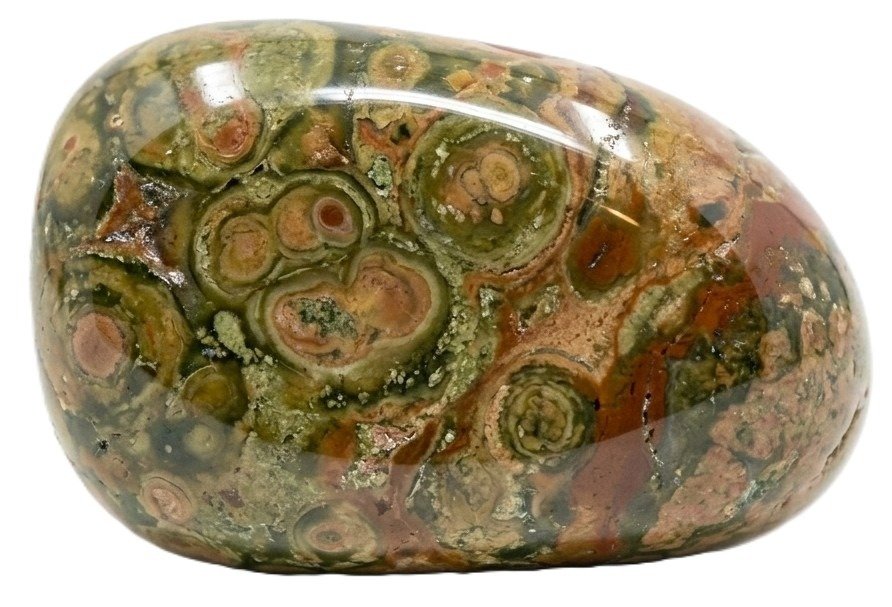
In the lapidary world, names are rarely what they seem and Rainforest Jasper is one of the gem trade’s most charming misnomers. With its mossy greens, earthy creams, and swirling pockets of quartz, it certainly looks the part of an exotic chalcedony. Yet beneath that polished, forest-canopy facade lies a completely different geological story. When examining Rainforest Jasper vs True Jasper, you are not simply comparing two varieties of the same stone, but contrasting entirely distinct geological processes: an explosive, gas-charged volcanic rock against a micro crystalline quartz quietly precipitated from silica-rich waters.
Comparing the two is far more than an exercise in mineralogical pedantry. While true jasper owes its dense, uniform structure to micro crystalline quartz interwoven with mineral oxides, Rainforest Jasper is actually a spherulitic rhyolite filled with devitrified glass, feldspar spherulites, and trapped chalcedony vugs. Whether you are an avid stone collector, a jewellery designer choosing the right cabochon, or a collector captivated by striking patterns, unravelling this mineral identity swap reveals the fascinating science behind the trade name—and precisely what to look for when inspecting each stone under the loupe.
The Origin Story: How It Formed
True jasper is a sedimentary or hydrothermal rock made almost entirely of interlocking micro-crystals of quartz (silicon dioxide). It forms quietly over long stretches of time as silica-rich water leaves mineral deposits in crevices and seabed sediments.
Rainforest Jasper, by contrast, owes its existence to an ancient Australian volcano. Around 120 million years ago, during the Cretaceous period, thick, sticky lava burst to the surface in what is now Mount Hay, near Rockhampton in Queensland.
- The Flash-Freeze: The lava was rich in silica and very thick. It cooled so quickly that crystals didn’t have time to grow normally. Instead, it froze into dark, natural volcanic glass—similar to obsidian.
- The Long Thaw (Devitrification): Natural glass is unstable. Over millions of years, the glass slowly reorganised itself. Microscopic fibres of quartz and feldspar grew outward from single points, transforming brittle glass back into solid, durable stone.
- Growing the “Orbs” (Spherulites): As the glass crystallised, mineral needles radiated outward like tiny 3D starbursts. These spherical nodules, known as spherulites, produce the distinctive circular “eyes” and cream-coloured dots scattered across the stone.
- Gas Pockets and Hidden Crystals (Thundereggs): Steam and volcanic gases got trapped in the sticky lava, leaving open bubbles behind. Mineral-rich groundwater later seeped through these pockets, lining them with chalcedony, banded agate, or sparkling quartz crystals. These filled bubbles are localised thundereggs.
Side-by-Side: True Jasper vs. Rainforest Jasper
| Feature | True Jasper | Rainforest “Jasper” (Rhyolite) |
| Rock Family | Sedimentary / Hydrothermal | Extrusive Igneous (Volcanic) |
| Origin | Mineral-heavy water deposits | Fast-cooling, crystallised volcanic lava |
| Primary Makeup | Pure microcrystalline quartz | Volcanic matrix, feldspar, quartz, and chlorite |
| Hardness (Mohs) | 6.5 to 7.0 (consistent throughout) | 5.5 to 6.5 (mixed hardness across the surface) |
| Texture & Voids | Dense, solid, and uniform | Full of tiny cavities, crystal pockets, and orbs |
| Break Pattern | Smooth, shell-like curve (conchoidal) | Uneven and granular |
Anatomy of the Stone: What Are You Looking At?
When you hold a piece of polished Rain forest Jasper, the wild pattern tells the story of its volcanic birth:
- The Forest Greens & Earth Tones: The green background is the devitrified volcanic glass coloured by microscopic mineral inclusions of chlorite and celadonite. The warmer brick-red, tan, and yellow zones get their colour from oxidised iron minerals (haematite and goethite).
- The Concentric Circles: These are the spherulites. They range from tiny pinpricks to spheres over an inch across, showing delicate, wheel-spoke patterns under a magnifying loupe.
- The Glistening Windows: The glassy, clear, or white windows are ancient volcanic gas bubbles that filled with chalcedony, banded agate, or tiny, sparkling quartz crystals (drusy vugs).
Working with the Stone: Lapidary & Jewellery Tips
Because true jasper is chemically uniform, it cuts and polishes cleanly at a predictable rate. Rain forest rhyolite is a composite of different minerals packed together, making bench work a distinct craft.
- Watch for “Undercutting”: The softer, clay-rich volcanic background grinds away faster than the hard quartz nodules and crystal pockets. If you use a soft, flexible wheel with heavy pressure, the stone can end up with a bumpy, orange-peel texture. Work on flat, rigid diamond wheels with light hand pressure to keep your curves level.
- Plan Around Natural Cavities: The same gas bubbles that created sparkling crystal pockets can leave small pits along a cut slab. High-end lapidaries either stabilise porous slabs with a clear lapidary resin or orient the cut so a crystal-lined hollow sits safely below the rim of the setting as a natural showpiece.
- Keep It Cool During Polish: Rain forest Jasper is sensitive to sudden heat changes. Polishing it dry can cause thermal shock, cracking the boundary where a hard quartz pocket meets the softer volcanic matrix. Polish semi-wet with aluminium oxide or cerium oxide on a firm leather lap for a smooth, uniform shine.