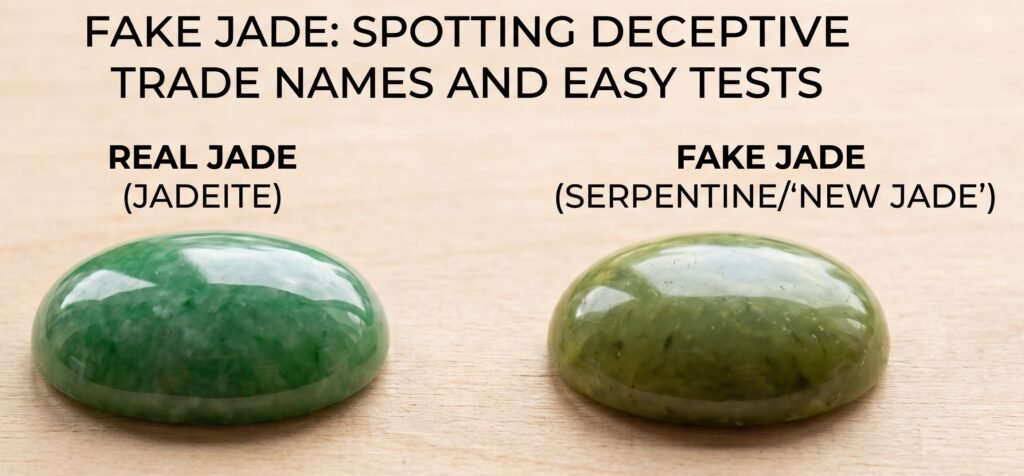
Because genuine, high grade jadeite and fine nephrite command extraordinary prices, the gem market is flooded with fake jade using deceptive trade euphemisms. Unscrupulous sellers routinely attach the prestigious word “jade” to inexpensive quartz, soft serpentines, garnets, or industrially dyed marbles to exploit consumer confusion.
In gemology, authentic jade refers strictly to two distinct mineral species: jadeite (a sodium-aluminum pyroxene) and nephrite (a calcium-magnesium-iron amphibole). Anything else bearing a geographic or fancy prefix is an imitation.
| Trade Name | Actual Mineral | Hardness (Mohs) | Diagnostic Telltale |
| “New Jade” / “Bowen Jade” | Serpentine | 2.5 – 5.5 | Scratches with a steel knife or sewing needle; waxy, greasy feel. |
| “Indian Jade” / “Australian Jade” | Aventurine Quartz or Chrysoprase | 6.5 – 7.0 | Internal glitter (aventurescence) or unnaturally flat, uniform apple green. |
| “Transvaal Jade” / “African Jade” | Hydrogrossular Garnet | 7.0 – 7.5 | Pepper-like black speckles (chromite inclusions); heavier than nephrite. |
| “Mexican Jade” / “Pakistan Jade” | Dyed Calcite or Banded Aragonite | 3.0 | Soft enough to scratch with a coin; fizzes when touched with mild acid. |
| “Korean Jade” / “Soochow Jade” | Soapstone, Talc, or Pyrophyllite | 1.0 – 2.5 | Scratches easily with a fingernail; chalky, soapy texture; rounded carving edges. |
| “Malaysia Jade” | Dyed Quartzite | 7.0 | Artificial dye pooling like webs inside fractured grain boundaries. |
Common Market Simulants (Fake Jade) and How to Spot Them
1. “New Jade” (Serpentine)
- The illusion: Semi-translucent with an oily, yellowish-green body colour that closely mimics pale nephrite mutton-fat or celadon jade.
- The reality: It is a magnesium silicate sheet mineral that lacks jade’s interlocking crystal strength.
- The reveal: Serpentine is soft. A standard steel blade (Mohs ~5.5) will gouge or powder the surface of serpentine, whereas real jadeite (6.5–7.0) and nephrite (6.0–6.5) will easily resist a steel tip.
2. “Indian Jade” (Aventurine Quartz)
- The illusion: Widely mass-produced into green beaded necklaces, bangles, and tumbled stones.
- The reality: Quartzite packed with tiny mica platelets (fuchsite).
- The reveal: Under a direct light, aventurine produces aventurescence—a distinct, metallic glitter caused by light bouncing off internal mica flakes. True jade has a soft, fibrous, or granular glow, never a disco-ball sparkle.
3. “Transvaal Jade” (Grossular Garnet)
- The illusion: Massive, translucent green boulders that look convincing enough to pass for imperial green jadeite.
- The reality: Massive hydrogrossular garnet found in South Africa.
- The reveal: Look closely under a 10× loupe. Grossular garnet almost universally contains scattered, pinpoint black speckles of chromite or magnetite that resemble ground black pepper. It also lacks jade’s characteristic fibrous weave.
4. “Mexican Jade” (Dyed Calcite / Marble)
- The illusion: Chemically stained bright emerald green or turquoise to mimic top-tier jade carvings, pendants, and bangles.
- The reality: Inexpensive calcium carbonate rock.
- The reveal: Calcite is exceptionally fragile (Mohs 3.0). It can be scratched by a copper coin or brass key, and because it is porous, the dye frequently bleeds onto cotton swabs moistened with acetone or rubbing alcohol.
5. “Korean Jade” (Soapstone / Talc)
- The illusion: Frequently carved into elaborate, multi-tiered pagodas, puzzle balls, and animal statuettes sold at antique stalls.
- The reality: Talc or pyrophyllite.
- The reveal: Soapstone feels distinctly greasy, powdery, or waxy. Because it is softer than a human fingernail (Mohs 2.5), the carving edges are soft and blurred rather than sharp and defined.
On-the-Spot Buyer’s Verification Protocol
- Step 1: The Temperature Check Press the stone against your wrist or cheek. Real crystalline jade acts as a natural heat sink—it feels ice-cold and absorbs heat slowly. Plastic, resin, and lightweight composite simulants warm up almost immediately.
- Step 2: The Heft Test Gently balance the piece in your hand. Jadeite has a high specific gravity (~3.33) and nephrite (~2.95). Inexpensive quartz (2.65), serpentine (2.55), or plastic (1.1–1.3) feel noticeably light and hollow for their size.
- Step 3: The Hardness Test (Hidden Area Only)With the seller’s permission, apply moderate pressure with a hardened steel pin or penknife tip to an inconspicuous spot (such as the uncarved underside or inside a bangle rim). If it leaves a permanent scratch or chalky powder, walk away—it is serpentine, calcite, or soapstone.
- Step 4: Loupe & Light Inspection Shine a strong penlight through the material and examine it through a 10× jeweller’s loupe:
- Look for the “orange peel” effect under reflected light (natural micro-dimples on jadeite’s surface).
- Check for dye pooling (concentrated colour trapped along fractures indicates dyed quartzite or calcite).
- Watch out for trapped spherical air bubbles, which instantly expose glass or poured resin imitations.