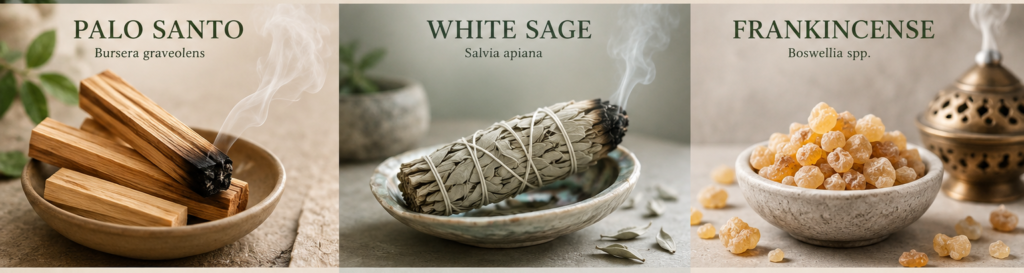
For millennia, across divergent continents and spiritual traditions, aromatic botanicals have served as the bridge between the physical and the sacred. Among the vast global pharmacopeia of ritual aromatics, three stand out for their enduring prominence: Palo Santo (Bursera graveolens), White Sage (Salvia apiana), and Frankincense (Boswellia spp.).
While often grouped together under the modern umbrella of space clearing and meditation, each botanical carries a distinct origin, chemical profile, and historical application:
- Palo Santo (“Holy Wood”): Native to the dry tropical forests of South America, this resinous heartwood produces a sweet, citrus-pine smoke rich in limonene, traditionally used by indigenous Andean and Amazonian cultures to invite peace, uplift mood, and clear stagnant energy.
- White Sage: An evergreen shrub native to the coastal sage scrub of Southern California and Baja California, this herb releases a sharp, herbaceous smoke dominated by cineole and camphor, historically utilised in traditional Native American ceremonial traditions for intense purification and resetting environments.
- Frankincense: An oleo-gum-resin harvested from the gnarly trunks of desert trees across the Arabian Peninsula and the Horn of Africa, this ancient incense yields a warm, balsamic aroma with deep liturgical roots spanning Mesopotamian rites, ancient Egyptian temples, and Christian cathedral rituals.
Understanding how to choose among them requires looking beyond generalities to examine their distinct aromatic notes, methods of preparation, ecological considerations, and specific ritual intents.
| Attribute | Palo Santo (Bursera graveolens) | White Sage (Salvia apiana) | Frankincense (Boswellia sacra/carterii) |
|---|---|---|---|
| Plant Part Used | Naturally aged heartwood & resin | Dried leaves and stems | Oleo-gum-resin tears |
| Botanical Family | Burseraceae (Torchwood family) | Lamiaceae (Mint/Sage family) | Burseraceae (Torchwood family) |
| Geographic Origin | Coastal Ecuador, Peru, Gran Chaco | Southwestern US & Baja California | Arabian Peninsula, Horn of Africa, India |
| Primary Active Compounds | d-Limonene (60–80%), α-terpineol, menthofuran | 1,8-Cineole / Eucalyptol (up to 40%), camphor, α-thujone | α-Pinene (up to 65%), incensole acetate, boswellic acids* |
| Energetic Mode | Attractor & Uplifter (Clears heavy energy, immediately infuses positive light) | Steriliser / Nullifier (Deep psychic reset; strips all ambient energy) | Elevator & Sanctifier (Vertical connection to the divine; formal consecration) |
| Planetary / Elemental | Sun / Air & Fire | Jupiter & Moon / Air & Earth | Sun / Fire |
| Scent Profile | Sweet, warm, citrus-pine, balsamic mint | Sharp, herbaceous, astringent, pungent | Resinous, woody, balsamic, lightly citrus-peppery |
1. Chemical Profiles & Pharmacological Action
Palo Santo (Bursera graveolens)
- Dominant Chemistry: Dominated by the monoterpene d-limonene (up to 80% of its volatile fraction), supplemented by α-terpineol, carvone, and menthofuran.
- Physiological Impact: Limonene is clinically noted for stimulating the parasympathetic nervous system via olfactory pathways, reducing salivary cortisol, downregulating acute anxiety, and providing bronchodilator activity.
White Sage (Salvia apiana)
- Dominant Chemistry: Rich in bicyclic monoterpenes and monoterpene ethers—chiefly 1,8-cineole (eucalyptol), camphor, and trace α-/β-thujone.
- Physiological Impact: Eucalyptol and camphor are potent airborne antimicrobials. Research shows that burning medicinal herb/sage smoke can reduce airborne bacterial populations by up to 94% in enclosed spaces. It acts as an aggressive sinus decongestant and nervous system stimulant.
Frankincense (Boswellia sacra / carterii / frereana)
- Dominant Chemistry: Dominated by α-pinene, octyl acetate, limonene, and macrocyclic diterpenes like incensole and incensole acetate.
- Physiological Impact: Incensole acetate acts as a potent agonist of TRPV3 channels in the brain, producing proven anxiolytic and anti-depressive neurological effects. α-Pinene increases alertness and pulmonary airflow, facilitating the deep, rhythmic diaphragmatic breathing typical of contemplative prayer.
2. Spiritual Traditions & Cultural Roots
Palo Santo (South American Sahumerio)
- Lineage: Indigenous cultures of the dry Andean and coastal forests (Manteño-Huancavilca, Valdivia, Incan Empire).
- Ritual Role: Used within the Andean shamanic system of Samay (breath/energy work) and curanderismo. Healers wave smoke over the energetic body to extract hucha (heavy/dense energy) caused by susto (fright/trauma) or mal de ojo, while welcoming back benevolent protective spirits and ancestral aid.
White Sage (Native American Smudging)
- Lineage: Indigenous nations of southern California and north-west Mexico (Kumeyaay, Tongva, Chumash, Luiseño, Cahuilla).
- Ritual Role: A sacred medicine bundle used in formal tribal blessings, sweat lodge ceremonies, and communal purification rites. The smoke acts as a vessel carrying prayers directly to the Creator while clearing ritual spaces of disruptive spiritual static.
Frankincense (Ancient Mediterranean, Semitic & Eastern Rites)
- Lineage: Ancient Egypt, ancient Levant/Judaism (Ketoret in the Temple of Jerusalem), early and contemporary Christian liturgies (Eastern Orthodox, Roman Catholic), Islamic fumigation (luban), and Ayurvedic medicine (Salai guggulu).
- Ritual Role: An offering of absolute reverence and sanctification. Burnt in thuribles to dedicate altars, honour the presence of the Divine, facilitate the transition of souls in funerary rites, and bridge the physical and celestial realms.
3. Energetic Differences & Practical Application
The “Clean Slate” vs. “Warm Illumination” Distinction
- White Sage acts like psychic bleach: It is energetically non-selective. Burning White Sage strips a room or an aura down to zero, eliminating both negative clutter and positive residual build-up. Because it leaves an energetic vacuum, practitioners generally follow sage with an herb or resin that recharges the space.
- Palo Santo acts like a harmonic tuner: Rather than creating a vacuum, its high solar-limonene profile dissolves heavy, sluggish, or discordant vibrations while simultaneously depositing warmth, grounded optimism, and joyful light. It is ideal for daily maintenance, creative studios, and bedroom clearings.
- Frankincense acts as a vertical conduit: It alters the vibrational frequency of a space from mundane to sacred. Rather than merely sweeping domestic stagnant air, it creates an atmosphere of solemn reverence, protection, and high-level ceremonial focus, making it the premier choice for formal ritual work, deep scrying, and temple consecration.