
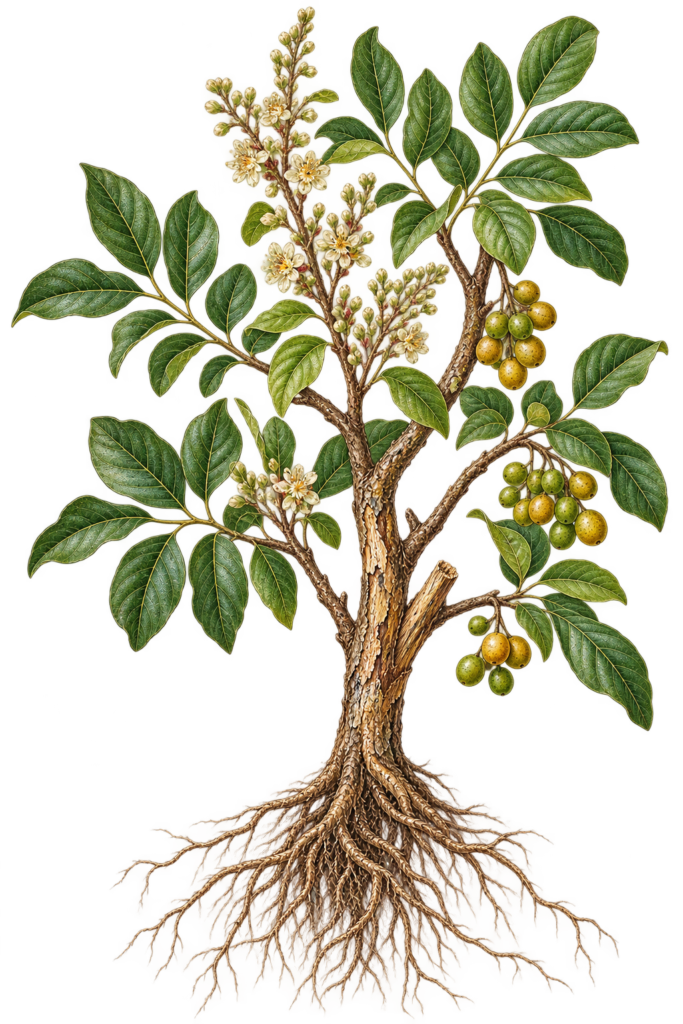
Palo Santo (“Holy Wood”) primarily refers to Bursera graveolens, a wild tree native to the seasonally dry tropical forests of the Yucatán Peninsula, Central America, and northern South America (chiefly Ecuador and Peru).
- Botanical Family: Burseraceae (the Torchwood or Frankincense family), closely related to frankincense (Boswellia) and myrrh (Commiphora).
- Growth Profile: A deciduous tree reaching heights of 4–10 meters, characterised by smooth, grey bark, compound leaves, and small white flowers. It thrives in arid, rocky terrain.
- Resin Metamorphosis: A living Palo Santo tree contains little usable aromatic resin. The distinctive chemical transformation occurs only after the tree dies naturally and cures on the forest floor for 3 to 8 years. During this postmortem ageing process, internal sap and resin crystallise throughout the heartwood, yielding high concentrations of monoterpenes—predominantly d-limonene (up to 60–80%), along with $\alpha$-terpineol, menthofuran, and carvone.
Species Clarification: Do not confuse Bursera graveolens with Bulnesia sarmientoi (recently reclassified as Gonopterodendron sarmientoi), commonly called “Paraguayan Palo Santo” or lignum vitae. Bulnesia belongs to the Zygophyllaceae family, is native to the Gran Chaco region, and is harvested for dense timber and guaiacwood essential oil, rather than ceremonial incense sticks.
Ancient Origins & Antiquity
The use of Bursera graveolens dates back millennia across pre-Columbian South America. Archaeological evidence and ethnobotanical records indicate that its fragrant smoke was integrated into ceremonial life long before European arrival.
- The Inca Civilisation: Incan priests and state shamans burned the wood during state religious rites and seasonal agricultural ceremonies to honour the sun deity Inti and cleanse sacred plazas.
- Pre-Inca Cultures: Peoples across coastal Ecuador (such as the Manteño-Huancavilca and Valdivia cultures) and northern Peru utilised the smoke to purify communal dwellings and prepare burial sites.
- Spanish Colonisation: When Spanish friars arrived in the 16th century, they observed indigenous healers using the wood to clear malignant spirits and sanctify sacred spaces. Noting its revered status and resinous scent, the friars christened it Palo Santo (“Holy Wood”).
Folklore, Superstition & Cultural Traditions
In traditional Andean and coastal Amazonian folklore, Palo Santo is treated not merely as aromatic wood, but as an animate plant teacher with its own protective spirit.
- The Law of Natural Fall: Local tradition strictly dictates that living trees must never be cut down. Doing so is believed to insult the tree’s spirit, rendering the wood inert and devoid of spiritual potency. The wood must “die of its own accord” and age on the earth.
- Dispelling Mala Energía & Susto: Healers (curanderos) burn Palo Santo to treat susto (soul loss caused by acute fear or trauma) and mal de ojo (the evil eye). The smoke is waved over the patient from head to toe to catch and extract heavy energies (hucha).
- Welcoming the Ancestors: Unlike bitter fumigants used solely for banishment, Palo Santo’s sweet, citrusy fragrance is believed to comfort friendly ancestral spirits, inviting good fortune (buena suerte) into the home.
Therapeutic & Medicinal Applications
Traditional South American folk medicine utilises every part of the naturally fallen tree—bark, twigs, leaves, and crystallised heartwood.
| Application | Preparation | Traditional & Pharmacological Mechanism |
| Respiratory Relief | Inhaling diffuse smoke or vaporised oil | High d-limonene and $\alpha$-terpineol act as natural bronchodilators and expectorants, easing coughs, colds, and asthma symptoms. |
| Pain & Inflammation | Topical infused oil or liniment | Inhibits inflammatory pathways; traditionally rubbed into joints to alleviate arthritis, rheumatism, and muscular soreness. |
| Stress & Anxiety | Aromatherapeutic diffusion | Olfactory uptake of limonene stimulates the parasympathetic nervous system, downregulating cortisol and soothing nervous tension. |
| Digestive Aid | Weak decoction (tea from wood shavings) | Used in traditional folk medicine as a carminative to soothe stomach spasms and dispel gas. |
Astrological & Mystical Correspondences
Palo Santo’s vibrant, resinous profile maps to distinct cosmological forces:
Planetary Rulers: The Sun (Primary): For its solar clarity, uplifting warmth, ability to banish shadows, and high limonene brightness. Also Mercury (Secondary): For its rapid energetic movement, communicative smoke, and connection to air pathways and mental clarity.
Elemental Affinity: Air & Fire. Fire activates the dormant resin, while Air carries the aromatic frequencies across the physical and ethereal planes.
Zodiac Associations: Leo (solar majesty, heart centre), Gemini (mental agility, clearing scattered thoughts), and Sagittarius philosophical seeking, spiritual ceremony).
Chakra Resonances: Crown Chakra (Sahasrara): Elevates consciousness and quiets mental chatter during meditation. Solar Plexus (Manipura): Restores personal vitality and dissolves energetic cords of fatigue.
Culinary & Domestic Uses
Beyond sacred ritual, Palo Santo holds functional roles in regional domestic life:
- Natural Insect Repellent: The volatile monoterpenes that give Palo Santo its scent are natural deterrents against mosquitoes, flies, and midges. Burning a stick on a porch or terrace keeps insects at bay without synthetic chemicals.
- Flavouring & Distillation: Craft distillers and culinary artisans use controlled infusions of food-grade essential oil or wood-aged distillates to flavoru regional gins, bitters, and smoked beers, adding notes of pine, citrus, and mint.
- Barbecue & Smoking: High-end chefs occasionally use tiny shavings of aged heartwood in smoke boxes to impart a sweet, balsamic glaze on grilled root vegetables and rich meats.
- Domestic Household Deodorizer: Simmering a small shaving in water cleanses persistent cooking odous, dampness, and stale indoor air.
Spiritual, Energetic & Metaphysical Properties
Palo Santo occupies a distinct niche in energetic space-clearing (sahumerio):
- Clearing vs. Invoking (The White Sage Contrast): While White Sage (Salvia apiana) acts as a total energetic neutraliser—stripping all energy (positive and negative) from a room—Palo Santo clears discordant, heavy vibrations while immediately infusing the space with light, grounded calm, and positivity.
- Deepening Meditation & Trance Work: The terpene-rich scent promotes alpha brain wave production, reducing monkey-mind distraction and deepening breathwork.
- Crystal & Altar Consecration: Passing tarot decks, talismans, and mineral specimens through the smoke cleanses accumulated ambient impressions without eroding delicate crystal structures.
Fun Facts
- It Belongs to the “Burping Trees”: The family name Burseraceae is named after Joachim Burser, a 17th-century botanist, but the tree itself produces visible beads of weeping resin that look like amber perspiration on aged deadwood.
- Gendered Trees: Local harvesters recognise “male” and “female” trees based on wood grain density and colouration; “female” wood (hembra) is typically darker, heavier with resin, and carries a sweeter aroma.
- Self-Extinguishing Nature: Unlike standard incense sticks that burn to ash continuously, authentic Palo Santo sticks burn for 30 to 60 seconds before putting themselves out, preserving the dense resin wood for dozens of uses.
Frequently Asked Questions
Is Palo Santo endangered?
The main ceremonial species, Bursera graveolens, is currently classified as Least Concern by the IUCN. However, its native dry tropical forest habitat is heavily threatened by agricultural deforestation. Furthermore, illegal harvesting (cutting down live trees to meet global demand) compromises local ecosystems and produces inferior, non-resinated wood. Always look for sustainably sourced wood harvested exclusively from certified, naturally fallen branches managed by local reforestation programs.
How do you properly light and burn a Palo Santo stick?
- Hold the stick at a $45^\circ$ downward angle.
- Light the tip with a match or candle until it catches a steady flame.
- Allow it to burn for 30–40 seconds so the ember penetrates the inner resin.
- Gently blow out the flame.
- Move through your space allowing the white smoke to billow, or place it in a heat-resistant ceramic or abalone dish.
How long does a single stick last?
Because a stick self-extinguishes after 1 to 2 minutes of smouldering, a single standard 4-inch stick can be relit 30 to 50 times, lasting several months under regular domestic use.
