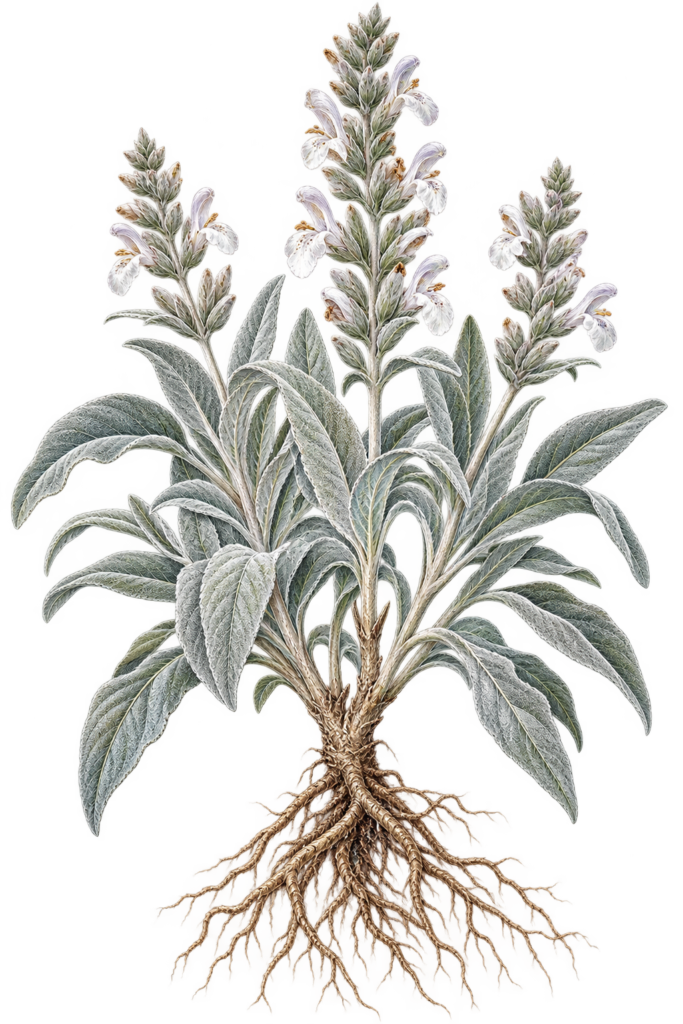
White sage (Salvia apiana) is an evergreen shrub, s native to the coastal sage scrub of Southern California and northern Baja California. Renowned for its distinctive silvery-white foliage, it has a deep cultural heritage. It is one of the most culturally significant plants of the Americas.
Botanical Profile & Natural Habitat
Belonging to the mint family (Lamiaceae), Salvia apiana is uniquely adapted to thrive in arid, sun-drenched coastal sage scrub and chaparral ecosystems.
- Foliage: Broad, velvety, lance-shaped leaves coated in dense, glandular hairs that give the plant its luminous, silver-white appearance. These hairs help retain moisture and reflect intense solar radiation.
- Aroma: Pungent, sharp, resinous, and herbaceous. The high concentration of volatile oils and terpenes (such as cineole, camphor, and pinene) serves as a natural deterrent against herbivores and water loss.
- Flowering: In spring and early summer, tall flowering stalks rise up to 1.5 to 2 metres above the shrub, bearing bilabiate white-to-pale-lavender blossoms with delicate purple markings.
- Etymology: The specific epithet apiana derives from the Latin apis (“bee”), celebrating the plant’s vital ecological role as a primary nectar source for native bumblebees, carpenter bees, and honeybees.
Indigenous Ceremonial Significance & Cultural Heritage
For thousands of years, White sage has been central to sacred, ceremonial, and medicinal practices.
It has been integral to Indigenous peoples of Southern California, including Chumash, Tongva, Kumeyaay, Cahuilla, Luiseño, and Serrano.
- Ceremonial Smudging: Unlike casual room deodorising, traditional smudging is a consecrated, prayerful ceremony. The rising smoke carries prayers directly to the Creator, purifies the human spirit, cleanses ceremonial grounds, and prepares participants for sacred rites.
- Medicinal Applications: Indigenous traditional medicine utilised white sage as a tea for respiratory ailments, a topical wash for skin irritations, and a postpartum restorative due to its natural antimicrobial and astringent properties.
- Spiritual Protocol: In native traditions, gathering white sage involves sacred protocols—offering tobacco, asking the plant for permission, harvesting without harming the root system, and giving thanks.
Ecological Challenges & Ethical Sourcing
In recent decades, global commercial popularity has created severe ecological strain on wild white sage populations.
Moreover, this trend raises concerns about conservation.
- Illegal Poaching: Large-scale commercial poaching on public and protected lands in Southern California has stripped native stands, disrupting local chaparral biodiversity and leaving ecosystems vulnerable to erosion.
- Cultural Appropriation & Commodification: Mass-market commercialisation has disconnected the plant from its sacred Indigenous roots and original custodians.
- Ethical Considerations for Modern Practitioners:
- Support Indigenous & Local Cultivators: If purchasing white sage, choose certified cultivated (farm-grown) sources or directly support Native-owned agricultural initiatives.
- Never Buy Wildcrafted Sage: Avoid commercial products labelled as “wild-crafted” from California, as this frequently masks illegal poaching.
- Embrace Regional Alternatives: Practitioners outside Southern California are encouraged to explore sustainable, culturally aligned, or garden-grown botanicals such as Garden Sage (Salvia officinalis), Rosemary, Juniper, or Cedar.
Traditional vs. Modern Spiritual Profile
White sage is recognised for producing one of the most potent, clarifying smoke signatures in botanical practice.
| Attribute | Profile & Meaning |
| Energetic Action | Powerful, deep purification; banishes heavy, stubborn energetic stagnation |
| Traditional Role | Sacred Indigenous ceremonial plant; prayer conduit and blessing |
| Aroma | Intensely sharp, pungent, clean, and herbal |
| Ideal Context | Deep ceremonial purification, major life transitions, consecration |
Best Practices for Mindful Use
- Approach with Reverence: Treat the botanical as a sacred entity rather than a casual home fragrance. Set a focused, grounded intention before lighting.
- Ensure Active Ventilation: Always open windows or doors to allow the dense smoke and cleared energetic heaviness to exit the room.
- Handle with Fire Safety: Rest smouldering bundles or loose leaves in a heatproof vessel (such as a cast iron cauldron, ceramic dish, or abalone shell) cushioned by a layer of sand.
- Delicate Tools: Hold crystals, spiritual instruments, or cards 6–8 inches above the rising plume to prevent soot accumulation or heat damage.
- Extinguish Completely: Press the smouldering tip firmly into sand or an insulated dish until the ember is fully extinguished.
Key Differences: Garden Sage vs. White Sage
While both belong to the mint family (Lamiaceae) and the genus Salvia, Garden Sage (Salvia officinalis) and White Sage (Salvia apiana) differ significantly across their origin, cultural role, physical appearance, and ecological impact.
| Feature | Garden Sage (Salvia officinalis) | White Sage (Salvia apiana) |
|---|---|---|
| Native Region | Mediterranean Basin and Southern Europe | Coastal scrub and chaparral of Southern California and Baja California |
| Physical Appearance | Soft, pebbled, grey-green leaves with violet-blue flowers | Broad, velvety, silver-white leaves with tall white-to-lavender flower stalks |
| Aroma & Smoke | Earthy, savoury, warm, and moderately sharp PDF+ 1 | Intensely pungent, resinous, herbal, and sharp PDF+ 1 |
| Cultural & Ritual Context | European folk traditions, domestic herbalism, culinary uses, and general household cleansing PDF+ 1 | Sacred ceremonial medicine and smudging rites of Indigenous nations PDF+ 1 |
| Sustainability & Sourcing | Abundant, non-threatened, and easily cultivated in home gardens | Threatened in the wild due to commercial poaching and overharvesting; requires mindful ethical sourcing |
| Energetic Signature | Brisk, cleansing, grounding, and clears static without leaving an energetic void | Deep, high-intensity purification, sacred blessing, and major transitional clearing PDF+ 1 |
- Growth & Sustainability: Garden sage grows readily in British and European domestic gardens, making it a sustainable, locally rooted choice for everyday resets. White sage requires arid, hot climates and is vulnerable to over-commercialisation and habitat loss in its native range.
- Appropriate Application: Garden sage is well-suited for regular home maintenance, cleansing tarot cards or crystals, and post-argument resets. White sage carries deep ceremonial significance and is traditionally reserved for sacred prayer rites, consecration, and major spiritual ceremonies.
Frequently Asked Questions
What is white sage (Salvia apiana) and where is it native?
White sage (Salvia apiana), is an evergreen shrub in the mint family. Native to the coastal sage scrub habitats of Southern California and northern Baja California. It is known for its broad silvery-white leaves and, its resinous fragrance and tall flowering stalks that bear white to pale lavender blossoms.
Why is white sage culturally significant to Indigenous communities?
White sage holds central sacred, ceremonial, and medicinal importance for Indigenous peoples of Southern California and northern Baja California. Nations include the Chumash, Tongva, Kumeyaay, Cahuilla, Luiseño, and Serrano, where it is used in smudging, healing, and spiritual practices.
What ecological challenges surround white sage and how should it be sourced ethically?
Global popularity has led to ecological strain, illegal poaching, and cultural appropriation. Ethical sourcing involves choosing farm-grown or certified cultivated white sage, avoiding wild-crafted products, supporting Native-owned or local cultivators, and considering regional alternatives when appropriate.
What are the key differences between garden sage and white sage?
Garden sage (Salvia officinalis) is native to the Mediterranean region, has grey-green leaves and blue flowers, a milder aroma, and is commonly used in European folk traditions and cooking. White sage is native to Southern California and Baja California, has silver-white leaves with tall flower stalks, a sharp resinous aroma, and carries sacred ceremonial significance.
What are best practices for mindful use of white sage?
Approach with reverence. Set a focused intention. Ensure active ventilation. Handle fire safely in a heatproof vessel. Keep instruments away from the plume. Extinguish completely by pressing the ember into sand. Then press it into a heatproof dish until fully out.