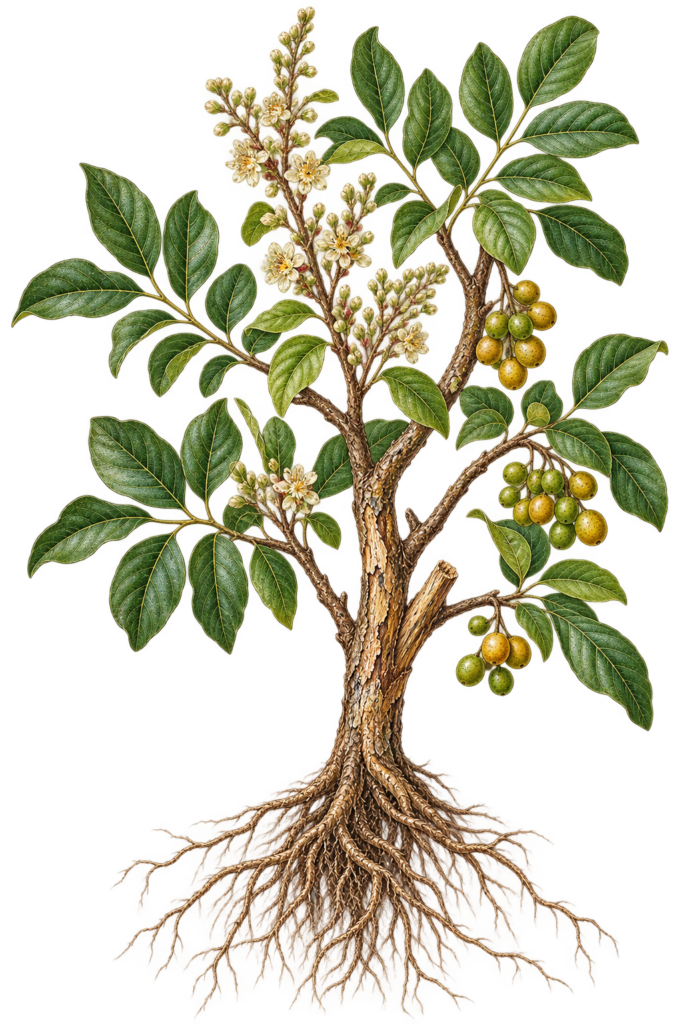
Frankincense (also known as olibanum) is an aromatic oleo-gum-resin exuded from trees of the genus Boswellia, belonging to the Burseraceae (Torchwood) family. These rugged, scrubby trees thrive in hyper-arid, limestone-rich environments, often anchoring their roots directly into vertical cliffs.
When the bark is shallowly incised (tapped), the tree secretes a milky, sap-like defence fluid to seal the wound and ward off microbial infections. Over several weeks, this secretion hardens upon exposure to the sun and air into translucent tears, which are then graded by colour, size, and geographic origin.
Key Boswellia Species
| Species | Primary Geographic Locale | Scent & Visual Profile | Distinctive Chemistry |
| Boswellia sacra | Southern Oman (Dhofar region), Yemen | Citrus, green pine, honey-amber; yields prized greenish-white Royal Hojari. | High $\alpha$-pinene, $\alpha$-thujene, limonene. |
| Boswellia carterii | Somaliland, Puntland (Somalia) | Warm, balsamic, woody, citrus peel undertones. | Rich in octyl acetate, $\alpha$-pinene. |
| Boswellia frereana | Northern Somalia (“King of Frankincense” / Maydi) | Deep, complex, musky balsamic; smooth, golden tears. | High p-cymene and $\alpha$-phellandrene; virtually no gum content. |
| Boswellia serrata | Central and Northern India (Salai Guggulu) | Earthy, sharp, pungent, slightly sour. | High concentration of boswellic acids (used heavily in Ayurveda). |
| Boswellia papyrifera | Ethiopia, Sudan, Eritrea | Sweet, floral, clean incense smoke. | Dominated by octyl acetate and diterpene incensole acetate. |
Ancient Origins & Antiquity
For over five thousand years, Frankincense was among the most valuable trade commodities on Earth, commanding parity with gold and shaping ancient geopolitics.
Ancient Egypt & Punt: The Pharaohs imported massive quantities from the legendary Land of Punt (documented during Queen Hatshepsut’s 15th-century BCE expedition). It was burned daily during temple rituals, utilised in royal mummification balms to preserve bodies and repel decay, and ground into kohl eyeliner.
The Incense Trade Route: By 1000 BCE, an intricate network of overland camel caravan routes stretched over 2,400 km across the Arabian Peninsula, from southern Oman and Yemen through Petra (the Nabataean capital) to the Mediterranean ports of Gaza and Alexandria.
The Temple of Jerusalem & The Ketoret: In Jewish antiquity, Frankincense (levonah) was one of the eleven holy spices prescribed in Exodus 30 for the sacred consecrated incense (Ketoret) burned daily upon the golden altar, as well as a required accompaniment for grain offerings.
Greco-Roman Devotion: The Roman Empire consumed vast quantities of Olibanum for state cults, funeral pyres, and public triumphs. Pliny the Elder famously recorded that Emperor Nero burned an entire year’s supply of Arabia’s frankincense harvest at the funeral of his wife Poppaea.
Folklore, Superstition & Cultural Traditions
Throughout the Middle East and the Horn of Africa, Frankincense (Luban) is embedded in domestic folklore and sacred hospitality:
- The Scent of Welcoming (Karam): In traditional Gulf and Bedouin culture, a burning clay incense burner (mabkhara) is passed among guests after meals. Guests waft the fragrant smoke into their hair, beard, and clothing (thobe or abaya) as a sign of hospitality, blessing, and farewell.
- Warding Off the Evil Eye & Jinn: Local folklore holds that smoke from high-grade resin repels disruptive spiritual entities (jinn) and shields newborns from the evil eye (ayn). It is customary to fumigate nurseries and marital chambers after childbirth.
- The Dragon Legend: Herodotus recorded a popular ancient belief that the sacred trees of Arabia were guarded by winged, venomous serpents that nested among the branches. Harvesters purportedly had to burn styrax resin to create smoke that drove the serpents away before collecting the tears—a narrative likely cultivated by Arabian merchants to protect their trade monopoly.
Therapeutic & Medicinal Applications
Modern pharmacological research increasingly corroborates historical uses of Boswellia in ancient Greek, Roman, Arabic (Unani), and Ayurvedic medicine.
- Anti-Inflammatory Action (5-LOX Inhibition): The resin’s heavy pentacyclic triterpenes—specifically acetyl-11-keto-$\beta$-boswellic acid (AKBA)—target and inhibit 5-lipoxygenase (5-LOX), a key enzyme in the synthesis of pro-inflammatory leukotrienes. This mechanism makes standardised extracts effective in managing osteoarthritis, rheumatoid arthritis, and inflammatory bowel diseases (Crohn’s disease and ulcerative colitis).
- Neurological & Psychoactive Effects: The smoke of Boswellia papyrifera and sacra contains incensole acetate. Neuropharmacological studies demonstrate that incensole acetate acts as an agonist on TRPV3 (Transient Receptor Potential Vanilloid 3) ion channels in the brain, eliciting anxiolytic (anti-anxiety) and antidepressant-like behavioural responses.
- Respiratory Decongestant: Inhaling diffuse steam infused with the essential oil loosens bronchial mucus, alleviates congestion, and promotes slow, deep respiration.
- Topical Dermatology: Frankincense essential oil and resin infusions exhibit astringent, cell-toning, and antimicrobial properties, making them staple additions to formulations for scar tissue, mature skin, and minor skin irritations.
Astrological & Mystical Correspondences
In Western astrological, and ceremonial traditions, Frankincense is linked to Solar Majesty.
Planetary Ruler: The Sun ($\odot$). It embodies divine light, vital force (prana/chi), sovereignty, spiritual clarity, and the dispelling of darkness.
Elemental Affinity: Fire ($\Delta$). Represents dynamic transformation, high-frequency purification, and direct ascent to the heavens.
Zodiac Association: Leo ($\♌$). Resonates with heart centred confidence, nobility, personal authority, and radiant solar expression.
Chakra Resonances:
- Crown Chakra (Sahasrara): Opens vertical channels to spiritual awareness and higher consciousness.
- Third Eye (Ajna): Sharpens spiritual perception, meditative stillness, and visualisation.
- Solar Plexus (Manipura): Strengthens willpower, courage, and core energetic boundaries.
Tarot Association: The Sun (XIX) and The Hierophant (V), symbolising divine revelation, truth, illumination, and spiritual lineage.
Culinary & Domestic Uses
Masticatory Gum (Chewing Resin): In Oman and Somalia, translucent tears of Boswellia sacra or frereana are chewed directly like chewing gum. It cleanses the palate, strengthens the gums, freshens the breath, and stimulates digestion.
Infused Drinking Water: In Dhofari tradition, a few tears of green Hojari resin are dropped into a terracotta pitcher of fresh drinking water and steeped overnight. The resulting resin-infused water is consumed at dawn for gastrointestinal soothing and internal cooling.
Clothing & Textile Fumigation: Garments and linen chests are placed over wooden wicker frames set atop smouldering burners, naturally infusing fabrics with a long-lasting wood-citrus fragrance while acting as a natural repellent against moths and carpet beetles.
Coffee & Tea Flavouring: In Gulf and Ethiopian coffee ceremonies, frankincense is burned alongside the brewing pot (jebena) or lightly infused to complement the roasted aromatics of cardamom-spiced coffee.
Spiritual, Energetic & Metaphysical Properties
Unlike herbs that merely cleanse domestic stagnation, Frankincense sanctifies and consecrates space:
The Vertical Conduit: In ceremonial magic and formal liturgy, the upward drift of frankincense smoke symbolises the translation of human prayer into spiritual realms. It acts as an energetic conduit that aligns the physical space with divine order.
Energetic Shielding & Protection: It seals a room’s perimeter, reinforcing auric boundaries against lower-vibrational interference, psychic fatigue, and ambient emotional static.
Consecration of Sacred Tools: Passing divination tools, chalices, athames, talismans, and crystals through frankincense smoke dedicates them to higher spiritual purposes and purges discordant energetic imprints.
Fun Facts
Old French Etymology: The English word frankincense derives from the Old French phrase franc encens, meaning “high-quality, pure, or noble incense.”
Tears on Roman Roads: During the height of the Pax Romana, Pliny estimated that over 3,000 tons of frankincense travelled the Arabian caravan routes annually to satisfy imperial and domestic religious demands.
The “Green Tear” Rarity: The highest tier of resin—Royal Hojari from Oman’s dry northern slopes—carries an emerald-green hue when freshly harvested. This colour naturally shifts to a pale bone-white or amber over months of air curing.
Frequently Asked Questions
What is the difference between Frankincense tears and Frankincense essential oil?
ears are the whole oleo-gum-resin containing water-soluble gums, volatile essential oils, and heavy triterpenoids (boswellic acids). Essential oil is produced via steam distillation; it contains only the light, volatile monoterpenes and sesquiterpenes ($\alpha$-pinene, limonene). Boswellic acids do not pass through distillation, meaning the heavy anti-inflammatory triterpenes remain in the spent resin and are only captured via solvent or alcohol extracts.
How do you properly burn raw Frankincense tears?
- Light a round, self-igniting charcoal disc using tongs until it sparks across the surface.
- Place the disc inside a heat-safe burner filled with sand or ash.
- Allow the charcoal to turn completely grey with a layer of white ash (3–5 minutes) to moderate the surface heat.
- Place 2 to 3 small tears of resin directly on top. For a slower, less smoky burn that preserves subtle top notes, use an indirect tea-light burner or place a thin piece of mica/foil over the hot coal.
Is Frankincense facing sustainability or over harvesting issues?
Yes. Global commercial demand has led to over-tapping in certain regions of Somalia and Ethiopia—making incisions too deep, tapping trees year-round without rest periods, and preventing trees from producing viable seeds. Sustainable sourcing requires purchasing resin from managed cooperatives that enforce traditional resting rotations (allowing trees a 1-to-2-year recovery period after tapping cycles).