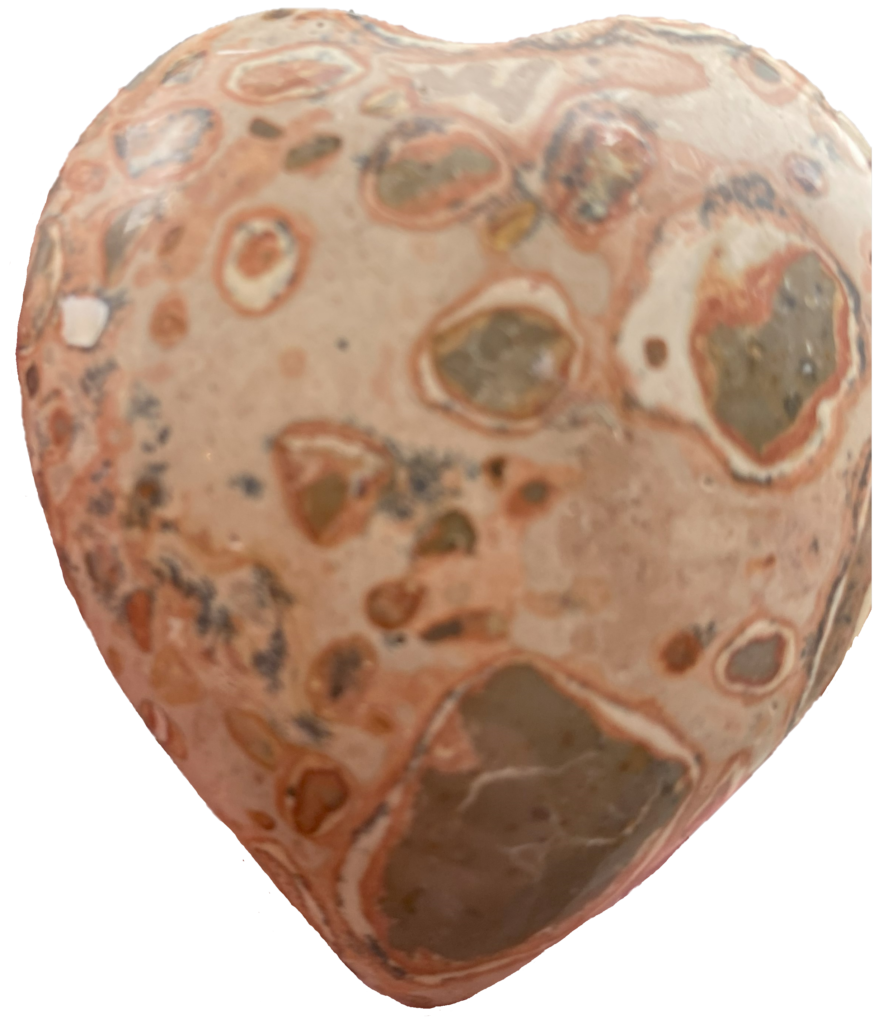
Leopard Skin Jasper frequently referred to by geologists and gemologists as orbicular silicified rhyolite—is among the most visually striking patterned stones in the lapidary world. Renowned for its distinctive concentric rings and variegated spot patterns that mirror the rosettes of wild big cats, this stone bridges igneous vulcanism and fine-grained silicate mineralogy.
Although marketed under the traditional jasper moniker, its origins lie in volcanic eruptions rather than sedimentary deposition. In lapidary arts and ornamental carving, Leopard Skin Jasper is prized for its high structural integrity, smooth waxy polish, and complex mosaic of earthy tones ranging from blush-pink and ochre to deep mahogany and charcoal. In contemporary crystal traditions, it is celebrated as a premier grounding and shamanic journeying talisman.
Alternate Names
Trade naming conventions, geological classifications, and regional folklore have given Leopard Skin Jasper several designations:
- Jaguar Stone: Commonly used across Central and South America, referencing the native apex predator of the Neotropics rather than the African/Asian leopard.
- Orbicular Rhyolite: The formal geological classification describing its volcanic matrix and circular spherulitic structures.
- Leopard Jasper / Leopardskin Stone: Standard commercial and retail lapidary variants.
- Spherulitic Rhyolite: Petrological terminology referring specifically to the radial crystal growth patterns forming the spots.
The Stone’s Science and Composition
Leopard Skin Jasper is technically a silica-rich volcanic rock (rhyolite) that has undergone pervasive secondary silicification.

- Chemical Formula: Predominantly silicon dioxide ($\text{SiO}_2$) with potassium feldspar ($\text{KAlSi}_3\text{O}_8$) and plagioclase feldspar constituents.
- Orbicular Formation: During the rapid cooling of viscous, felsic lava, crystallisation begins around minute nuclei. Needle-like crystals of quartz and feldspar radiate outward into spherical aggregates called spherulites.
- Silicification: Subsequent hydrothermal fluids saturate the fine-grained volcanic groundmass with microcrystalline chalcedony and quartz, sealing the matrix into a dense, non-porous rock capable of taking a mirror polish.
- Chromophores: Iron oxides (haematite, goethite) and manganese dendrites impart the characteristic terracotta reds, mustard yellows, warm browns, and jet-black ring contours.
Key Physical Characteristics
Leopard Skin Jasper’s macro and micro-properties make it resilient and well-suited for cabochons and everyday jewellery.
| Diagnostic Property | Specification |
| Mineral / Rock Class | Igneous (Silicified Spherulitic Rhyolite) |
| Crystal System | Trigonal (Microcrystalline aggregate) |
| Mohs Hardness | 6.5 – 7.0 |
| Lustre | Vitreous to waxy when polished; dull in rough fractures |
| Diaphaneity | Opaque |
| Specific Gravity | 2.58 – 2.66 |
| Refractive Index | ~1.54 (aggregate reading) |
| Cleavage / Fracture | No cleavage; conchoidal to uneven splintery fracture |
| Tenacity | High (exceptionally tough due to interlocking micro-texture) |
Common Geologic Varieties
While distinct in pattern, Leopard Skin Jasper belongs to a wider family of patterned felsic volcanic rocks and orbicular chalcedonies:
- Classic Rosette Leopard Skin: Showcases multi-ringed cream, pink, and ochre spherulites enclosed by sharp, dark haematite boundaries.
- Rainforest Rhyolite (Rainforest Jasper): A related Australian silicified volcanic rock featuring spherulites in a dominant apple-green to mossy matrix.
- Ocean Jasper: A coastal Madagascan orbicular chalcedony displaying translucent to opaque multi-coloured orbs, often accompanied by micro drusy cavities.
- Poppy Jasper: Characterised by vibrant crimson orbs floating in dark grey or yellow brecciated host matrix, famously discovered in California.
Global Mining and Volcanic Sources
Leopard Skin Jasper deposits occur within ancient volcanic calderas and rhyolitic lava flows. Mining is generally conducted through open-pit trenching and surface quarrying of primary volcanic beds:
- Mexico (Chihuahua State): The foremost global supplier of high-grade lapidary material, famous for distinct, high-contrast rosettes.
- Peru: Produces specimens exhibiting earthy rust, beige, and slate-grey undertones.
- South Africa: Sources banded, weathered rhyolitic aggregates featuring pronounced circular orbs.
- United States: Notable deposits found across rhyolitic volcanic zones in Oregon, California, and Utah.
Crystal Pairings: What to Combine and Avoid
In holistic crystal healing and metaphysical practices, stones are combined according to vibrational resonance, elemental focus, and intentional balance.
Optimal Crystal Pairings
- Smoky Quartz & Black Tourmaline: Amplifies grounding and psychic protection, anchoring the physical body during deep emotional release.
- Carnelian: Resonates with the sacral centre, pairing with Leopard Skin’s feral vitality to awaken creative drive, physical endurance, and sensuality.
- Tiger’s Eye: Harmonises solar plexus and root energies, blending mental clarity and focus with instinctive self-preservation.
- Petrified Wood & Moss Agate: Deepens earth-element connections, facilitating grounding and communication with nature spirits.
Crystal Pairings to Avoid
- Moldavite & High-Vibration Tektites: Moldavite’s rapid, ungrounded extraterrestrial frequency can clash with Leopard Skin Jasper’s earthy stability, resulting in mental fuzziness or spatial disorientation.
- Selenite & Apophyllite: Highly ethereal crown-chakra stones can dilute the pragmatic, survival-oriented instincts that Leopard Skin Jasper is specifically chosen to foster.
- Direct Polar Opposites in High-Stress Work: Pairing high-stimulation stones (such as intense raw cinnabar or hyper-stimulating phenakite) alongside protective grounding pieces can create conflicting intentional fields during focused meditation.
Archaeology, Art and Ancient History
Because of its toughness and lack of cleavage, fine-grained silicified rhyolite was utilised across prehistoric civilisations for durable hunting tools, scrapers, and adzes. In pre-Columbian Mesoamerica, spotted stones echoing the pelt of the sacred jaguar (Panthera onca) were carved into talismans, beads, and ceremonial effigies. Mesoamerican artisans recognised that the stone accepted abrasive shaping and retained polished edges without crumbling, making it an enduring medium for totemic pectoral ornaments.
Folklore, Legends and Sacred Tales
Across indigenous lore, spotted stones have long been woven into myths of protective camouflage and animal kinship:
- The Jaguar Shamans: In Amazonian and Olmec mythology, shamans (naguals) were believed capable of shapeshifting into jaguars to walk between the physical and underworld realms. Stones displaying rosette markings were carried as protective amulets ensuring safe passage across these spiritual thresholds.
- The Gift of Camouflage: Folktales from southern African tribes held that spotted rocks carried the protective essence of the leopard, helping hunters move unseen through the brush by blending their aura with the wild landscape.
Metaphysical and Mystical Healing Properties
Contemporary esoteric traditions view Leopard Skin Jasper as a stone of resilience, animal instinct, and shadow integration:
- Emotional Healing: Helps unmask self-deceptions, assisting individuals in acknowledging harsh emotional realities without cynicism. It encourages emotional equilibrium, emotional accountability, and steady perseverance through upheaval.
- Spiritual Connection: Often called the “Stone of the Spirit Guide,” practitioners utilise it during drum circles and shamanic journeying to discover, honour, and integrate animal totems.
- Physical Vitality (Esoteric Lore): In alternative wellness lore, it is aligned with physical stamina, the digestive tract, cellular regeneration, and recovery from chronic physical exhaustion.
Astrological Connections
- Primary Zodiac Signs:Virgo and Scorpio.
- Virgo: Anchors Virgo’s analytical, sometimes overly self-critical tendencies into steady, earthy self-acceptance.
- Scorpio: Matches Scorpio’s investigative nature, offering emotional insulation while delving into shadow work and psychological transformation.
- Secondary Resonances: Also works closely with Capricorn (for enduring perseverance) and Gemini (for balancing active dualities and mental grounding).
The Chakra System
Leopard Skin Jasper interacts predominantly with the lower vibrational chakras, establishing physical presence and primal security:
- Root Chakra (Muladhara): Clears stagnation in the foundational centre, alleviating existential anxiety and anchoring consciousness firmly into the physical vessel.
- Sacral Chakra (Svadhisthana): Enhances primal vitality, instinctual movement, and tactile creative expressions.
- Solar Plexus Alignment: Secondary tones of yellow-ochre stimulate personal agency, courage, and boundary enforcement.
Additional Article Suggestions: Practical Care, Identification, and Cutting
Gemological Identification: Real vs. Simulated
Given the commercial appeal of animal-print minerals, Leopard Skin Jasper is sometimes confused with other materials:
- Dalmatian Stone (Dalmatian “Jasper”): Often mistaken by novices, but Dalmatian stone is an aplite/peralkaline rock composed of white feldspar, quartz, and black arfvedsonite needles, lacking the concentric spherulitic rings of rhyolite.
- Dyed Agates and Calcites: Natural Leopard Skin Jasper displays muted, earthy mineral colours. Porous stones dyed bright neon pinks, blues, or purples feature dye concentrations within fractures and drill holes.
Lapidary Cutting and Polishing Guide
For lapidaries and cabochon cutters, working with silicified rhyolite requires specific handling:
- Slab Sawing: Use continuous-rim diamond blades with water or oil coolant. The material is dense and uniform, with low spalling risk.
- Grinding: Shape cabochons starting with 80-grit diamond wheels, progressing to 220 and 600 grit.
- Polishing: Achieve a bright waxy-to-vitreous sheen using cerium oxide or tin oxide on leather or hard felt laps.
Cleaning, Care, and Maintenance
- Hardness Safety: At 6.5–7 on the Mohs scale, it resists accidental scratches from common household dust (which contains quartz).
- Chemical Exposure: Wash with mild dish soap and warm water. Avoid prolonged exposure to concentrated hydrofluoric or harsh industrial acids.
- Cleansing & Recharging (Metaphysical): Cleanse using smudging (cedar, white sage) or sound clearing; recharge directly on natural soil or overnight under a full moon.
Interesting Facts
- Not a True Jasper: Scientifically, it is a spherulitic volcanic igneous rock (rhyolite), not a microcrystalline sedimentary chert.
- Natural Fingerprints: Because spherulites form dynamically in turbulent cooling lava, no two cabochons ever share the same ring pattern.
- Tougher Than Glass: Unlike natural volcanic obsidian (which has a Mohs hardness of ~5 to 5.5 and shatters readily), secondary silicification elevates Leopard Skin Jasper to a resilient 6.5–7.
Modern Milestones: Birthstones and Anniversaries
- Traditional Birthstone Status: While not an official birthstone in modern commercial jewellers’ charts, it is celebrated as an alternative planetary birthstone for Virgo and Scorpio.
- Modern Anniversaries: Frequently utilised in artisan and non-traditional jewellery gifting for the 24th wedding anniversary, which historically honours various jaspers and fine chalcedonies.
Leopard Skin Jasper Frequently Asked Questions
Is Leopard Skin Jasper rare or expensive?
No, it is relatively abundant and considered an affordable semi-precious decorative stone. Prices are largely dictated by the sharpness of the orbicular rosettes, symmetry of cabochon cuts, and quality of the lapidary polish.
Can Leopard Skin Jasper go in water?
Yes. Because it is a dense, silicified silicate with a hardness of 6.5–7 and no water-soluble minerals, it can safely be rinsed in water or submerged for brief periods. Avoid soaking rough, unsealed stones containing exposed matrix cracks for prolonged days to prevent staining.
How can I tell if my stone is authentic?
True Leopard Skin Jasper has weight, feels naturally cold to the touch, and features multi-layered, imperfect orbicular rosettes surrounded by earthy iron and manganese pigments. It will easily scratch standard glass or a pocketknife blade without damage to the stone
What is the best way to wear Leopard Skin Jasper?
Because of its alignment with the lower energy centres, it works exceptionally well as a pocket stone, ring, or belt ornament. When worn as a pendant, resting it near the solar plexus aids grounded self-confidence and personal boundaries.
These are my personally selected and curated Leopard Skin Jasper