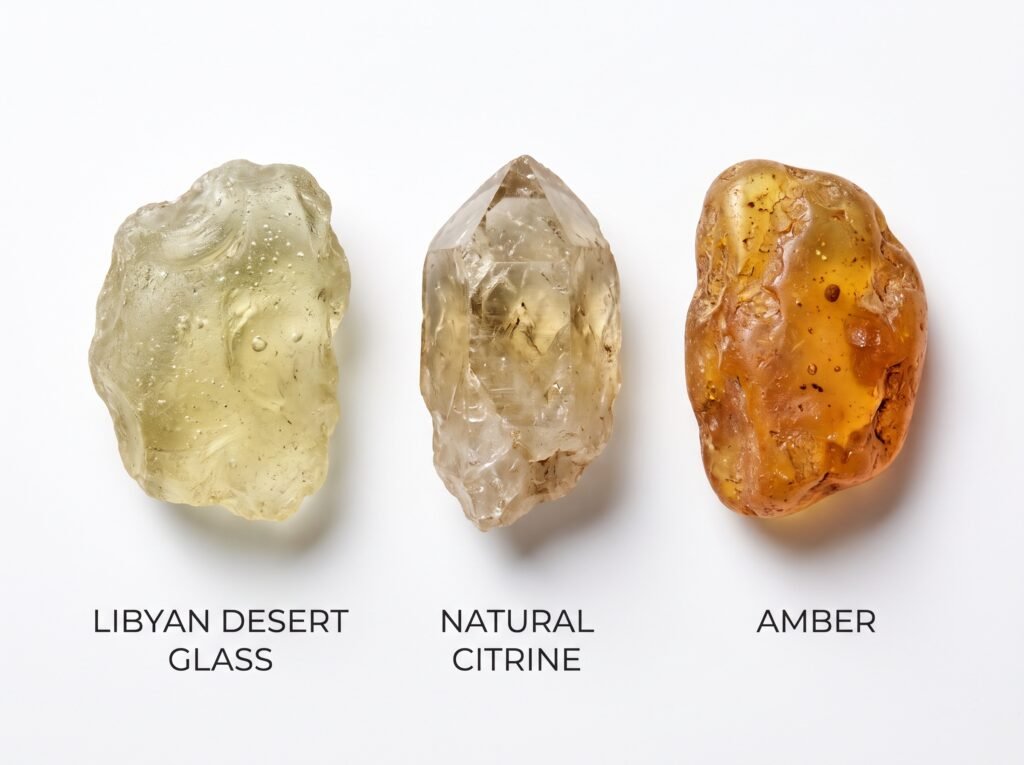
The world of golden gemstones is filled with warmth, beauty, and more than a little confusion. If you’re holding a translucent, honey-yellow specimen in your hand, you might find yourself asking: Libyan Desert Glass, Citrine or Amber? On a screen or behind a display case, these three popular natural treasures can look remarkably similar, all boasting rich, sun-kissed hues that have captivated humans for millennia.
However, beneath their shared golden glow lies vastly different origins. One is a rare, space-born glass forged in the fires of a prehistoric Saharan impact; another is a beloved, Earth-grown crystalline quartz; and the third is the ancient, fossilised resin of prehistoric trees. Because they are so frequently confused—and because unscrupulous sellers often pass off common materials or man-made imitations as their rarer counterparts knowing how to identify golden stones correctly is essential.
Whether you’re an avid collector, a jewellery enthusiast, or simply trying to verify a treasure, you don’t need a geology degree to tell them apart. From simple touch and weight tests to examining internal inclusions and testing Mohs hardness, this guide will show you exactly how to distinguish between Libyan Desert Glass, citrine, and amber with absolute confidence. Let’s delve into the physical clues and unique traits that make each of these golden marvels one of a kind.
Side-by-Side Gemmological Diagnostic Table
| Diagnostic Property | Libyan Desert Glass (LDG) | Natural Citrine (Quartz) | Baltic / Dominican Amber |
| Material Classification | Amorphous Mineraloid (Impactite Glass) | Crystalline Mineral (Silicate) | Organic Gem (Fossilised Tree Resin) |
| Chemical Composition | $\text{SiO}_2$ (~96.5% – 98% Silica) | $\text{SiO}_2$ (Silicon Dioxide with trace Fe) | Hydrocarbon polymer ($\text{C}_{10}\text{H}_{16}\text{O}$ + succinic acid) |
| Geological Age | ~28.5 – 29 Million Years (Oligocene) | Millions to hundreds of millions of years | ~15 – 50 Million Years (Eocene / Miocene) |
| Crystal System | Amorphous (Non-crystalline) | Trigonal (Hexagonal prism habit) | Amorphous (Organic polymer) |
| Hardness (Mohs Scale) | 5.5 – 6.5 | 7.0 | 2.0 – 2.5 (Easily scratched by a fingernail or copper coin) |
| Specific Gravity (SG) | 2.20 – 2.21 g/cm³ | 2.65 g/cm³ | 1.05 – 1.10 g/cm³ (Floats in saturated salt water) |
| Refractive Index (RI) | 1.460 – 1.465 (Isotropic / SR) | 1.544 – 1.553 (Anisotropic / DR) | 1.539 – 1.545 (Isotropic / SR) |
| Thermal Feel (Touch) | Cool to the touch initially | Cold to the touch (high thermal conductivity) | Distinctly warm to the touch immediately |
| UV Fluorescence | Inert (No reaction) | Inert (No reaction) | Strong chalky blue, green, or yellow-white glow |
| Typical Inclusions | Stretched gas bubbles, lechatelierite swirls, white cristobalite spheres | Natural mineral veils, colour zoning, liquid-gas two-phase inclusions | Prehistoric insects, botanical debris, stress spangles (“sun spangles”) |
Crystalline Quartz vs. Amorphous Glass vs. Organic Resin
Understanding how each material formed immediately explains why they behave so differently under gemmological testing:
- Libyan Desert Glass (Extraterrestrial Impact Glass): Created ~29 million years ago when a hypervelocity meteorite impact flash melted quartz sand in the Great Sand Sea at temperatures above 1,600°C. Because the molten silica quenched rapidly, atoms had no time to align into crystals—resulting in an ultra-pure (~98% $\text{SiO}_2$) amorphous glass.
- Citrine (Crystalline Macro-Quartz): Formed deep within hydrothermal veins and pegmatites where silica-rich fluids cooled slowly over geological epochs, allowing silicon and oxygen atoms to lock into an ordered trigonal crystal lattice. Natural citrine derives its subtle smoky-champagne to pale golden hue from trace iron centres, whereas bright orange-brown “baked citrine” is produced by heating amethyst in a furnace.
- Amber (Fossilised Tree Resin): Not a mineral at all, amber is the polymerised, fossilised resin of ancient coniferous or leguminous trees. Over millions of years under sediment pressure, volatile terpenes evaporated, leaving behind a lightweight organic hydrocarbon solid.
Practical Non-Destructive Tests to Separate Them
1. The Specific Gravity & Saltwater Float Test
The dramatic density gap between these three golden materials is one of the fastest ways to tell them apart without specialised laboratory optics:
- Amber (~1.05–1.10 g/cm³): Remarkably feather light. Drop an unmounted piece into a glass of saturated salt water (roughly 3 tablespoons of table salt dissolved in 250 ml of warm water)—genuine amber floats, while both Libyan Desert Glass and Citrine sink immediately.
- Libyan Desert Glass (~2.20–2.21 g/cm³): Noticeably lighter in the hand than quartz of identical dimensions. Hydrostatic weighing confirms a specific gravity right around 2.21.
- Citrine (~2.65 g/cm³): Feels distinctly dense and weighty in the palm compared to an equivalent volume of LDG.
2. Thermal Conductivity (The “Warmth to the Touch” Test)
Because crystalline quartz conducts heat away from human skin far more efficiently than organic resin, a simple touch test provides an instant clue:
- Citrine feels decidedly cold against the cheek or lip and takes several seconds to warm up.
- Libyan Desert Glass feels moderately cool initially, warming slightly faster than crystalline quartz.
- Amber feels warm and almost room-temperature the moment it touches your skin.
3. Long-Wave UV Fluorescence & Polariscope Checks
- UV Light (365 nm): Place the specimen under a standard long-wave UV torch in a darkened room. Baltic and Dominican Amber fluoresce vividly in chalky blue, greenish-yellow, or butterscotch tones. Both Libyan Desert Glass and Citrine remain completely dark (inert).
- Polariscope (Separating LDG from Faceted Citrine): Under crossed polarising filters, Citrine blinks brightly from light to dark four times during a 360-degree rotation (anisotropic double refraction), whereas Libyan Desert Glass stays dark or exhibits faint, shadowy strain bands (isotropic single refraction).
4. Magnified Inclusion Inspection (10x Loupe)
Inspecting the interior with transmitted light removes all doubt:
- Libyan Desert Glass: Look for stretched gas bubble trails, wavy ribbons of pure melted silica (lechatelierite), and tiny opaque white spheres of high-temperature cristobalite.
- Citrine: Never contains round gas bubbles. Natural citrine displays subtle planar colour zoning, wispy fluid “fingerprints,” or tiny mineral crystal inclusions.
- Amber: Frequently contains trapped prehistoric plant fragments, organic debris, or disc-shaped internal stress fractures known as “sun spangles” (often created during modern heat clarification).
Price Per Gram & Rarity Breakdown
Because supply dynamics differ vastly across the three materials, price per gram serves as a strong commercial sanity check:
- Libyan Desert Glass (Highest Rarity): Sourced from a single protected strewn field in the Great Sand Sea with strict Egyptian export restrictions. Genuine raw specimens typically command £1.50 to £6.00+ per gram, with transparent gem-grade pieces and faceted stones reaching substantially higher figures.
- Natural Unheated Citrine (Moderate-to-High Rarity): True natural pale-gold citrine from localities such as Brazil, Madagascar, or Zambia commands a significant premium over common heat-treated amethyst, typically retailing from £0.80 to £4.00+ per gram for clean facet-grade rough or cut gems (whereas baked amethyst sells for a fraction of that).
- Amber (Variable by Origin & Clarity): High-clarity Baltic or blue-glowing Dominican amber—especially pieces containing intact insect inclusions—commands strong collector prices, while standard commercial amber beads and tumbled nuggets are widely available at accessible mid-range prices.
Libyan Desert Glass, Citrine or Amber Frequently Asked Questions
What are the main differences between Libyan Desert Glass, citrine, and amber?
Libyan Desert Glass is an amorphous glass formed by a prehistoric Saharan impact; citrine is a crystalline quartz; amber is fossilised tree resin. They differ in chemical composition (SiO2 for LDG and citrine, organic polymer for amber), crystal structure (amorphous for LDG and amber, crystalline for citrine), hardness (LDG 5.5–6.5, citrine 7.0, amber 2.0–2.5), and density (LDG ~2.20–2.21 g/cm³, citrine ~2.65 g/cm³, amber ~1.05–1.10 g/cm³). Their age and inclusions also vary, with LDG about 28.5–29 million years old, citrine formed in silica-rich fluids over long timescales, and amber containing prehistoric plant or insect inclusions.
How can I tell them apart using non-destructive tests?
Use a combination of tests: perform a saltwater float test to check density (amber floats, while LDG and citrine sink); feel the warmth to the touch (amber feels warm immediately, citrine feels cold and takes time to warm, LDG feels cool and warms faster than citrine); observe under UV light (amber glows chalky blue or greenish-yellow, while LDG and citrine are inert); and inspect with a loupe for inclusions (amber often has plant debris or sun spangles, citrine shows colour zoning or fluid inclusions, LDG shows stretched gas bubbles and cristobalite spheres). A polariscope can also help: citrine shows anisotropic double refraction, LDG remains dark.
Which material is the hardest among the three?
Citrine is the hardest with a Mohs hardness of 7.0, while Libyan Desert Glass ranges from 5.5 to 6.5 and amber is 2.0 to 2.5, making citrine the most resistant to scratching among the three.
What does UV fluorescence tell me about amber compared to LDG and citrine?
Under long-wave UV light, Baltic and Dominican amber fluoresce vividly in chalky blue, greenish-yellow, or butterscotch tones, whereas Libyan Desert Glass and citrine remain inert and do not fluoresce.
Why is it important to distinguish between Libyan Desert Glass, citrine, and amber?
They have different origins, values, and authenticity concerns. LDG is a rare, space-born glass from a Saharan impact; natural citrine is a crystalline quartz, and amber is fossilised tree resin. Misidentifying or passing off common materials or man-made imitations as one of these rarer stones can mislead buyers and collectors, so correct identification through physical clues, inclusions, and non-destructive tests is essential.