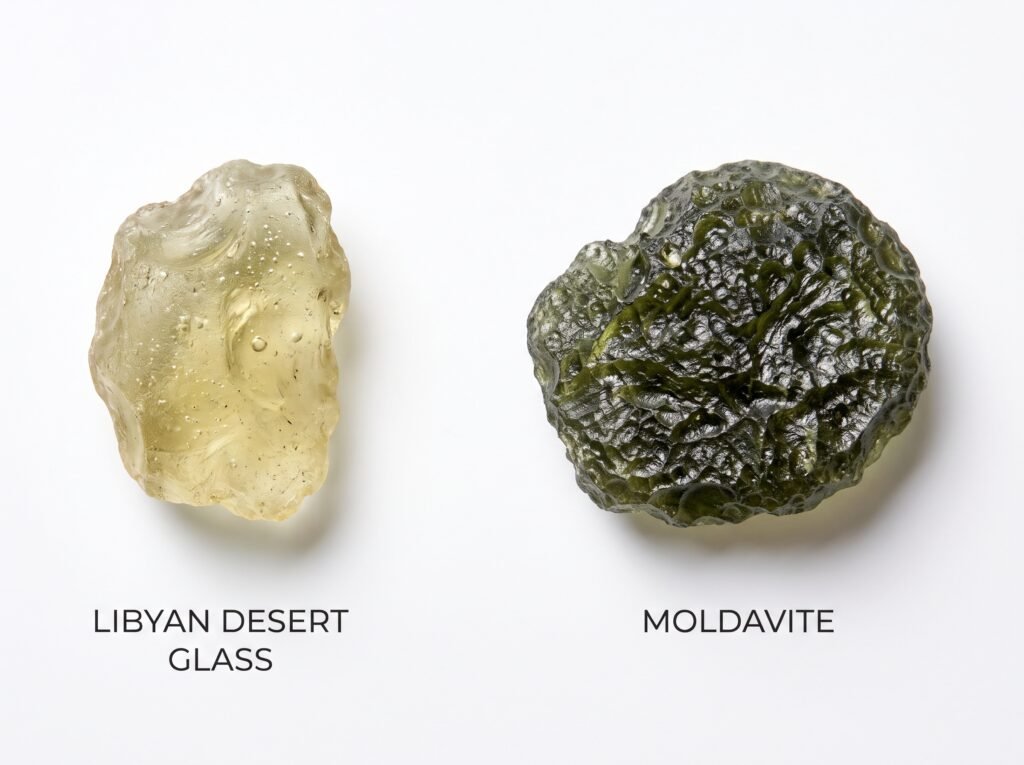
Comparing Libyan Desert Glass v Moldavite brings together two of the most sought-after natural impact glasses on Earth—both born from violent cosmic collisions, yet entirely distinct in their geological formation, chemical makeup, and energetic signature. While both stones carry an unmistakable extraterrestrial pedigree that sets them apart from terrestrial quartz crystals, they originate from separate impact events millions of years apart and behave very differently in lapidary work, collection care, and spiritual practice.
Forged roughly 29 million years ago in the Great Sand Sea of Egypt and Libya, Libyan Desert Glass is an exceptionally pure natural silica glass (around 98% $\text{SiO}_2$) prized for its warm, translucent golden hue and grounding Solar Plexus resonance. By contrast, Moldavite was created roughly 14.8 million years ago during the Ries crater impact in southern Germany, scattering forest-green, deeply sculpted tektites across the Bohemian plateau of the Czech Republic—a stone renowned for its rapid, heart-centred transformational intensity.
In this side-by-side guide, we break down Libyan Desert Glass v Moldavite across their cosmic origins, mineral composition, Mohs hardness, authenticity markers, and metaphysical properties so you can choose—or safely pair—the right impact glass for your collection.
Impactite vs. True Tektite: The Scientific Distinction
Although commercial sellers often market Libyan Desert Glass as “Libyan Gold Tektite”, planetary geologists draw a clear technical distinction between the two materials:
- Moldavite is a true distal tektite: Formed approximately 14.8 to 15 million years ago (Miocene epoch) when a massive asteroid struck the Nördlinger Ries crater in southern Germany. The hypervelocity impact launched molten terrestrial rock hundreds of kilometres into the upper atmosphere, where droplets cooled in mid-air before raining down across the Bohemian and Moravian strewn fields of the Czech Republic.
- Libyan Desert Glass is a proximal impactite (layered impact glass): Formed approximately 28.5 to 29 million years ago (Oligocene epoch) in the Great Sand Sea along the Egypt–Libya border. Rather than being ejected hundreds of miles across the sky, LDG was forged in situ when an extraterrestrial impactor flash-melted quartz-rich desert sands at temperatures exceeding 1,600°C–2,000°C, creating puddles and sheets of molten silica near ground zero.
Side-by-Side Gemmological & Geological Comparison
| Feature | Libyan Desert Glass (LDG) | Moldavite |
| Geological Classification | Impactite (Proximal Impact Glass) | True Tektite (Distal Splash-Form Glass) |
| Mineral Class | Amorphous Mineraloid (Natural Glass) | Amorphous Mineraloid (Natural Glass) |
| Age of Formation | ~28.5 – 29 Million Years (Oligocene) | ~14.8 – 15 Million Years (Miocene) |
| Locality / Strewn Field | Great Sand Sea (Western Egypt / Eastern Libya) | Primarily Bohemia & Moravia (Czech Republic) |
| Parent Crater | Buried / Unconfirmed (Great Sand Sea region) | Nördlinger Ries Impact Crater (Bavaria, Germany) |
| Silica Purity ($\text{SiO}_2$) | ~96.5% – 98% (Purest natural silica glass) | ~75% – 80% (Silica-rich aluminosilicate) |
| Colour Range | Pale champagne, milky cream, straw yellow, honey gold | Forest green, olive green, brownish-green |
| Surface Texture | Wind-abraded ventifact pitting, frosted satiny skin | Deeply sculpted, craggy, fern-like or worm-like etching |
| Hardness (Mohs Scale) | 5.5 – 6.5 | 5.5 – 6.0 (Slightly more brittle due to surface grooves) |
| Specific Gravity (SG) | 2.20 – 2.21 g/cm³ | 2.32 – 2.38 g/cm³ |
| Refractive Index (RI) | 1.460 – 1.465 (Isotropic) | 1.480 – 1.500 (Isotropic) |
Chemical Purity and Internal Inclusions
The stark difference in colour and refractive index between the two glasses comes down to their parent target rocks at the moment of impact:
- Libyan Desert Glass (~98% $\text{SiO}_2$): Because the impact struck nearly pure quartz desert sand, LDG is almost pure fused silica—closer in composition to laboratory fused quartz than to volcanic glass. Trace amounts of iron and titanium impart its warm golden-yellow hue. Under magnification, it displays elongated gas bubble streams, dark meteoritic schlieren swirls, and tiny white spherical clusters of high-temperature cristobalite.
- Moldavite (~75%–80% $\text{SiO}_2$): The Ries asteroid struck clay-rich, sedimentary soils containing aluminium, iron, potassium, calcium, and magnesium oxides. These additional oxides give Moldavite its signature moss-to-bottle-green colour, higher specific gravity (~2.35), and higher refractive index (~1.49). Under a 10x loupe, genuine Moldavite reveals twisted, worm-like lechatelierite ribbons and spherical-to-elliptical gas bubbles, without the white cristobalite spheres seen in LDG.
Physical Durability and Jewellery Wearability
Both materials share a similar Mohs hardness range (5.5 to 6.5), meaning both are softer than everyday quartz dust (Mohs 7) and require thoughtful handling:
- Surface Fragility: Raw Moldavite’s deeply etched, spiky “hedgehog” ridges are thin and fragile—dropping an unmounted specimen onto a hard floor can snap off delicate surface points. Raw Libyan Desert Glass, having been tumbled and sandblasted by Saharan winds for 29 million years, has smoother, rounded ventifact contours that resist edge chipping slightly better in raw form.
- Setting Recommendations: For rings or bracelets worn regularly, protective bezel settings are essential for both stones. Prong settings leave their brittle glass edges exposed to knocks, while ultrasonic cleaners and sudden thermal shocks (boiling or freezing water) must be strictly avoided for both.
Metaphysical Comparison: Heart Transformation vs. Solar Willpower
Disclaimer: Metaphysical properties reflect traditional holistic lore and spiritual practice rather than clinical or scientific claims.
In modern crystal healing traditions, Libyan Desert Glass and Moldavite are viewed as complementary halves of a cosmic polarity:
- Moldavite — Rapid Heart & Soul Awakening:
- Primary Chakras: Heart (Anahata), Third Eye, and Crown.
- Energetic Signature: Intense, catalytic, and ungrounded. Often associated with the “Moldavite flush”—a sensation of warmth or emotional release—it is used to accelerate spiritual awakening, clear stagnant life patterns, and invite rapid personal transformation.
- Libyan Desert Glass — Grounded Solar Willpower & Manifestation:
- Primary Chakras: Solar Plexus (Manipura) and Sacral (Svadhisthana).
- Energetic Signature: Warm, sovereign, and empowering. Rather than upheaving your life unexpectedly, LDG is traditionally worked with to build self-belief, clarify personal boundaries, and channel cosmic inspiration into decisive, real-world action.
Can You Wear Libyan Desert Glass and Moldavite Together?
Yes—in fact, pairing them is one of the most popular combinations among collectors of impactites and tektites, provided you introduce a grounding stone:
- How They Work Together: Moldavite opens the Heart and upper chakras to new possibilities and higher perspective, while Libyan Desert Glass anchors that insight into the Solar Plexus—giving you the courage, focus, and willpower to act on what you discover.
- Who Should Pace Themselves: If you are sensitive to high-vibration stones, wearing raw Moldavite and LDG simultaneously right away can feel overly stimulating or restless. Start with short 15–20 minute sessions and pair them with Black Tourmaline, Smoky Quartz, or Hematite to keep the energy comfortably anchored in the body.
Libyan Desert Glass v Moldavite Frequently Asked Questions
What is the scientific distinction between Libyan Desert Glass and Moldavite?
Libyan Desert Glass is an impactite (proximal impact glass) formed in the Great Sand Sea around 28.5 to 29 million years ago, while Moldavite is a true distal tektite formed about 14.8 to 15 million years ago from the Ries crater impact in southern Germany. The two are different in origin, with LDG created near ground zero and Moldavite formed from ejecta that rained down after an asteroid impact.
How do their formation ages and locations differ?
Libyan Desert Glass formed roughly 28.5–29 million years ago in the Great Sand Sea along the Egypt–Libya border. Moldavite formed roughly 14.8–15 million years ago, primarily from the Bohemian & Moravian strewn fields after the Nördlinger Ries impact in Germany.
What are their hardness and durability like for wear or jewellery?
Both have a Mohs hardness of about 5.5–6.5, making them softer than quartz. Moldavite tends to be more fragile due to its deeply etched surface, while Libyan Desert Glass is smoother and somewhat more resistant to edge chipping in its raw form. Protective settings and careful handling are recommended for both in jewellery.
What are key authenticity markers to look for in each glass?
LDG is almost pure fused silica (roughly 96.5%–98% SiO2) with a warm golden hue, gas bubble streams, schlieren swirls, and white cristobalite spheres visible under magnification. Moldavite has about 75%–80% SiO2, a moss-to-bottle-green colour, deeper etching, twisted lechatelierite inclusions, and gas bubbles, but lacks the cristobalite spheres seen in LDG.
Can Libyan Desert Glass and Moldavite be worn together, and how should they be paired?
Yes, pairing them is popular. Moldavite opens the heart and upper chakras while Libyan Desert Glass anchors the energy in the Solar Plexus. To avoid overstimulation, start with short wear times (15–20 minutes) and pair with grounding stones like Black Tourmaline, Smoky Quartz, or Haematite to keep energy balanced.