Working with single stones offers focused, predictable energy. However, combining minerals creates an entirely different dynamic. When distinct crystalline structures, trace elements, and vibrational frequencies meet, they either resonate harmoniously to amplify your intention or clash—leaving you feeling scattered, overstimulated, or drained. That is why intentional Labradorite crystal pairing is essential.
Mineralogically, Labradorite is a plagioclase feldspar renowned for labradorescence—an optical effect caused by internal light interference within its layered crystal structure. Metaphysically, this high-frequency stone stimulates the Third Eye (Ajna) and Crown (Sahasrara) chakras while forming a protective auric shield around your subtle body.
Because Labradorite is fluid, introspective, and intensely etheric, pairing it requires conscious curation. Knowing which crystals harmonise with Labradorite—and which combinations to avoid—ensures you unlock its full transformative power while staying emotionally balanced and physically grounded.
Labradorite’s Energy Matrix
Before selecting companion stones, consider the core properties that define labradorite’s vibrational footprint:
- Primary Elemental Rulers: Wind (Air) and Water (Etheric).
- Primary Chakra Alignment: Third Eye (Intuition, Inner Vision) and Crown (Spiritual Connection).
- Operational Mode: Introspective, transmutational, refractive, and psychic-shielding.
- Tectonic Nature: Slow-cooled plutonic silicate with sub-microscopic exsolution lamellae that bounce and redirect environmental frequencies.
When pairing stones with labradorite, companion minerals must satisfy one of three functional roles:
- The Anchor: Grounding the physical body so higher visionary states do not trigger space-headedness or dissociation.
- The Clarifier: Calming lower-frequency mental chatter so intuitive impressions register with sharp fidelity.
- The Mirror / Amplifier: Expanding the auric perimeter and balancing masculine/feminine polarities.
Optimal Crystal Pairings (Synergistic Alliances)
These companion stones naturally align with labradorite’s silicate matrix and etheric frequency.
Rainbow Moonstone (White Labradorite) or Classical Moonstone (Adularia)
- The Synergy: The Alchemical Union of Solar and Lunar Light.
- Why It Works: While classical moonstone is an alkali orthoclase feldspar and “rainbow moonstone” is white plagioclase labradorite, both share related crystallographic frameworks. Labradorite carries the electric, flashes of celestial fire and energetic shielding; moonstone channels the soft, introspective, tidal rhythms of the divine feminine.
- Practical Benefit: Balances analytical and intuitive insight. It softens emotional triggers during intense spiritual transformations, making it the premier pairing for hormonal balance, dream incubation, and psychic development.
Black Tourmaline (Schorl)
- The Synergy: The “Root-to-Crown” Shielding Circuit.
- Why It Works: Labradorite seals the upper and outer layers of the auric field by refracting external projections; black tourmaline grounds surplus electrical charge into the earth via the Root Chakra (Muladhara).
- Practical Benefit: Prevents the “spaciness,” lightheadedness, or clumsiness that sensitive individuals experience when working with high-vibrational stones. It is the benchmark combination for empaths entering high-density public venues, hospitals, or volatile workplaces.
Amethyst
- The Synergy: Psychic Filter & Mental Calming.
- Why It Works: Amethyst vibrates with the violet ray, cooling sympathetic nervous system arousal and clearing cognitive loops. Labradorite opens the Third Eye to subtle impressions.
- Practical Benefit: Without amethyst, an overactive analytical mind might dismiss or second-guess intuitive downloads. Amethyst stills the egoic intellect, allowing labradorite’s symbolic insights to be recognised without anxiety or mental distortion.
Clear Quartz
- The Synergy: Prismatic Amplification & Directional Focus.
- Why It Works: As an energetic amplifier, clear quartz magnifies the vibrational output of any stone placed alongside it.
- Practical Benefit: Ideal for deliberate ritual work, manifestation grids, and shamanic vision-questing where the practitioner wishes to broadcast their intentions across a wider energetic field.
Lapis Lazuli
- The Synergy: The Visionary Speaker (Third Eye + Throat Alignment).
- Why It Works: Lapis lazuli connects directly to Vishuddha (the Throat Chakra) and ancient intellectual wisdom. Labradorite unlocks inner vision.
- Practical Benefit: Many people perceive clear intuitive truths through labradorite but struggle to articulate them out loud. Lapis bridges this divide, empowering teachers, writers, and leaders to vocalise esoteric concepts with authority and clarity.
Crystals to Avoid Pairing with Labradorite
Not all crystals harmonise. Combining stones with opposing elemental governors, conflicting chakra targets, or clashing velocities can create energetic friction, cognitive fog, or emotional restlessness.
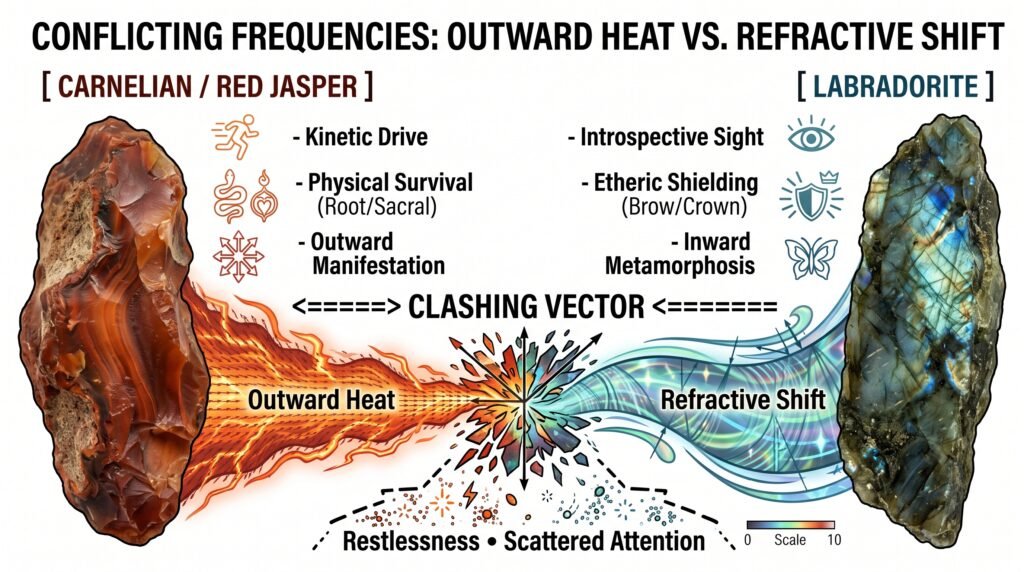
Carnelian (Avoid in Meditative or Intuitive Work)
- The Conflict: Aggressive Lower-Chakra Fire vs. Etheric Air/Water.
- Why It Clashes: Carnelian is a fiercely kinetic stone that activates the Sacral and Root chakras, stimulating physical drive, blood circulation, sexual vitality, and rapid outward action. Labradorite’s energy is slow, cool, introspective, and multidimensional.
- The Result: Wearing them simultaneously can create internal discord resembling physical restlessness, agitation, an inability to focus during meditation, and scattered creative impulses that fail to ground.
Red Jasper (Avoid During Visionary Journey work)
- The Conflict: Immovable Terrestrial Weight vs. Fluid Lamellar Refraction.
- Why It Clashes: Red jasper carries a heavy, dense, slow-moving terrestrial signature designed to anchor consciousness to physical survival, routine, and discipline. While grounding is beneficial, red jasper’s density is too rigid for labradorite’s fluid, dream-state frequencies.
- The Result: Acts like an energetic anchor dropped during flight. It blunts intuitive perception and dampens the lucidity of meditation, often leaving the user feeling mentally muddy or sluggish.
Sunstone (Avoid in High-Stress Environments)
- The Conflict: Unmitigated Solar Projection vs. Nocturnal Shielding.
- Why It Clashes: Though both belong to the feldspar family, sunstone is aggressively solar, masculine, and radiant. In low doses or structured grids, they can coexist, but wearing both as everyday talismans during periods of high stress or burnout creates conflicting signals.
- The Result: Can overstimulate the nervous system, amplifying anxiety, hot flashes, or emotional reactivity in individuals already prone to sensory overwhelm.
Malachite (Avoid for Inexperienced Practitioners)
- The Conflict: Volatile Shadow Excavator vs. Subtle Auric Shield.
- Why It Clashes: Malachite is a heavy copper carbonate that unearths deeply buried emotional traumas, demanding immediate confrontation. Labradorite works subtly, protecting the aura and initiating steady, phased metamorphosis.
- The Result: Combining malachite’s blunt emotional surfacing with labradorite’s psychic expansion can trigger intense emotional purging, panic, or ungrounded vulnerability without providing the necessary stability to integrate the shadow work.
Master Pairing Reference Matrix
| Companion Stone | Compatibility Level | Primary Focus | Best Setting / Placement |
| Black Tourmaline | ⭐⭐⭐⭐⭐ (Optimal) | Grounding & impenetrable auric defence | Beaded bracelet (receptive wrist) or pocket stone pair |
| Rainbow Moonstone | ⭐⭐⭐⭐⭐ (Optimal) | Intuition, emotional balance, yin/yang synthesis | Twin-stone silver ring or dual-pendant necklace |
| Amethyst | ⭐⭐⭐⭐⭐ (Optimal) | Third Eye clarity, peaceful sleep, anti-anxiety | Placed together on bedside table or during meditation |
| Lapis Lazuli | ⭐⭐⭐⭐ (High) | Intuitive vocalisation, authentic expression | Throat-level pendant or meditation palm stones |
| Clear Quartz | ⭐⭐⭐⭐ (High) | Energy amplification, intentional programming | Crystal grid layout or ceremonial wand setting |
| Lepidolite | ⭐⭐⭐⭐ (High) | Calming empathic burnout and nervous tension | Carried in pocket during high-stress social gatherings |
| Carnelian | ❌ (Avoid) | Kinetic physical drive vs. subtle etheric vision | Keep in separate rooms or use during alternate cycles |
| Red Jasper | ❌ (Avoid) | Dense root anchoring vs. fluid psychic expansion | Do not combine in the same jewellery piece |
| Malachite | ⚠️ (Caution) | High-volatility emotional purge; overwhelming | Only pair under the guidance of an experienced worker |
Practical Protocols for Combining Stones
When working with multi-stone layouts or designing bespoke jewellery, apply these structural protocols to preserve energetic balance:
Protocol A: The Empath’s Daily Protective Amulet (Pendant/Ring)
- Minerals: Labradorite (cabochon) + Black Tourmaline or Smoky Quartz (accent bead).
- Placement: Worn over the thymus (Higher Heart) or on the non-dominant wrist.
- Mechanism: The labradorite acts as an optical buffer, scattering external projections and energetic siphoning, while the tourmaline grounds negative atmospheric static into the earth.
Protocol B: The Dream Incubation Grid (Sleep Layout)
- Minerals: One labradorite palm stone + one raw amethyst cluster + one tumbled moonstone.
- Placement: Positioned on a night stand within three feet of the head, or under the bed directly beneath the heart line.
- Mechanism: Amethyst quiets the mental chatter of the day, moonstone softens emotional currents, and labradorite protects the subtle body during astral travel and lucid dream integration.
Protocol C: The Visionary Creator (Desk/Studio Layout)
- Minerals: Freeform labradorite standing piece + raw lapis lazuli + point of clear quartz.
- Placement: Arranged in a triangle around your primary creative workspace or drafting table.
- Mechanism: Labradorite unlocks creative breakthroughs and pattern recognition, quartz amplifies focus, and lapis lazuli grounds the ideas into articulate, expressive written or visual work.
Summary: Designing Intentional Resonance
Crystals are tools of vibrational resonance. Labradorite is one of the most versatile stones in the mineral kingdom, but its transformative potential depends heavily on the company it keeps.
- Seek stability: Pair labradorite with black tourmaline, smoky quartz, or amethyst to maintain a grounded physical foundation while expanding your vision.
- Harmonise polarities: Pair it with moonstone to balance celestial fire with lunar waters.
- Avoid friction: Keep fiery, outward-driving stones like carnelian and dense earthen minerals like red jasper for distinct, dedicated rituals where kinetic physical action is your sole priority.
Labradorite Crystal Pairing Frequently Asked Questions
Why is intentional Labradorite crystal pairing essential?
Because Labradorite is fluid, introspective, and energetically etheric, and when it is paired with other crystals its energy can either harmonise to amplify your intention or clash, leaving you scattered or drained. The pairing process helps maintain balance while unlocking its transformative power.
Which crystals are optimal pairings with Labradorite and why?
Optimal pairings include Rainbow Moonstone, Black Tourmaline, Amethyst, Clear Quartz, and Lapis Lazuli, each chosen for how they complement Labradorite’s silicate matrix and etheric frequency by supporting intuition, grounding, mental calm, amplification, or expressive communication.
Which crystals should be avoided with Labradorite?
Avoid Carnelian, Red Jasper, Sunstone, and Malachite in certain contexts; Carnelian and Red Jasper clash with Labradorite’s introspective frequencies, Sunstone can overstimulate in high-stress settings, and Malachite requires caution or guidance due to its high-volatility emotional effects.
What practical protocols help balance Labradorite when using multiple stones?
Practical protocols include protocols for daily protective amulets, dream incubation grids, and visionary creator layouts, which use specific stone combinations and placements to preserve energetic balance while enabling grounding, protection, focus, and creative flow.
What is the Master Pairing Reference Matrix and how do I use it?
The Master Pairing Reference Matrix lists companion stones, their compatibility levels, primary focus, and best placement, guiding you to choose combinations that maximize Labradorite’s benefits while indicating which stones to avoid or exercise caution with.