Walk into any commercial gem show, lapidary supplier, or holistic crystal boutique, and you will encounter an astonishing spectrum of stones labelled “jasper.” From the spotted hide of Dalmatian stone to the vibrant, warning-stripe bands of Bumblebee jasper and the mossy swirls of Rainforest stone, the commercial market applies the name to virtually any interestingly patterned rock that can be polished. Hence we developed this overview of how to identify Real Jasper vs False Jaspers.
Yet, from the standpoint of petrology and mineralogy, many of these are complete impostors. The commercial impulse to market disparate rocks as jasper obscures fascinating geological distinctions, masks critical lapidary challenges, and in some cases, hides genuine workshop safety hazards. For a foundational exploration of authentic varieties, see our complete guide to Jasper Guide: Geology, Origins, Meanings & Pairings
Understanding true jasper vs fake jasper and commercial jasper misnomers is not mere pedantry. Whether you are a collector curating authentic mineral cabinets, a lapidary artist adjusting your wheel speeds, or a buyer seeking authentic material, this guide unpacks the science separating true microcrystalline quartz from intrusive igneous aplites, extrusive volcanic rhyolites, toxic hydrothermal carbonates, and ancient fossil beds.
The Geologic Baseline: What Qualifies as “True Jasper”?
To separate true specimens from trade misnomers, we must first establish the scientific baseline. In rigorous mineralogical classification, true jasper is defined as an opaque, impure variety of cryptocrystalline or microcrystalline quartz ($\text{SiO}_2$).
Unlike macrocrystalline quartz (such as amethyst or citrine) which grows visible hexagonal prisms, jasper is formed from billions of submicroscopic quartz crystals interwoven with the monoclinic silica polymorph moganite. What gives jasper its distinctive opacity, rich palette, and patterned banding is foreign particulate matter: up to 20% of its volume consists of mineral oxides (chiefly haematite and goethite), clay minerals, volcanic silt, or organic detritus incorporated as silica gel solidified within sedimentary or hydrothermal environments.
Core Diagnostic Benchmarks of True Jasper
- Chemical Formula: Predominantly $\text{SiO}_2$ (Silicon Dioxide) with foreign mineral phases.
- Mohs Hardness: 6.5 to 7.0. True jasper cannot be scratched by a steel pocketknife or common glass plate.
- Specific Gravity ($SG$): 2.58 to 2.91. Highly dense, trending upward toward $2.91$ when heavily enriched with iron oxide inclusions like haematite.
- Fracture & Cleavage: Shows no cleavage. It fractures with a clean, smooth-to-splintery conchoidal fracture, producing curved, shell-like surfaces with razor-sharp edges.
- Chemical Resistance: Completely inert to acids. A drop of dilute hydrochloric acid ($\text{HCl}$) or household acetic acid (vinegar) produces zero reaction.
- Diaphaneity: Strictly opaque. Even along thin, slabbed edges, true jasper does not transmit light. Translucent banded silica is classified gemologically as agate or chalcedony, not jasper.
For safe cleaning protocols and immersion boundaries for silica minerals, refer to our guide on [How to Cleanse & Water-Test Jasper Safely].
High-Profile Trade Misnomers (And What They Really Are)
Commercial naming conventions prioritise market appeal over chemical truth. Below are the most prevalent commercial “jaspers” that belong to entirely different mineral and rock families.
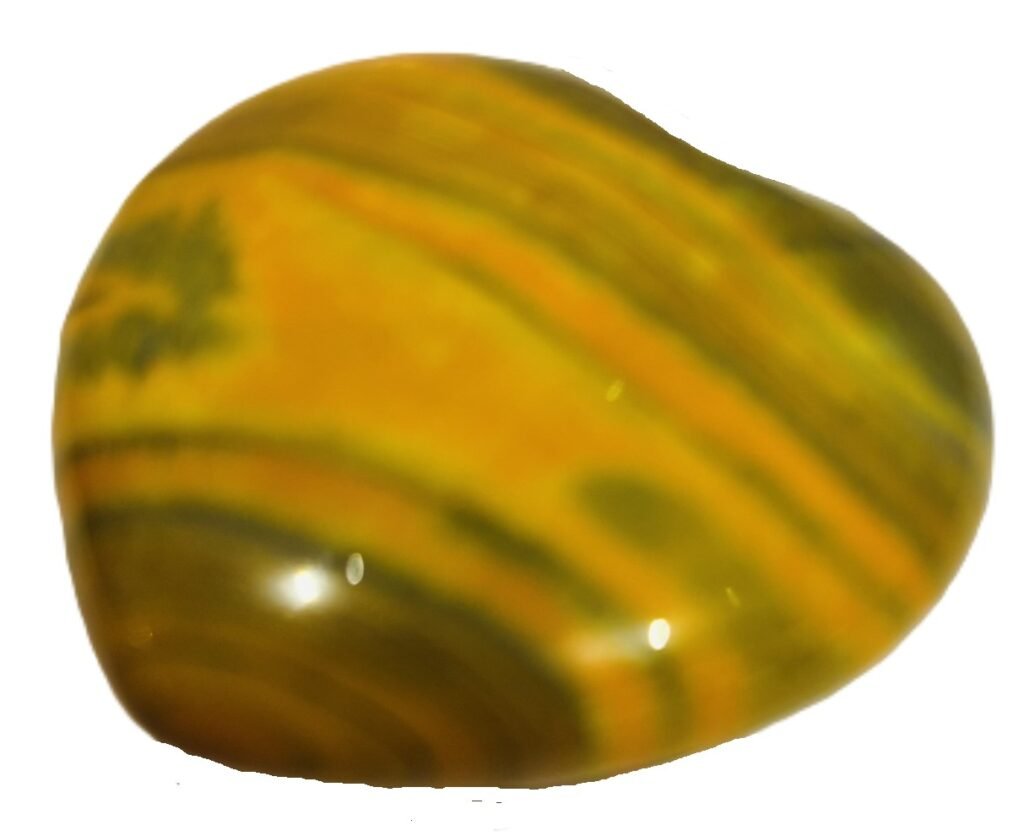
1. Bumblebee “Jasper” (Eclipse Stone / Fimbristylis Stone)
- True Geologic Classification: Hydrothermal Carbonate and Sulphide Rock (Fumarolic Deposit)
- Primary Locality: Mount Papandayan, West Java, Indonesia
Despite its bright yellow, charcoal, and orange concentric banding, Bumblebee Jasper is not a jasper. It is an ultra-porous hydrothermal rock formed inside active volcanic fumaroles and hot-spring vents.
- Actual Mineralogy: The structural base is composed of calcite and aragonite ($\text{CaCO}_3$). The dark grey and black bands are volcanic ash and iron sulphides (pyrite and marcasite, $\text{FeS}_2$). The vivid canary yellows and fiery oranges are derived from toxic arsenic sulphide minerals: orpiment ($\text{As}_2\text{S}_3$) and realgar ($\text{As}_4\text{S}_4$).
- Diagnostic Clashes: With a Mohs hardness of only 3.0 to 4.0, Bumblebee “Jasper” is exceptionally soft and readily scratched with a copper penny. Because it is carbonate-based, it effervesces violently when exposed to acids. Furthermore, realgar is photosensitive; prolonged exposure to sunlight causes the orange zones to alter into dull, powdery pararealgar.
- True Geologic Classification: Hydrothermal Carbonate and Sulphide Rock (Fumarolic Deposit)
- Primary Locality: Mount Papandayan, West Java, Indonesia
Despite its bright yellow, charcoal, and orange concentric banding, Bumblebee Jasper is not a jasper. It is an ultra-porous hydrothermal rock formed inside active volcanic fumaroles and hot-spring vents.
- Actual Mineralogy: The structural base is composed of calcite and aragonite ($\text{CaCO}_3$). The dark grey and black bands are volcanic ash and iron sulphides (pyrite and marcasite, $\text{FeS}_2$). The vivid canary yellows and fiery oranges are derived from toxic arsenic sulphide minerals: orpiment ($\text{As}_2\text{S}_3$) and realgar ($\text{As}_4\text{S}_4$).
- Diagnostic Clashes: With a Mohs hardness of only 3.0 to 4.0, Bumblebee “Jasper” is exceptionally soft and readily scratched with a copper penny. Because it is carbonate-based, it effervesces violently when exposed to acids. Furthermore, realgar is photosensitive; prolonged exposure to sunlight causes the orange zones to alter into dull, powdery pararealgar.
2. Dalmatian “Jasper” (Dalmatian Stone)
- True Geologic Classification: Peralkaline Igneous Aplite (Microgranite)
- Primary Locality: Chihuahua, Mexico
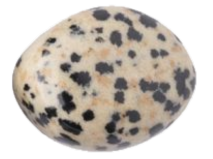
Traded across the world as a playful, spotted variety of jasper, Dalmatian Stone is not a cryptocrystalline sediment. It is an intrusive igneous rock related to the granite family.
- Actual Mineralogy: The off-white to cream coloured groundmass is an equigranular intergrowth of microcline feldspar and quartz. The contrasting black spots are not “black tourmaline (schorl)” as commonly repeated in trade lore. Petrographic analyses confirm these dark needles are iron-rich amphiboles, specifically arfvedsonite and riebeckite.
- Diagnostic Clashes: Under magnification, Dalmatian Stone exhibits a distinct crystalline, sugary (aplitic) texture rather than the continuous microcrystalline flow of chalcedony. Its Mohs hardness sits at 5.5 to 6.0, softer than true quartz-based jasper.
3. Rainforest “Jasper” (Australian Rainforest Stone)
- True Geologic Classification: Spherulitic Devitrified Rhyolite
- Primary Locality: Mount Hay, Queensland, Australia
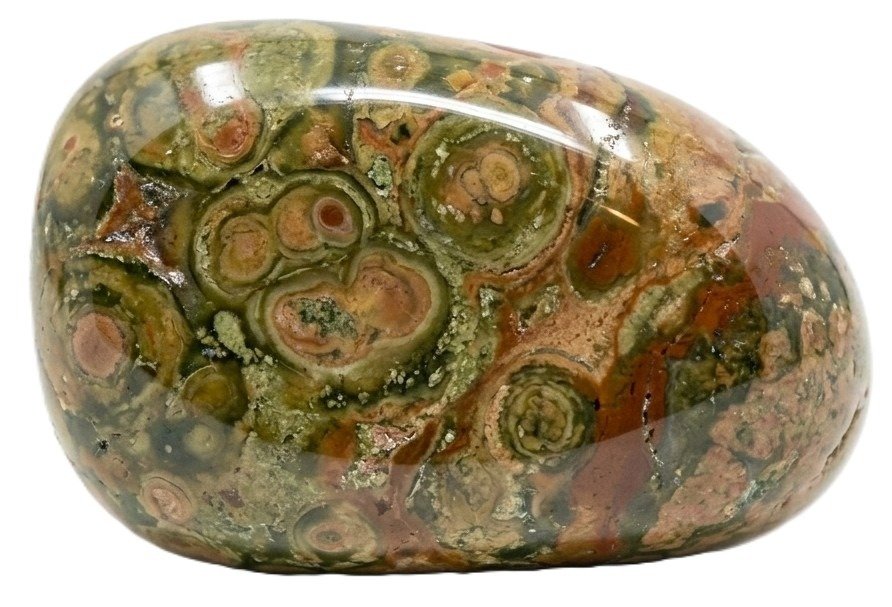
Famous for its earthy moss-green, tan, and reddish patterns dotted with circular inclusions, Rainforest Jasper is an extrusive felsic volcanic rock (rhyolite) formed approximately 120 million years ago during the Cretaceous period.
- Actual Mineralogy: Highly viscous, silica-rich volcanic lava cooled rapidly into an amorphous volcanic glass that subsequently underwent devitrification—a process where the glass slowly recrystallised into microscopic quartz and alkali feldspar. The circular eyes are spherulites: radiating, needle-like clusters of quartz and orthoclase that grew outward from central nuclei. The green colouration comes from pervasive chlorite and celadonite inclusions.
- Diagnostic Clashes: Rainforest Rhyolite contains gas vesicles and lithophysae that were subsequently filled by hydrothermal activity, creating pockets of secondary chalcedony, agate bands, and hollow drusy quartz vugs (thundereggs). Its structural porosity and variable hardness (5.5 to 6.5) distinguish it from uniform jasper.
4. Kambaba “Jasper” (Crocodile Jasper / Crotalyte / Eldarite)
- True Geologic Classification: Spherulitic Mafic-to-Intermediate Volcanic Rhyolite/Andesite
- Primary Locality: Central-Western Madagascar
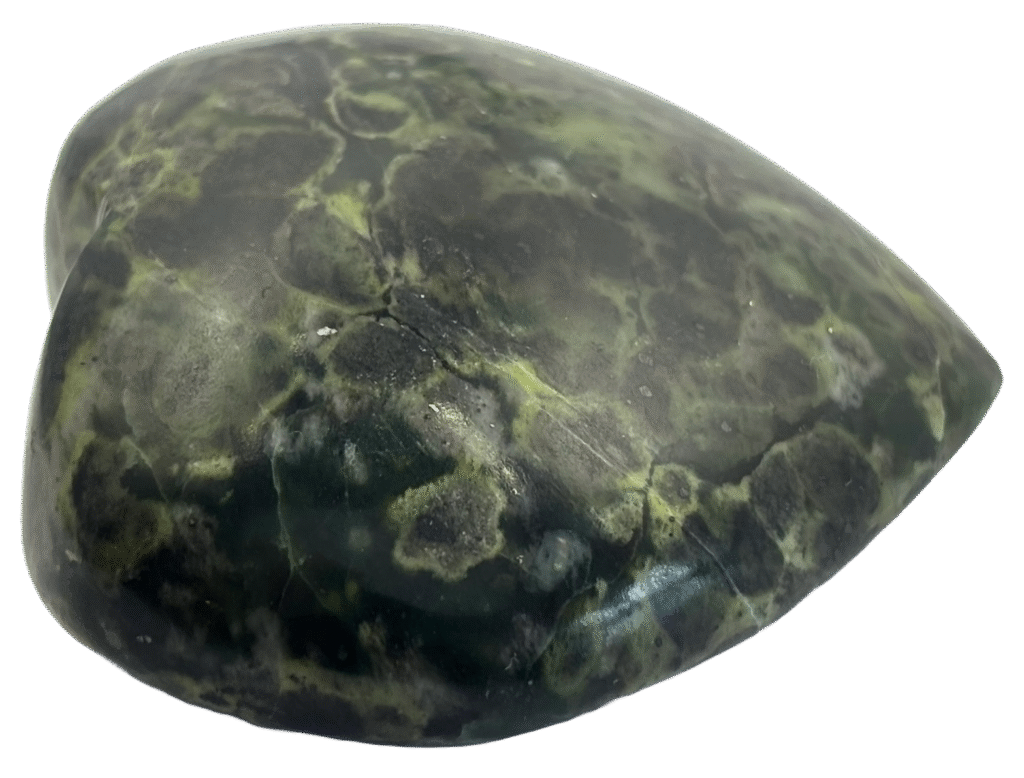
Kambaba Jasper is surrounded by one of the most persistent myths in the gemstone trade: that it is a 3-billion-year-old fossilised marine stromatolite composed of ancient cyanobacteria (blue-green algae).
- Actual Mineralogy: Thin-section petrography has disproven the biogenic fossil theory. Kambaba is an igneous volcanic rock. Its dark olive-green to charcoal groundmass consists of fine-grained quartz, alkali feldspar, and plagioclase heavily pigmented by chlorite. The hypnotic, dark orbicular “eyes” are spherulitic aggregates of amphibole minerals (specifically edenite and actinolite), often entered around microscopic grains of aegirine and iron oxides.
- Diagnostic Clashes: Kambaba lacks the lamellar, sedimentary sediment-trapping structures seen in genuine Precambrian stromatolites (such as Mary Ellen Jasper). Its amphibole-rich eyes feature typical $56^\circ/124^\circ$ cleavage angles under a loupe and display differential hardness (5.5 to 6.5).
5. Turritella “Jasper” (Turritella Agate)
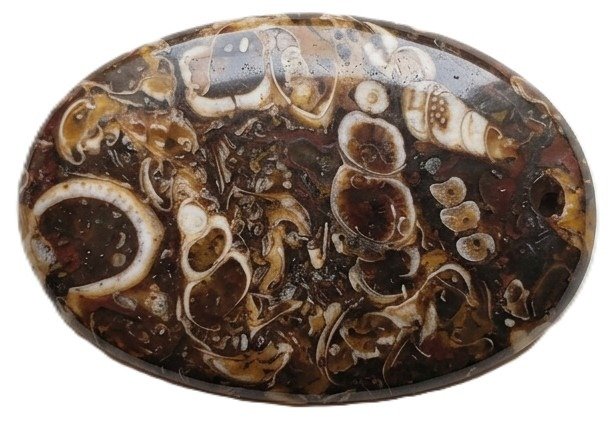
- True Geologic Classification: Silicified Fossiliferous Coquina / Mudstone
- Primary Locality: Green River Formation, Sweetwater County, Wyoming
Turritella material presents a double misnomer: it is neither a true homogeneous jasper nor does it contain snails of the marine genus Turritella.
- Actual Mineralogy & Paleontology: The high-spired conical shells belong to Elimia tenera (formerly Goniobasis tenera), a freshwater snail that inhabited subtropical Eocene lakes approximately 50 million years ago. Trapped within shallow shoreline muds, the discarded shells were fossilised as silica-rich groundwater from volcanic ash beds dissolved the original aragonite shells and replaced them with microcrystalline chalcedony.
- The Agate vs. Jasper Distinction: The surrounding host matrix is an opaque, dark brown-to-black mudstone enriched with organic bitumen and iron oxides (qualifying as a jasperised sediment). However, the interior chambers of the fossil snail shells are frequently filled with translucent, micro-banded chalcedony and drusy quartz crystals. It is accurately designated as a silicified fossiliferous mudstone, straddling the boundary between jasper and agate.
Quick-Reference Diagnostic Comparison Matrix
| Trade Name | Commercial Label | True Geologic Classification | Primary Mineral Phases | Mohs Hardness | Acid Reactive? |
| Red / Picture Jasper | Jasper | Microcrystalline Quartz | $\text{SiO}_2$ with hematite / clays | 6.5 – 7.0 | No (Inert) |
| Bumblebee “Jasper” | Jasper | Fumarolic Hydrothermal Carbonate | Calcite, Aragonite, Orpiment, Realgar, Pyrite | 3.0 – 4.0 | Yes (Vigorous) |
| Dalmatian “Jasper” | Jasper | Peralkaline Igneous Aplite | Microcline Feldspar, Quartz, Arfvedsonite | 5.5 – 6.0 | No (Inert) |
| Rainforest “Jasper” | Jasper | Spherulitic Devitrified Rhyolite | Quartz, Orthoclase, Chlorite, secondary chalcedony | 5.5 – 6.5 | No (Inert) |
| Kambaba “Jasper” | Jasper | Altered Spherulitic Rhyolite/Andesite | Quartz, Feldspar, Edenite/Actinolite amphiboles | 5.5 – 6.5 | No (Inert) |
| Turritella “Jasper” | Jasper / Agate | Silicified Lacustrine Coquina | Silicified Elimia tenera shells, Chalcedony, Bitumen | 6.5 – 7.0 | No (Inert) |
(Note: True orbicular chalcedonies from volcanic regimes, such as Madagascar Ocean Jasper, represent silica precipitation rather than devitrified rhyolite; explore our detailed breakdown in the Ocean Jasper: Veins, Grading & Locality Guide
Why Terminology Matters for Sellers, Collectors & Practitioners
The divergence between commercial trade names and geological reality is not an academic debate, it has practical consequences across the gemstone market:
- Consumer Protection and Trust: When a seller markets Dalmatian aplite as “Dalmatian Jasper” or Mount Papandayan fumarole carbonate as “Bumblebee Jasper” without geological clarification, it erodes customer trust. Transparency about mineral identity builds authority, protects retail businesses from misrepresentation claims, and justifies appropriate pricing tiers.
- Workshop and Domestic Safety: Labelling a stone containing realgar and orpiment as a simple “jasper” can lead buyers to assume it is chemically inert. Unsuspecting hobbyists have placed Bumblebee stone into water jugs to create crystal elixirs, or cut raw slabs on dry trim saws without ventilation, exposing themselves to toxic dust.
- Metaphysical and Energetic Integrity: In holistic and metaphysical disciplines, stones are selected based on elemental associations and vibrational properties. True jasper resonates with dense, slow, grounding Earth-element frequencies rooted in the microcrystalline quartz matrix. Substituting an explosive, extrusive volcanic rhyolite (Rainforest or Kambaba), an aplitic igneous rock (Dalmatian), or an active geothermal sulfur/carbonate deposit (Bumblebee) introduces entirely different geological origins—substituting fiery, volatile volcanic mechanisms for ancient, stabilising sedimentary grounding.
By understanding the true geology behind the trade names, lapidaries, collectors, and practitioners can appreciate these extraordinary stones for what they actually are: unique snapshots of dynamic Earth processes.