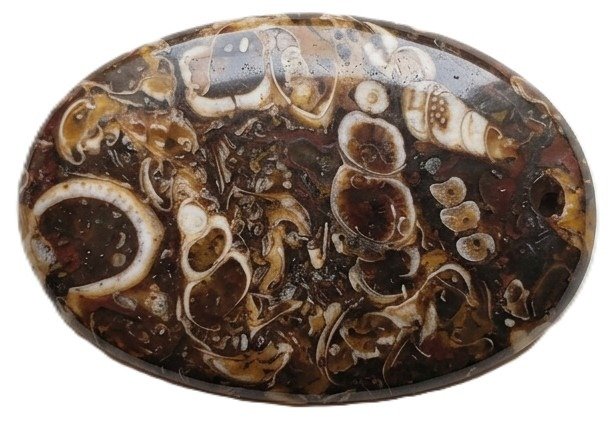
Few popular gemstones carry a name as thoroughly misleading as Turritella Jasper. Revered by lapidaries and fossil collectors alike, this striking, earthy stone mottled in shades of rich chocolate brown and studded with stark, creamy spiral shells—suffers from not just one identity crisis, but two.
In geological reality, it is neither a true jasper nor is it made of Turritella snails.
Where authentic jasper is an opaque, micro crystalline variety of quartz formed primarily through hydrothermal or chemical precipitation, “Turritella Jasper” is actually an organic, fossil-rich sedimentary rock: a silicified coquina limestone plucked from Wyoming’s 50-million-year-old Green River Formation. Compounding the confusion, the spiralled gastropods forever entombed in its matrix do not belong to the marine genus Turritella, but are in fact Elimia tenera, freshwater snails that once carpeted the beds of an ancient, subtropical lake.
How a freshwater fossil deposit came to borrow the mantle of a marine snail and an entirely distinct class of silicate is one of the gem world’s most persistent misnomers. Unpacking the divide between “Turritella” and true jasper reveals a compelling collision of trade naming traditions, prehistoric ecology, and mineralogical precision.
The Snail That Wasn’t: A Marine Sea Snail vs. a Lakeside Crawler
When early geologists explored southwest Wyoming, the conical, corkscrew shells reminded them of Turritella a famous genus of marine snails found in oceans worldwide. The catchy name stuck, but paleontology tells a very different story:
- The Real Identity: The fossils belong to Elimia tenera (historically catalogued as Goniobasis tenera), a species of freshwater snail in the Pleuroceridae family.
- The Environment: These snails never saw an ocean. They thrived roughly 50 million years ago during the Eocene Epoch, living in massive, warm, subtropical freshwater lakes across parts of modern Wyoming, Colorado, and Utah.
How Ancient Wyoming Built a Fossil Gem
The stone comes from the renowned Green River Formation, concentrated around the Wilkins Peak Member and Fontenelle Basin near Wamsutter, Wyoming. The process that preserved them played out across millions of years:
- Ancient Lake Gosiute: Lake Gosiute was a sprawling, shallow inland lake that fluctuated in size as the climate swung between wet and dry. Snails multiplied in staggering numbers in shallow shorelines. When water levels dropped or conditions shifted, trillions of shells piled up into thick beach deposits called coquina—a natural gravel bed made entirely of shell fragments.
- Volcanic Glass: Surrounding volcanoes regularly showered the lake basin with thick blankets of fine ash. As rainwater seeped through this ash, it dissolved the volcanic glass and loaded underground water tables with soluble silica.
- Petrification in Place: As silica-rich groundwater soaked into the buried shell beds, it replaced the original calcium carbonate of the shells molecule by molecule while saturating the surrounding mud. The entire shoreline hardened into solid, gem-grade silicate rock.
Agate vs. Jasper: The Lapidary Tug-of-War
Whether to label the finished stone “jasper” or “agate” depends entirely on which part of the rock you examine under the light:
- The Case for Jasper: The matrix holding the shells together is an opaque, fine-grained silicified shale and mudstone darkened by organic bitumen and iron oxides. Because standard jasper is defined as opaque micro crystalline quartz, this dark background fits the description.
- The Case for Agate: The hollow chambers within the shells rarely filled with mud. Instead, mineral-rich fluids slowly deposited layers of translucent, glowing chalcedony and tiny, sparkling quartz crystals inside each whorl. Sliced thin and held to the light, these shell interiors glow with classic agate translucency.
| Feature | True Jasper | Turritella “Jasper” / Agate |
| Origin | Hydrothermal silica precipitates | Silicified freshwater lake bed and shell bank |
| Fossil Content | None (inorganic minerals and clays) | Dense clusters of fossilised freshwater snails (Elimia tenera) |
| Light Transmission | Opaque throughout | Opaque dark matrix with translucent shell chambers |
| Hardness | 6.5 – 7.0 Mohs | 6.5 – 7.0 Mohs (when fully silicified) |
| Colour Source | Iron oxides, chlorite, and clay minerals | Organic lake bitumen, plant detritus, and iron |
Cutting and Polishing for Maximum Visual Impact
Turritella stone cannot be cut randomly; the direction of the slab saw determines whether the shells appear as elegant corkscrews or abstract rings.
- Longitudinal Cuts (Parallel to Bedding): Slicing along the flat layer where the shells settled exposes long side profiles, revealing the pointed, spire-like anatomy of the snails.
- Cross-Section Cuts (Perpendicular to Bedding): Cutting straight down across the layer yields circular, bullseye-like cross-sections.
- Watch for Soft Pockets: Specimens that did not fully petrify can retain soft chalky limestone or crumbly silt within the shell cavities. Cutters avoid coarse 80-grit grinding wheels that might “pluck” or tear out shell walls, stepping down quickly to 220-grit diamond wheels with plenty of water coolant.
- Finishing: When completely silicified, both the shells and host matrix share an identical hardness (Mohs 6.5–7), taking a mirror-bright polish on leather or felt using cerium oxide or fine diamond paste.