
The heart motif in antique jewelry underwent a dramatic metamorphosis between the early 18th century and the dawn of the 20th century. Over this two-hundred-year span, the emblem shifted from an amulet of folk protection and royalist allegiance into an emblem of intense sentimentality, mourning, and romantic language.
The Georgian “Witch’s Heart”: Protection and Subtle Allegiance (c. 1714–1830)
During the early Georgian era, the heart motif was rarely a simple statement of romantic love; instead, it served as an apotropaic charm, a political symbol, or a token of early betrothal.
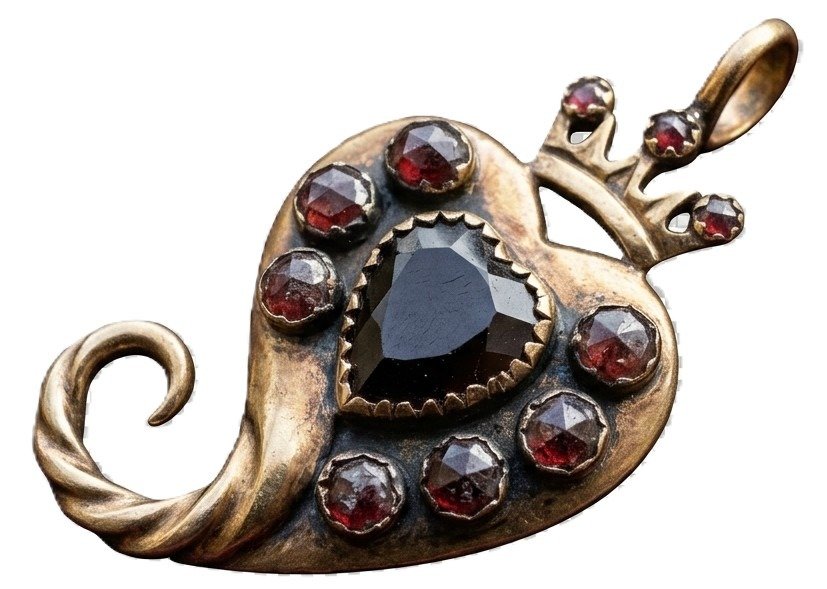
- The Asymmetrical “Witch’s Heart”: Characterized by a curved bottom tip that playfully twists to one side (frequently toward the right), this design gained widespread use in 18th-century Britain and the Scottish lowlands (where it was often referred to as a Luckenbooth heart).
- Protective Folklore: In rural folklore, it was pinned to a child’s swaddling clothes or a crib to ward off evil spirits, hexes, and the “evil eye”—believed to turn away witches from stealing breast milk or harming infants.
- The Romantic Shift: As the design migrated from silver folk pins into fine jewelry crafted from 15k or 18k gold, garnet, paste, and flat-cut almandines, the meaning evolved. When given to a lover, the twisted tail was said to signify that the giver’s heart was “bewitched” or held captive by the wearer.
- The Crowned Heart and Stuart Crystals: Heart motifs topped with a stylised royal crown gained traction following the English Civil War and the restoration of the monarchy. These frequently housed faceted rock crystals (Stuart Crystals) laid over woven hair, gold cipher initials, or mementos honouring King Charles I. By the mid-Georgian period, the crowned heart symbolised that love reigned supreme, setting the stage for romantic devotion.
Mid-to-Late Georgian Period: Sentimentalism and the Secret Language of Love
By the late 18th century, the Enlightenment and the Romantic literary movement replaced superstitious talismans with poetic, secretive expressions of affection.
- Lover’s Knots and Entwined Hearts: Jewellers paired two hearts together under a single bow or “lover’s knot.” Two heart-shaped stones side-by-side typically represented the bride and groom or two dedicated companions, bound irrevocably by the knot above.
- Acrostic Heart Jewellery: The Georgians popularised secret messages spelled out in gemstones set across heart plaques and rings:
- Ruby, Emerald, Garnet, Amethyst, Ruby, Diamond (REGARD)
- Lapis, Opal, Vermeil (garnet), Emerald (LOVE)
- Foiled Gemstones & Closed Backs: Hearts in this period were almost universally set in silver-topped gold with closed-back settings lined with metallic foils. Flat-cut Bohemian garnets, rose-cut diamonds, and foiled pink topazes gave heart pendants a luminous, firelit glow under candlelight.
Early Victorian Era: The Romantic Zenith (1837–1861)
Queen Victoria’s accession to the throne in 1837 ushered in the golden age of romantic sentimentality. Her passionate marriage to Prince Albert set the taste of the entire British Empire and Western Europe.
- The Queen’s Charm Bracelet: In the early 1840s, Albert gave Victoria an enamel charm bracelet featuring heart-shaped lockets. Each heart was enamelled in a different colour, containing a lock of hair from each of their children as they were born. This propelled heart lockets into the must-have keepsake for mothers and wives.
- The Claddagh and the Hand Holding a Heart: Victorian jewellers revived ancient sentimental motifs. Hands clasped around a heart represented friendship, fidelity, and love, popularised in rings, brooches, and watch fobs.
- The Snake Guarding the Heart: Victoria’s engagement ring from Albert was an ouroboros—an emerald-set serpent coiled in an unbroken circle, signifying eternity. Soon, jewelers designed coiled serpents wrapping around heart pendants or holding heart-shaped drops in their mouths, symbolising eternal, protected love.
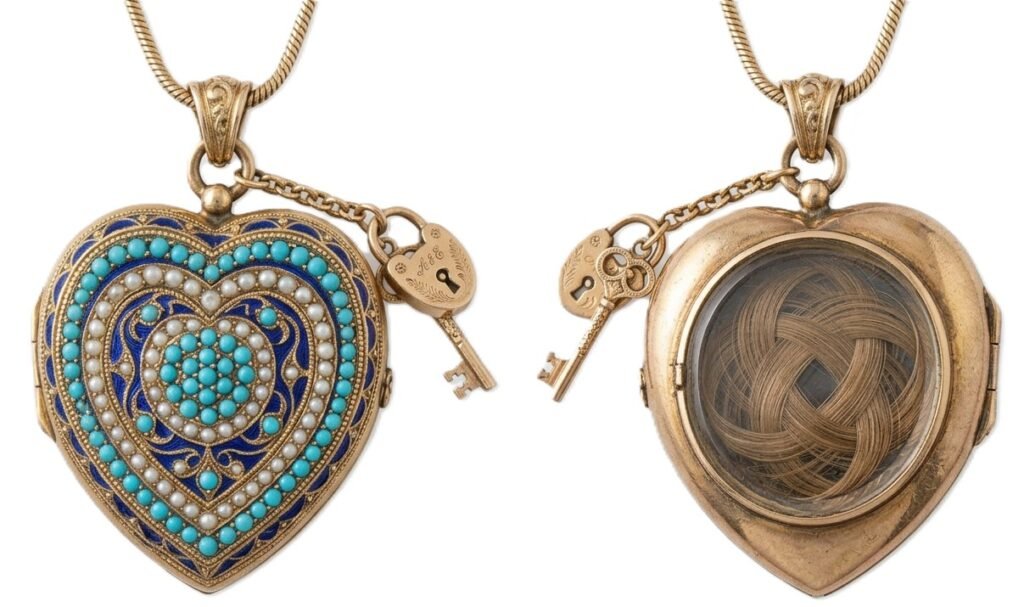
- Turquoise Pave and Seed Pearls: Early Victorian heart lockets featured dense pavé-set Persian turquoise (symbolising true love and forget-me-nots) and delicate seed pearls (representing purity, tears of joy, and innocence).
Mid-Victorian Era: Mourning and Memorial Hearts (1861–1885)
The sudden death of Prince Albert in December 1861 plunged Queen Victoria into lifelong mourning, altering the visual vocabulary of jewelry across the Western world.
- Whitby Jet, Black Onyx, and French Jet Hearts: Brightly coloured gems and turquoise gave way to sombre black materials. Hearts were carved directly out of Whitby jet, vulcanite, or bog oak.
- The Broken Heart: Pendants and brooches occasionally featured split hearts, weeping willows draped over a heart, or a heart pierced with an arrow to represent profound grief.
- Mourning Compartments: The reverse of heart lockets became deeper to house elaborate hairwork intricate Prince of Wales feathers woven from the deceased’s hair, resting behind bevelled rock crystal windows.
Late Victorian Era: Whimsy, Padlocks, and the Belle Époque Transition (1885–1901)
As the Victorian era entered its twilight, the sombre tones of the mourning period lifted. Industrial advancements allowed jewellery to be produced with finer tolerances and lighter settings.
- The Heart Padlock Bracelet: Perhaps the quintessential late-Victorian piece was the curb-link or gate-link bracelet fastened with a functioning heart-shaped padlock clasp.
- The Symbolism: The padlock clasp symbolised romantic exclusivity—the key was held by the lover, keeping the heart locked and faithful. Many padlocks featured a tiny key charm dangling alongside or were paved in alternating sapphires and diamonds.
- Heart-Cut Gemstones: Advances in lapidary techniques allowed gems like rubies, sapphires, and diamonds to be cut cleanly into symmetrical heart brilliants, moving away from cabochons and foil-backed flat cuts.
- Mistletoe, Ivy, and Shamrock Hearts: The Aesthetic Movement influenced jewellery to incorporate delicate naturalism. Hearts were framed by engraved ivy (for deep friendship and clinging fidelity) or shamrocks set with demantoid garnets.
Chronological Comparison
| Period | Typical Shape / Motif | Dominant Materials | Primary Significance |
| Early Georgian (1714–1760) | Witch’s Heart (asymmetrical, curved tail); Stuart Crystal crowned hearts | Silver, 15k gold, rock crystal, foil-backed garnets | Protection against hexes; Jacobite or Royalist loyalty; early folk betrothal |
| Late Georgian (1760–1830) | Double hearts tied with lover’s knots; acrostic “REGARD” settings | Silver-topped gold, closed-back foiled gemstones, paste | Romantic alliance, secret poetic messages, courtship pledges |
| Early Victorian (1837–1861) | Plump, symmetrical hearts; snakes holding hearts; hands holding hearts | Persian turquoise pavé, seed pearls, coral, royal blue enamel | Sentimental devotion, maternal milestones, eternal love (Albert & Victoria) |
| Mid-Victorian (1861–1885) | Carved hearts, memorial lockets with woven hair compartments | Whitby jet, black onyx, black enamel, deep almandine garnets | Grief, bereavement, faithful remembrance of lost loved ones |
| Late Victorian (1885–1901) | Heart padlocks on curb bracelets; faceted gemstone hearts; heart stickpins | 9k–18k gold, open-back platinum accents, diamonds, sapphires, rubies | Exclusivity, “locked fidelity,” light hearted romantic gifting |
