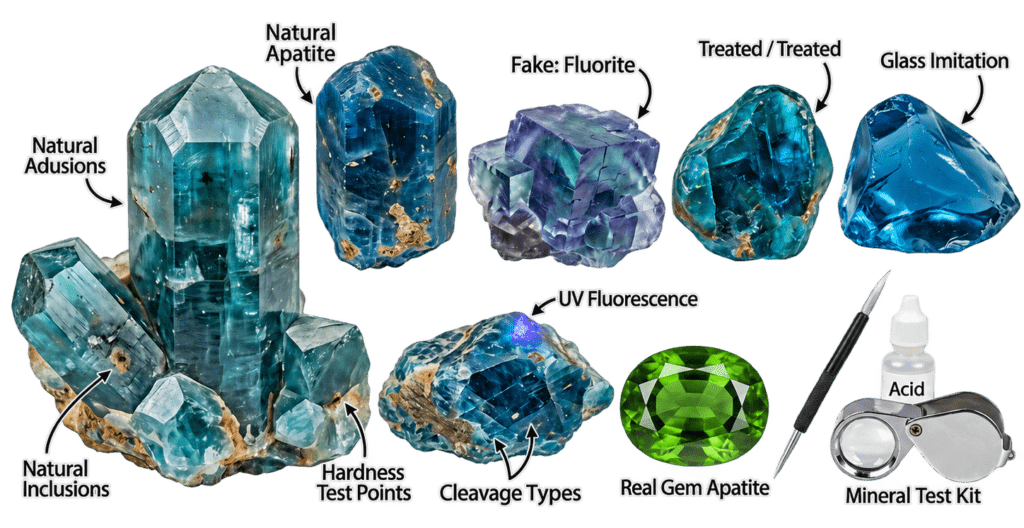
The name apatite stems from the Greek verb apatao, meaning “to deceive” or “to mislead.” Historically, early mineralogists routinely confused gem-quality apatite with tourmaline, peridot, beryl, and topaz. In the modern gemstone and crystal marketplace, however, the deception has reversed: sellers frequently imitate apatite using dyed minerals, synthetic glass, cubic zirconia, and resin. These are sometimes so well made that even professionals at first glance can fail to spot fake apatite at first glance. However, there are few tell tale signs that can reveal its authenticity on closer examination:
The Common Imitations by Apatite Variety
1. Neon & Deep Blue Apatite
Neon and deep Blue apatite is one of the most desirable and commands the highest prices and suffers the most counterfeiting. Common materials used to impersonate Blue Apatite are:
Dyed Quartzite / Crackle Quartz: Quartz rough is thermally shocked to induce micro-fractures, then submerged in bright cyan or blue dye. Under 10x magnification, the dye visibly pools in a spiderweb network inside the cracks, while the surrounding quartz matrix remains pale. Additionally, because it is hard ( Mohs 7,), it will easily scratch window glass, whereas genuine apatite (Mohs 5) cannot.
Coloured Slag or Silica Glass: Cut stones or beads made of blue glass frequently exhibit spherical air bubbles, microscopic swirl/flow marks, and a vitreous sheen that lacks natural internal fractures or iron-oxide staining.
Dyed Magnesite or Howlite: Often sold as rough or tumbled “natural blue apatite,” Because they are made of porous calcium/magnesium minerals, they absorb dye unevenly and when scratched display a soft chalkiness underneath their surface.
Simple tests: When illuminated with UV light in a dark environment, real Blue Apatite emits blue fluorescence. If they do not fluoresce or in colours other than expected, it could be a sign of a counterfeit.
2. Golden and Yellow Apatite
Golden and yellow apatite is a rare, vibrant mineral belonging to the apatite group, prized by collectors and crystal enthusiasts for its warm yellow-to-gold hue and semi transparent look. However, this tends to be very similar to several man made products and is prone to be manipulated to look like apatite.
Melted Glass / Cullet: Some sources of golden apatite (e.g. from Durango, Mexico) have a high transparency/ clarity, which making it easy to mimic with yellow glass. Glass imitations lack apatite’s natural birefringence (where light shines through and splits) and will shine straight through.
Synthetic Corundum or Cubic Zirconia (CZ): Cut jewellery stones masquerading as yellow apatite is far denser (nearly double) than natural apatite and will feel significantly heavier in the hand.
Simple test: Genuine Yellow Apatite has a natural, vibrant yellow hue, but it should not look like neon plastic or bright uniform glass.Real stone feels cold to the touch initially, whereas plastic imitations warm up quickly in your hand.
3. Green Apatite (“Asparagus Stone” / Moroxite)
Whilst green apatite is relatively cheap, it is still prone to be cloned by other stones or man made resins:
- Serpentine and Prehnite: Often substituted as tumbled stones or carved pieces. Serpentine is greasy and softer (Mohs 2.5–4), while prehnite is harder (Mohs 6–6.5) and displays an oily-to-pearly lustre rather than apatite’s crisp vitreous shine.
- Dyed Agate / Chalcedony: Microcrystalline quartz dyed green lacks the natural hexagonal columnar crystal terminations characteristic of natural green apatite specimens.
- Simple test: Polished green apatite has a distinct greasy-to-glassy feel and
4. Chatoyant (Cat’s Eye) Apatite
Cat’s Eye Apatite is a unique gemstone that shows a bright band of reflected light gliding across its surface. This glowing optical effect is known as chatoyancy
- Synthetic Fibre-Optic Glass (Ulexite Imitations): Genuine cat’s-eye apatite produces a soft, floating band of light caused by dense, parallel growth tubes or needle-like rutile inclusions along the c-axis. Synthetic fibre optic glass creates a hyper-sharp, razor-thin line of light across unnatural neon hues; under a loupe, the perpendicular edge reveals a hexagonal honeycomb matrix of optical fibres.
5 Hands-On Tests to Spot Fake Apatite
Test 1: The 10x Loupe Inspection (Inclusions & Polish)
Natural apatite possesses distinct internal growth architecture:
- Real: Shows natural healing veils, needle like fluid channels, two-phase inclusions, and occasional brownish-red iron-oxide films along fractures. Because of its low hardness, faceted apatite often displays slightly rounded facet junctions, tiny chips on girdle edges, or pitted polishing planes.
- Fake (Glass/Plastic): Look for perfectly round gas bubbles (never present in natural crystalline minerals), curved flow lines, or completely flawless, lifeless interiors. In tumbled beads, dye pooling at drill-hole mouths is a telltale sign of dyed quartzite.
Test 2: The Acetone / Solvent Rub
Dyed quartzite, magnesite, or howlite will often surrender its surface pigment when exposed to an organic solvent:
- Dip a cotton swab in 100% pure acetone and rub an inconspicuous area or inside a bead’s drill hole.
- Real: Unaffected; natural colour centres are embedded in the crystal lattice.
- Fake: The swab will pick up blue or green pigment residues.
Test 3: Controlled Hardness & Scratch Resistance
Note: Destructive testing should be reserved for rough specimens or hidden areas (e.g., the girdle of a stone or the inside of a bead).
- Apatite sits at Mohs 5: It can be scratched by a standard steel pocketknife blade or a glass slide (both ~Mohs 5.5).
- Apatite cannot scratch a standard quartz crystal (Mohs 7). If a suspected “blue apatite” specimen easily scratches quartz or resists a steel file, it is dyed quartz, beryl, or topaz.
- If it can be scratched by a copper coin or fingernail (Mohs 2.5–3), it is likely dyed calcite or resin.
Test 4: Thermal Conductivity & Touch
- Plastic/Resin: Feels room-temperature or warm immediately upon picking it up, warms quickly in the palm, and exhibits low density.
- Real Apatite: Maintains a noticeably cold touch when picked up and conducts heat away slowly due to its crystalline structure.
Test 5: Specific Gravity (Heft Test)
Apatite has a specific gravity (SG) of 3.16 to 3.23, which is noticeably heavier than standard quartz/chalcedony (SG 2.65) and commercial glass (SG ~2.4–2.5):
- Using a hydrostatic precision scale setup, measuring weight in air versus weight in water yields an accurate SG reading.
- A loose gemstone claiming to be apatite that registers an SG near 2.65 is almost certainly dyed quartz or chalcedony.
Natural Apatite vs. Treated Apatite: What Counts as “Fake”?
A critical distinction exists between an outright counterfeit (glass, dyed rock) and an enhanced natural stone:
- Heat Treatment: A significant portion of neon blue and teal apatite on the commercial market is gently heated at low temperatures (around 400°C–500°C) to lighten brownish or greenish tones into vibrant electric blues. This is an industry-accepted treatment, but it remains natural apatite.
- Resin Impregnation / Stabilisation: Low-grade, friable apatite used for mass-market bead strands is often stabilised with clear resins or polymers to prevent crumbling during cutting. While the mineral is real, untreated natural specimens hold greater gemological integrity. Always ask sellers to clarify whether stones are untreated, heated, or stabilised.