Inspiration and Ray mines
The Globe-Miami mining district and Pinal County are two pivotal hubs in Arizona’s copper history.
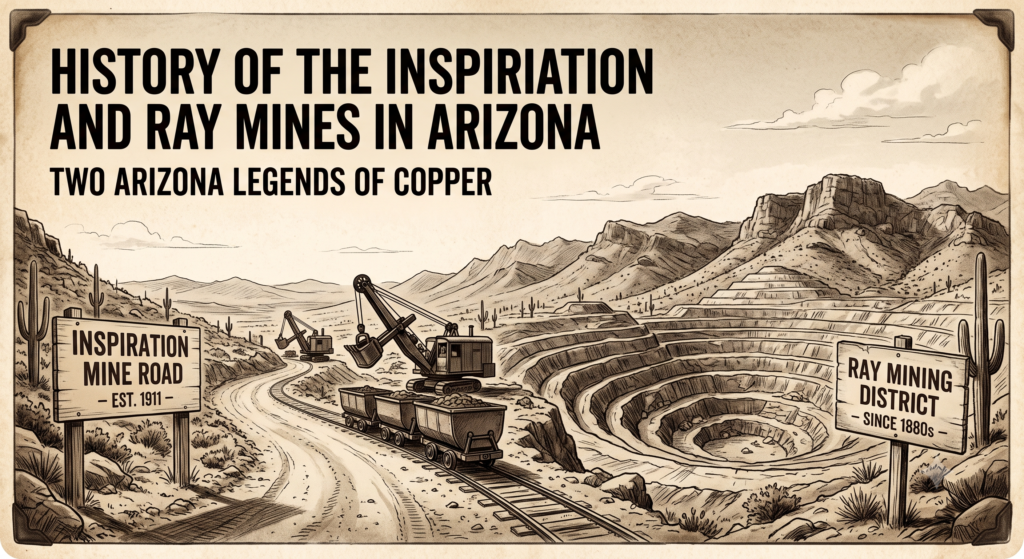
At the centre of these regions are two monumental operations: the Inspiration Mine Road and the Ray Mine.
Both sites gained global fame for copper production, yet they are celebrated in mineralogy, geology, and lapidary arts.
The focus is on Inspiration and Ray mines as historic copper hubs.
Beyond the thousands of tons of commercial copper ore extracted over the decades, these mines yielded a far rarer treasure: gem silica.
Widely regarded as one of the most sought-after precious materials in North America, gem silica is a rare, high-grade variety of translucent chalcedony quartz deeply saturated with vivid blue-green chrysocolla.
The unique geological conditions at Inspiration and Ray provided the perfect recipe: copper-rich solutions, silica-dense groundwater, and precise pressure over millions of years to create gem silica of incomparable saturation, clarity, and hardness.
Today, specimens from these two legendary Arizona locations remain the gold standard for gem silica collectors and master lapidaries worldwide.
The Inspiration Mine (Globe-Miami District, Gila County)
The Inspiration Mine, situated immediately north of Miami in the historic Globe Miami mining district of Gila County, Arizona, belongs to one of the most important porphyry-copper regions in the United States. Copper mining transformed this part of central Arizona during the late nineteenth and early twentieth centuries, eventually producing an interconnected landscape of enormous mines, processing plants, smelters and mining communities.
Why Inspiration Gem Silica Became So Famous
The finest Inspiration material can possess an almost luminous quality. Its intense turquoise, cyan and blue-green colours appear to glow when light enters the translucent chalcedony. Polishing can produce an exceptionally smooth, glass-like surface while preserving the rich copper-derived colour beneath it.
This combination of colour, translucency and hardness makes Gem Silica quite different from ordinary chrysocolla. Whereas much chrysocolla can be comparatively soft or porous, Gem Silica owes its durability largely to its chalcedony component. Material with convincing old Inspiration and Ray mines provenance carries additional appeal because the locality has become legendary amongst collectors.
The Famous Live Oak Pit
Particularly important to collectors is the Live Oak Pit, part of the wider Inspiration workings. This locality became renowned for spectacular blue-green chrysocolla associated with quartz and chalcedony.
Material from Live Oak occurs in several forms. Chrysocolla may appear as massive or botryoidal blue-green material, line cavities and veins, occur within translucent silica, or be coated by sparkling microcrystalline quartz. Some pockets produced material grading into the translucent chrysocolla bearing chalcedony properly described as Gem Silica
Current Status
Modern Operations Industrial extraction focuses strictly on large-scale copper leaching and hydrometallurgical processing. Commercial recovery of gem silica at Inspiration has long since ceased. Because modern heavy machinery grinds ore indiscriminately, intact pockets of gem silica are no longer salvaged. Hence there is no modern commercial Gem Silica mining programme at Inspiration. The historical material was essentially an incidental treasure encountered during enormous copper-mining operations rather than the target of those operations. This makes older Inspiration material particularly desirable.
The Ray Mine (Pinal County, near Kearny)
The Ray Mine, situated in Pinal County near the modern town of Kearny, is one of Arizona’s great historic copper mines. Set beneath the rugged mountains of central Arizona, the enormous open pit represents more than a century of industrial copper production, yet amongst mineral collectors and lapidaries Ray has another reputation entirely.
The mine has produced spectacular native copper, chrysocolla, malachite, quartz and chalcedony, including vivid turquoise-blue chrysocolla enclosed within or coated by translucent silica. Some of this highly silicified material possesses the colour, translucency and polish associated with material marketed and collected as Gem Silica or chrysocolla chalcedony. For this reason, Ray occupies an important position alongside the Inspiration Mine in the history of Arizona’s blue-green copper minerals.
Ray Mine Chrysocolla
The chrysocolla from Ray can display extraordinary colour. Classic specimens range from turquoise and robin’s-egg blue through blue-green to darker teal. In the finest pieces, the colour can be exceptionally saturated. Chrysocolla occurs in cavities, fractures and oxidised portions of the copper deposit, where circulating groundwater interacted with copper-bearing minerals.The resulting secondary mineral assemblages can be remarkably complex.
Chrysocolla may occur alongside:Quartz • Chalcedony • Malachite • Native Copper • Cuprite • Dioptase • Libethenite. Documented mineralogical records for the Ray area specifically associate chrysocolla with dioptase, libethenite and quartz. These combinations produced some of the most visually distinctive specimens recovered from the mine.
The Famous Chrysocolla and Quartz Specimens
One of Ray’s signature mineral combinations consists of an intensely coloured layer of blue-green chrysocolla covered by sparkling drusy quartz crystals. The effect can be spectacular. The underlying chrysocolla provides a saturated turquoise-blue or green-blue colour, while hundreds of tiny transparent quartz crystals create a glittering surface.
Documented Ray specimens show exactly this structure: a vivid blue-green chrysocolla layer covered by drusy quartz. Such pieces have become highly desirable amongst collectors of Arizona minerals and classic American localities. But an even more interesting relationship occurs when the silica becomes massive or chalcedonic rather than simply forming quartz crystals. That is where Ray enters the story of Gem Silica.
Why Ray Mine Material Is So Collectable
Ray is special because it brings together three distinct areas of interest:
Arizona mining history, mineral collecting and lapidary gemstones.
- For mining historians, it represents the development of one of America’s great porphyry-copper deposits and the extraordinary expansion of open-pit mining that ultimately displaced the communities of Ray, Sonora and Barcelona.
- For mineral collectors, it is a classic locality for native copper, chrysocolla, malachite, quartz and chalcedony.
- For lapidaries, its highly silicified chrysocolla can provide vivid blue-green material possessing unusual patterns, translucency and polish.
Current Status
Unlike the historic Inspiration/Miami operation discussed previously, the Ray Mine remains an active copper mine. This is therefore an important distinction between the two famous Arizona Gem Silica localities:
- Inspiration/Miami: fresh ore mining has ceased.
- Ray: remains an operating large-scale copper mine.
The modern Ray operation, however, exists to produce copper — not Gem Silica or mineral specimens.
Modern industrial mining involves drilling, blasting, loading, hauling, crushing and processing rock on a tremendous scale. Delicate mineral pockets can easily be fragmented during this process.
Ray Versus Inspiration Gem Silica
Although Ray and Inspiration are both famous Arizona copper deposits, their collectable silica-rich copper minerals have somewhat different reputations.
Inspiration Mine material is particularly renowned for exceptionally translucent, intensely saturated chrysocolla chalcedony traditionally sold as classic Arizona Gem Silica.
Ray Mine material, meanwhile, is especially famous for the extraordinary diversity of its chrysocolla-silica combinations — including blue-green chrysocolla, chalcedony-coated chrysocolla stalactites and chrysocolla covered by brilliant drusy quartz.
There is considerable overlap. Exceptional material from either locality can be extremely beautiful, and provenance becomes important because polished pieces may be difficult to attribute confidently once separated from their original labels.
For a collector building a suite of classic Arizona copper minerals, specimens from both Inspiration and Ray represent important historic localities.
Key Summary for Gem Collectors
Both mines demonstrate how geological conditions in Arizona’s copper belt created ideal pockets for cryptocrystalline silica to replace chrysocolla. Because active commercial copper mining prioritises volume efficiency over delicate gemstone recovery, both mines are functionally extinct as active sources of new gem silica, which drives the high market scarcity and premium valuation of vintage Arizona specimens.
Here is a website-ready FAQ section designed to accompany your article on the history of the Inspiration and Ray mines. I’ve kept the answers concise enough for FAQ/SEO use while retaining the important distinction between Gem Silica, chrysocolla and chrysocolla chalcedony.
Frequently Asked Questions – Inspiration and Ray Mines, Arizona
Where is the Inspiration Mine located?
The Inspiration Mine is in Gila County, Arizona, near Miami in the historic Globe–Miami mining district. The former Inspiration mining community developed alongside the copper workings.
Where is the Ray Mine located?
The Ray Mine is in Pinal County, Arizona, near the town of Kearny. It forms part of one of Arizona’s major historic porphyry-copper mining districts.
What were the Inspiration and Ray mines famous for?
Both mines were developed primarily for copper. Among mineral and gemstone collectors, however, they are also renowned for beautiful secondary copper minerals, particularly chrysocolla, together with quartz, chalcedony and other copper minerals.
Is the Inspiration Mine famous for Gem Silica?
es. Inspiration is regarded as one of the classic Arizona localities for exceptionally fine Gem Silica, also known as chrysocolla chalcedony. The finest historic material displays intense turquoise, cyan or blue-green colour combined with excellent translucency and a superb polish.
Did the Ray Mine also produce Gem Silica?
The Ray Mine produced chrysocolla intimately associated with chalcedony and quartz, including highly silicified and translucent material that may be described as Gem Silica or chrysocolla chalcedony when it possesses the appropriate characteristics. Ray is particularly famous for its varied chrysocolla-and-silica mineral specimens.
What is Gem Silica?
Gem Silica is a rare blue-to-green variety of chalcedony coloured by copper-bearing material, commonly associated with chrysocolla. Its silica content gives high-quality material considerably greater hardness and durability than ordinary chrysocolla.
Is all chrysocolla from Inspiration and Ray Gem Silica?
No. This is an important distinction. Both mines produced ordinary chrysocolla as well as chrysocolla associated with quartz and chalcedony. The term Gem Silica should generally be reserved for sufficiently silicified, translucent, gem-quality material rather than being applied to every attractive blue-green chrysocolla specimen.
Why is Inspiration Mine Gem Silica so valuable?
Fine Inspiration material combines exceptional colour, translucency, rarity, polish and historic provenance. High-quality examples from documented old collections are especially sought after because the mine is a classic locality and newly mined material is not routinely entering the gemstone market.
What colours can Arizona Gem Silica display?
Gem Silica from these historic Arizona copper districts can range from pale blue-green and turquoise through brilliant cyan, robin’s-egg blue, greenish blue and deep teal. Colour varies according to the nature and concentration of the copper-bearing material.
How did Gem Silica form in these copper mines?
Copper-bearing fluids and groundwater moved through fractures and cavities within oxidised portions of the deposits. Under suitable conditions, copper minerals such as chrysocolla formed alongside or became incorporated into silica deposited as chalcedony and quartz, producing intensely coloured silicified material.
What is the Live Oak Pit?
The Live Oak Pit forms part of the historic Inspiration workings and is an important collector locality. It became particularly famous for beautiful chrysocolla, quartz, chalcedony and associated blue-green copper mineralisation.
What other minerals occur at the Inspiration Mine?
In addition to Gem Silica and chrysocolla, the Inspiration area is associated with numerous copper minerals, including malachite and azurite, as well as quartz and chalcedony and the primary and secondary copper minerals associated with the porphyry deposit.
What minerals is the Ray Mine famous for?
Ray is particularly renowned amongst collectors for native copper, chrysocolla, malachite, quartz and chalcedony. Spectacular combinations of blue-green chrysocolla with sparkling drusy quartz are especially characteristic collector pieces.
Why are some Ray chrysocolla specimens covered with quartz crystals?
Mineralisation occurred in multiple stages. Chrysocolla could first form within a cavity or fracture, followed by later silica deposition. When quartz crystals subsequently grew over the chrysocolla, they produced the characteristic sparkling drusy quartz over chrysocolla specimens for which Ray is well known.
When did major mining begin at Inspiration?
The Inspiration Consolidated Copper Company was formed in 1911, with major mining operations beginning in 1915. The operation subsequently became an important large-scale producer of low-grade porphyry copper.
When did mining begin at Ray?
Mining activity in the Ray district developed during the late nineteenth century, with substantial expansion following improvements in transportation and processing. The arrival of the railroad in 1905 was particularly important to the district’s growth.
What happened to the original town of Inspiration?
Inspiration developed as a company mining town supporting the copper operation. As mining practices and the local industry changed, the settlement declined and eventually became a ghost town. The historic site lies on mining company property
What happened to the original town of Ray?
Expansion of the enormous open-pit copper mine eventually required the removal of the old mining communities of Ray, Sonora and Barcelona. Many residents were relocated to the newly developed town of Kearny during the late 1950s.
Why was Kearny, Arizona, created?
Kearny was developed in 1958 as a planned community to accommodate people displaced by expansion of the Ray Mine. It remains closely connected with the area’s copper-mining heritage.
Are the Inspiration and Ray mines still operating?
Their present situations are different. The Ray Mine remains an active large-scale copper operation. At Miami, which incorporates the historic Inspiration property, fresh ore mining has ceased, although copper continues to be recovered by leaching previously mined stockpiled material.
Who operates the Ray Mine today?
The Ray Mine is operated by ASARCO as part of its Arizona copper-mining operations.
Who owns the historic Inspiration Mine today?
The historic Inspiration property is associated with the Miami mining complex operated by Freeport-McMoRan.
Is Gem Silica still commercially mined at Inspiration?
There is no regular commercial Gem Silica mining operation at Inspiration today. Historic Inspiration material encountered on the collector and lapidary markets commonly originates from older collections, estate collections, dealer stock or previously recovered rough.
Is Gem Silica currently mined commercially at Ray?
Although Ray remains an active copper mine, Gem Silica is not a principal commercial product of the modern operation. Historic Ray chrysocolla, chrysocolla chalcedony and lapidary rough continue to circulate through old collections and the mineral market.
Can collectors visit the Inspiration or Ray mines to search for Gem Silica?
These are not public gemstone collecting sites. Historic and active mining areas may be private, company-controlled, restricted or hazardous, and collectors should never enter mine property without explicit permission.
How can I tell whether Gem Silica really came from Inspiration or Ray?
Locality generally cannot be established reliably from colour alone. The strongest evidence is documented provenance, such as an original mine label, historic collection label, dealer documentation, collection records or a traceable history connecting the specimen to the locality
Does an old mine label increase a specimen’s value?
It can. For material from famous historic localities such as Inspiration and Ray, an original or otherwise trustworthy old label can add considerable historical and collector interest, particularly when the specimen itself is exceptional.
Which is more famous for Gem Silica – Inspiration or Ray?
Inspiration is generally the more celebrated Gem Silica locality, particularly for intensely coloured translucent chrysocolla chalcedony. Ray is exceptionally important for the broader diversity of its chrysocolla, chalcedony, quartz and other copper-mineral combinations.
Why are Inspiration and Ray important to mineral collectors?
They combine the geological importance of enormous Arizona porphyry-copper deposits with a remarkable secondary mineral heritage. Their specimens preserve beautiful examples of the processes that produced chrysocolla, chalcedony, quartz and other copper minerals within these deposits.
Why is old Arizona Gem Silica particularly collectable?cularly
Fine historic material combines gemstone beauty with scarcity, mineralogical interest and documented mining history. A well-provenanced piece from Inspiration or Ray is therefore more than an ornamental gemstone: it is also a surviving piece of Arizona’s copper-mining and mineral-collecting heritage