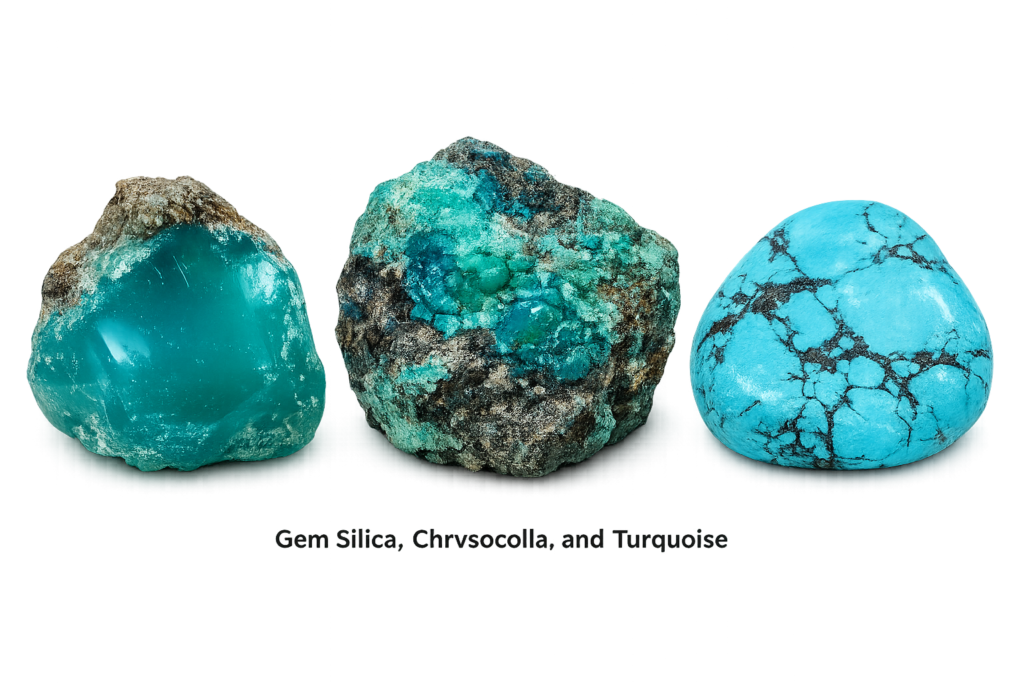
At a glance, Gem Silica vs Chrysocolla and Turquoise can be mistaken for one another. They share vibrant blue-green hues born from copper deposits, attracting lapidaries, jewellers, and collectors. Yet despite their palette overlap and shared roots, they differ in composition, hardness, rarity, and value. Understanding them helps buyers judge quality for gem collecting.
Whether you are identifying a new piece for your collection, selecting the ideal stone for custom jewellery, or simply seeking to deepen your mineralogical knowledge, understanding the subtle nuances between them is essential.
In this guide, we will break down the key differences between Gem Silica, Chrysocolla, and Turquoise—exploring their unique geological formations, durability, optical characteristics, practical identification tips, and proper care guidelines.
Key Differences: Gem Silica vs. Chrysocolla vs. Turquoise
While all three minerals owe their vivid blue and green shades to copper-rich geological environments, they are fundamentally distinct in chemical composition, durability, and rarity. Understanding these defining characteristics reveals why they perform differently in jewel and carry vastly different market values.
1. Mineral Composition & Geological Origin
- Gem Silica (Chrysocolla Chalcedony): Formally a variety of micro crystalline quartz (chalcedony) that has been naturally infused with microscopic inclusions of chrysocolla. It is not an independent mineral species, but rather a rare hybrid where silica envelops copper silicates, locking the rich blue hue inside a hard quartz matrix.
- Chrysocolla: A hydrous copper silicate mineral ($\text{Cu}_2\text{H}_2\text{Si}_2\text{O}_5(\text{OH})_4 \dot n\text{H}_2\text{O}$). It forms in the secondary oxidation zones of copper ore bodies, frequently intergrown with other minerals like malachite, azurite, quartz, or tenorite.
- Turquoise: A hydrous phosphate of copper and aluminium ($\text{CuAl}_6(\text{PO}_4)_4(\text{OH})_8 \dot 4\text{H}_2\text{O}$). It forms when acidic groundwater reacts with copper and aluminium minerals in arid, weathered volcanic environments.
2. Optical Properties & Diaphaneity
- Gem Silica: Celebrated for its unique translucency to semi-transparency. Quality specimens allow light to pass through smoothly, giving the gem an inner glow or “gel-like” depth reminiscent of fine jade or chalcedony.
- Chrysocolla: Predominantly opaque with an earthy, porcelain, or waxy lustre. Pure specimens do not transmit light.
- Turquoise: Strictly opaque with a sub-vitreous to waxy lustre. High-grade robin’s-egg blue turquoise exhibits a solid, uniform colour depth without light transmission.
3. Hardness & Durability
- Gem Silica: Registers a 7 on the Mohs scale, matching standard quartz. It resists everyday scratches, holds a high mirror-like polish, and does not require stabilisation.
- Chrysocolla: Unusually soft, rating between 2 and 4 on the Mohs scale. Pure chrysocolla is brittle, friable, and easily scratched by a steel point or copper penny unless naturally silicified or artificially resin-stabilised.
- Turquoise: Ranks moderately at 5 to 6 on the Mohs scale. While far tougher than chrysocolla, natural turquoise remains somewhat porous and susceptible to surface wear over extended periods.
4. Rarity & Market Value
- Gem Silica: The rarest and most valuable of the three. High-grade, gem-quality deposits are found primarily in Arizona (Inspiration Mine, Ray Mine), Peru, and select locations in Mexico. Top-tier translucent electric-blue cabochons command premium prices per carat.
- Chrysocolla: Widely available globally across major copper-producing regions (Chile, DRC, USA, Australia). It is the most affordable of the group, though specimens mixed with quartz (“chrysocolla chalcedony”) carry higher value due to increased toughness.
- Turquoise: Moderate to high rarity depending on the specific mine (e.g., Sleeping Beauty, Bisbee, Kingman, or Persian mines). Untreated, high-grade natural turquoise with rich colour and minimal porous matrix holds high collector value.
Comprehensive Comparison Matrix
| Attribute | Gem Silica | Chrysocolla | Turquoise |
| Chemical Category | Microcrystalline Quartz (Silica) | Hydrous Copper Silicate | Hydrous Copper Aluminium Phosphate |
| Mohs Hardness | 7.0 (Hard) | 2.0 – 4.0 (Very Soft) | 5.0 – 6.0 (Medium) |
| Diaphaneity | Translucent to Semi-Transparent | Opaque | Opaque |
| Lustre | Vitreous (Glassy) | Earthy, Waxy, or Porcelain | Waxy to Sub-vitreous |
| Colour Spectrum | Vivid Cyan, Electric Blue, Blue-Green | Teal, Deep Blue, Forest Green | Robin’s-Egg Blue, Sky Blue, Apple Green |
| Porosity | Non-porous | High (Porous) | Moderate |
| Relative Value | High to Extremely High | Accessible / Low to Moderate | Moderate to High (Mine-dependent) |
| Main Sources | Arizona (USA), Peru, Mexico | Chile, DRC, USA, Australia | USA, Iran, China, Egypt |
Practical At-Home Testing Methods
Because Gem Silica vs Chrysocolla can share overlapping colour profiles with Turquoise, sight alone may lead to misidentification. Luckily, you can perform several safe, non-destructive tests at home to help differentiate them.
1. The Light & Translucency Test
Holding the stone up to a focused light source (such as an intense flashlight or smartphone light) provides immediate clues regarding light transmission:
- Gem Silica: Highly translucent to semi-transparent. Light passes effortlessly through the stone, casting a glowing, brilliant electric-blue or teal hue.
- Chrysocolla: Opaque. Pure raw or cabochon Chrysocolla blocks light almost entirely, though low-grade pieces impregnated with quartz may show slight edge translucency.
- Turquoise: Strictly opaque. Light will not transmit through natural turquoise, regardless of piece thickness or light intensity.
2. Mohs Hardness Test
A controlled scratch test on an unpolished or hidden area (like the back of a cabochon) provides strong diagnostic data:
- Gem Silica (Hardness 7): Being a copper-infused chalcedony (micro crystalline quartz), it easily resists steel. It cannot be scratched by a steel nail, copper penny, or pocket knife blade.
- Turquoise (Hardness 5–6): Moderate hardness. A quality piece resists a copper penny but can be scratched by a hardened steel point or glass plate if firm pressure is applied.
- Chrysocolla (Hardness 2–4): Very soft and friable. A copper penny, glass plate, or even a steel key will easily scratch pure Chrysocolla.
3. Surface Porosity & Moisture Test
The mineral structures of raw or unsealed specimens absorb moisture at distinctly different rates:
- Chrysocolla: Highly porous. Unsealed Chrysocolla exhibits strong capillary attraction—if touched with a damp fingertip, it will feel distinctly “tacky” or sticky as it rapidly absorbs moisture.
- Turquoise: Slightly porous in raw form, but usually sealed or polished. It absorbs liquid very slowly compared to Chrysocolla.
- Gem Silica: Completely non-porous. Its dense quartz matrix repels water entirely; liquid beads up instantly on the surface.
4. Acetone Solvent Test (Checking for stabilisation or Dyes)
Imitation or low-grade stones are often dyed to mimic high-grade Turquoise or Gem Silica:
- Dip a white cotton swab into pure acetone (or heavy-duty nail polish remover).
- Gently rub a small, inconspicuous area of the stone for 10–15 seconds.
- Results: Genuine Gem Silica, natural Chrysocolla, and untreated Turquoise will not transfer colour or fade. If blue or green pigment transfers onto the cotton swab, the stone has been artificially dyed.
jewellery Applications & Care Guidelines
Choosing between Gem Silica, Chrysocolla, and Turquoise comes down to durability and maintenance. Because they possess radically different hardness levels and chemical vulnerabilities, each stone suits different styles of jewel and care routines.
Gem Silica: High-End & Everyday Wearability
Thanks to its micro crystalline quartz structure (Mohs hardness of 7), Gem Silica is remarkably durable. It resists scratching and abrasion better than almost any other copper-bearing mineral, making it suitable for heirloom-quality pieces.
- Best jewellery Uses: Excellent for high-contact jewel like daily-wear rings, bangles, and bracelets, as well as statement pendants and earrings. It holds a high-polish shine and withstands daily exposure to friction without dulling easily.
- Cleaning & Care: Clean safely using warm water, mild dish soap, and a soft-bristled toothbrush. Unlike soft gemstones, high-grade Gem Silica can tolerate brief exposure to gentle ultrasonic cleaners, provided the stone is natural, untreated, and free of fracture fillings.
- Storage: Store separately from harder gemstones like diamonds, sapphires, or topaz, which can still scratch quartz.
Chrysocolla: Delicate Statement Pieces
Pure Chrysocolla is extraordinarily soft (Mohs hardness of 2–4) and fragile. Due to its brittle nature, standard un-silicified Chrysocolla requires thoughtful setting techniques and light wear.
- Best jewellery Uses: Reserved for protective or low-impact settings, such as statement pendants, brooches, or drop earrings where the stone avoids accidental bumps. In ring or cuff designs, it should feature protective bezel-set borders. (Note: “Chrysocolla Chalcedony” or “Chrysocolla in Quartz” offers higher durability and can withstand broader jewel uses).
- Cleaning & Care: Never use steam, ultrasonic cleaners, or harsh chemicals. Clean exclusively by wiping gently with a soft, damp microfiber cloth. Avoid submerging unsealed Chrysocolla in liquids, as its high porosity allows water to seep into micro-fractures, potentially weakening the stone.
- Storage: Keep wrapped in soft velvet or cloth pouches, away from all other jewel items, metal edges, and key rings to prevent deep surface scratches.
Turquoise: Traditional & Protective Wear
Turquoise holds a moderate hardness (Mohs 5–6). While tough enough for regular jewel wear, its porous nature makes it highly susceptible to chemical damage and discolouration over time.
- Best jewellery Uses: Iconic for Southwestern and Mediterranean-style silverwork, cabochon rings, cuffs, bead necklaces, and earrings.
- Chemical Vulnerabilities: Natural, untreated turquoise acts like a sponge. Direct contact with skin oils, hand sanitisers, lotions, perfumes, hairsprays, and household cleaners will cause the stone to absorb chemicals and permanently shift in colour—turning vivid sky-blue into a dull greenish-brown over time.
- Cleaning & Care: Use only a soft cloth dampened with lukewarm water to clean after wearing. Allow the piece to air-dry completely before storing. Never submerge in chemical dip solutions, soap baths, or steam cleaners. Apply perfumes, cosmetics, and lotions first, allowing them to dry fully before putting on turquoise jewel.
- Storage: Keep in a dry, temperature-regulated environment out of direct sunlight, which can dry out hydrated turquoise and cause fracturing.
Frequently Asked Questions
What is the primary difference between Gem Silica, Chrysocolla, and Turquoise?
The main differences lie in their mineral composition, hardness, and translucency:
- Gem Silica: A translucent, hard form of chalcedony (quartz) infused with copper/chrysocolla inclusions (Mohs hardness 7).
- Chrysocolla: A soft, opaque hydrous copper silicate mineral (Mohs hardness 2–4).
- Turquoise: An opaque hydrous copper-aluminium phosphate mineral of medium hardness (Mohs hardness 5–6).
Is Gem Silica just high-grade Chrysocolla?
While often casually called “Chrysocolla Chalcedony” or “Gem Silica Chrysocolla,” Gem Silica is technically a variety of chalcedony (microcrystalline quartz). Its intense blue-green colour comes from microscopic inclusions of copper salts (the same colourant in chrysocolla), but its matrix is hard quartz rather than soft copper silicate.
Why is Gem Silica so much more expensive than Chrysocolla or Turquoise?
Gem Silica is exceptionally rare, with gem-quality deposits found in only a handful of mines worldwide (notably in Arizona, USA, and Peru). Its combination of vivid electric-blue colour, high translucency, and quartz-level durability (Mohs 7) makes it highly prized by gem collectors and lapidaries.
Can I wear Chrysocolla as a daily ring?
Pure Chrysocolla is generally too soft (Mohs 2–4) and brittle for daily-wear rings, as it can easily scratch, chip, or crumble from accidental impacts. However, “Silicified Chrysocolla” (where quartz has naturally bonded with the mineral) or Chrysocolla set in protective pendant/earring designs is much more practical.
How do I quickly test if my stone is Turquoise or Chrysocolla at home?
Two simple tests can help differentiate them:
- The Tongue/Moisture Test: Unsealed Chrysocolla is highly porous and will feel slightly “sticky” or tacky to a damp finger.
- Scratch Test: In an inconspicuous spot, a copper penny or glass edge will easily scratch pure Chrysocolla (Mohs 2–4), but Turquoise (Mohs 5–6) will resist a penny.
Why does Turquoise change colour to green over time?
Natural Turquoise is porous and absorbs oils, soaps, cosmetics, perspiration, and environmental chemicals. Over time, these absorbed materials oxidise and react with the copper and aluminium within the stone, permanently shifting its blue colour into a yellowish-green hue.
Can Gem Silica or Turquoise go in an ultrasonic cleaner?
- Gem Silica: Untreated, natural Gem Silica is safe in gentle ultrasonic cleaners due to its quartz durability.
- Turquoise & Chrysocolla: Never put Turquoise or Chrysocolla in an ultrasonic cleaner. High-frequency vibrations and liquids can crack brittle chrysocolla or strip natural oils and resin stabilisers from turquoise.
Conclusion
Whether you are captivated by the vibrant hues of Turquoise, the striking earthy patterns of Chrysocolla, or the fiery brilliance of rare Gem Silica, understanding their unique characteristics ensures you make informed decisions for your collection or wardrobe. Each stone carries its own distinct geological story, care requirements, and aesthetic appeal. Before purchasing your next piece, always request details on stone origin and stabilisation treatments, and inspect the gem’s translucency and surface finish to ensure you are acquiring authentic quality. Ready to find your next statement piece? Explore our curated collection of verified copper-bearing gemstone jewel today, or speak with our lapidary specialists to select the perfect certified gemstone for your custom design.