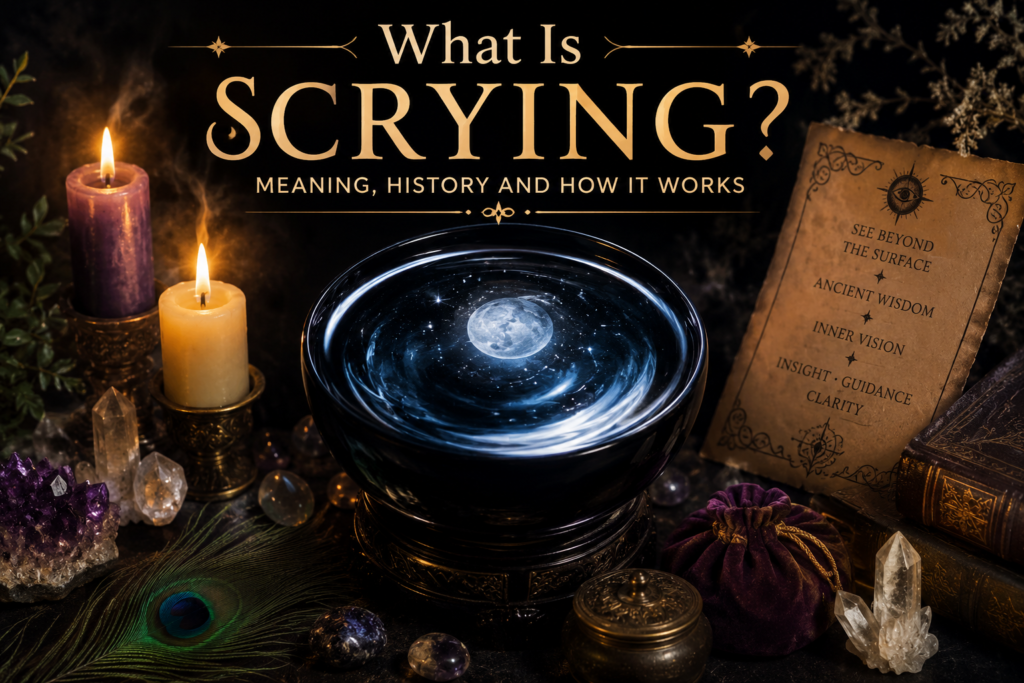
Unlike tarot cards or runes, What is scrying describes a practice that yields spontaneous imagery. Moreover, rather than relying on predefined meanings, practitioners observe symbols, impressions or sensations that emerge and interpret them. Additionally, they do so within the context of their lives, intuition and spiritual beliefs.
A practitioner typically enters a relaxed, meditative state before gazing softly into the chosen medium. They gaze into the medium, such as a crystal ball or candle flame, without forcing their eyes to focus. Additionally, as the conscious mind begins to quieten, subtle impressions may arise. Some people experience vivid visual images. Others receive thoughts, emotions or intuitive insights that emerge naturally during the practice.
Scrying impressions
Additionally, these impressions can include.
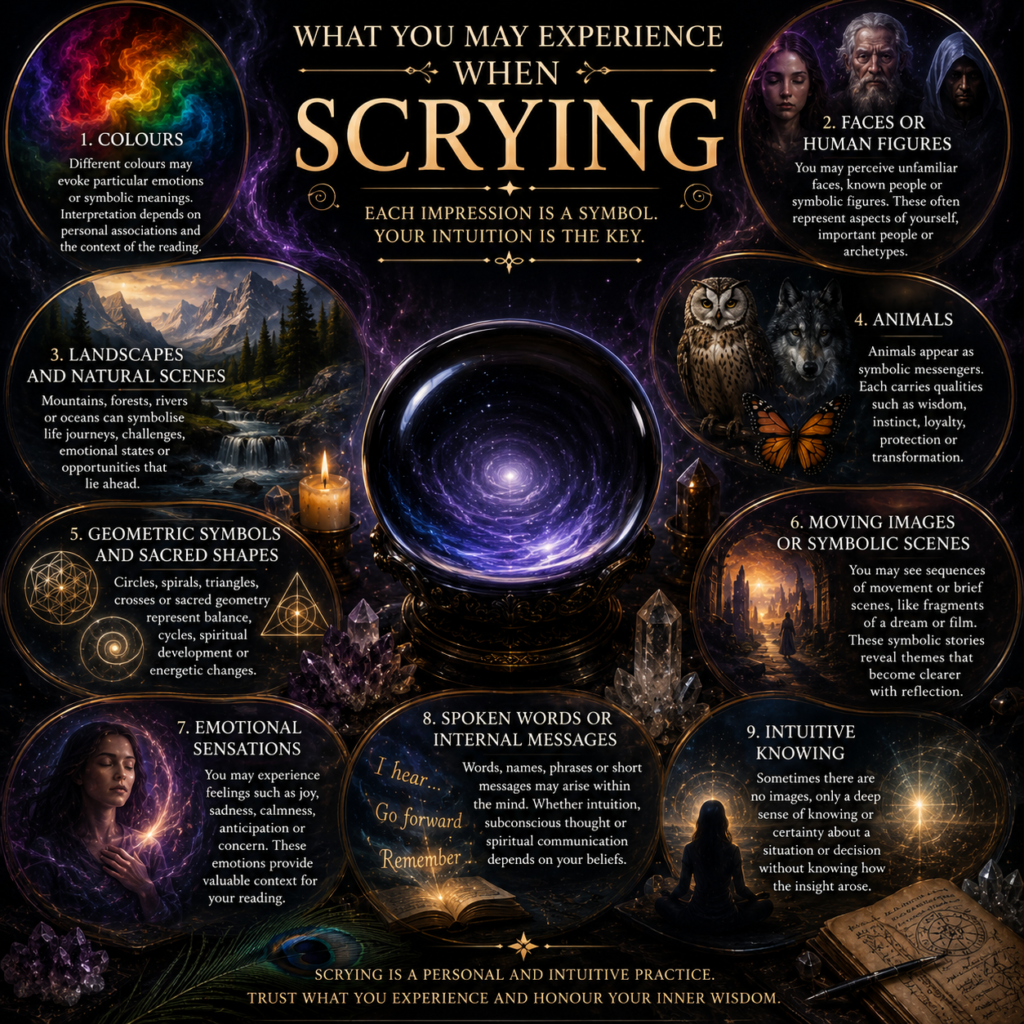
- Colours – Different colours may evoke particular emotions or symbolic meanings. For example, blue might suggest peace or communication, while red could represent passion, energy or a warning. The interpretation often depends on the practitioner’s personal associations and the context of the reading.
- Faces or Human Figures – Practitioners may perceive unfamiliar faces, recognisable people or symbolic human forms. These images are often interpreted as representing aspects of oneself, significant individuals, or symbolic archetypes rather than literal apparitions.
- Landscapes and Natural Scenes – Mountains, forests, rivers, oceans or other landscapes may appear during a session. Such imagery can symbolise life journeys, personal challenges, emotional states or opportunities that lie ahead, depending on the wider context.
- Animals – Animals frequently appear as symbolic messengers. Many traditions associate different creatures with particular qualities, such as the owl representing wisdom, the wolf symbolising instinct and loyalty, or the butterfly signifying transformation and personal growth.
- Geometric Symbols and Sacred Shapes – Circles, spirals, triangles, crosses or more complex sacred geometry may emerge. These patterns are often interpreted as representing balance, cycles, spiritual development or energetic changes within the practitioner’s life.
- Moving Images or Symbolic Scenes – Rather than isolated pictures, some people describe seeing brief sequences of movement, almost like watching fragments of a dream or film. These symbolic scenes may tell a story or reveal themes that become clearer through reflection.
- Emotional Sensations – Instead of visual imagery, a practitioner may experience unexpected feelings such as joy, sadness, calmness, anticipation or concern. These emotions are often considered valuable clues that help provide context for the symbols or questions being explored.
- Spoken Words or Internal Messages – Occasionally, words, names, phrases or short messages seem to arise within the mind during a session. Whether viewed as intuition, subconscious thought or spiritual communication depends on the individual’s beliefs and interpretive framework.
- Intuitive Knowing – Sometimes there are no obvious images at all. Instead, a practitioner may simply experience a strong sense of certainty or understanding about a person, situation or decision without being able to explain exactly how the insight emerged.
Meaning of these impressions is interpreted using personal intuition and symbolism.
It may also draw on life experience and the practitioner’s symbolic traditions.
No universal system exists, and the same image may hold different meanings for different individuals.
Many practitioners use scrying to:
Inspire Creative Problem-Solving – Artists, writers and creative thinkers sometimes use scrying as a way of stimulating imagination and allowing unexpected ideas to surface. The relaxed, contemplative state may encourage new perspectives and creative inspiration that might not arise through analytical thinking alone.
Gain Clarity About Life Decisions – Scrying is often used as a tool for self-reflection when facing important choices involving relationships, careers, personal goals or major life changes. Rather than providing definitive answers, it encourages fresh perspectives and deeper contemplation.
Receive Spiritual Guidance – Those with spiritual or religious beliefs may use scrying to seek symbolic guidance from a higher power, the divine, guardian spirits or the universe. The experience is generally viewed as a means of reflection rather than a guaranteed source of supernatural knowledge.
Enhance Meditation – The focused, repetitive act of gazing into a reflective surface can deepen meditation by calming mental chatter, improving concentration and encouraging mindfulness. Many practitioners find it helps them reach a more receptive and contemplative state.
Develop Intuition – Regular practice is believed by many to strengthen intuitive awareness by encouraging trust in subtle impressions, symbolic thinking and inner guidance. Over time, practitioners often report becoming more confident in recognising intuitive insights in everyday life.
Understand Recurring Dreams – Some people use scrying to explore symbols or themes that repeatedly appear in their dreams. By focusing on these images during a session, they hope to gain greater personal insight into unresolved emotions or recurring life patterns.
Explore Shadow Work – Within certain spiritual and psychological practices, scrying is used as a reflective exercise to examine hidden emotions, limiting beliefs or neglected aspects of the personality. This process is intended to encourage greater self-awareness and emotional growth.
Communicate Symbolically with Ancestors or Spirit Guides – In many spiritual traditions, practitioners believe scrying can facilitate symbolic communication with ancestors, spirit guides or other non-physical beings. These experiences are matters of personal belief and are not supported by scientific evidence.
When is the Best Time to Practise Scrying?
Although scrying can be practised at any time, many traditions associate certain periods with heightened spiritual focus.
New Moon
Favoured for beginnings, self-discovery and setting intentions.
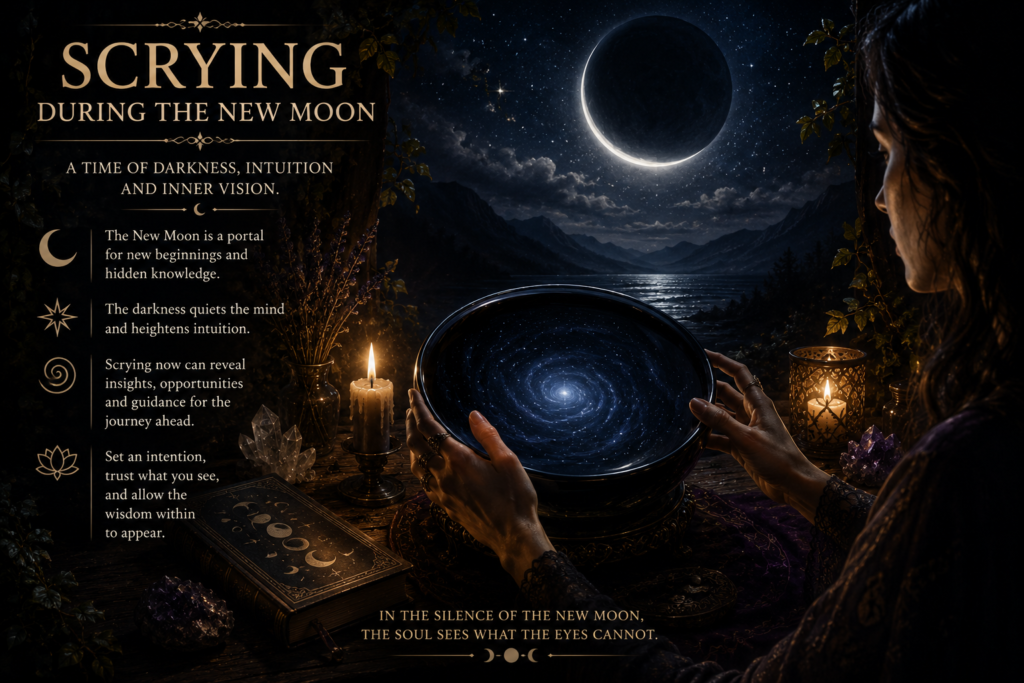
Scrying during the new moon is popular because it matches the dark, quiet energy of the lunar phase, enhances inner reflection, and helps people set clear intentions for the month ahead. Practitioners use this time for three main reasons:
Why Choose the New Moon
Fresh Starts: It is an ideal time to ask for guidance and plan new goals as a new cycle begins.
Deep Darkness: The lack of light in the sky makes it easier to look into black mirrors or water bowls without bright distractions.
Inner Focus: The quiet phase helps quiet your busy mind and connect with your own hidden thoughts.
Full Moon
Considered ideal for heightened intuition, emotional insight and spiritual connection.
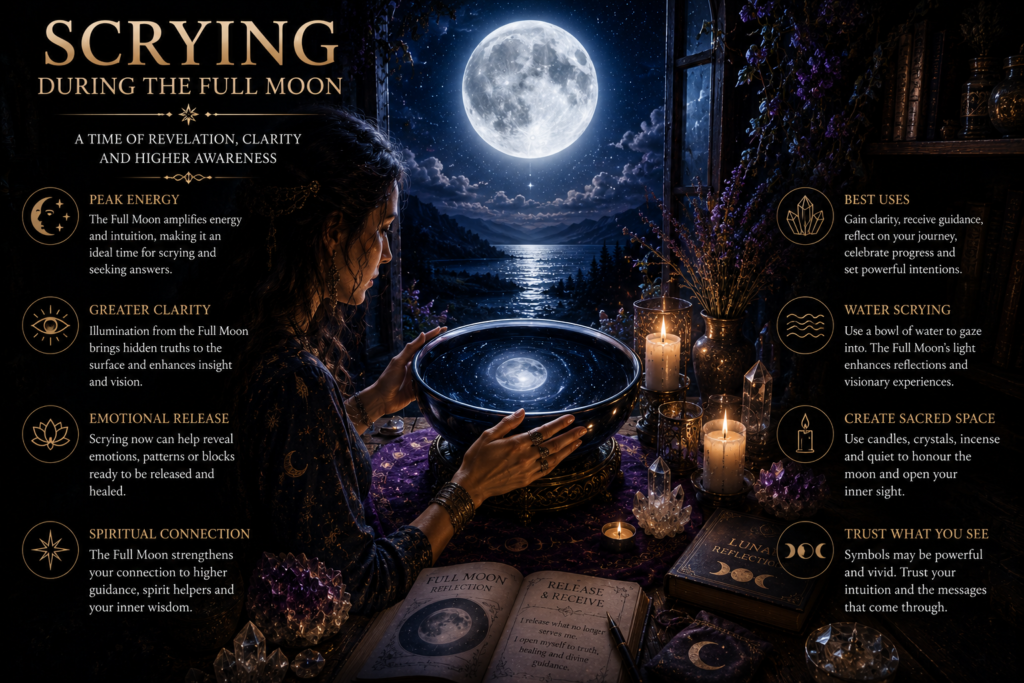
People practice scrying during the full moon to harness heightened intuition, maximum illumination, and a symbolic connection to water and emotional depth. [1, 2]
Spiritual and Symbolic Reasons
- Peak Energy: The full moon represents the height of the lunar cycle, making many feel more alert and psychically open.
- Clear Illumination: Bright moonlight provides natural lighting to reflect off water bowls, mirrors, or crystals without artificial light.
- Water Connection: Tides and inner emotions are linked to the moon, enhancing water-based scrying method
Dawn
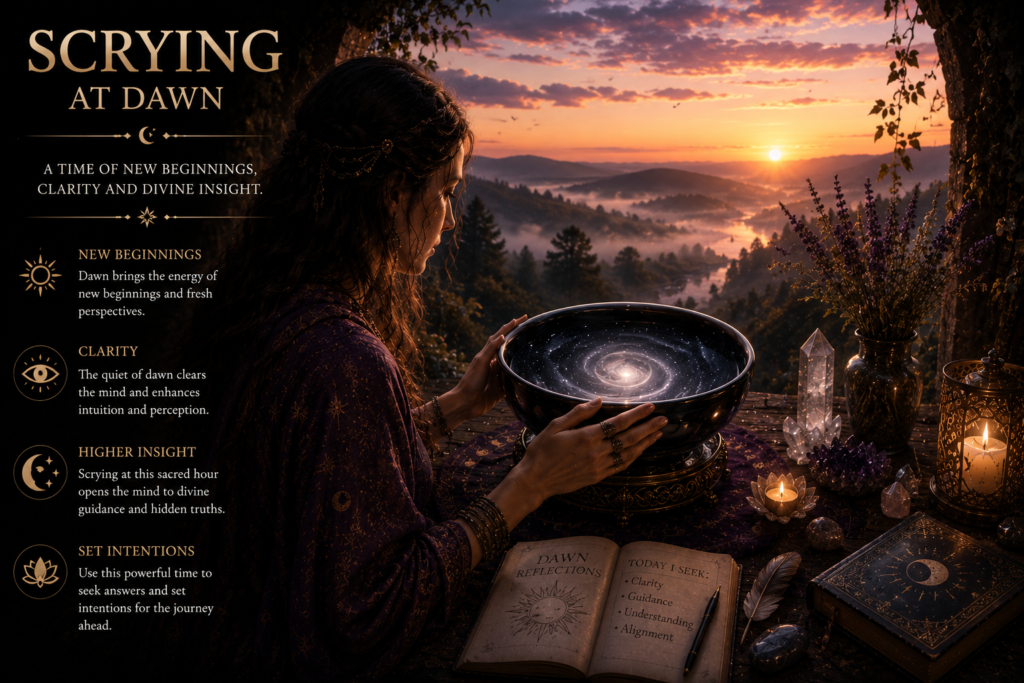
Scrying at dawn is practised because dawn is a powerful liminal time—a quiet, transitional border between night and day that helps the mind enter a calm trance.
Benefits of Dawn Scrying
- Liminal energy: The transition from dark to light represents new beginnings, awakening, and clear vision.
- Quiet environment: Early morning hours offer peace before daily distractions begin.
- Fresh focus: A rested mind in the morning can concentrate deeply on symbols and intuition.
Many traditions view sunrise as a peaceful time when the mind is naturally calm and distractions are minimal.
Midnight
Historically associated with magical practice and deep contemplation, though there is no evidence that midnight inherently enhances scrying.
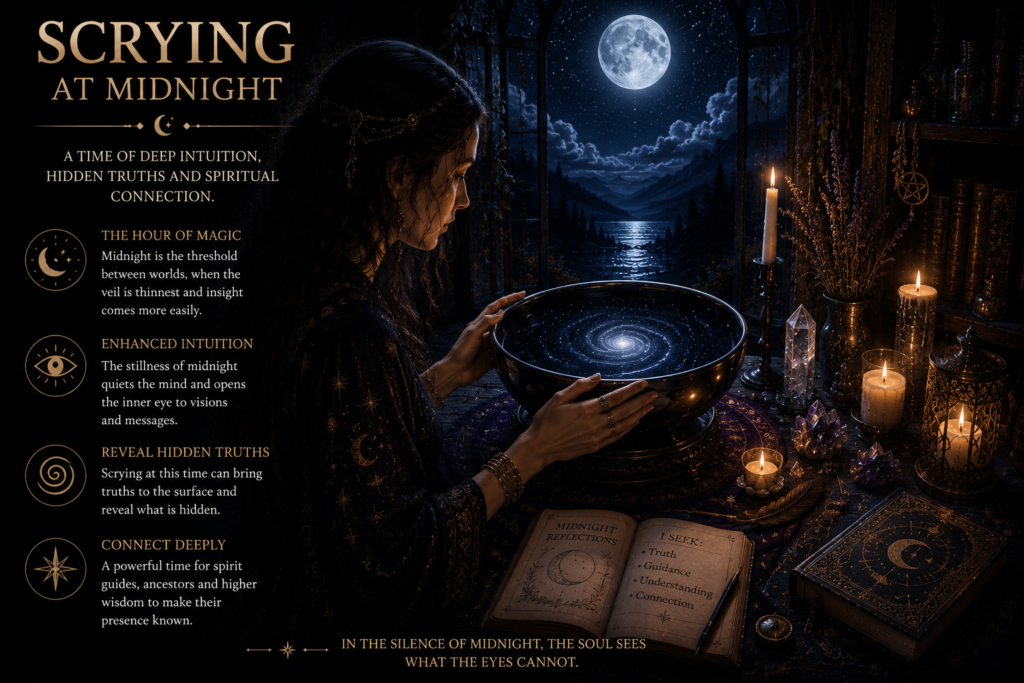
Scrying at midnight is done to achieve deep quiet, tap into liminal energy, and minimise visual distractions.
Reasons for Midnight Scrying
- Silence and Peace: Late hours provide an undisturbed environment without daytime noise, making it easier to enter a calm, focused state.
- Liminal Timing: Midnight is traditionally viewed as a threshold time—a boundary between days or worlds—believed in occult lore to thin the veil between the conscious mind and unseen insights.
- Low Light: Darkness or minimal candlelight helps the eyes relax and prevents glare on reflective surfaces like black mirrors, water, or crystals, aiding the transition into a trance-like gaze.
During Meditation
Many experienced practitioners recommend scrying immediately after meditation because the mind is already relaxed and receptive.

Crying during meditation is a normal and healthy release of pent-up stress, shifting nervous system states, and surfacing hidden emotions. When you quiet your mind and body, the barriers keeping those feelings down finally open up.
Why Tears Happen
- Nervous System Shift: Moving from high-stress “fight-or-flight” mode to deep “rest-and-digest” relaxation lets your physical armour and tension soften.
- Releasing Stored Stress: Daily life forces you to push aside heavy feelings; stillness gives your mind a safe space to let go of that baggage.
- Deep Relief or Awe: Tears do not only come from sadness; they can flow from sudden gratitude, beauty, or a deep sense of self-acceptance.
Ultimately, the most effective time is when you are rested, free from distractions and able to concentrate.
Origins and History of Scrying
The history of scrying stretches back more than 5,000 years and spans numerous civilisations.
Ancient Egypt: Priests are believed to have used bowls of water, polished stone and sacred oils during temple rituals to seek divine guidance. Although later occult traditions frequently describe Egyptian mirror divination, surviving evidence is fragmentary and interpretations remain debated among historians.
Mesopotamia: Babylonian and Assyrian diviners practised various forms of omen interpretation. Some historical sources describe reflective liquids and sacred vessels being used in ritual contexts alongside astrology and dream interpretation.
Ancient Greece: Greek oracles often sought visions through altered states of consciousness. Catoptromancy—divination using mirrors—was recorded by classical authors, sometimes involving mirrors lowered into sacred wells to seek signs concerning health or the future.
Ancient Rome: Romans inherited many Greek divinatory practices, including mirror divination and hydromancy (water divination). Professional seers often combined multiple methods when advising political leaders and military commanders.
Celtic Britain: While direct evidence for Celtic scrying is limited, medieval literature and later folklore describe druids and seers using sacred wells, reflective pools and polished stones for visionary experiences.
Renaissance Europe: Scrying experienced renewed interest through ceremonial magic. One of the best-known practitioners was Dr John Dee, astrologer and adviser to Queen Elizabeth I, who worked with Edward Kelley. Kelley claimed to receive angelic visions through a polished obsidian mirror now housed in the British Museum.
Victorian Spiritualism: The nineteenth century saw a resurgence of crystal ball gazing, influenced by Spiritualism, ceremonial magic and popular occult societies. Crystal balls became iconic symbols of fortune telling during this period.
Folklore and Myth Associated with Scrying
- Throughout history, reflective surfaces have been viewed as liminal spaces between the physical and spiritual worlds.
- Many European folk traditions believed wells, lakes and springs could reveal hidden truths. Scottish and Irish folklore tells of seers who gazed into sacred waters to foresee battles, marriages or changes in fortune.
- In Welsh legend, prophetic figures such as Myrddin (Merlin) are associated with visions and magical insight, though not specifically with crystal-ball scrying.
- Norse mythology speaks of Odin sacrificing an eye at Mímir’s Well to gain profound wisdom, symbolising the pursuit of hidden knowledge through reflective waters.
- In Aztec culture, the deity Tezcatlipoca—whose name means “Smoking Mirror”—was associated with divination using polished obsidian mirrors.
- During the Middle Ages, polished beryl crystals became so closely associated with divination that the word “beryl” contributed to the development of the term “to brill” or “to gaze,” although the precise linguistic history is debated.
Tools and Materials Needed for Scrying
Almost any reflective or visually engaging surface can be used, provided it helps the practitioner enter a focused, contemplative state.
Popular tools include:
Crystal Ball: The most recognisable form of scrying. Clear quartz is traditional, though optical glass is also commonly used.
Black Mirror: Usually made from polished obsidian or black glass. Favoured for reducing visual distractions and encouraging symbolic imagery.
Bowl ;of Water: One of the oldest methods, often enhanced with moonlight or candlelight.
Flame: A single candle flame can provide a focal point for trance-like concentration.
Smoke: Incense smoke is used in some traditions to encourage imaginative interpretation of shifting forms.
Polished Stone: Obsidian, onyx and other dark polished stones are commonly chosen.
Supporting Items
Many practitioners also use:
- candles
- incense
- journals
- grounding crystals
- meditation music
- blackout cloths
- comfortable seating
Steps to Begin Scrying
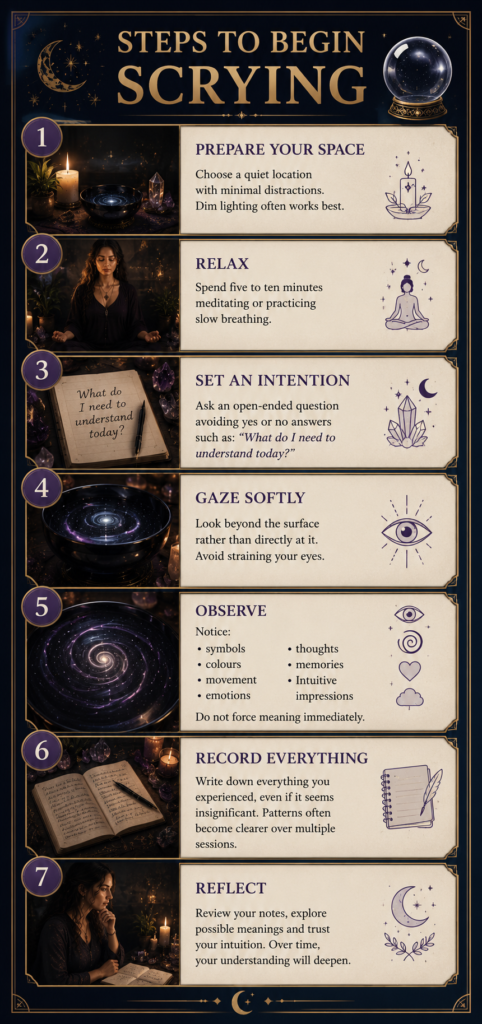
Frequently Asked Questions
Is scrying dangerous?
There is no scientific evidence that scrying itself is dangerous. Some people may find prolonged gazing into reflective surfaces unsettling or emotionally intense. If the experience causes distress, it is advisable to stop and take a break.
Do I need psychic abilities?
No. Many practitioners view scrying as a skill that develops through patience, mirror because these methods require minimal equipment.
Can beginners learn scrying?
Yes. Most beginners start with a bowl of water, a candle flame or a simple black mirror because these methods require minimal equipment.
Which crystal is best for scrying?
Clear quartz is traditionally associated with crystal-ball scrying. Polished obsidian is also widely used for black mirror scrying because of its dark reflective surface.
How long should a session last?
Beginners often benefit from sessions of 10–15 minutes. As concentration improves, sessions of 20–30 minutes may feel more comfortable.
Can I use a normal mirror?
Yes. While specialised black mirrors are popular in some traditions, an ordinary mirror can also be used as a focal point for reflective meditation and symbolic observation.
What should I do if I see nothing?
This is common, especially for beginners. Many practitioners recommend focusing on relaxation and observation rather than expecting dramatic visions.
Is scrying scientifically proven?
There is no scientific evidence that scrying can predict future events or access supernatural information. Psychologists generally explain reported experiences through phenomena such as pattern recognition, imagination, suggestion and altered states of attention. Many practitioners, however, value scrying as a contemplative, symbolic or spiritual practice.
Can scrying be combined with other divination methods?
Yes. Some practitioners combine scrying with tarot, runes, pendulums, astrology or meditation to support reflection and explore different symbolic perspectives.