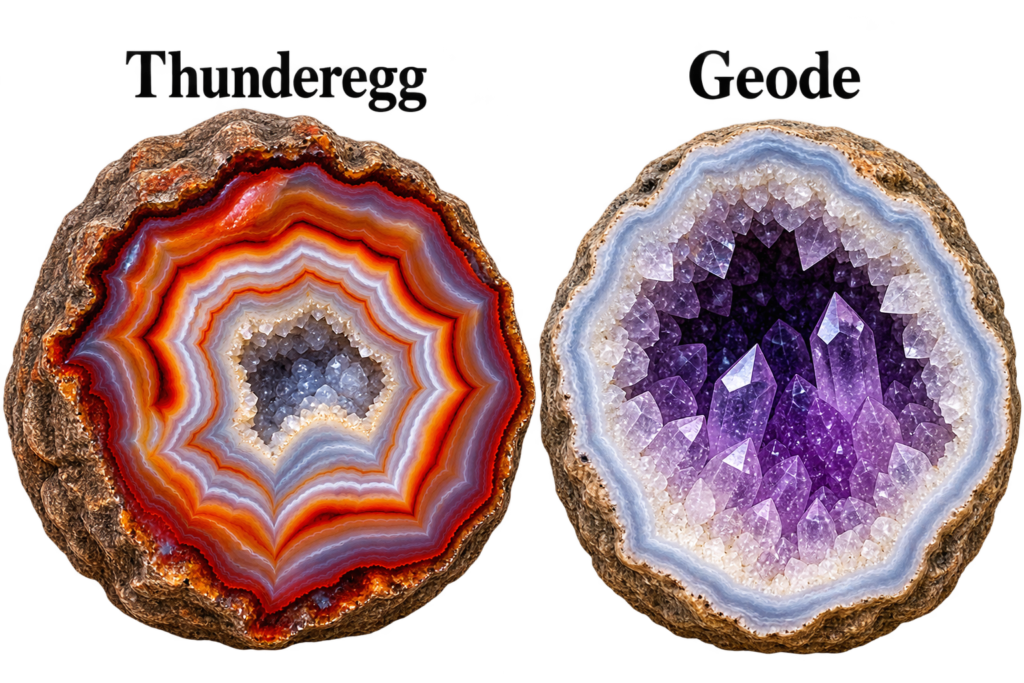
From the outside, thundereggs look like nothing more than drab, rough mud balls scattered across volcanic ash beds. Cut one open with a diamond saw, however, and you reveal a vibrant, star shaped core filled with intricate layers of banded agate, jasper, or opal. Even though the interiors are very different, thundereggs are often confused with geodes., Whilst many collectors may recognise a geode, few would know what are thundereggs and the key distinctions between them and geodes. Understanding the distinction comes down to three basic differences: how they formed, what lies at their core, and how to identify them in the wild.
The Origin Story: How Thundereggs Form
Unlike typical geodes, which develop inside trapped gas vesicles or dissolved limestone cavities, thundereggs form through a specific two-stage process tied to explosive volcanic eruptions.
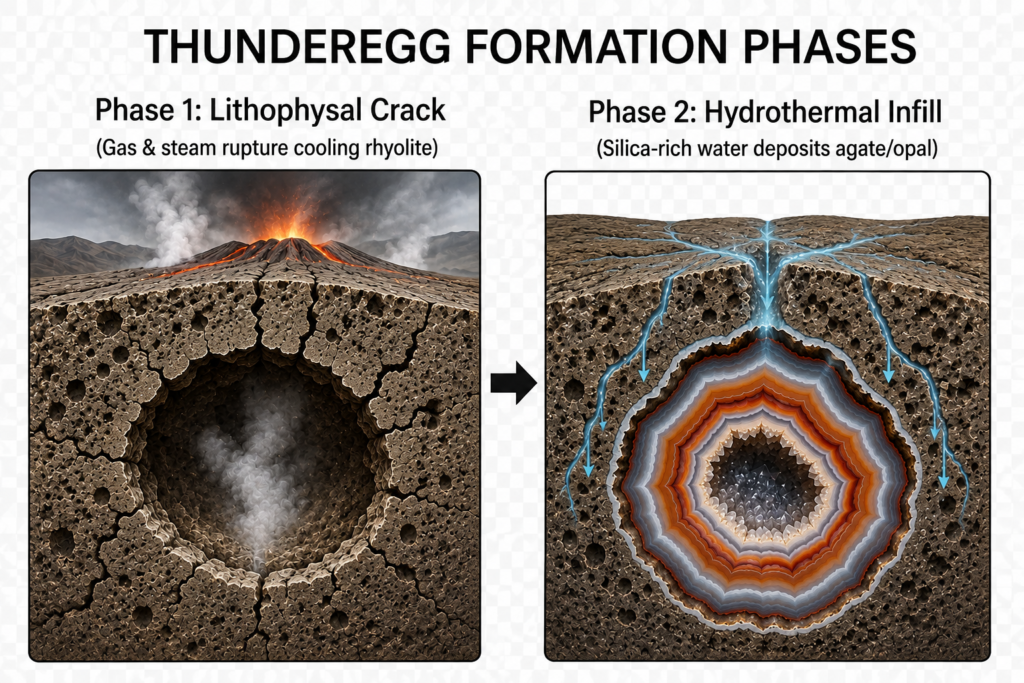
Phase 1: The Lithophysal Rupture
Millions of years ago, explosive volcanic eruptions deposited dense layers of silica-rich lava and volcanic ash (rhyolite and perlite). As this super heated lava flow cooled and solidified, trapped steam and volatile gas expanded under immense pressure.
Instead of forming a smooth, spherical bubble, the pressure cracked the cooling rock matrix along internal stress lines. This produced a multi-lobed, star-shaped cavity surrounded by a dense core of rhyolite or welded tuff. Geologists call these specialised hollow structures lithophysae (meaning “rock bubbles”).
Phase 2: Hydrothermal Infilling
Long after the lava flow cooled, silica-saturated thermal waters percolated through fractures in the volcanic ash bed. As these solutions entered the star-shaped lithophysae cavities, dissolved minerals precipitated out of solution:
- Rhyolite Shelling: The rough outer shell formed a durable, spherical border.
- Layered Deposition: Colloidal silica deposited along the jagged floor and walls of the star cavity, forming horizontal or concentric bands of agate, opaque jasper, or soft common opal.
- Crystalline Cores: If mineral solutions ran dry before the cavity was completely filled, small quartz or amethyst point clusters grew in the remaining central void.
Diagnostic Anatomy of a Thunderegg
When cut in cross-section, a high-quality thunderegg displays a distinct structural layout:
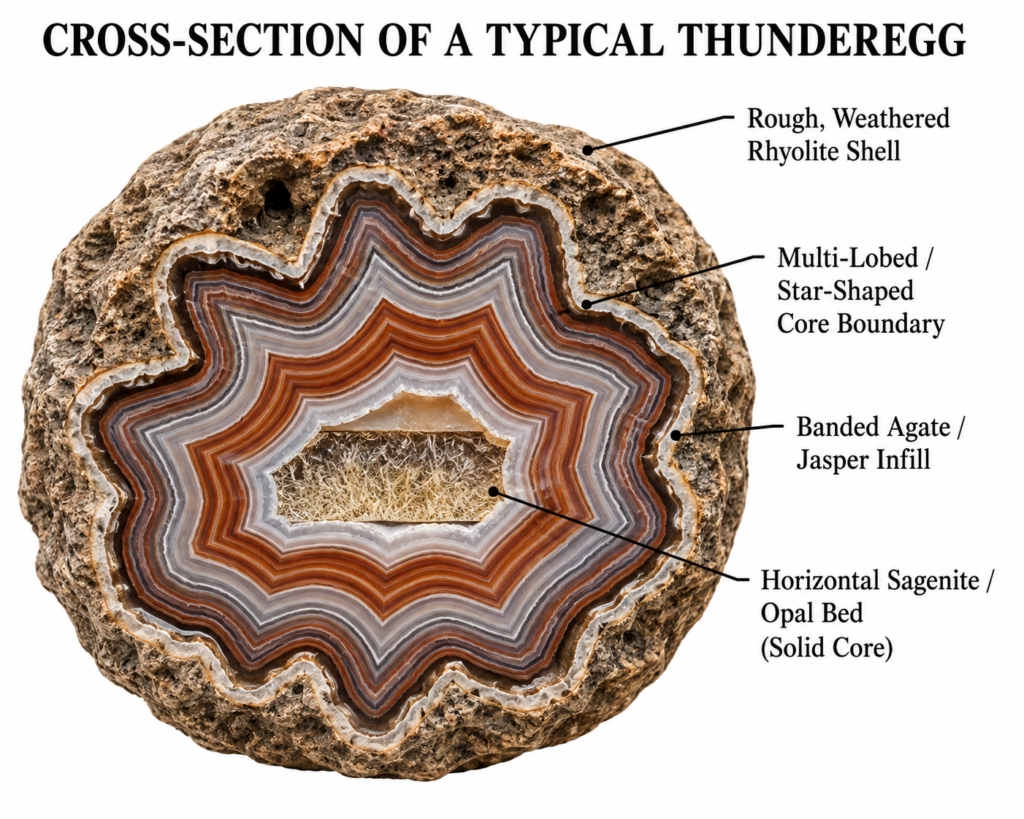
- Matrix Exterior: The outer shell consists of rough, reddish-brown or grey rhyolite or perlite, often bearing knobby ridging or spherical seam marks.
- Internal Cavity Geometry: Rather than round or oval interiors, thunderegg cavities feature distinct 4-, 5-, or 8-pointed star geometries radiating outward from the centre.
- Infill Minerals: The internal cavity is typically filled with microcrystalline chalcedony, agate (fortification or horizontal tube banding), jasper, or precious opal.
Thundereggs vs. Geodes: Key Geological Differences
Both formations feature weather‑resistant exteriors that hide mineral interiors. Their structural mechanics, growth patterns, and density differ significantly. The focus is on What are thundereggs? How they compare to hollow crystal geodes in this context.
| Diagnostic Feature | Thunderegg | Traditional Geode |
| Primary Host Rock | Volcanic Rhyolite, Perlite, or Tuff | Basalt, Limestone, or Dolomite |
| Interior Void State | Solid or near-solid (90–100% infilled) | Hollow cavity lined with inward points |
| Internal Cavity Shape | Star-shaped, multi-lobed, or angular | Spherical, oval, or smooth bubble shape |
| Dominant Infill | Banded Agate, Jasper, Opal | Quartz, Amethyst, Calcite, Celestite |
| Weight-to-Size Ratio | Very heavy and dense (solid rock mass) | Lightweight for its size (hollow interior) |
| Outer Boundary | Blends into rhyolite core; rough exterior | Smooth chalcedony skin; separates cleanly |
Native American Legend and Name Origin
The name “thunderegg” originates from Warm Springs and Paiute Native American folklore in Central Oregon.
According to ancient legends, the towering volcanic peaks of Mt. Hood, Mt. Jefferson, and Mt. St. Hellenes were inhabited by powerful Thunder Spirits who ruled the skies. When angry, these spirits would hurl massive, fiery boulders at one another during fierce thunderstorms. Native tribes believed that these spherical stones that were scattered across volcanic beds after the storm subsided, were the actual eggs laid by the Thunder birds or weapons hurled by the gods.
Notable Global Mining Hotspots
Thundereggs form exclusively in continental volcanic belts rich in silica-heavy lava. Famous locations include:
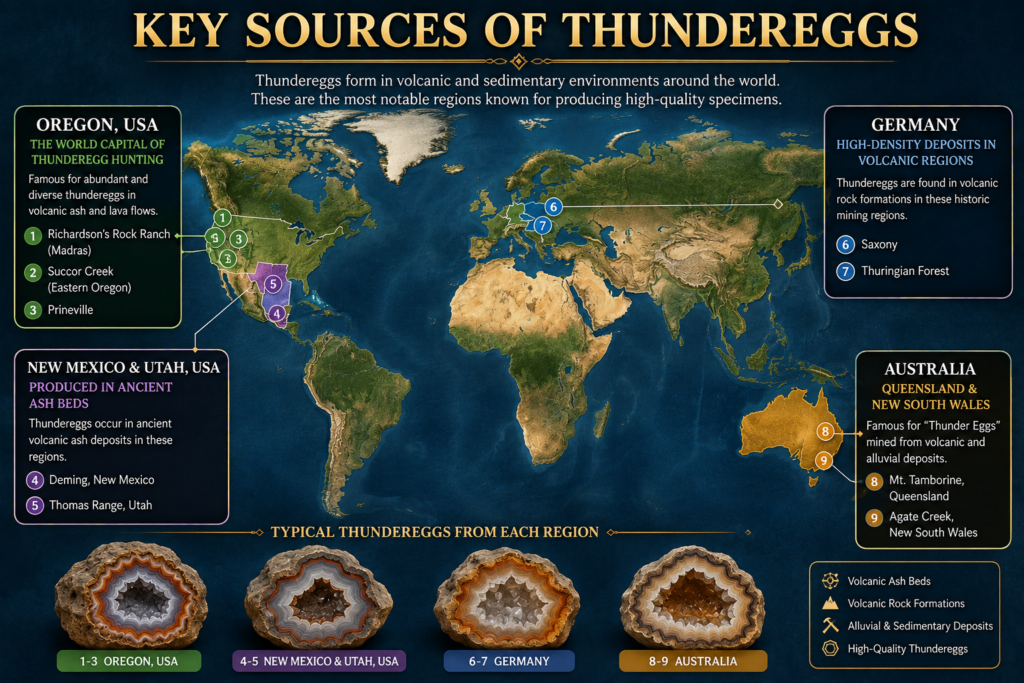
- Oregon, USA: The world capital of thunderegg hunting. Key regions include Richardson’s Rock Ranch (Madras), Succor Creek (Eastern Oregon), and Prineville.
- New Mexico & Utah, USA: Produced in ancient ash beds across Deming, New Mexico, and the Thomas Range in Utah.
- Queensland & New South Wales, Australia: Famous for “Thunder Eggs” mined from Mt. tambourine and the Agate Creek fields.
- Germany: High-density thunderegg deposits occur in the volcanic regions of Saxony and the Thuringian Forest.
Summary Checklist for Collectors
When evaluating a prospective specimen in the field:
- Feel the weight: A heavy, solid stone with no hollow rattle is likely a thunderegg or nodule, not a geode.
- Examine the shell: Look for reddish-grey volcanic rhyolite matrix marked by ribbed, knobby seams.
- Look at the cut: A true thunderegg showcases a sharp, star-shaped boundary separating the dull rhyolite crust from a solid agate or jasper core.
Frequently Asked Questions
What is a thunderegg and how do thundereggs form?
A thunderegg is a rock that appears plain on the outside but reveals brilliant inner layers when cut and polished. They form through a two-stage process tied to explosive volcanic eruptions: phase one creates a lithophysal rupture with star-shaped cavities, and phase two involves hydrothermal infilling where silica-rich waters deposit layers of agate, jasper, or opal inside the cavities.
How can you distinguish a thunderegg from a traditional geode?
Although both have mineral interiors, thundereggs have a volcanic rhyolite host and a solid or near-solid interior with a star-shaped cavity, while geodes form in basalt, limestone, or dolomite and have hollow interiors with inward-pointing crystals. Thundereggs are dense and heavy, whereas geodes are typically hollow and lighter for their size.
What is the diagnostic anatomy of a thunderegg when cut open?
In cross-section, a thunderegg shows a rough rhyolite exterior and a multi-lobed star-shaped interior boundary, with infill minerals such as agate, jasper, or opal forming the inner layers, and sometimes small quartz or amethyst crystals in the central void if the cavity wasn’t fully filled.
What is the Native American legend behind the name thunderegg?
The name thunderegg originates from Warm Springs and Paiute folklore in Central Oregon. Legends tell of Thunder Spirits hurling fiery boulders during storms, and the spherical stones scattered after the storms were believed to be eggs laid by Thunderbirds or weapons hurled by the gods.
Where are notable thunderegg mining hotspots located?
Notable hotspots include Oregon in the United States, especially Richardson’s Rock Ranch, Succor Creek, and Prineville; also New Mexico and Utah in the United States; Queensland and New South Wales in Australia; and German deposits in Saxony and the Thuringian Forest.