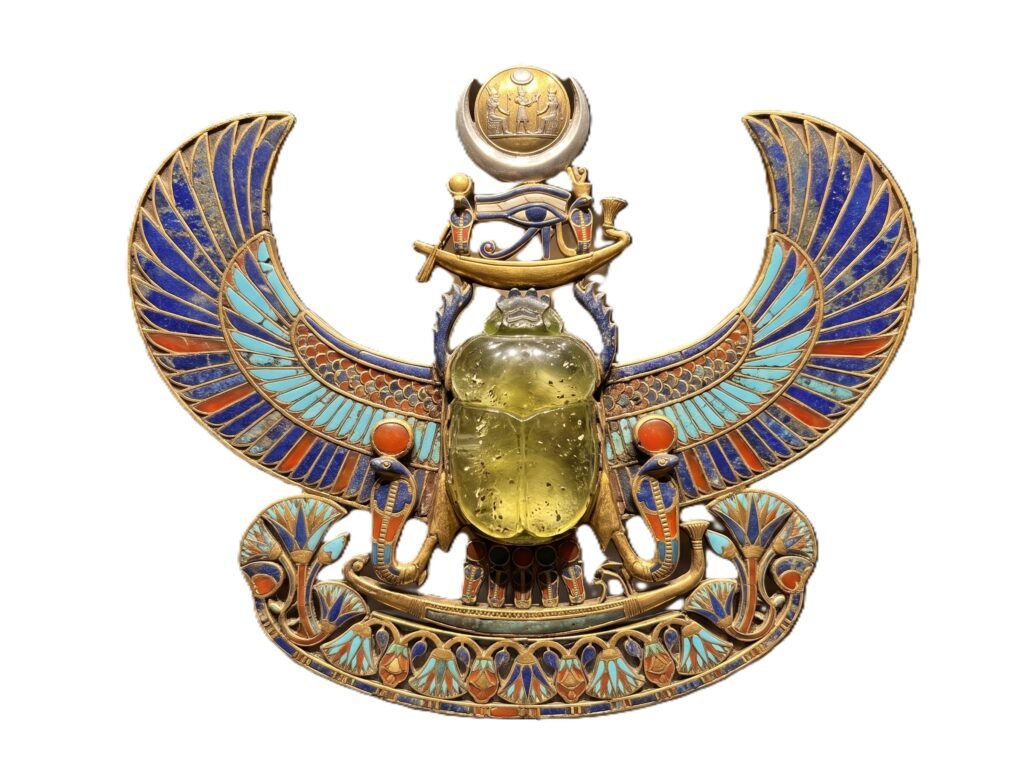
When Howard Carter unsealed the burial chamber of Pharaoh Tutankhamun in 1922, he uncovered one of the most extraordinary treasures of the ancient world: an intricate gold and gemstone pectoral featuring a glowing, translucent yellow beetle at its heart. For decades, Egyptologists assumed this central carving was chalcedony or quartz, until modern mineralogical testing revealed a far more dramatic truth. Tutankhamun’s Libyan Desert Glass scarab was sculpted from an exceptionally rare natural glass forged roughly 29 million years ago, when a colossal meteorite or atmospheric airburst superheated the sands of the Great Sand Sea in western Egypt.
To the ancient Egyptians, the scarab beetle known as Khepri, embodied the rising sun, rebirth, and eternal renewal. By setting a stone born from celestial fire directly into the Boy King’s funerary jewellery, royal artisans united earthly craftsmanship with cosmic symbolism, creating an amulet meant to guide the pharaoh safely into the afterlife.
Inside Howard Carter’s 1922 Discovery
In November 1922, British archaeologist Howard Carter and his patron Lord Carnarvon breached the sealed doorway of Tomb KV62 in the Valley of the Kings, uncovering the nearly intact burial chamber of the Eighteenth Dynasty boy-king Tutankhamun (reigned c. 1332–1323 BC).
Inside the Treasury room—resting within a finely decorated wooden casket, Carter catalogued an intricate gold pectoral (registered as Carter No. 267d, now housed in the Grand Egyptian Museum). Measuring approximately 14.9 cm across, the breastplate features an open-work gold frame inlaid with imported lapis lazuli, red carnelian, turquoise, and coloured faience, arranged around a striking translucent yellow-green scarab beetle at its heart.
Because Libyan Desert Glass would not be formally described by Western geologists until Patrick Clayton’s 1932 expedition into the Great Sand Sea, ten years after KV62 was opened, Carter and early Egyptologists naturally assumed the translucent yellow stone was chalcedony or yellow quartz.
Symbolism of the Winged Scarab (Khepri)
For ancient Egyptian royal jewellers, every mineral, colour, and motif woven into a funerary pectoral functioned as protective magic to ensure the deceased Pharaoh’s safe passage into the afterlife:
- Khepri — God of the Rising Sun: The central scarab beetle (Scarabaeus sacer) embodies Khepri, the solar deity who rolls the nascent morning sun across the eastern horizon each dawn, just as the dung beetle rolls a ball of earth across the desert sand.
- The Throne Name (Nebkheperure): The pectoral itself forms a visual rebus spelling out Tutankhamun’s royal prenomen, Nebkheperure (“Lord of the Manifestations of Ra”). Beneath the scarab sits a basket sign (neb, meaning “Lord”), above it rests the lunar-solar barque bearing the Eye of Horus, and the scarab itself supplies kheper (“manifestation” or “transformation”).
- Celestial Wings & Protective Deities: Falcon wings inlaid with lapis lazuli and carnelian sweep outward from the yellow scarab, lifting the king’s soul skyward while flanked by protective cobras (uraei) and lotus blossoms symbolising eternal regeneration.
- Sacred Desert Provenance: To Egyptian priests, discovering a glowing golden stone deep in the western desert—the sacred realm of the setting sun—would have appeared as solidified sunlight or a direct gift from the sun god Ra, making it the ultimate medium for carving Khepri.
How 1998 Raman Spectroscopy Proved Its Desert Origin
For more than seven decades after Carter’s excavation, the scarab remained labelled in museum catalogues as chalcedony. That classification changed permanently in 1998, when Italian mineralogist Vincenzo de Michele examined the pectoral in Cairo alongside Egyptian museum curators.
Noticing the stone’s distinctive pale yellow-green hue, internal bubble streams, and silky vitreous lustre, de Michele suspected it matched the natural silica glass found 800 kilometres west in the Great Sand Sea. Because removing the scarab from its ancient gold bezel was impossible, researchers used non-destructive optical testing and Raman spectroscopy:
- Refractive Index Verification: Optical measurements confirmed a refractive index of ~1.46—far too low for crystalline chalcedony or quartz (~1.544–1.553), and an exact match for ~98% pure silica Libyan Desert Glass.
- Raman Spectroscopic Fingerprint: Shining a low-power laser onto the scarab produced the broad, diffuse scattering bands characteristic of amorphous silica glass rather than the sharp crystalline peaks of quartz.
- Microscopic Inclusions: Visual inspection revealed tiny stretched gas bubbles and faint white cristobalite spherulites—diagnostic signatures of high-temperature meteorite impact glass.
The findings confirmed that royal artisans of the New Kingdom had acquired raw desert glass—likely via long-distance Saharan caravan trade routes through the Western Oases—and masterfully carved the brittle Mohs 5.5–6.5 glass using copper drills and quartz sand abrasives.
Other Ancient Egyptian & Prehistoric Desert Glass Artefacts
Tutankhamun’s scarab is the most celebrated artistic masterpiece carved from Libyan Desert Glass, yet archaeological evidence shows human interaction with the material stretches back tens of thousands of years:
- Palaeolithic & Neolithic Stone Tools: Field surveys across the Great Sand Sea have uncovered numerous Acheulean handaxes, Mousterian scrapers, and Neolithic blades knapped directly from LDG. Roughly 10% of surface glass fragments in parts of the strewn field bear deliberate percussion flaking, prized by prehistoric hominins for yielding razor-sharp cutting edges rivalling volcanic obsidian.
- Predynastic & Dynastic Beads: Isolated beads and small amulets of pale yellow silica glass have been documented in Predynastic and New Kingdom burials, demonstrating that desert traders occasionally transported intriguing raw nodules from the deep Sahara to Nile Valley workshops.
- Legacy of Craftsmanship: Given that Libyan Desert Glass lacks natural cleavage and fractures conchoidally with razor-sharp edges, carving a symmetrical, detailed scarab without shattering the stone stands as a testament to the extraordinary lapidary skill of Eighteenth Dynasty royal craftsmen.