
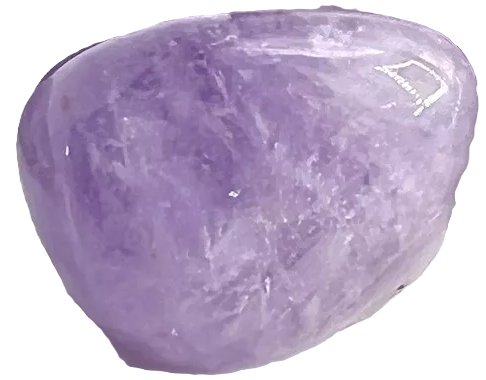
Few minerals bridge the boundary between geological wonder and spiritual serenity quite like Lavender Amethyst. While deep Siberian amethyst commands reverence with its royal, saturated purple, Lavender Amethyst—often called Rose de France in fine jewellery—offers a softer, crystalline brilliance. Its delicate violet, lilac, and orchid tones possess an ethereal translucence that captures light effortlessly.
Whether approached through the lens of petrology, lapidary craftsmanship, historical lore, or vibrational healing, this comprehensive guide explores the geology, mineralogy, myth, and practical application of this gentle quartz variety.
Alternate Names and Gemological Trade Terms
In the gem trade, marketing names often cause confusion among buyers and collectors. Lavender Amethyst has carried several descriptive and geographical titles across the centuries:
- Rose de France: The most prominent trade name in high-end jewellery, popularised during the Victorian and Edwardian eras. It specifically denotes pale lilac, lavender, or pinkish-mauve gem-grade quartz cut for faceted settings.
- Lilac Amethyst / Orchid Amethyst: Widely used commercial terms to differentiate soft pastel hues from dark violet stones.
- Pink Amethyst (Clarification): Often erroneously conflated with lavender quartz. Genuine Pink Amethyst—discovered in the El Chiquada mine in Patagonia, Argentina—derives its turbid, peachy-pink colour from microscopic haematite ($\text{Fe}_2\text{O}_3$) inclusions within the quartz matrix. Lavender Amethyst, by contrast, is true amethyst coloured by irradiated structural iron lattice substitutions.
- Lavender Quartz: A broad trade term that sometimes encompasses irradiated rose quartz or synthetic hydrothermal material. Genuine specimens should always be confirmed as natural macrocrystalline quartz.
The Stone’s Science and Composition
At its core, Lavender Amethyst belongs to the silicate mineral family. Its crystalline purity and unique pastel saturation arise from precise geochemical conditions during hydrothermal growth.
       [ Silicon Dioxide Matrix (SiO2) ]
                      │
   Trace Fe3+ Substitution at Silicon Sites
                      │
   Natural Gamma Irradiation from Host Rock
                      │
          [ [FeO4]0 Colour Centre ]
                      │
   Pale Lilac Hue (Low Iron Concentration)
- Chemical Formula: $\text{SiO}_2$ (Silicon Dioxide).
- Colouration Mechanism: The lilac coloration is produced by natural ionising radiation from radioactive isotopes in surrounding host rocks (such as $^{40}\text{K}$, $^{232}\text{Th}$, and $^{238}\text{U}$). This radiation interacts with trace trivalent iron ($\text{Fe}^{3+}$) substituting for silicon in the crystal matrix, ejecting an electron and forming a quadruply coordinated colour centre ($[\text{FeO}_4]^0$). In Lavender Amethyst, the concentration of iron substitutions or total absorbed radiation dose is lower than in deep purple specimens, yielding a delicate pastel tone rather than dark saturation.
- Crystal System: Trigonal (Hexagonal Trapezohedral class $32$). Crystals form six-sided prisms terminating in positive and negative rhombohedral faces ($r$ and $z$), often showing distinct growth twinning (Brazil-law twinning).
Key Physical Characteristics
| Gemological Property | Diagnostic Measurement / Specification |
| Mohs Hardness | 7.0 (resists dust scratches; durable for daily ring wear) |
| Refractive Index (RI) | $n_\omega = 1.544$, $n_\epsilon = 1.553$ (Birefringence: +0.009) |
| Specific Gravity (SG) | 2.651 to 2.655 |
| Optical Character | Uniaxial positive ($\text{U}+$), showing the classic quartz “bull’s-eye” interference figure under a polariscope |
| Luster | Vitreous to sub-vitreous on fracture surfaces |
| Cleavage & Fracture | No true cleavage; pronounced conchoidal fracture |
| Pleochroism | Weak to distinct: shifts between subtle reddish-violet and bluish-purple |
| Thermal Stability | Heat-sensitive: colour fades or alters to pale citrine or prasiolite between 300°C and 450°C |
Common Geologic Varieties
Lavender Amethyst exhibits several natural morphological forms:
- Chevron Lavender Amethyst: Characterised by alternating V-shaped bands of pale lilac amethyst and opaque white quartzite. This banding reflects episodic fluctuations in hydrothermal fluid chemistry and iron concentration during crystallisation.
- Spirit Quartz (Cactus Quartz): Rare formations predominantly sourced from the Magaliesberg region in South Africa. A large central prismatic crystal is encrusted with a second generation of hundreds of tiny, shimmering lavender termination points.
- Bicolour Ametrine with Lilac Zoning: Where hydrothermal growth conditions fluctuated in temperature and pH across growth sectors, natural crystals can exhibit adjacent sectors of pale lavender amethyst and golden-yellow citrine within a single crystal lattice.
- Geode Druzy Plates: Thick aggregations of thousands of miniature, interlocking pyramidal terminations that carpet the interiors of volcanic basalt vesicles.
Global Mining and Volcanic Sources
Natural amethyst crystallises in low-temperature hydrothermal veins and volcanic gas cavities (vesicles) deep underground.
+-------------------------------------------------------------------------+
|                  PRIMARY GLOBAL DEPOSITS                                |
|                                                                         |
|  [Brazil]               [Bolivia]              [Africa]                 |
|  - Rio Grande do Sul    - Anahí Mine           - Madagascar             |
|  - Paraná Basin Basalt  - Hydrothermal Veins   - Namibia (Brandberg)    |
|  - Massive Gas Geodes   - Bicolour Zones       - High Structural Purity |
+-------------------------------------------------------------------------+
1. The Paraná Basin, Rio Grande do Sul (Brazil)
The world’s most prolific source of amethyst geodes. Around 130 million years ago, extensive flood basalt volcanism during the opening of the South Atlantic Ocean trapped immense gas pockets. Silica-rich hydrothermal waters cooled over millennia, forming geode linings ranging from dark purple to light lilac.
2. The Anahí Mine (Santa Cruz, Bolivia)
Famous for structural purity, the hydrothermal limestone replacement deposits of the Anahí Mine yield stones with clean colour zoning, including exceptional Rose de France rough and natural ametrine.
3. Madagascar & Namibia
Namibian deposits (notably around the Brandberg massif) and Madagascan pegmatitic borders produce translucent, optical-grade crystals often displaying liquid inclusions, negative crystals, and ethereal phantoms.
Crystal Pairings: What to Combine and Avoid
Combining minerals in metaphysical practice requires matching structural, chemical, and energetic characteristics.
Optimal Crystal Pairings
- Rose Quartz ($\text{SiO}_2$ with Ti/Mn trace elements): The quintessential pairing for emotional harmony. Combining the heart-centred frequencies of Rose Quartz with the crown-activating energy of Lavender Amethyst bridges compassion and spiritual awareness.
- Selenite / Satin Spar ($\text{CaSO}_4 \cdot 2\text{H}_2\text{O}$): A natural energy conductor. Selenite clears energetic residue and maintains the subtle, airy vibration of pale amethyst without dulling its lustre.
- Lepidolite (Lithium Mica): Because both stones address overactive nervous systems, combining Lavender Amethyst with lithium-rich Lepidolite creates an effective energetic pairing for sleep support and easing anxiety.
- Clear Rock Crystal ($\text{SiO}_2$): Acts as a non-interfering amplifier, focusing intentions set within crystal grids or altar work.
Crystal Pairings to Avoid
- Red Jasper or Cinnabar: Heavily dense, fiery, lower-chakra stones can overwhelm the delicate, meditative frequency of Lavender Amethyst, creating discordant mental vibrations.
- Black Obsidian (in high-intensity shadow work): Obsidian abruptly pulls deep subconscious blockages to the surface. Lavender Amethyst encourages gentle, gradual release; pairing them can produce conflicting emotional states unless mediated by a neutral buffer like Smoky Quartz.
Archaeology, Art, and Ancient History
The cultural history of quartz extends back to the dawn of civilisation:
- Greco-Roman Intaglios: In classical antiquity, pale amethyst was highly valued by Roman lapidaries because its transparency allowed detailed intaglio portraits, seal stones, and mythological carvings without obscuring the underlying subject in dark shadow.
- Medieval Ecclesiastical Rings: Bishops and prelates frequently wore pale amethyst rings as symbols of spiritual devotion, purity, and piety, believing the stone’s lilac colour represented Christ’s passion and heavenly contemplation.
- Victorian “Rose de France” Renaissance: During the mid-to-late 19th century, jewellery designers moved away from heavy Victorian mourning jewellery toward romantic, floral pastel aesthetics. Cut into cushion, pear, and oval cuts, Rose de France became a central stone in ornate yellow gold and platinum filigree lavalieres, tiaras, and brooches.
Folklore, Legends, and Sacred Tales
- The Legend of Dionysus (Bacchus): Classical myth tells of a young maiden named Amethyste who, walking to the temple of Diana, crossed paths with an enraged Dionysus. Seeking to save her from the god’s fierce tigers, Diana transformed the maiden into a pillar of pure, crystalline quartz. Overcome with grief and remorse, Dionysus emptied his goblet of wine over the statue, tinting the quartz with shades of violet. In esoteric folklore, Lavender Amethyst represents the first drop of wine—symbolising forgiveness, temperance, and emotional restoration.
- The Stone of Temperance & Clarity: In Renaissance herbals and lapidaries (such as the writings of Camillus Leonardus in Speculum Lapidum, 1502), amethyst was recorded as a stone that sharpens the intellect, banishes idle illusions, and keeps the mind steady and composed in high-stakes negotiations.
Metaphysical and Mystical Healing Properties
While traditional royal amethyst operates with high intensity, Lavender Amethyst has a softer, more soothing energetic resonance:
[ Mental Realm ]       Eases overthinking, analytical paralysis, and anxiety.
[ Emotional Realm ]    Soothes grief, eases nervous tension, and nurtures patience.
[ Subtle Body ]        Cleanses the aura and dissolves energetic blockages without disorientation.
[ Dream State ]        Calms night terrors and promotes lucid, restorative sleep.
- Emotional Calming: Delivers a cool, stabilising resonance to turbulent thoughts, easing tension and helping calm panic reactions.
- Meditation and Intuitive Reception: Ideal for sensitive meditators who find deep purple quartz overly stimulating. It expands inner sight while preserving emotional grounding.
- Dream Work & Rest: Placed under a pillow or on a bedside table, its soft frequency encourages slow, deep sleep cycles while moderating intense dreams.
Astrological Connections
- Pisces (Ruling Element: Water): Strengthens natural intuitive and empathic faculties while preventing emotional depletion.
- Aquarius (Ruling Element: Air): Bridges intellectual analysis with emotional empathy, softening stubborn viewpoints and sparking inspired creativity.
- Virgo (Ruling Element: Earth): Calms habitual over-analysis and worry, helping quiet the inner critic and encouraging peace of mind.
The Chakra System
Lavender Amethyst interacts primarily with the upper energy centres:
                  ( ) Sahasrara (Crown Chakra)
                   │  - Violet / White Ray: Spiritual Connection
                   │
                  ( ) Ajna (Third Eye Chakra)
                   │  - Indigo / Lilac Ray: Subtle Intuition
                   │
                  ( ) Thymus (Higher Heart Chakra)
                      - Transmutation of Compassion & Release
- Crown Chakra (Sahasrara): Located at the crown of the head, this centre governs spiritual awareness and our connection to higher states of consciousness. Lavender Amethyst helps gently open this gateway, clearing stagnant thought patterns.
- Third Eye Chakra (Ajna): Encourages peaceful inner vision, enhances imagination, and deepens meditative focus.
- Higher Heart (Thymus Chakra): Positioned between the heart and throat chakras, it harmonises deep emotional vulnerability with genuine spiritual wisdom.
Interesting Facts
- Susceptible to Sun Bleaching: The $[\text{FeO}_4]^0$ colour centres in pale quartz are photochemically sensitive. Prolonged exposure to direct UV rays causes the iron ions to capture free electrons, reducing the colour centre and causing the lavender hue to fade back to clear or cloudy quartz over time.
- Heat Treatment Secrets: Heating pale amethyst to around 400°C–500°C alters the iron valence state entirely, turning the stone into a delicate mint-green prasiolite or golden citrine.
- Twinning Lines: Under cross-polarised light, Brazilian-law growth twinning creates distinctive dark and light “fingerprint” zebra stripes, serving as proof of natural origin versus synthetic hydrothermal lab-grown quartz.
Modern Milestones: Birthstones and Anniversaries
- February Birthstone: Alongside deep purple amethyst, Lavender Amethyst serves as an alternative birthstone for February, offering a lighter option for modern bespoke jewellery.
- 6th and 33rd Wedding Anniversaries: Traditionally presented as an anniversary gemstone, celebrating six years of enduring harmony, emotional balance, and shared affection.
Extensive Frequently Asked Questions (FAQ)
Is Lavender Amethyst a naturally occurring gemstone?
Yes. Genuine Lavender Amethyst is 100% natural macrocrystalline quartz, sharing the exact physical properties and chemical composition ($\text{SiO}_2$) of deep purple amethyst, with a lighter concentration of irradiated iron colour centres.
How does Lavender Amethyst differ from Rose de France?
They refer to the same variety of quartz. “Rose de France” is an established trade name traditionally reserved for pale lilac gems cut and faceted for fine jewellery, while “Lavender Amethyst” is common in mineral collecting, specimen display, and metaphysical practices.
Can Lavender Amethyst safely go in water?
Yes, for brief periods. With a Mohs hardness of 7 and an absence of cleavage, quartz is water-safe. It can be rinsed under cool running water. Avoid salt-water soaks, hot water, and abrasive chemical cleaners, which can degrade protective polishes and corrode underlying silver or gold jewellery mounts.
Why does Lavender Amethyst turn white or yellow?
When exposed to excessive heat or prolonged direct UV sunlight, the structural $[\text{FeO}_4]^0$ colour centres break down. Thermal energy or UV photons re-distribute electrons back to the iron site, stripping away the purple coloration and leaving behind clear, cloudy, or yellow quartz.
What is the safest way to cleanse and recharge Lavender Amethyst?
To protect its delicate colour centres from UV degradation, avoid solar charging. Cleanse your stone using moonlight, placing it on a selenite charging plate, passing it through botanical incense smoke, or using sound resonance from singing bowls and tuning forks.
