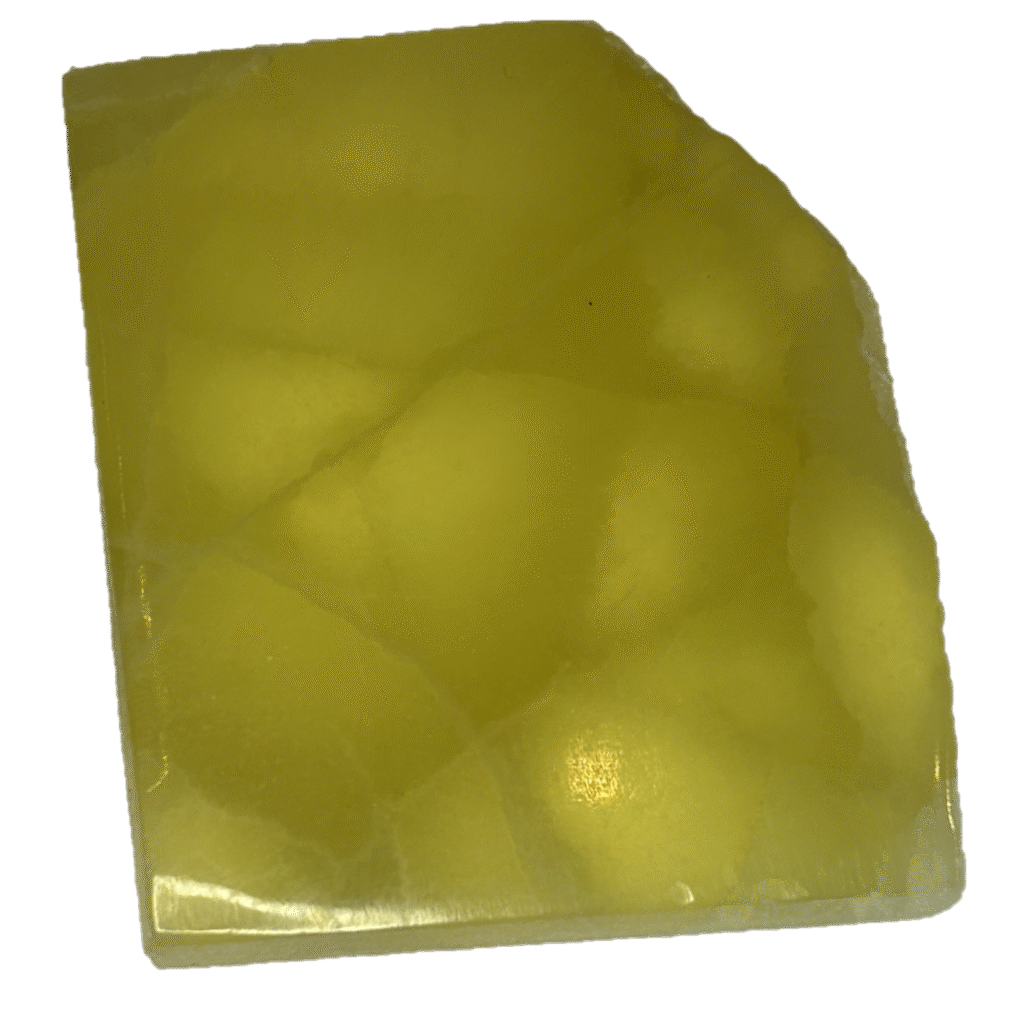
Lemon Calcite is a vibrant, translucent to opaque variety of calcium carbonate prized for its luminous, citrus-yellow glow. Known across mineralogical and lapidary circles for its signature “soapy” or waxy feel, this stone combines optical clarity with vibrant, sunny colouration. Metaphysically regarded as a premier stone of mental clarity, personal power, and optimism, Lemon Calcite bridges accessible mineral science with transformative energetic work.
Alternate Names & Trade Designations
While chemically classified simply as yellow calcite, the gemstone and mineral market recognises several regional and descriptive aliases:
- Citron Calcite: Common commercial label emphasising its zesty, sharp yellow tint.
- Yellow Calcite / Golden Calcite: Broader categorisations (though Golden and Honey Calcite generally exhibit deeper amber tones).
- Elestial Lemon Calcite: Specifically applied to layered, skeletal, or etched formations mined primarily in Pakistan.
- Butterscotch Calcite: Used for milky, pastel-yellow, banded specimens.
The Stone’s Science and Composition
Lemon Calcite is an abundant rock-forming mineral classified as a carbonate:
$$\text{CaCO}_3 \quad (\text{Calcium Carbonate})$$
Belonging to the trigonal crystal system, its crystal lattice consists of alternating calcium cations ($\text{Ca}^{2+}$) and carbonate anions ($\text{CO}_3^{2-}$). The bright yellow hue is primarily caused by trace iron inclusions ($Fe^{3+}$), microscopic organic matter, or naturally occurring structural lattice defects (colour centres) that absorb violet-blue light and reflect sunny yellow wavelengths.
Key Physical Characteristics
Lemon Calcite exhibits diagnostic traits crucial for lapidary identification:
| Property | Value / Measurement | Lapidary & Collector Relevance |
| Mohs Hardness | 3.0 | Extremely soft; easily scratched by a copper coin or steel blade. |
| Cleavage | Perfect Rhombohedral (3 directions at ~74.5°) | Fractures predictably into slanted rhombohedrons when struck. |
| Lustre | Vitreous to Resinous / Waxy | Often exhibits a distinct “soapy” tactile feel when handled. |
| Specific Gravity | 2.71 | Lightweight compared to lookalikes like Citrine ($2.65$) or Topaz ($3.5$). |
| Birefringence | 0.172 | High double refraction; clear cleavage rhombs visually double printed text. |
| Acid Reaction | Strong effervescence in dilute $\text{HCl}$ | Dissolves and fizzes rapidly when exposed to acidic liquids. |
Common Geologic Varieties
- Massive Lemon Calcite: Microcrystalline beds lacking distinct crystal faces; the standard source for tumbling, carvings, and spheres.
- Iceland Spar (Optical Yellow Calcite): Completely transparent rhombohedral cleavage blocks demonstrating extreme double refraction with a pale lemon tint.
- Banded / Travertine Calcite: Concentrically layered deposits formed in thermal springs or caves, showcasing alternating pale yellow, cream, and white bands.
- Dogtooth & Nailhead Spar: Scalenohedral and rhombohedral terminations found inside hydrothermal pockets and limestone vugs.
Global Mining and Volcanic Sources
Calcite forms across sedimentary, metamorphic, and hydrothermal environments:
- Pakistan (Balochistan): Premier exporter of high-grade, gemmy, translucent Lemon Calcite.
- Mexico (Chihuahua): Famous for vibrant yellow calcite crystals embedded within polymetallic hydrothermal vein systems.
- Madagascar: Produces rich, butter-yellow, massive deposits often carved into decorative spheres and obelisks.
- United States (Tennessee, Missouri, Kansas): Classic Mississippi Valley-type (MVT) lead-zinc deposits yielding sharp scalenohedral yellow crystals on limestone matrix.
Crystal Pairings: What to Combine and Avoid
Optimal Crystal Pairings
- Sunstone & Pyrite (Action & Solar Synergy): Combining Lemon Calcite with Sunstone and Pyrite creates an energising trifecta for the Solar Plexus, amplifying productivity and self-confidence.
- Clear Quartz (Amplification): Calcite’s natural energy is soft and diffuse; Clear Quartz acts as a directional lens to focus its mental-clarity attributes.
- Carnelian (Creative Ignition): Fuses the confidence of the 3rd Chakra with the generative, passionate drive of the 2nd (Sacral) Chakra.
- Black Tourmaline or Smoky Quartz (Stabilisation): Balances calcite’s high-vibrational cerebral optimism, preventing spacey or ungrounded mental hyperactivity.
Crystal Pairings to Avoid
- Deep Sleep Stones (e.g., Lepidolite, Selenite, Scolecited): Placing Lemon Calcite alongside high-melatonin, sedative sleep aids can counteract their tranquil frequencies, leading to restless or overactive dreaming.
- High-Intensity Volcanic Stones (e.g., Raw Black Obsidian): Obsidian’s abrupt, shadow-exposing friction can overwhelm Lemon Calcite’s gentle, mood-lifting frequencies, generating internal discord.
- Physical Hardness Incompatibility: Never tumble or store soft Lemon Calcite (Mohs 3) loose in the same pouch with Quartz (Mohs 7), Topaz (Mohs 8), or Corundum (Mohs 9), as it will be quickly scratched and dulled.
Archaeology, Art, and Ancient History
Calcite has served humanity since the dawn of civilisation. Ancient Egyptian artisans quarried vast deposits of banded calcite (often historically mislabelled as “Egyptian Alabaster”) from Hatnub to carve canopic jars, cosmetic vessels, and statues honouring the solar deities Ra and Horus. While deep golden calcite was reserved for sarcophagi and divine funerary items, pale yellow and lemon calcite varieties were chiselled into intricate drinking goblets and decorative palace inlays across Mesoamerica, Mesopotamia, and Minoan Crete.
Folklore, Legends, and Sacred Tales
Folklore long associated yellow-hued minerals with captured sunlight. Ancient travellers carried small rhombs of pale calcite as protective talismans against night terrors and melancholia, believing the stone stored the noon sun’s power to ward off spirits of gloom. In classical European folk magic, placing a piece of yellow calcite above the ledger or hearth was believed to draw household prosperity and prevent domestic disputes by “illuminating hidden grievances” with sweet reason.
Metaphysical and Mystical Healing Properties
- Emotional Resilience: Helps dispel depressive fog, chronic self-doubt, and lethargy.
- Mental Focus & Study Aid: Cleanses mental fatigue; ideal for students and professionals processing dense, complex material.
- Manifestation: Shifts focus away from scarcity toward decisive personal agency.
Astrological Connections
- Gemini (Primary): Calcite sharpens Gemini’s rapid-fire intellect while stabilising its tendency toward scattered thoughts and nervous exhaustion.
- Leo (Secondary): Harmonies with Leo’s solar affinity, stoking personal charisma, healthy leadership, and creative ambition without tipping into egoic pride.
The Chakra System
Lemon Calcite is universally tied to the Manipura (Solar Plexus Chakra), situated just above the navel:
- Center of Agency: Governs digestion, willpower, self-esteem, and autonomy.
- Energetic Action: Dissolves energetic blockages caused by past criticism or chronic impostor syndrome, replenishing the body’s internal battery.
- Secondary Resonance: When held during breathwork, its light hue reaches upward toward the Third Eye (Ajna), aligning intellectual vision with practical execution.
Additional Critical Guidance (Recommended Pillar Sections)
Safe Care, Cleansing, and Handling
Warning: Calcite is chemically fragile and water-sensitive.
- No Water Soaks: Extended water exposure dissolves its micro-surface polish; salt water will pit the stone irreversibly.
- Zero Acid Contact: Keep away from perfumes, citrus juices, vinegar, and household chemical cleaners.
- Cleansing Alternatives: Cleanse energetically using brown rice beds, sound baths (singing bowls, 528 Hz tuning forks), smoke cleansing (cedar, frankincense), or indirect moonlight.
How to Authenticate: Spotting Fakes and Lookalikes
- Dyed Crackle Quartz: Often sold as Lemon Calcite; look for deep dye concentrations along fracture lines. Quartz easily scratches glass; Calcite will not.
- Yellow Glass: Glass often contains circular air bubbles, conchoidal fractures without cleavage planes, and higher surface hardness (Mohs 5.5).
- Real Lemon Calcite: Rhombohedral cleavage breaks, waxy touch, acid reactivity, and low surface hardness (Mohs 3).
Interesting Facts
- The Double-Vision Stone: High-grade optical Iceland spar calcite can split light rays into two distinct paths, a phenomenon known as polarisation.
- The “Viking Sunstone” Connection: Historical sagas recount Viking navigators finding the sun through cloudy skies using Icelandic optical calcite.
- Biological Construction: The shells of marine mollusks, corals, and bird eggs are built from calcium carbonate polymorphs chemically identical to Lemon Calcite.
Modern Milestones: Birthstones and Anniversaries
- Birthstone Status: Recognised as an alternative, non-traditional astrological birthstone for Gemini (May 21 – June 20).
- Anniversaries: Frequently gifted on the 13th Anniversary as an energetic alternative to Citrine, representing renewed mental vitality, optimism, and unyielding illumination in long-term relationships.
Lemon Calcite Frequently Asked Questions
Is Lemon Calcite water-safe?
No. Lemon Calcite is slightly soluble in water, and extended soaking will dull its waxy finish, weaken its internal cleavage bonds, and create pitting. Quick rinses must be dried immediately with a soft microfiber cloth.
What is the difference between Lemon Calcite and Honey Calcite?
While both are varieties of calcium carbonate, their chemical trace elements and vibrational profiles diverge:
- Lemon Calcite: Sharp, bright yellow tone; focused on mental clarity, cognitive processing, and daytime energy.
- Honey Calcite: Rich amber-gold to brown; focuses on grounded leadership, personal boundaries, and long-term goal endurance.
How do I activate Lemon Calcite for study sessions?
Place a polished palm stone or tower on the north east corner of your desk. Before reading, hold the stone in your receptive (non-dominant) hand for 60 seconds, breathe deeply, and set the clear intention: “I absorb, comprehend, and retain this knowledge with ease.”
Can Lemon Calcite go in direct sunlight?
Brief exposure (15–30 minutes) is safe, but prolonged direct UV exposure will bleach the yellow colour centres over time, fading vibrant lemon specimens into dull white.
These are my personally selected and curated Lemon Calcite products