With their pale sky-blue hues and warm, golden-to-clear crystal formations, celestite and calcite geodes are among the most striking additions to any mineral collection. While they can occasionally resemble one another at a casual glance, they occupy entirely distinct branches of mineralogy—each defined by its own unique chemical architecture, crystal habits, and environmental sensitivities.
Understanding these differences is more than just an academic exercise; it is the key to preserving their natural lustre and structural integrity over time. Both minerals are relatively soft, highly reactive to everyday substances, and easily damaged by conventional cleaning techniques. Delving into the fundamental chemistry, identifying features, and tailored handling methods for both celestite and calcite ensures your specimens remain pristine display pieces for years to come.
1. Geological Overview and Mineral Chemistry
Celestite and calcite geodes differ fundamentally from quartz geodes in their chemical composition and crystalline systems. Instead of silicon dioxide (SiO2), these geodes form from sulphate and carbonate mineral solutions.
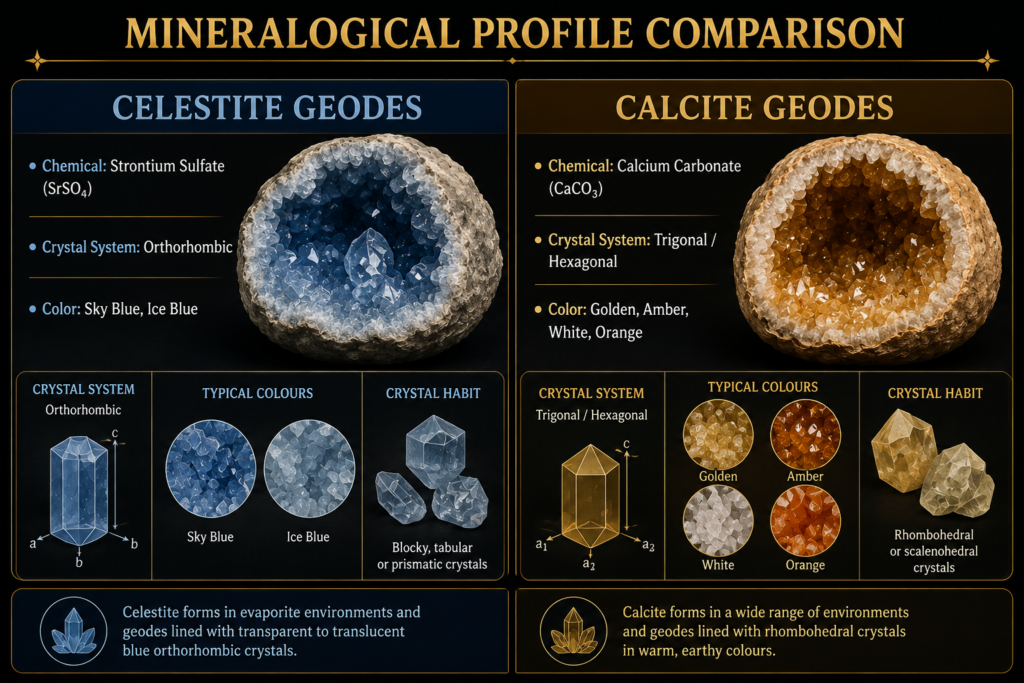
Celestite Geodes (SrSO4)
Celestite (also known as Celestite) is a strontium sulphate mineral named for its delicate sky-blue (celestial) colour.
- Formation Environment: Celestite geodes form primarily in sedimentary strata—particularly within dolomitised limestone’s, gypsum beds, and evaporite deposits. Strontium-rich marine groundwater percolates through rock voids, precipitating tabular, blocky orthorhombic crystals as temperature and salinity conditions shift.
- Primary Sources: The world’s premier source for gem-grade sky-blue celestite geodes is Sakoany in the Majunga Basin of Madagascar. High-clarity tabular specimens also originate from Morocco and Ohio, USA.
Calcite Geodes (CaCO3)
Calcite is a calcium carbonate mineral renowned for displaying the widest variety of crystal habits of any mineral on Earth—with over 800 distinct forms recorded.
- Formation Environment: Calcite geodes form in both sedimentary limestone beds and volcanic basalt flows. Calcium-saturated groundwater or low-temperature hydrothermal fluids deposit carbonate minerals inside cavities, forming distinct rhombohedral (blocky/diamond) or scalenohedral (“dog tooth spar”) crystals.
- Primary Sources: Exceptional calcite geodes originate from the Keokuk region (Iowa/Illinois/Missouri, USA), Rio Grande do Sul (Brazil), Chihuahua (Mexico), and Somerset (UK).
2. Physical Characteristics & Fragility Comparison
Understanding the structural vulnerabilities of celestite and calcite is essential for anyone handling or displaying these specimens.
| Physical Property | Celestite Geodes | Calcite Geodes | Quartz/Amethyst Geodes (Reference) |
|---|---|---|---|
| Chemical Formula | Strontium Sulphate (SrSO4) | Calcium Carbonate (CaCO3) | Silicon Dioxide (SiO2) |
| Mohs Hardness | 3.0 – 3.5 (Very Soft) | 3.0 (Very Soft) | 7.0 (Hard) |
| Cleavage | Perfect in 3 directions (Perfect {001}, Good {210}) | Perfect basal/rhombohedral in 3 directions ({1011}) | None (Conchoidal fracture) |
| Density / Weight | High (Specific Gravity ~3.96; surprisingly heavy) | Moderate (Specific Gravity ~2.71) | Moderate (Specific Gravity ~2.65) |
| Acid Sensitivity | Low | High (Effervesces/dissolves in dilute HCl or vinegar) | None |
| Sunlight/Heat | Fades under strong UV/sunlight | Heat sensitive; prone to cleavage shock | Amethyst fades; Clear quartz unaffected |
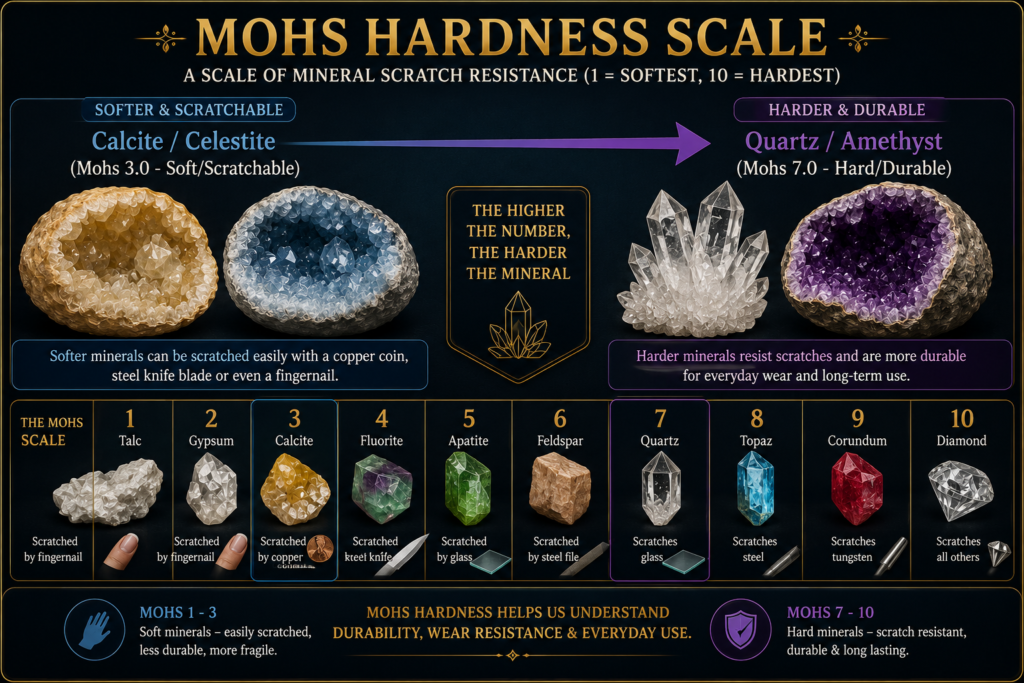
Why Celestite is Deceptively Heavy
One diagnostic trait of celestite geodes is their surprising weight. Because strontium (Sr) is a heavy alkaline earth metal, celestite has a specific gravity of nearly 4.0—making a celestite geode feel considerably denser and heavier in the hand than a quartz or calcite geode of equal size.
3. Structural Vulnerabilities and Hazards
Because of their soft, highly cleavable crystal structures, celestite and calcite geodes face three main structural risks:
A. Mechanical Shock and Cleavage Splitting
Both minerals possess perfect 3-directional cleavage. This means that sudden impact, vibration, or dropping a specimen will not cause a random crack; instead, the crystal structure will sheer cleanly along internal atomic planes, shattering fragile point terminations into flat, useless shards.
B. Thermal Shock and Crystal Cracking
Celestite and calcite have high thermal expansion coefficients. Moving a specimen rapidly between cold outdoors and a hot indoor environment—or washing it in hot water—causes differential expansion that triggers internal fracturing and cloudy cleavage planes.
C. Chemical Vulnerability
- Calcite & Acids: Calcite reacts violently with acid. Cleaning a calcite geode with acidic bath cleaners, vinegar, or harsh descaling chemicals will permanently dissolve the crystal faces, turning crisp, shiny points into dull, chalky blobs.
- Celestite & Water Soluble Impurities: While celestite is only sparingly soluble in water, long exposure to standing water can dull the vitreous, glass-like lustre of delicate tabular points.
4. Preservation, Cleaning, and Display Protocols
To maintain the brilliant blue lustre of celestite or the crisp golden geometry of calcite geodes for generations, adhere to these preservation rules:
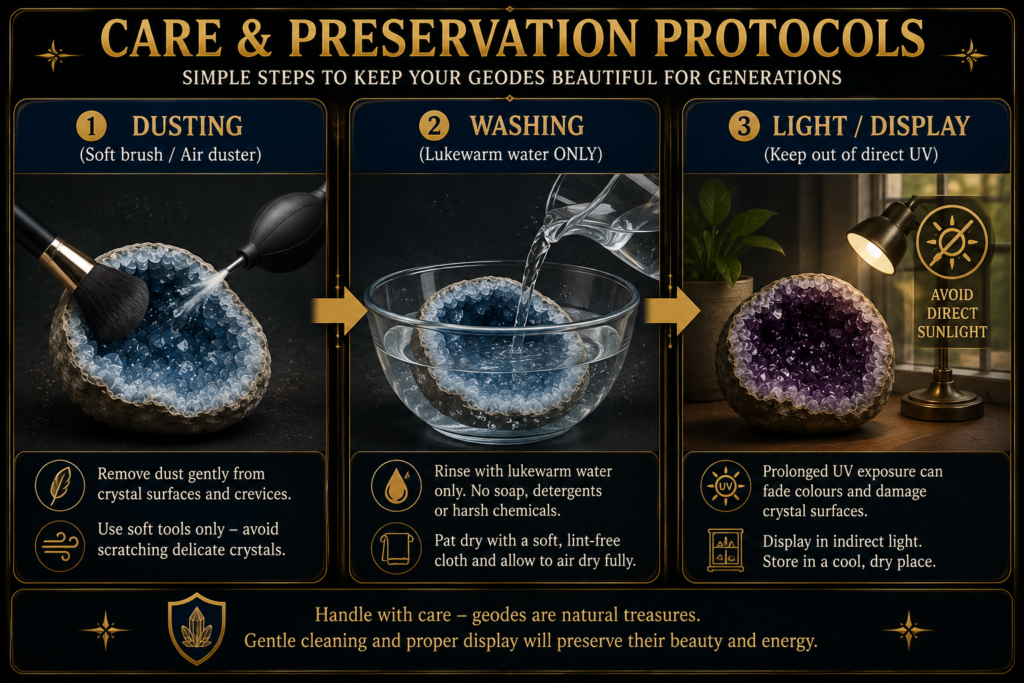
Cleaning Protocol
- Dry Cleaning (First Choice): Use a soft, natural-bristle paintbrush, makeup brush, or canned compressed air to clear dust from between delicate crystal points.
- Wet Cleaning (When Necessary): Rinse briefly with lukewarm or cool distilled water and mild, pH-neutral soap. Never use hot water, vinegar, or chemical solvents.
- Drying: Blot gently with a lint-free microfiber towel and allow to air-dry completely in a warm room. Never use a high-heat blow dryer.
Display Environment Rules
- Avoid Direct Sunlight: Celestite geodes—like amethyst—can fade or lose their delicate sky-blue saturation under prolonged exposure to direct sunlight and strong ultraviolet (UV) rays. Display them on interior shelves away from sunny window sills.
- Stable Mounting: Place specimens on padded, stable bases or custom acrylic display cradles to prevent accidental tipping.
- Humidity & Dust Protection: Display delicate, high-value specimens inside glass display cabinets to minimise dust accumulation and shield against accidental physical contact.
Summary Checklist for Collectors
- Celestite Geodes: Soft (Mohs 3.0–3.5), heavy, sky-blue tabular crystals; sensitive to sunlight and impact; premier source is Madagascar.
- Calcite Geodes: Soft (Mohs 3.0), light to golden rhombohedral/scalenohedral points; highly reactive to acids; requires gentle, chemical-free care.
- Handling Golden Rule: Never scrub with hard brushes, never expose to acidic cleaners, and always support the base of the geode with both hands.
Frequently Asked Questions
What distinguishes celestite and calcite geodes from quartz geodes in terms of composition and crystals?
Celestite geodes are strontium sulphate (SrSO4) and calcite geodes are calcium carbonate (CaCO3), forming from sulphate and carbonate mineral solutions rather than silicon dioxide. They also exhibit different crystal systems and habits compared with quartz geodes.
How soft and fragile are celestite and calcite geodes compared to quartz geodes?
Celestite geodes have a Mohs hardness of 3.0–3.5 and calcite geodes have a hardness of 3.0, making them very soft relative to quartz and amethyst, which are around 7.0 on the Mohs scale. They are highly cleavable and sensitive to chemical, thermal, and environmental stress.
What are the main vulnerabilities of celestite and calcite geodes that collectors should avoid?
The three main vulnerabilities are mechanical shock and cleavage splitting.
Additionally, sudden impact can cause clean shear along internal planes.
Rapid temperature changes can cause internal fracturing.
Additionally, acids or improper cleaning can damage calcite faces.
Finally, celestite surfaces can become dull.
How should celestite and calcite geodes be cleaned and maintained to preserve their lustre and shape?
Cleaning should start with dry cleaning using a soft brush or compressed air.
If washing is necessary, rinse briefly with lukewarm or cool distilled water. Additionally, use a mild, pH-neutral soap, never hot water or acids. Keep the rinse brief and avoid soaking the item. Do not expose it to direct heat.
Dry by blotting and air-drying in a warm room, and avoid high-heat dryers. If possible, place the item on a soft surface away from direct sunlight. This helps prevent heat damage and preserves lustre.
What display and storage practices help protect celestite and calcite geodes from degradation?
Display them away from direct sunlight to prevent fading.
Place them on padded, stable bases or display cradles.
Use glass display cabinets to minimise dust and accidental contact, ensuring stable mounting and gentle handling.