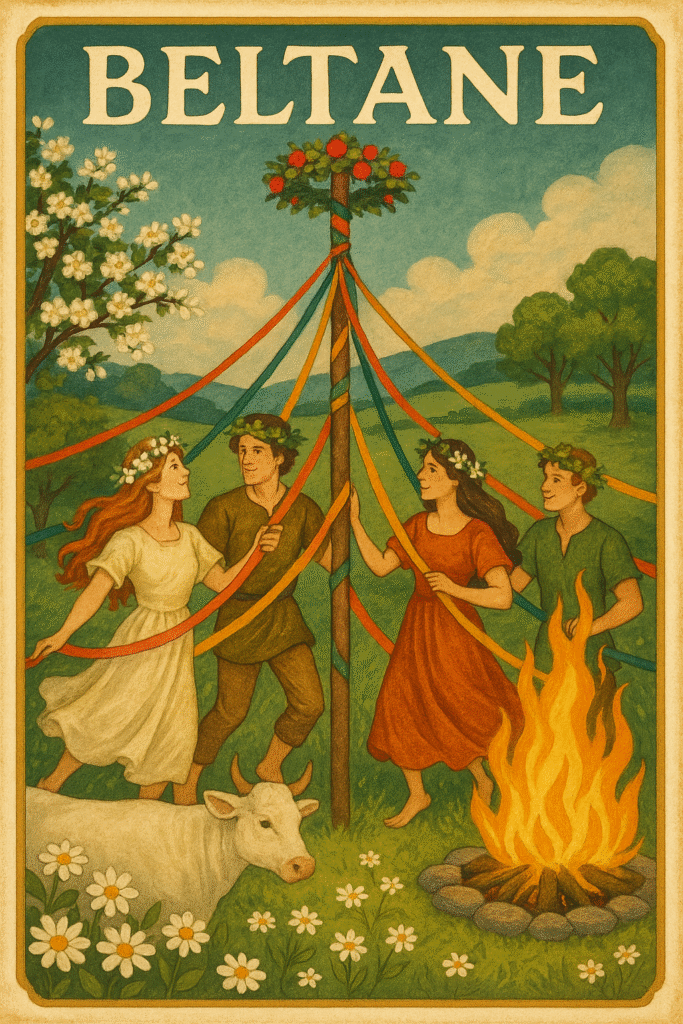
Beltane, traditionally celebrated on 1st May, is one of the four major fire festivals on the ancient Celtic wheel of the year, alongside Samhain, Imbolc, and Lammas. Marking the exact midpoint between the spring equinox and the summer solstice, Beltane heralds the height of spring and the arrival of summer.
Rooted deeply in Celtic history, this seasonal festival honours fertility, growth, and the sacred union of earth energies. In contemporary Pagan and Wiccan practices, the Beltane festival remains a vibrant celebration of life, passion, and the blossoming of nature.
Historical Origins of Beltane
The name “Beltane” derives from the Old Irish Beltene, which translates to “bright fire” or “Bel’s fire”. This is a direct reference to the Celtic sun god Belenus, who was widely associated with light, healing, and the sun.
The festival is identical to the traditional Welsh celebration of Calan Mai (the first day of summer). In pre-Christian Gaelic societies, Beltane marked the crucial beginning of the pastoral summer season when livestock were moved to high summer pastures.
Historical records describe rituals where cattle were driven between two large bonfires. This practice was believed to provide magical protection against disease and ensure fertility for the coming farming year. Communities gathered on historic hilltops, such as the Hill of Uisneach in Ireland, to light sacred fires that could be seen for miles. While these practices were suppressed during Christianisation, local Beltane customs persisted for centuries in the folklore of Ireland, Scotland, and the Isle of Man.
Calon Mai
In Wales, the Celtic festival of Beltane is known as Calan Mai (the first day of May) or Calan Haf (the first day of summer). While it shares identical ancient roots with the Gaelic Beltane—focusing on fire, the awakening of the land, and livestock fertility—the Welsh tradition has its own distinct, beautiful, and sometimes brilliantly eccentric customs.
See my in-depth article about Calon Mai
Key Beltane Folklore and Symbolism
Beltane folklore is rich with symbols that celebrate the union of opposites and the natural fertility of the earth.
- The Maypole: As a central symbol of May Day and Beltane traditions, the maypole represents the generative force of nature. The ribbons spiralling around the pole symbolise the weaving together of masculine and feminine energies.
- The Green Man and the May Queen: These two iconic figures personify seasonal energies. The Green Man represents wild nature, virility, and the woodlands, while the May Queen embodies growth, beauty, and the earth’s fertility. Their symbolic marriage reflects the harmony between earth and sky.
- Sacred Bonfires: Fire is the ultimate purifying element of the festival. Leaping over the flames or walking through the smoke was traditionally believed to bring good luck, health, and protection.
- Hawthorn and Rowan Trees: These plants hold a sacred place in May rituals. Hawthorn blossoms—often simply called “May”—were traditionally gathered to decorate homes, while rowan branches were crafted into protective charms.
Modern Beltane Rituals and Traditions
Today, modern Pagan, Wiccan, and secular communities celebrate Beltane with lively outdoor gatherings that focus on creativity and community connection.
1. Fire Ceremonies
Bonfires are lit at dusk, frequently accompanied by drumming, dancing, and intentional offerings. Participants still leap over smaller embers to symbolise personal renewal, shedding old habits to embrace summer’s growth.
2. Handfasting Ceremonies
Because Beltane is deeply tied to love and fertility, it is a peak season for handfasting. These traditional Celtic marriage ceremonies involve binding a couple’s hands together with coloured ribbons or cords to symbolise their commitment.
3. Maypole Dancing
Communities gather to dance in intricate, overlapping patterns around the maypole. This communal dance visually weaves the energy of the changing seasons and brings people together in celebration.
4. Nature Immersion and Floral Offerings
Celebrants spend time in woodlands and meadows, gathering spring flowers like bluebells and primroses. Altars are beautifully adorned with these blossoms alongside seasonal foods like honey, wine, and fresh fruit.
Symbolic Gift-Giving and Crafts
While gift exchange was not a primary feature of ancient celebrations, modern practitioners often share handmade tokens of seasonal energy:
- Floral Crowns: Garlands woven from fresh wildflowers are worn during rituals or gifted to loved ones to celebrate spring’s peak.
- Herbal Bundles: Dried sprigs of hawthorn, rose, and mugwort are tied together for use in protection charms or dreamwork.
- Crystals: Stones aligned with the solar energy of the festival—such as carnelian (creativity), garnet (passion), and emerald (abundance)—are shared to support personal transformation.
- Beeswax Candles: Natural candles are gifted to represent the element of fire, bringing warmth and light into the home.
Frequently Asked Questions
When is Beltane celebrated?
Beltane is traditionally celebrated on 1st May in the Northern Hemisphere. Some practitioners choose to celebrate it astronomically when the sun reaches 15 degrees of Taurus, which usually falls around 5th May to 7th May.
What is the difference between Beltane and May Day?
Beltane is the ancient Celtic religious and spiritual festival centered on fire, fertility, and the sun god Belenus. May Day is the broader, secular European folk holiday celebrated on the same date, famous for maypole dancing, Morris dancing, and crowning a May Queen.
Why is hawthorn associated with Beltane?
Hawthorn blooms in May, earning it the common nickname “the May-tree”. In Celtic folklore, it is deeply connected to the fae (fairies) and represents the blooming fertility of spring. However, bringing hawthorn inside before May Day was historically considered bad luck.
Conclusion
Beltane is a joyful celebration of life’s exuberance, inviting us to honour the fertility of the earth and the creative power within ourselves. Whether through a large community fire ceremony, dancing around a maypole, or a quiet walk through a blooming forest, this ancient festival remains a potent reminder of the cyclical dance of light, warmth, and natural renewal.