
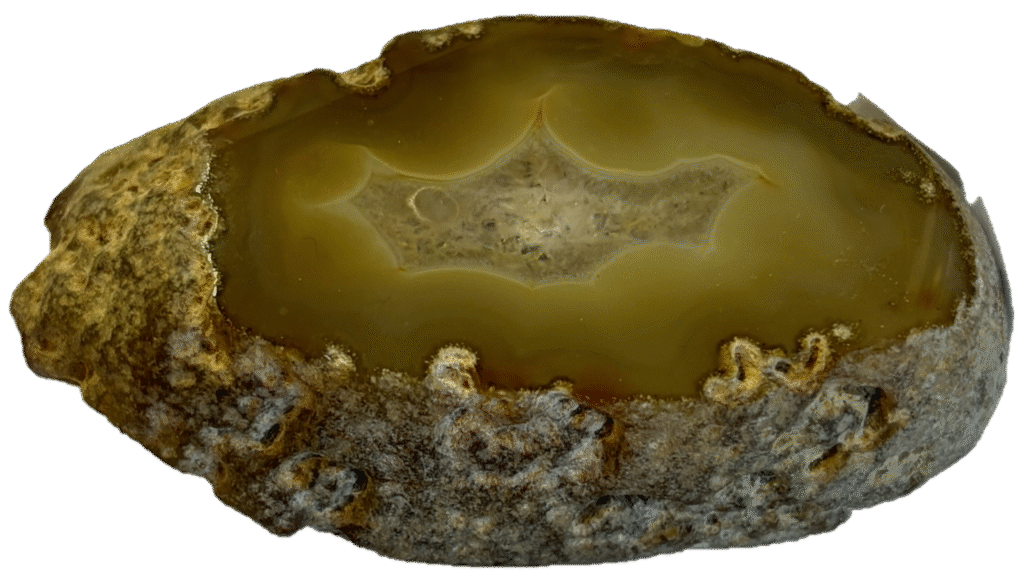
Theophrastus, a Greek philosopher, named Agate after discovering the gem along the banks of the river Achates (now called Cirilo) in Ragusa, Sicily, during the 4th century BC. The Bible later referenced the gemstone as one of the stones of fire.
Composition and Structure
Agate, a variety of chalcedony, belongs to the cryptocrystalline form of quartz. It primarily consists of silicon dioxide (SiO₂), distinguished by its fine banding and translucency. Silica deposits from groundwater gradually form these bands inside igneous rock cavities, creating the layered appearance unique to Agate.
Many Agates develop in molten rock cavities, where trapped gas bubbles make way for alkali- and silica-rich solutions. As layers form, Agate takes shape as a banded round nodule, similar to tree rings. One well-known type, Riband Agate, displays intricate bands of colour.
Locations and Sources
Agate is found worldwide, with significant deposits in:
- Brazil – A major producer, particularly of large and vividly coloured specimens.
- Uruguay – Noted for its high-quality geodes and stalactitic formations.
- India – Famous for banded and fortification agates.
- United States – Montana, Oregon, and South Dakota are known for their unique varieties such as moss agate and blue lace agate.
- Mexico – Renowned for fire agate, which exhibits an iridescent play of colour.
- Germany – The Idar-Oberstein region historically produced fine agate for ornamental use.
Physical Characteristics
- Colour: Agate comes in a range of colours, including white, grey, blue, green, red, and brown, often with distinctive banding.
- Hardness: It ranks 6.5–7 on the Mohs scale, making it relatively durable.
- Transparency: Typically translucent, though some varieties can be opaque.
- Lustre: Waxy to vitreous.
- Fracture: Conchoidal, producing a smooth, curved break.
Historical Use and Archaeological Discoveries
Since antiquity, people have used Agate for both decorative and practical purposes. Archaeologists have uncovered ancient Agate objects, including seals, jewellery, and ceremonial items.
Legends and Mystical Properties
Myths describe Agate as a stone that enhances charm and likability. Many believe it quenches thirst, protects against illnesses such as fevers, and cures insomnia. Some tribes in Brazil credit Agate with the ability to neutralise scorpion stings and venomous snake bites.
Muslim traditions often feature Agate in rings worn on the right hand, inscribed with the name of Allah, Ali, or one of the twelve Imams, serving as a spiritual protector.
Agate in Ancient Civilisations
Neolithic cultures crafted objects from Agate. Sumerians used Agate in seals, necklaces, and signet rings, often pairing it with other stones to ward off the curses of Goddess Lamashtu, known for threatening newborns. In the Epic of Gilgamesh, the garden of the Gods gleamed with agate-like dewdrops.
Mithridates, the Greek king of Pontus, amassed a collection of four thousand Agate bowls. In Greek mythology, Agate connects to Gaia, the goddess of Earth, and Nyx, the goddess of night. Byzantine artisans valued Agate for crafting ornamental cups, many of which remain in European museums.
Agate in Welsh and Chinese Traditions
In Wales, Agate is linked to Ceridwen, goddess of death and fertility. As queen of the west, of water, and of autumn, she embodies transformation and magic.
Ancient Chinese legends describe Agate as originating from the brain of a fossilised horse. During the reign of the Yellow Emperor (2500–2600 BC), some believed Agate formed from the crystallisation of spilled blood. The Han Dynasty (25–220 BC) revered Agate, especially red varieties, for their striking beauty.
Persian, Roman, and Mystical Associations
Persian magicians burned Agate to dispel storms. Romans associated Agate with Aurore (Aurora), goddess of dawn and mother of the winds, and Bona Dea, protector of women and virtue. Romans also believed Agate held healing properties, mixing it with water to cure snake bites.
Interesting Facts
- Agate has been used for centuries to craft goblets, bowls, and even entire tabletops.
- Some cultures believed that agate could make warriors invisible in battle.
- The Idar-Oberstein region in Germany became a centre for agate cutting due to local discoveries and expertise passed down through generations.
- The patterns within some agates, such as dendritic and moss agate, resemble landscapes or trees, making each piece unique.
Folklore, Legends, and Tales
Agate has been associated with mystical properties across cultures. Some ancient beliefs include:
- Greek Mythology – Agate was believed to bring strength and courage to warriors.
- Persian and Islamic Traditions – Agate was worn as a talisman to guard against the evil eye.
- European Folklore – People carried agate amulets to attract good fortune and harmony.
- Native American Legends – Some tribes considered agate a stone of connection to the Earth’s spirit, using it in healing ceremonies.
Astrological and Zodiac Associations
Agate is connected to multiple zodiac signs, each linked to different varieties:
- Gemini – Enhances communication and balance.
- Virgo – Promotes analytical thinking and emotional stability.
- Capricorn – Offers grounding energy and perseverance.
- Scorpio – Encourages transformation and protection.
Chakra System Connections
Different types of agate are believed to resonate with specific chakras:
- Blue Lace Agate – Throat chakra, aiding communication.
- Moss Agate – Heart chakra, encouraging emotional healing.
- Fire Agate – Root chakra, igniting passion and motivation.
- Black Agate – Base chakra, offering grounding and stability.
Crystal Pairings
Agate is a stabilising, grounding crystal that harmonises well with many stones. Because Agate comes in numerous varieties, pairings can vary slightly, but the following combinations are generally popular.
Crystals That Pair Well with Agate
- Amethyst Agate’s grounding energy complements Amethyst’s spiritual and calming qualities, creating a balanced combination for emotional stability and intuition.
- Clear Quartz Clear Quartz amplifies the energy of Agate and can enhance its soothing and balancing properties.
- Rose Quartz This pairing encourages emotional healing, self-love, compassion, and inner peace.
- Citrine Agate provides grounding while Citrine brings optimism, confidence, and abundance, making them a good combination for motivation and positivity.
- Black Tourmaline Together they create a strong protective and grounding energy, helping to shield against negativity.
- Carnelian Agate’s stabilising influence balances Carnelian’s vibrant and motivating energy, promoting confidence without becoming overwhelming.
- Labradorite A popular pairing for those seeking spiritual growth while remaining grounded and protected.
- Moonstone Agate’s steady energy complements Moonstone’s intuitive and feminine qualities, creating emotional balance.
- Hematite Both stones are highly grounding and can help improve focus, concentration, and emotional resilience.
- Selenite Selenite helps cleanse and recharge Agate while promoting clarity and spiritual awareness.
Crystals Commonly Avoided with Agate
There are no strict rules about crystals that must never be paired with Agate. However, some practitioners find that certain combinations can create conflicting energetic intentions.
- Moldavite Moldavite’s intense transformational energy can feel overwhelming when paired with Agate’s slow, stabilising vibration. Some people prefer to use them separately depending on their goals.
- Phenacite Similar to Moldavite, Phenacite is associated with very high-frequency energy that may not align with Agate’s gentle grounding nature.
- Herkimer Diamond Although not necessarily incompatible, Herkimer Diamond strongly amplifies energy and may overshadow Agate’s subtle balancing effects.
High-Energy Stimulation Combinations If using Agate specifically for relaxation and grounding, combining it with multiple highly stimulating stones such as Moldavite, Phenacite, and Libyan Desert Glass may dilute the calming effect you are seeking.
Best Crystal Pairings for Agate by Intention
| Intention | Crystal Pairing |
| Protection | Black Tourmaline, Hematite |
| Calm & Stress Relief | Amethyst, Lepidolite |
| Love & Compassion | Rose Quartz |
| Confidence | Carnelian, Citrine |
| Spiritual Growth | Labradorite, Moonstone |
| Grounding | Smoky Quartz, Hematite |
| Energy Amplification | Clear Quartz |
| Cleansing | Selenite |
Birthstone and Wedding Anniversary Links
- Birthstone: Agate is an alternative birthstone for May and June.
- Wedding Anniversary: Traditionally associated with the 14th wedding anniversary, symbolising strength and durability in a relationship.
Agate Frequently Asked Questions (FAQ)
What is the origin and meaning of Agate?
- Origin: The name comes from the Achates River (now the Dirillo River) in Sicily, where the Greek philosopher Theophrastus reportedly discovered the stone around 350 BCE.
- Meaning: In crystal practices, it is often referred to as the “stabiliser.” It is widely believed to harmonise energies, reduce stress, and protect against negative influences.
What are the different types of Agate?
Because of varying trace minerals and formation conditions, there are literally dozens of unique types
Is Agate durable for everyday jewellery?
Yes, it is highly durable. Agate rates between 6.5 and 7 on the Mohs Hardness Scale, making it resilient enough for daily-wear items like rings and bracelets, while being less prone to scratching than softer stones like opals.
How do you care for an Agate crystal?
- Cleaning: Gently wash with warm, soapy water and a soft brush. Avoid harsh chemical cleaners or prolonged submersion in water.
- Cleansing: In metaphysical traditions, crystals need energetic cleansing. You can cleanse your agate using sage smoke, moonlight, or by placing it near a cluster of selenite or clear quartz.
Can Agate be faked or treated?
Yes. Agates are frequently dyed or heat-treated to accentuate or alter their natural colors. For example, a deeply bright “electric” blue or vivid pink usually indicates an artificial dye. While heating is a permanent structural change, some dyed stones may fade when exposed to prolonged, direct sunlight.
My personally selected Agate products
Products by Category
-
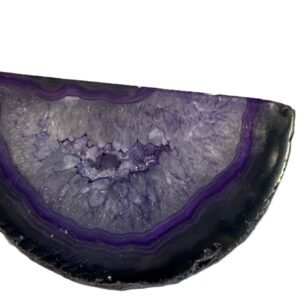
Purple Agate Quarter Geode no 14
£10.00 -

Small Blue Banded Agate Tumble stone
£1.00 -

Small Brown Banded Agate Tumblestone
£1.00 -
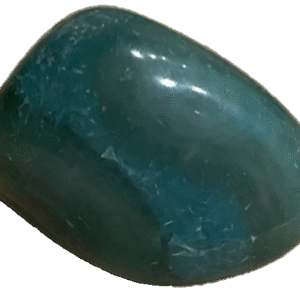
Small Green Banded Agate Tumble stone
£1.00 -

Small Pink Banded Agate Tumble stone
£1.00 -

Small Purple Banded Agate Tumblestone
£1.00 -

White Agate Polished Point tower AGD
£12.50
