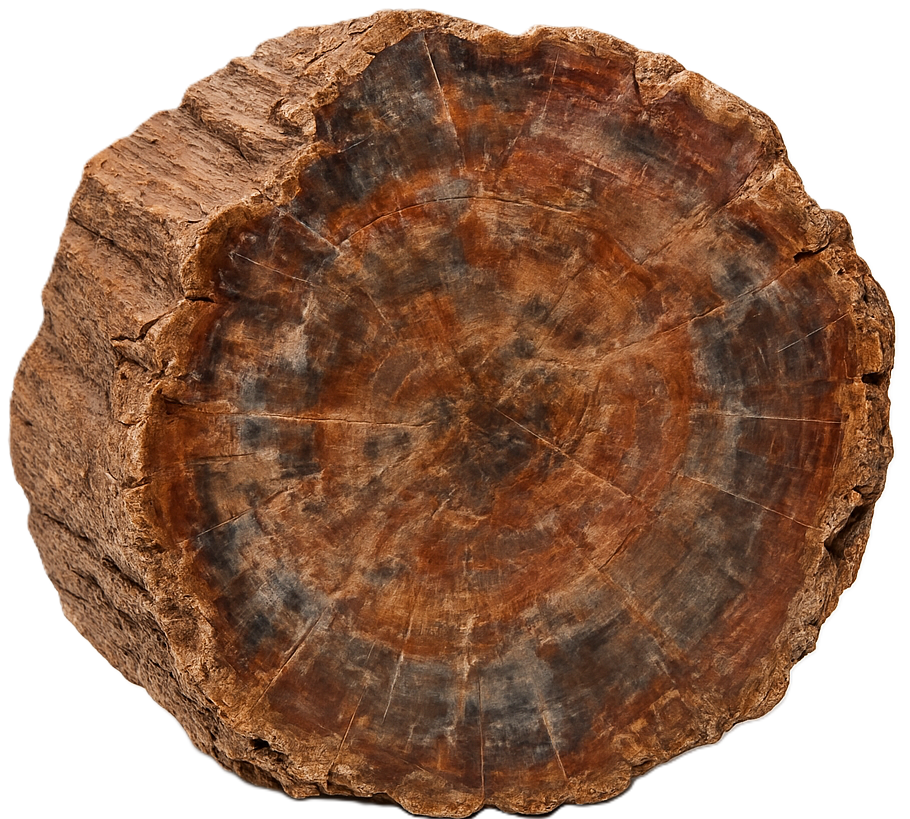
Fossilised wood, often referred to as petrified wood—is a captivating geological marvel that bridges the gap between ancient biology and modern archaeology. Formed through millions of years of intense geological pressure, this material transforms prehistoric trees into solid stone.
Today, it is highly revered by scientists, mineral collectors, and spiritual practitioners alike. Here is a comprehensive look into how fossilised wood forms, its historical significance, and its enduring symbolic power.
What Is Fossilised Wood and How Does It Form?
Fossilised wood consists of the preserved remains of trees or woody plants that have undergone a complex mineralisation process over millions of years. This incredible natural transformation relies on two distinct scientific phases:
- Permineralisation: Mineral-rich groundwater saturates the dead wood, filling the pores and cavities with dissolved elements like silica, calcite, or pyrite.
- Replacement: Over vast stretches of time, the plant’s original organic cellular structure decays and is entirely substituted by stone, perfectly retaining the original wood grain, bark textures, and growth rings.
The result is a highly durable, rock-like specimen. Depending on the specific trace minerals present during its formation, the stone can display vivid colours ranging from deep, earthy browns to brilliant reds, blues, and greens.
Main Types of Fossilised Wood
Not all mineralised wood forms in the same way. Geologists classify fossilised wood into several distinct types based on their environment and preservation style:
Petrified Wood
This is the most common form. It is fully mineralised, incredibly dense, and typically discovered in ancient volcanic ash beds or floodplains where wood was quickly buried away from oxygen.
Mummified Wood
Unlike petrified specimens, mummified wood is preserved without significant mineralisation. Found primarily in freezing or extremely arid environments, these specimens retain their original organic cells and tissues, making them invaluable to climate researchers.
Submerged Forests
These are intact tree remains that were swallowed by the sea due to marine transgression. They provide crucial timelines for scientists studying post-glacial sea-level changes.
(Note: Botanists also classify these ancient specimens by their evolutionary lineages, using terms like Araucarioxylon for ancient pine relatives, Palmoxylon for palm-like structures, and Castanoxylon for chestnut ancestors.)
Historical and Scientific Significance
Fossilised wood provides geologists and palaeobotanists with a tangible archive of prehistoric ecosystems. These stones help scientists reconstruct ancient climates, track historical shifts in global vegetation, and analyze ancient ecological dynamics.
Several world-famous deposits include:
- The Petrified Forest National Park (Arizona, USA): A vast, world-renowned deposit of Late Triassic wood showcasing vibrant, technicolour silica mineralisation.
- Craigleith Quarry (Scotland): Home to Pitys withamii, a remarkable 330-million-year-old fossil tree dating back to the Carboniferous period.
- Axel Heiberg Island (Canada): A high Arctic site famous for its mummified forests, offering precise snapshots of ancient greenhouse climates.
Modern Uses and Applications
Because of its unique durability and aesthetic variety, fossilised wood is highly sought after across several major industries:
- Scientific Research: Serving as a primary resource for palaeobotany and paleoclimate modelling.
- Collecting and Museums: Highly prized as display specimens for natural history exhibits and private mineral collections.
- Jewellery and Lapidary Arts: Frequently cut, shaped, and polished into stunning cabochons, beads, and statement pendants.
- Interior Design: Sliced into large slabs to create luxury tabletops, tiles, backsplashes, and ornamental sculptures.
Symbolism, Folklore, and Metaphysical Properties
Beyond its scientific value, fossilised wood has been steeped in folklore, superstition, and spiritual practices for centuries. Ancient cultures frequently buried pieces near their homes to ward off negative energies and connect with nature spirits.
Holistic & Metaphysical Benefits
In modern crystal healing and energy work, fossilised wood is championed as a premier grounding stone:
- Chakra Alignment: It strongly resonates with the Root Chakra (Muladhara), anchoring spiritual energy and promoting emotional stability.
- Transformation & Resilience: Because it represents an organic object that endured the test of time to become unbreakable, it symbolizes long-term growth, endurance, and overcoming adversity.
- Ancestral Memory: Many practitioners use it during meditation to tap into ancient Earth wisdom, unlock akashic records, or aid in past-life recall.
Zodiac Associations
Fossilised wood aligns beautifully with the practical, grounded energies of Earth signs:
- Virgo: Enhances natural patience, organisation, and practicality.
- Capricorn: Supports long-term ambitions, structural discipline, and perseverance.
- Taurus: Deepens the physical connection to the natural world and emotional well-being.
Quick Facts About Fossilised Wood
- Mineral Variety: A single piece of fossilised wood can contain up to 40 different trace minerals, though silica (quartz) is the primary component.
- Dendrochronology: Many specimens retain pristine growth rings, allowing scientists to calculate the exact age and seasonal weather patterns of a tree that lived millions of years ago.
- Incredible Age: The oldest known examples of fossilised wood date back well over 300 million years, predating the rise of many dinosaurs.
These are my personally selected and curated Petrified Wood project