In the vast world of crystals and minerals, natural patterns hold a unique, almost magnetic fascination. Among the most captivated are those drawn to the earthy, wildly intricate, and spot-patterned stones: Leopard Skin Jasper, Ocean Jasper, and Dalmatian Stone. Though they are often grouped together in holistic spaces for their organic, animalistic, and elemental appearances, each of these stones boasts a entirely distinct geological origin, mineral makeup, and energetic signature.
At first glance, it is easy to see why they are celebrated together. From the leopard-like rosettes of Leopard Skin Jasper and the bubbling, multi-colored orbicular patterns of Ocean Jasper to the whimsical, spotted contrast of Dalmatian Stone, they look like pieces of the natural world captured in stone. Yet, beneath their patterned surfaces lies a story of volcanic fire, ancient water, and deep-earth transformation.
Whether you are a gemstone collector, a geology enthusiast, or someone looking to work with their grounded, creative, and protective energies, understanding what sets these three remarkable stones apart is the key to truly connecting with them. In this comprehensive guide, we will journey into the origins, unique features, and metaphysical properties of Leopard Skin Jasper, Ocean Jasper, and Dalmatian Stone—helping you identify, appreciate, and integrate these patterned wonders into your life.
Comparative Overview Matrix
| Diagnostic Feature | Leopard Skin Jasper | Ocean Jasper | Dalmatian Stone |
| True Petrological Classification | Silicified spherulitic rhyolite (volcanic rock) | Spherulitic chalcedony / silicified rhyolite | Peralkaline aplite / microgranite (plutonic/hypabyssal rock) |
| Primary Mineral Composition | Microcrystalline quartz ($\text{SiO}_2$) & alkali feldspar matrix | Microcrystalline chalcedony ($\text{SiO}_2$), macro-quartz, moganite | Mesoperthite feldspar ($\text{KAlSi}_3\text{O}_8$–$\text{NaAlSi}_3\text{O}_8$) & quartz |
| Inclusions / Spot Mineralogy | Radial quartz/feldspar spherulites ringed by hematite/goethite | Radial fibrous chalcedony spherulites with iron oxides/hydroxides | Arfvedsonite (alkali amphibole), historically misidentified as tourmaline |
| Mohs Hardness | 6.5 – 7.0 | 6.5 – 7.0 | 6.0 – 6.5 (matrix); 5.5 – 6.0 (arfvedsonite spots) |
| Diaphaneity | Completely opaque | Opaque to translucent (edges transmit light through chalcedony) | Completely opaque |
| Specific Gravity | 2.58 – 2.66 | 2.60 – 2.65 | 2.60 – 2.75 |
| Primary Global Source | Chihuahua, Mexico; Peru; South Africa | Marovato & Kabamby, Analalava District, Madagascar | Chihuahua, Mexico |
Visual and Morphological Distinctions
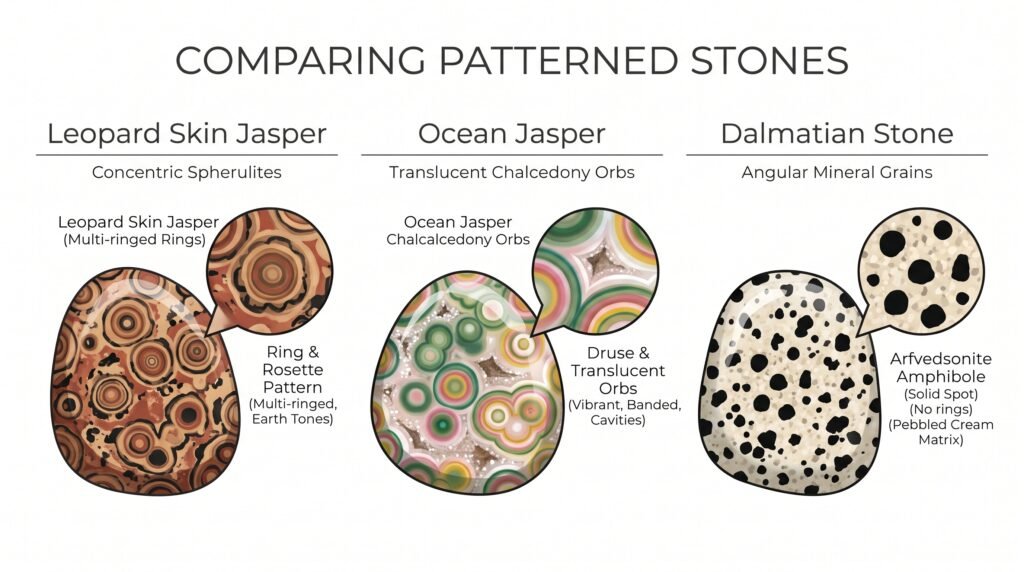
Leopard Skin Jasper
- Pattern Structure: Displays distinct, concentric rosettes and multi-layered circular “eyes”. The spots feature clear radial growth rings, mimicking the multi-tonal coats of leopards or jaguars.
- Colour Palette: Muted, warm earth tones: terracotta pink, brick red, ochre yellow, chocolate brown, tan, and charcoal black.
- Surface Texture: Solid, dense, and uniform. It lacks natural internal vugs, pockets, or micro-druses.
Ocean Jasper
- Pattern Structure: Spherical spherulitic chalcedony orbs ranging from pinpoint clusters to large bullseyes. The patterning frequently interweaves with wavy agate-like banding, botryoidal formations, and translucent chalcedony seams.
- Colour Palette: Exceptionally diverse, ranging from seafoam green, teal, and moss to bubblegum pink, creamy white, golden yellow, and deep crimson.
- Surface Texture: Regularly features tiny vugs, pocket cavities, or drusy quartz crystal linings breaking through polished faces.
Dalmatian Stone
- Pattern Structure: Discrete, solid black irregular dots and angular flecks randomly distributed across a pale background. There are no rings, no concentric banding, and no spherulites.
- Colour Palette: Monochromatic to low-saturation: uniform white, light cream, pale grey, or beige base studded with ink-black spots.
- Surface Texture: Uniformly fine-grained igneous rock texture without translucent windows or hollow cavities.
Petrogenesis: How They Form
Leopard Skin Jasper (Igneous Rhyolite + Hydrothermal Silicification)
Forms within subaerial, high-silica felsic volcanic flows. During rapid cooling, quartz and feldspar rapidly nucleate into radial crystalline aggregates (spherulites). Later, secondary hydrothermal fluids infiltrate the porous groundmass, depositing microcrystalline quartz/chalcedony throughout the rock until it becomes dense and non-porous.
Ocean Jasper (Hydrothermal Chalcedony / Spherulitic Silicification)
Forms along tidal and inland volcanic formations in northwestern Madagascar. Like Leopard Skin, its framework originates from rhyolitic vulcanism, but Ocean Jasper underwent pervasive chalcedonic infiltration. The orbs are fibrous radial chalcedony intergrown with microcrystalline quartz and moganite, resulting in a stone that behaves more like true agate/chalcedony with localized translucent zones.
Dalmatian Stone (Plutonic/Hypabyssal Aplite)
Forms from slow to moderate subsurface cooling of a peralkaline granitic magma. It is an intrusive igneous rock (aplite or fine-grained microgranite). The feldspar (intergrown albite and orthoclase/mesoperthite) crystallises alongside quartz, while late-stage iron- and sodium-rich fluids crystallise into discrete arfvedsonite amphibole grains. It has experienced no secondary silicification.
Lapidary and Workability Considerations
- Cutting & Sawing:
- Leopard Skin Jasper: Highly cohesive, takes clean slab cuts without pitting or flaking.
- Ocean Jasper: Dense, but cutters must navigate internal voids and drusy pockets that can cause catching or chipping on thin edges.
- Dalmatian Stone: Softer on diamond blades due to its high feldspar content; cuts quickly without excessive blade wear.
- Polishing & Undercutting:
- Leopard Skin Jasper: Polishes evenly across both the groundmass and spherulites using cerium oxide or tin oxide, yielding a vitreous finish without surface texture variations.
- Ocean Jasper: Polishes to a vitreous, glassy finish on cerium oxide, with translucent depth across chalcedony-rich zones.
- Dalmatian Stone: Susceptible to undercutting. The arfvedsonite amphibole spots (Mohs ~5.5–6.0) are slightly softer than the surrounding quartz/feldspar matrix (Mohs ~6.0–6.5). Aggressive polishing on soft leather or felt laps can drag out the black spots, creating tiny dimples. Hard wooden, phenolic, or canvas laps with diamond paste yield the flattest finish.
Identification Checklist for Collectors and Cutters
- Check for Light Transmission: Hold a bright penlight directly behind a 4–6 mm slab. If light shines through with cloudy translucency, it is Ocean Jasper. If it remains completely opaque, it is either Leopard Skin Jasper or Dalmatian Stone.
- Inspect Spot Geometry: Under a 10× loupe, look at the spots. If they possess concentric rings or radial needle structures, it is a spherulitic rhyolite (Leopard Skin Jasper) or spherulitic chalcedony (Ocean Jasper). If the spot is a solid, irregular mineral grain lacking any internal concentric rings, it is Dalmatian Stone.
- Beware of Artificial Dyeing: Dalmatian Stone is frequently dyed bright neon colours (electric blue, magenta, turquoise) by soaking the porous feldspar matrix. An acetone swab test along a drill hole or rear facet will quickly dissolve artificial pigments. Natural Leopard Skin Jasper and Ocean Jasper are rarely dyed because their dense silicate matrix resists dye uptake.