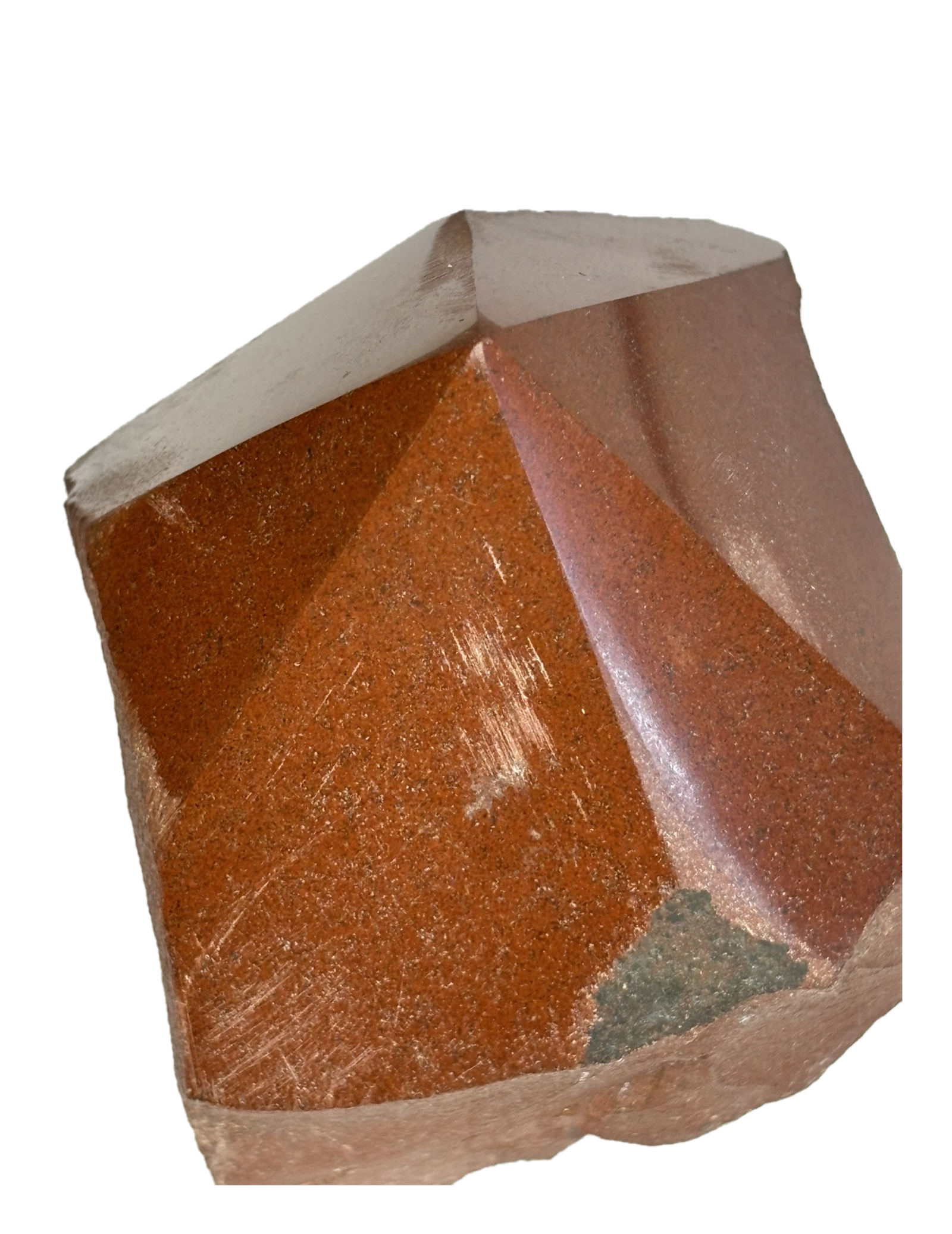
Renowned as the “Supreme Nurturer,” jasper is a dense, opaque variety of micro crystalline quartz celebrated for its grounding presence, rich geological heritage, and kaleidoscopic patterns. Prized across civilisations for millennia, jasper forms through intricate volcanic, hydrothermal, and sedimentary events where silica-rich fluids permeate rock cavities, carrying mineral impurities like iron oxides and clay. These dynamic inclusions create its signature painterly bands, orbicular rings, and earthy hues. Today, jasper bridges mineralogy, lapidary craft, and holistic wellness, serving as an emblem of enduring strength, protection, and balanced vitality in both contemporary gemstone collections and metaphysical practices.
Alternate Names
The term jasper traces to the ancient Greek iaspis (ἴασπις), passing into Latin as jaspis and Old French as jaspre, universally describing spotted or speckled stones. Throughout historical lapidaries, commercial markets, and localised geology, jasper has earned numerous distinct titles:
- The Supreme Nurturer: A traditional metaphysical moniker referencing its stabilising, comforting energy.
- Heliotrope / Bloodstone Jasper: A dark green variety featuring bright flecks of iron oxide (haematite) resembling blood drops.
- Egyptian Marble: A historic trade name for banded brown, tan, and ochre jasper native to the Nile Valley.
- Ocean Jasper (Atlantis Stone / Cellular Jasper): A spherulitic, orbicular chalcedony mined along coastal deposits in Madagascar.
- Landscape or Scenic Jasper: Common descriptive titles for picture jasper varieties resembling horizons, mountain vistas, or desert dunes.
- Ribbon Jasper: A geologic market name applied to parallel-banded sedimentary jaspers.
The Stone’s Science and Composition
Geologically, jasper is a dense, impure variety of cryptocrystalline or micro crystalline quartz (chalcedony). Unlike translucent chalcedony or macrocrystalline quartz (such as amethyst), jasper is strictly opaque, containing up to 20% foreign mineral inclusions, iron phases, oxides, and clay sediments.
- Chemical Formula: $\text{SiO}_2$ (Silicon dioxide) with variable mineral impurities.
- Crystal System: Trigonal (micro crystalline aggregate of microscopic quartz crystals with moganite intergrowths).
- Genesis: Jasper primarily forms when silica-saturated hydrothermal fluids precipitate within fractures, volcanic ash beds, or sedimentary cavity voids. As the silica gel solidifies, it incorporates surrounding mineral particulates, volcanic ash, silts, and oxides, locking permanent pictorial patterns and bands into the stone’s solid matrix.
Key Physical Characteristics
| Property | Mineral Specification |
| Mohs Hardness | 6.5 – 7.0 |
| Specific Gravity | 2.58 – 2.91 (elevated by iron/hematite inclusions) |
| Lustre | Waxy to vitreous; accepts a brilliant mirror polish |
| Transparency | Completely opaque (does not transmit light through edges) |
| Fracture | Conchoidal to smooth, splintery, or uneven |
| Cleavage | None |
| Refractive Index | 1.530 – 1.540 (spot reading) |
| Tenacity | Brittle to tough |
Common Geologic Varieties
- Red Jasper: Saturated with disseminated haematite ($\text{Fe}_2\text{O}_3$), presenting deep brick-red to terracotta tones.
- Yellow / Ochre Jasper: Coloured by goethite or limonite hydrated iron oxides, yielding mustard, gold, and warm amber shades.
- Green Jasper (Plasma): Tinted by micro-inclusions of chlorite, amphibole, or celadonite silicate minerals.
- Picture Jasper: Silicified mudstones and fine-grained volcanic ash flows exhibiting dendritic, rippled, or landscape-like sedimentation patterns (notably Biggs Jasper and Bruneau Jasper).
- Brecciated Jasper: Naturally fractured jasper deposits recemented over geological epochs by white or gray chalcedony veins, frequently carrying specular haematite.
- Mookaite Jasper: A colourful, silicified radiolarian porcellanite fossil deposit from Western Australia displaying rich burgundy, mustard, cream, and lavender pigments.
- Ocean Jasper: A rare spherulitic or orbicular chalcedony from Madagascar featuring concentric spheres, circular eyes, and drusy quartz vugs.
- Dalmatian “Jasper”: A white-to-cream igneous rock speckled with black tourmaline/arfvedsonite needles (technically an aplite/peralkaline rock rather than true chalcedony, though commercially sold under the jasper banner).
Global Mining and Volcanic Sources
Jasper deposits occur across every continent, predominantly where ancient volcanic activity, hydrothermal vents, and silica-rich host rocks converge:
- United States: The Pacific Northwest and American West are famous for scenic jaspers, notably Biggs Jasper and Deschutes Jasper (Oregon), Bruneau Jasper (Idaho), and diverse petrified wood/jasper beds in Arizona and California.
- Madagascar: Coastal areas near Marovato and Analalava produce genuine orbicular Ocean Jasper, traditionally harvested exclusively by boat during low tide.
- Australia: The Windalia Radiolarite formation near Carnarvon, Western Australia, remains the exclusive source of authentic Mookaite.
- India: Vast deposits in the Deccan Traps produce gem-grade red, yellow, and fancy patterned jaspers.
- Egypt: The Eastern Desert and Nile gravels host historic brown banded jaspers worked since the Predynastic era.
- Brazil & Russia: Massive deposits in Minas Gerais (Brazil) and the Ural Mountains / Orsk region (Russia) yield red, orbicular, and banded ornamental jaspers.
Crystal Pairings: What to Combine and Avoid
Optimal Crystal Pairings
- Red Jasper + Black Tourmaline or Smoky Quartz: A grounding combination that anchors physical awareness, shields the aura, and diffuses environmental electromagnetic or emotional stress.
- Picture Jasper + Petrified Wood: Anchors the physical body to Earth frequencies, deepening meditation and historical resonance.
- Mookaite Jasper + Citrine: Blends primal vitality with creative motivation, stimulating clear, confident decision-making.
- Ocean Jasper + Rose Quartz: Pairs nurturing terrestrial stability with soft emotional clearing to soothe grief, self-criticism, and heart tensions.
Crystal Pairings to Avoid
- Red Jasper + High-Vibration Ethereal Stones (e.g., Moldavite, Phenakite): The intense, rapid, ungrounded frequency of tektites like Moldavite conflicts with the slow, stabilising root pull of dense red jasper, creating energetic discord, lightheadedness, or restlessness.
- Dynamic Red Jasper + Calming Sleep Stones (e.g., Blue Lace Agate, Lepidolite): Red jasper’s stimulating, circulation-boosting nature works against the sedating, tranquil properties required for deep sleep and anxiety relief.
Archaeology, Art, and Ancient History
- Mesopotamia & The Indus Valley (4th–3rd Millennium BCE): Jasper was carved into intricate cylindrical seals used to imprint identity, trade contracts, and religious prayers into wet clay tablets.
- Ancient Egypt: Craftsmen carved red jasper into protective Tyet amulets (the Knot or Girdle of Isis), ensuring the protection of Isis’s blood for travellers and the deceased. It was prominently featured in pectorals, scarabs, and burial masks, including those recovered from Tutankhamun’s tomb.
- Minoan Civilisation: Palaces at Knossos (Crete) revealed polished jasper seals dating to 1800 BCE, engraved with marine wildlife, bull-leaping rituals, and religious icons.
- Classical Antiquity: Greek and Roman lapidaries cut jasper into signet rings, believing it cooled fever and preserved physical vitality.
- Biblical Foundations: In the Book of Exodus, jasper (yashfeh) is described as the twelfth stone set into the Breastplate of the High Priest Aaron; it is also listed in Revelation as a primary foundation stone of the New Jerusalem.
Folklore, Legends, and Sacred Tales
- The Rainbringer: Various Native American traditions venerated jasper as an earthly talisman, utilising it during sacred prayer rituals to call seasonal rains and align with the spirit of the land.
- The Blood of the Earth: Norse mythology closely associated red jasper with Thor’s thunderous protection, while medieval European warrior lore maintained that the hilt of Siegfried’s magical sword, Balmung, was set with red jasper to confer invincibility and staunch battlefield bleeding.
- Protection Against the Unseen: Medieval herbals and lapidaries (such as those compiled by Marbodus of Rennes) recorded that wearing jasper guarded against venomous bites, dispelled nightmares, and drove away mischievous forest phantoms.
- Chronicles of Past Worlds: Shamanic legends concerning Picture Jasper held that its landscape-like patterns were painted by ancient spirits to preserve messages and geographical memories of pre-flood civilisations.
Metaphysical and Mystical Healing Properties
- Emotional Resilience: Functions as an emotional stabiliser, steadying mood swings, dismantling chronic self-doubt, and instilling patient determination during prolonged hardship.
- Physical Vitality & Stamina: Associated with physical endurance, stamina, and cellular circulation. Metaphysical practitioners employ it to support convalescence and reinforce overall energetic vigour.
- Psychic Grounding & Protection: Absorbs negative thought forms, anchors fragmented auric fields, and establishes a safe boundary against psychic drain.
- Sustained Manifestation: Unlike fleeting, air-element stones, jasper works steadily over long periods, instilling the practical persistence required to bring large-scale creative or financial goals into physical reality.
Astrological Connections
- Aries (Red Jasper): Directs fiery Mars-driven impulsiveness into grounded stamina, strategic courage, and disciplined leadership.
- Virgo (Picture & Brown Jasper): Harmonises with Earth-ruled precision, soothing analytical mental loops and deepening connection to natural cycles.
- Leo (Yellow Jasper): Balances solar radiance with warm self-assurance, fostering authentic personal expression without ego inflation.
- Scorpio (Brecciated Jasper): Assists through deep psychological transformations, providing grounding stability when navigating intense internal changes.
- Pisces (Ocean Jasper): Balances watery emotional states, promoting joyful presence and relieving unconscious stress patterns.
The Chakra System
Because jasper varieties occur across an expansive colour spectrum, individual stones target distinct energy centres within the human subtle body:
- Root Chakra (Muladhara): Red & Brecciated Jasper anchors scattered survival energy, establishing security, stability, and physical embodiment.
- Sacral Chakra (Svadhishthana): Orange & Yellow Jasper clears creative and emotional blocks, supporting healthy vitality and passion.
- Solar Plexus (Manipura): Mookaite & Bumblebee “Jasper” (calcite/pyrite matrix) fuels personal willpower, boundary-setting, and decisive action.
- Heart Chakra (Anahata): Green Jasper & Rain forest Rhyolite soothes heart-centered trauma, fostering patience, compassion, and emotional balance.
- Throat Chakra (Vishuddha): Blue Jasper supports deliberate, truthful communication and steady articulation under pressure.
Interesting Facts
- Mineral Pigments of Antiquity: Red and yellow jasper were regularly pulverised by ancient civilisations, blending with oils and animal fats to yield permanent earth pigments for cave murals and temple frescoes.
- Imperial Russian Urns: The Hermitage Museum in Saint Petersburg houses massive, hand-carved jasper vases and pedestals—some weighing several tons—commissioned by Catherine the Great from the Kolyvan lapidary works.
- Geological Misnomers: Many famous stones marketed as “jaspers” are actually distinct rock formations. Bumblebee Jasper is a carbonate-rich volcanic rock; Dalmatian Jasper is an aplite; Ocean Jasper is technically an orbicular chalcedony/rhyolite; and Rain forest Jasper is a silicified volcanic rhyolite.
Modern Milestones: Birthstones and Anniversaries
- Alternative Birthstone for March: Historically recognised in ancient Roman, Arabic, and Hebrew calendars as a March birthstone alongside Bloodstone (heliotrope), symbolising resilience at the dawn of spring.
- 12th & 19th Wedding Anniversaries: Jasper is traditionally gifted on the 12th wedding anniversary to celebrate endurance, loyalty, and deep foundational stability, and frequently appears as an alternate gemstone for the 19th anniversary.
Jasper Frequently Asked Questions
Is jasper a crystal or a rock?
Jasper sits precisely at the boundary. Technically, it is classified as a micro crystalline mineral aggregate (a form of chalcedony quartz). However, because it contains up to 20% foreign rock fragments, clay, and mineral oxides, petrologists frequently treat jasper as a sedimentary or volcanic rock aggregate.
Can jasper be submerged in water safely?
Yes. With a Mohs hardness of 6.5–7 and no cleavage planes, pure jasper is completely safe in plain water for cleansing. However, avoid soaking porous or fractured stones (such as Brecciated Jasper or Mookaite) in salt water, as salt crystals can enter micro-fissures and cause internal stress over time.
How do I tell genuine jasper apart from synthetic or dyed stones?
Real jasper feels distinctly cool, dense, and solid in the hand. It is completely opaque—light from a strong penlight will not shine through the body of the stone (unlike coloured glass or dyed agate). Under a loupe, look for natural inclusions, uneven sedimentation patterns, and microscopic fractures rather than uniform colouring or air bubbles.
Why is Ocean Jasper becoming so rare and expensive?
The original Ocean Jasper deposit in Marovato, Madagascar, was located in an intertidal zone accessible only by foot or boat at low tide. Veins 1 and 2 were largely exhausted during the early 2000s. While subsequent nearby veins have been discovered, high-grade rough with vibrant, distinct circular orbs remains limited on the global market.