
In the lapidary, jewellery, and gemstone collecting worlds, dark feldspars present a persistent challenge of misidentification. Tumblestones, polished slabs, and jewellery pieces showcasing a dark groundmass and optical flashes are frequently mislabelled. Commercial trade terms such as “Black Labradorite” or “Norwegian Moonstone” blur petrological distinctions, confusing buyers and collectors alike.
While Larvikite, Labradorite, and Black Moonstone all belong to the broader feldspar group and display iridescent optical effects, they originate from entirely different geological environments, possess distinct mineral chemistries, and express unique optical mechanisms.
The Feldspar Framework: Plagioclase vs Alkali Series
To separate these three stones, one must first look at the feldspar ternary system. Feldspars are classified along a compositional spectrum defined by three end-members:
- Orthoclase ($KAlSi_3O_8$) – Potassium end-member
- Albite ($NaAlSi_3O_8$) – Sodium end-member
- Anorthite ($CaAl_2Si_2O_8$) – Calcium end-member
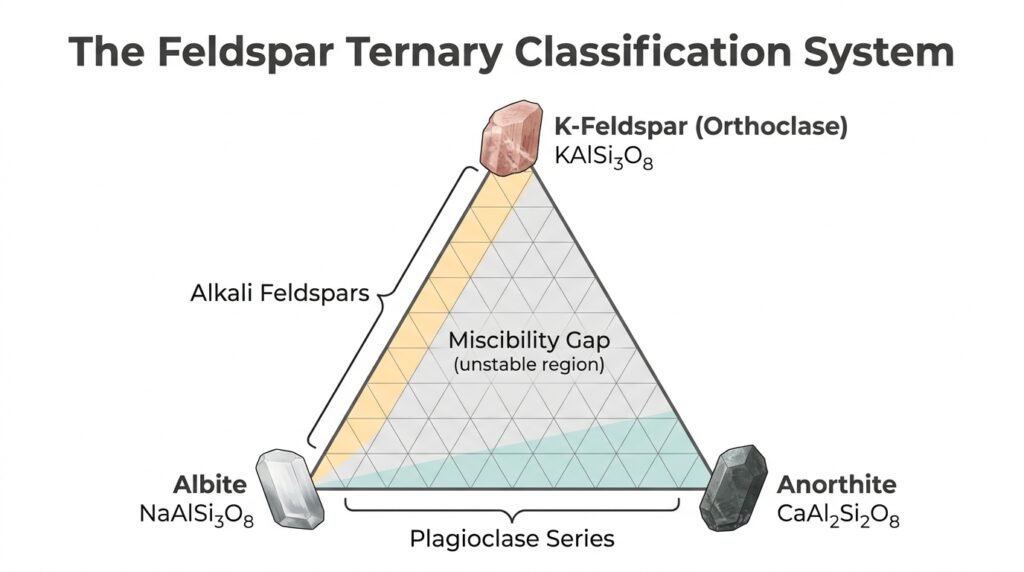
- Labradorite sits squarely within the plagioclase series, defined by a calcium-to-sodium ratio between 50:50 and 70:30 (specifically, $An_{50}$ to $An_{70}$).
- Black Moonstone belongs to the alkali feldspar series, dominated by potassium-rich orthoclase or microcline interlaminated with sodium-rich albite.
- Larvikite is not a single mineral species; it is an igneous rock (an augite syenite or monzonite) dominated by ternary alkali feldspars (anorthoclase to microperthite) that fall near the centre of the ternary diagram, crystallised from high-temperature plutonic magmas.
1. Larvikite: The Plutonic Anorthoclase Monzonite
- Rock Classification: Igneous plutonic rock (augite syenite/monzonite).
- Dominant Mineral: Ternary feldspar (anorthoclase/cryptoperthite) making up 85–90% of the rock mass, accompanied by augite, biotite, magnetite, and apatite.
- Optical Phenomenon: Schiller effect (labradorescence-like interference from cryptoperthitic cryptolamellae).
Identification Markers
- Groundmass: Opaque, crystalline matrix of slate grey, charcoal, deep steel blue, or greenish-black.
- Flash Character: Distinct, scattered, pinpoint flashes of metallic silver, icy electric blue, or pearlescent white. Unlike Labradorite, which flashes across wide continuous faces, Larvikite sparkles in individual, tabular, rhomb-like feldspar cleavage fragments.
- Inclusions: Visible flecks of black biotite mica and augite pyroxene throughout the matrix, frequently accompanied by microscopic titanomagnetite grains that occasionally make fragments weakly responsive to strong neodymium magnets.
2. Labradorite: The Anorthosite Plagioclase
- Mineral Classification: Tectosilicate; intermediate-to-calcic plagioclase feldspar.
- Chemical Formula: $(Ca,Na)(Al,Si)_4O_8$ ($An_{50\text{–}70}$).
- Optical Phenomenon: Labradorescence.
Identification Markers
- Groundmass: Translucent to semi-opaque smoky grey, olive-grey, or greyish-brown base. True black groundmass is exceptionally rare; so-called “dark” labradorite is typically a saturated charcoal-grey.
- Flash Character: Broad, sheet-like swathes of colour that sweep across entire cleavage planes as the stone rotates. The spectral palette is notoriously broad, exhibiting vivid peacock blues, gold, bronze, copper-orange, and violet.
- Twinning & Structure: Displays fine polysynthetic twinning lines (visible under magnification as parallel striations across cleavage planes) alongside dark needle-like inclusions of ilmenite or rutile.
3. Black Moonstone: The Adularescent Alkali Feldspar
- Mineral Classification: Tectosilicate; alkali feldspar (predominantly orthoclase/albite intergrowths).
- Chemical Formula: $KAlSi_3O_8$ with $(Na,K)AlSi_3O_8$ exsolution lamellae.
- Optical Phenomenon: Adularescence (frequently exhibiting a cat’s eye / chatoyant effect).
Identification Markers
- Groundmass: Charcoal to jet-black, often with subtle brownish-chocolate undertones or cream-coloured structural zones. It is semi-translucent when backlit along thin edges.
- Flash Character: A soft, billowing, floating interior sheen—typically silver, pearl-white, champagne, or pale peach-bronze. Unlike the surface-bound metallic reflections of Larvikite or the intense multi-colour sheets of Labradorite, the adularescent light in Black Moonstone appears to float beneath the surface of the gem like moonlight through water.
- Inclusions & Fractures: Shows typical orthoclase “centipede” inclusions (stress micro-cracks along cleavage traces) and distinct chatoyancy (a concentrated light band) when cut into high-domed cabochons.
Side-by-Side Comparison: Diagnostic Testing Matrix
| Physical / Diagnostic Trait | Larvikite | Labradorite | Black Moonstone |
| Geological Type | Plutonic Igneous Rock (Monzonite) | Single Mineral Species (Plagioclase) | Single Mineral Species (Alkali Feldspar) |
| Mohs Hardness | 6.0 – 6.5 | 6.0 – 6.5 | 6.0 – 6.5 |
| Specific Gravity (SG) | 2.59 – 2.72 | 2.68 – 2.72 | 2.56 – 2.59 (Noticeably lighter) |
| Refractive Index (RI) | Variable (Composite rock: ~1.52 – 1.54) | 1.554 – 1.573 (Birefringence 0.008–0.010) | 1.518 – 1.526 (Birefringence 0.005–0.008) |
| Optical Phenomenon | Schiller (Metallic/silvery flash) | Labradorescence (Broad spectral flash) | Adularescence (Floating sheen / Cat’s Eye) |
| Flash Colour Palette | Silver, ice-blue, steel-grey | Peacock blue, green, gold, orange, violet | Silvery-white, bronze, champagne, cream |
| Groundmass Diaphaneity | Completely opaque | Translucent to semi-opaque | Translucent on edges to semi-opaque |
| Primary Origin | Vestfold, Norway (Larvik complex) | Madagascar, Canada, Finland (Spectrolite) | Madagascar, India |
Practical Visual Identification Workflow
When holding an unidentified dark feldspar specimen, follow this three-step inspection protocol:
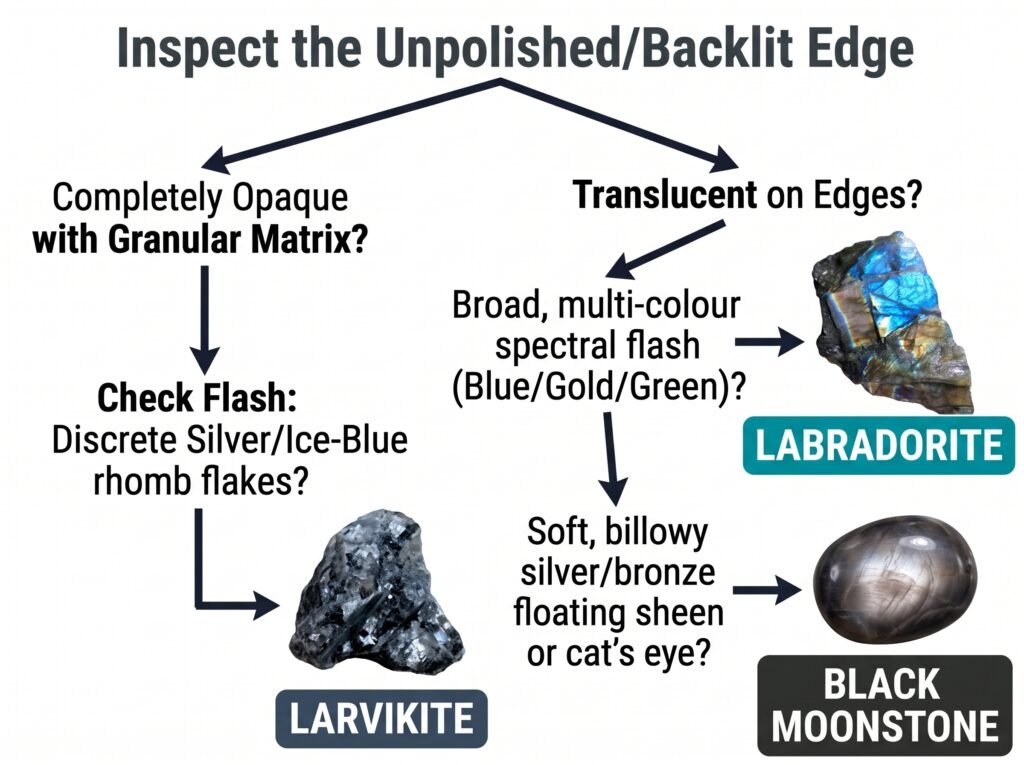
- Test Diaphaneity with a Penlight: Hold a strong LED penlight directly behind a thin edge of the stone. Larvikite will block the light completely due to its dense, interlocked plutonic crystal matrix and opaque accessory mafic minerals. Labradorite and Black Moonstone will reveal translucent inner structures, often showing cloudy brownish or greyish light transmission.
- Observe the Geometry of the Flash:
- If the flash is isolated within individual, mosaic-like grains that flash independently of their neighbours, it is Larvikite.
- If the flash rolls across a continuous planar surface in a vivid sheet of peacock blue, yellow, or multi-hue spectrum, it is Labradorite.
- If the sheen moves smoothly over the dome like a wide, soft satin ribbon or concentrated line, it is Black Moonstone.
- Verify Specific Gravity (Hydrostatic Weighing): If you possess a high-precision scale and a specific gravity kit, Black Moonstone will consistently yield an SG below 2.60 (averaging 2.56–2.58), whereas Labradorite will consistently measure 2.68 to 2.72 due to its calcium (anorthite) content.
Frequently Asked Questions (FAQ)
Is “Black Labradorite” a real geological term?
No. “Black Labradorite” is a commercial trade misnomer. In almost every retail instance, stones sold under this label are either genuine Larvikite from Norway or unusually dark, iron-included Labradorite from Madagascar. Using the term obscures the true mineral classification of the material.
Can Larvikite display rainbow colours like Labradorite?
No. Larvikite’s optical interference is limited by its internal cryptoperthite structure. It produces bright silvery-white, steel-grey, and vibrant electric-blue reflections. If a stone displays broad sheets of orange, magenta, golden-yellow, or emerald-green, it is Labradorite (or its Finnish varietal, Spectrolite), not Larvikite.
Why is Black Moonstone lighter in weight than Labradorite?
Black Moonstone is composed of potassium and sodium feldspars ($KAlSi_3O_8$ and $NaAlSi_3O_8$), both of which have relatively light atomic weights. Labradorite contains a high proportion of calcium ($CaAl_2Si_2O_8$), which increases its overall density and results in a higher specific gravity (2.68–2.72 vs 2.56–2.59).
How can I distinguish Larvikite from Black Tourmaline or Obsidian?
Black Tourmaline (Schorl) and Black Obsidian lack internal feldspar cleavage flashes. Obsidian is volcanic glass with a conchoidal fracture and a glassy, smooth surface. Black Tourmaline crystallises in trigonal prisms with strong vertical striations and no schiller. Larvikite is easily distinguished by its coarse, crystalline granular texture and distinctive blue-silver feldspar flash.
Black Tourmaline (Schorl) and Black Obsidian lack internal feldspar cleavage flashes. Obsidian is volcanic glass with a conchoidal fracture and a glassy, smooth surface. Black Tourmaline crystallises in trigonal prisms with strong vertical striations and no schiller. Larvikite is easily distinguished by its coarse, crystalline granular texture and distinctive blue-silver feldspar flash.
