Whether you are drawn to the ethereal adularescence of Moonstone, the peacock flashes of Labradorite, or the dark, protective schiller of Larvikite, preserving the brilliance of these minerals requires a nuanced touch. This comprehensive Feldspar Care Guide explores the essential practices needed to safeguard your collection against physical, thermal, and chemical damage.
Because feldspar gemstones possess two intersecting planes of perfect cleavage and sit at a moderate 6.0 to 6.5 on the Mohs hardness scale, everyday handling errors can lead to irreversible damage. From daily maintenance routines and safe, non-abrasive storage methods to critical warnings regarding ultrasonic and steam cleaners, this guide provides the practical, science-backed protocols necessary to keep your feldspar specimens and jewellery pristine for years to come.
Structural Vulnerabilities: Why Feldspars Require Special Care
Every member of the feldspar group shares two foundational mineralogical traits that dictate how they must be handled:
- Mohs Hardness: 6.0 – 6.5 ──► Vulnerable to Quartz dust (Mohs 7.0) abrasion
- Two Cleavage Planes @ ~90°]──► Prone to catastrophic splitting along sub-lamellae
Cleavage and Twinning
Feldspars crystallise in the monoclinic (e.g., orthoclase) or triclinic (e.g., plagioclase, microcline) systems. They exhibit two directions of perfect cleavage intersecting at or near 90°.
Furthermore, varieties displaying optical phenomena (such as the cryptoperthitic unmixing in Larvikite or the exsolution lamellae in Labradorite and Moonstone) consist of alternating microscopic layers of potassium-rich and sodium-rich feldspar. A direct mechanical blow, sudden temperature fluctuation, or high-frequency vibration can cause these micro-lamellae to shear, resulting in internal fractures or complete cleavage failure.
Hardness vs Environmental Dust
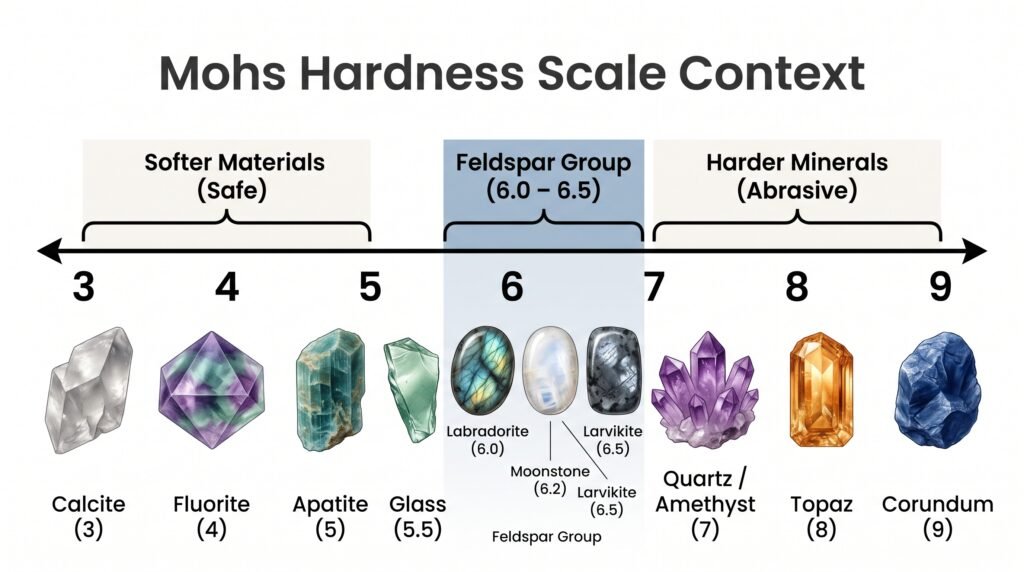
Sitting at 6.0 to 6.5 on the Mohs scale, feldspars are harder than glass or household cutlery, but softer than common ambient dust. Household and workshop dust is predominantly composed of microscopic quartz particles (Mohs 7.0). Dry-wiping a dusty feldspar specimen with a cloth or tissue drags quartz grains across the surface, creating micro-scratches that progressively dull the stone’s high polish and diminish its optical refraction.
Ultrasonic and Thermal Hazards: Why Machines Fail
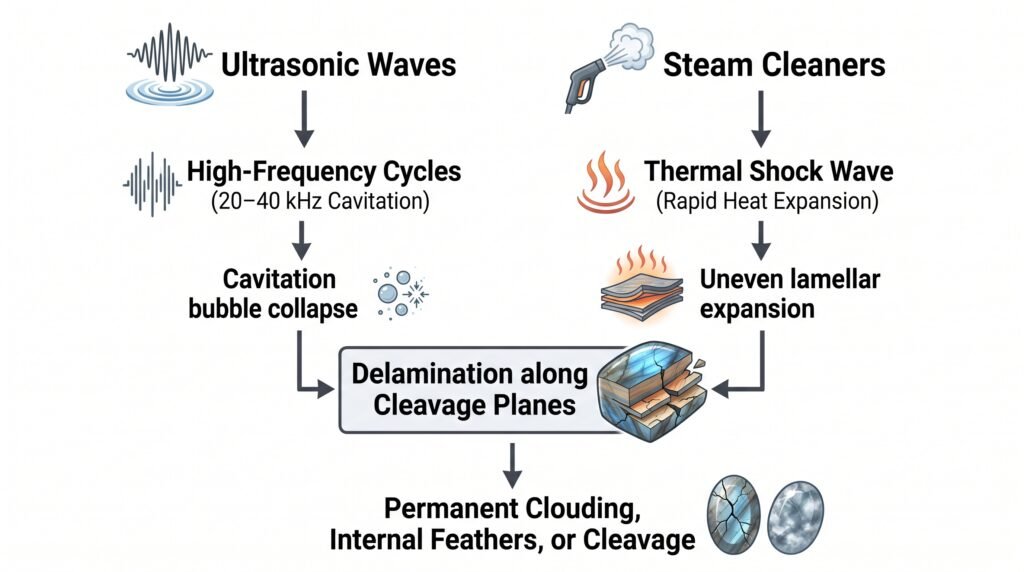
Commercial ultrasonic tanks and steam-cleaning wands are standard in many jewellery workshops, but neither should ever be used on feldspar minerals.
The Ultrasonic Cavitation Threat
Ultrasonic cleaners work by sending high-frequency sound waves (typically 20 to 40 kHz) through a fluid bath, creating millions of microscopic vacuum bubbles. When these bubbles collapse (cavitation), they generate minute shockwaves that blast dirt away from metal mountings.
On feldspars, this cavitation process poses severe structural risks:
- Sub-surface Delamination: The shockwaves penetrate the open cleavage planes and micro-fractures of the stone, forcing the delicate exsolution lamellae apart.
- Internal Clouding: Cavitation vibrations induce microscopic shattering along internal twinning boundaries, turning transparent or translucent feldspars (like Moonstone) cloudy and opaque.
- Liquid Entrapment: Cleaning fluid can be driven deep into sub-microscopic cleavage fissures, leaving trapped, unevaporated fluid that discolours the stone or reacts with iron-bearing inclusions.
Thermal Shock Risks (Steam Cleaning)
Steam cleaning applies extreme localised heat followed by rapid cooling. Because the alternating albite and orthoclase/anorthite lamellae expand and contract at slightly different rates, this differential thermal expansion induces thermal shock. The result is often an immediate, audible fracture across the face of the specimen.
Physical Cleaning Protocol
To safely remove oils, fingerprints, and accumulated dust without compromising the integrity of the mineral, adhere to a gentle, manual regimen.
Approved Cleaning Procedure
- Rinse First (Float the Grit): Never rub a dry or dusty stone. Submerge the piece in a basin of lukewarm (never hot) water, or hold it under a gentle stream of tepid tap water for 30–60 seconds. This flushes away loose quartz dust before any mechanical contact occurs.
- Apply Mild Detergent: Prepare a solution of lukewarm water and a few drops of pH-neutral, fragrance-free liquid soap (such as standard washing-up liquid or pure castile soap). Avoid citrus-based detergents, ammonia solutions, bleach, or jewellery dips containing sulphuric or hydrochloric acid.
- Gentle Agitation: Use your fingertips or an ultra-soft, natural-bristle artist’s brush (or an extra-soft baby toothbrush) to gently work the soapy water across the surface and into settings. Apply minimal pressure; let the bristles do the work.
- Final Rinse: Thoroughly rinse the piece in clean, lukewarm water to remove all surfactant residue. Soap films left on the surface create an oily sheen that interferes with light transmission and dulls the stone’s natural schiller.
- Drying: Pat—do not scrub—the stone dry using a clean, lint-free microfibre cloth. Allow it to air-dry completely on a flat towel away from radiators or heat vents before placing it into enclosed storage.
Chemical Sensitivities and Liquid Immersion Limits
| Agent / Solution | Safety Status | Effect on Feldspar Minerals |
|---|---|---|
| Lukewarm Fresh Water | Safe | Safe for routine rinsing and hand-washing. |
| Salt Water / Brine | Hazardous | Salt crystals penetrate cleavage planes; as water evaporates, recrystallising salt expands and splits micro-fissures. |
| Household Acids (Vinegar, Lemon) | Damaging | Prolonged contact etches surface polish, particularly on calcium-bearing plagioclase (Labradorite). |
| Solvents (Acetone, Alcohol) | Conditional | Safe for untreated, pure stones to remove adhesives; dissolves surface resins, oils, or waxes on stabilised material. |
| Bleach & Ammonia | Prohibited | Breaks down surface lustre and attacks mountings or settings. |
Lapidary Note on Dyed/Treated Specimens: Some commercial “Rainbow Moonstone” (white labradorite) or low-grade Amazonite is treated with colourless stabilising polymers, paraffin wax, or surface oils to conceal surface-reaching cleavage cracks. Exposure to warm water, alcohol, or acetone will strip these sealants, exposing matte white fractures across the stone.
Feldspar Care Guide to Storage
Feldspars should never be stored loose in a shared pouch, drawer, or tray where harder mineral specimens can grind against them.
Storage Best Practices
- Individual Compartments: House specimens in acid-free, fabric-lined display cases, individual acrylic mineral boxes with non-reactive polyethylene foam liners, or separate soft cotton/velvet drawstring pouches.
- Separation by Hardness: Keep feldspars physically isolated from quartz-family minerals (Agate, Jasper, Amethyst, Chalcedony), Beryls (Emerald, Aquamarine), and Corundum (Sapphire, Ruby), which will gouge feldspar faces during handling or transport.
- Climate and Humidity Control: Store specimens in a stable, climate-controlled environment. Avoid locations subject to rapid diurnal temperature swings (such as uninsulated conservatories or draughty window sills). Relative humidity between 40% and 55% prevents packaging adhesives or display foams from breaking down and depositing residue onto the stone.
- UV Light Exposure: While Larvikite and Labradorite are structurally resilient to sunlight, varieties such as Amazonite (coloured by trace lead and water molecules) and Sunstone can experience colour fading or altered structural water balance when subjected to prolonged, direct ultraviolet radiation. Store light-sensitive varieties away from intense, unshaded southern exposures.