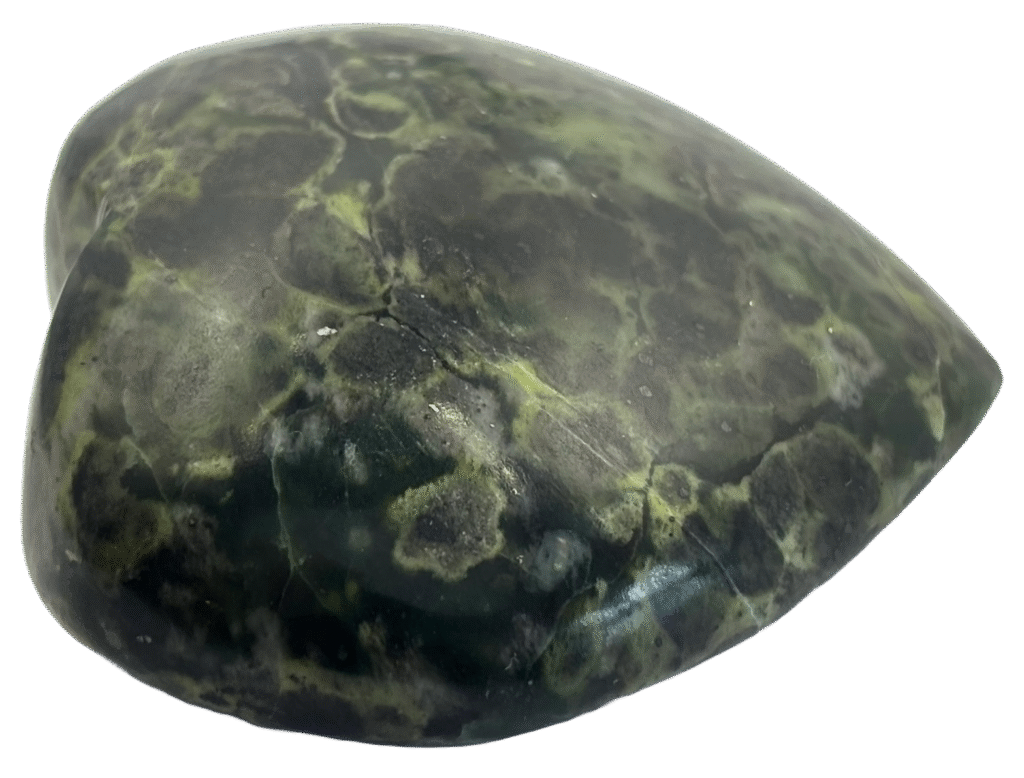
With its mesmerising deep-forest groundmass and striking orbicular eyes of mottled grey-green, Kambaba Jasper is instantly recognisable. Long marketed under evocative trade names such as Crocodile Jasper, Nebula Stone, and Star Galaxy Stone, it has captured the imagination of lapidaries and collectors who are drawn to its prehistoric aesthetic. Yet examining Kambaba Jasper vs True Jasper uncovers one of the most tenacious mineralogical misconceptions in the trade: in truth, it is neither an authentic jasper nor a three-billion-year-old fossil.
For decades, popular lapidary lore has promoted Kambaba Jasper as a silicified stromatolite—a preserved colony of ancient cyanobacteria and algae dating back to the Archean Eon. It is a romantic narrative, but modern petrological analysis tells an entirely different story. Rather than an organic sedimentary relict or a true microcrystalline quartz precipitated in silica-rich fluids, Madagascar’s famous green-and-black stone is an igneous, volcanic rock: a heavily altered rhyolite. Those mysterious concentric “eyes” are not fossilised colonies of primordial life, but radiating spherulitic crystal aggregates of amphibole and feldspar that nucleated rapidly within cooling lava.
Untangling the reality of Kambaba Jasper from both true quartz jaspers and genuine biogenic stromatolites exposes a fascinating intersection of volcanic petrology and trade nomenclature. By stripping away the ancient fossil myth, we uncover a rock whose genuine geological origin is every bit as remarkable as the folklore it inspired.
Debunking the Myth: 3-Billion-Year-Old Algae or Volcanic Fire?
The most widespread story found in retail listings and crystal guides is that Kambaba Jasper is a fossilised stromatolite—petrified mats of 3-billion-year-old cyanobacteria (blue-green algae) that helped produce Earth’s earliest breathable oxygen.
While genuine fossil stromatolites do exist (such as the ancient Mary Ellen Jasper found in Minnesota), laboratory analyses—including optical petrography and X-ray diffraction (XRD)—have thoroughly disproven this story for Kambaba:
- No Cellular or Sedimentary Matting: Under high magnification, Kambaba lacks the thin, delicate layers (laminae) and sediment-trapping structures that characterise real algae colonies.
- Purely Igneous Mineralogy: The stone is packed with high-temperature volcanic minerals—amphiboles, pyroxenes, and feldspars—that form exclusively in cooling magma. These minerals cannot crystallise inside organic marine algae mats.
- The True Classification: Kambaba is an extrusive igneous rock, specifically an altered volcanic rhyolite or andesite/dacite.
How Kambaba Actually Formed
True jasper is sedimentary: it precipitates slowly at low temperatures when silica-rich waters seep into voids, cementing microcrystalline quartz into a uniform, dense block.
Kambaba formed under radically different conditions. A silica-rich volcanic lava flow surged to the surface, cooling rapidly. As the molten rock solidified and hot, mineral-laden fluids altered it over time, distinct volcanic minerals segregated into round, radiating clusters called spherulites:
- The Olive-Green Groundmass: The matrix is a dense volcanic mixture of fine-grained quartz and feldspar, stained deep sage and olive by micro-inclusions of green chlorite and celadonite.
- The Dark “Eye” Orbs: The dark rings and centres are radiating fibrous sprays of amphibole-group minerals, chiefly edenite and actinolite.
- The Obsidian-Like Cores: Minute needles of aegirine, titanite, and iron-titanium oxides concentrate at the centres of the rings, giving the “eyes” their deep, metallic sheen.
| Property | True Jasper | Kambaba “Jasper” |
| Geological Origin | Low temperature sedimentary precipitation | Extrusive volcanic lava (altered rhyolite/andesite) |
| Primary Structure | Uniform cryptocrystalline quartz ($\text{SiO}_2$) | Intergrown igneous quartz, feldspars, and amphiboles |
| Key Inclusions | Iron oxides (haematite, goethite), clay minerals | Edenite, actinolite, chlorite, aegirine |
| Mohs Hardness | 6.5 to 7.0 (uniform) | 5.5 to 6.5 (variable between matrix and eyes) |
| Specific Gravity | 2.58 to 2.91 | ~2.65 to 2.78 |
| Fracture Behaviour | Smooth, conchoidal (shell-like) | Granular to splintery along amphibole cleavage planes |
Lapidary Workshop Guide: Cutting & Polishing Kambaba
Working Kambaba in the lapidary shop requires a different approach than cutting standard quartz or chalcedony. Because it is an assemblage of distinct minerals rather than a uniform microcrystalline mass, cutters must account for uneven hardness across the slab.
1. Taming Differential Hardness & Pitting
- The Challenge: The green quartz-feldspar matrix sits at Mohs 6–6.5, while the fibrous amphibole “eyes” register at a softer Mohs 5.5–6. Aggressive grinding easily plucks the brittle amphibole needles from the stone, leaving hollow, pitted craters right in the centre of the dark eyes.
- The Technique: Avoid aggressive coarse grits (such as 80-grit diamond wheels). Slab with a continuous-rim, thin-kerf diamond blade under generous water or oil coolant. Begin rough shaping at 180 or 220 grit, using light, uniform hand pressure without dwelling on the eyes.
2. Eliminating Surface “Dimpling”
- The Challenge: Sanding on flexible belts or soft foam drums erodes the softer amphibole rings faster than the surrounding green groundmass, creating an uneven “orange-peel” or dimpled topography across the dome.
- The Technique: Use rigid, hard-backed flat laps or steel/phenolic diamond wheels through the 280, 600, and 1,200 pre-polish stages. Keep the cabochon rotating continuously to equalise abrasion across both mineral phases.
3. Polishing Chemistry & Heat Control
- Abrasive Selection: Standard cerium oxide—the universal favourite for true jaspers—often leaves Kambaba with a hazy, uneven sheen. Switch to optical-grade aluminium oxide (1 micron down to 0.3 micron) run damp on a hard felt lap or tight-weave canvas disc.
- Thermal Discipline: Amphiboles possess two directions of perfect cleavage intersecting at approximately 56° and 124°. Frictional heat generated on dry or high-speed polishing laps will cause tiny thermal fractures (“cleavage checks”) across the dark orbs. Keep the lap cool, damp, and well-lubricated to bring up a uniform, glass-like lustre.
Distinguish natural Kambaba Jasper from dyed or synthetic lapidary simulants.
Because authentic Kambaba Stone is an altered volcanic rhyolite with intricate igneous microstructures, laboratory and benchtop testing can quickly separate it from commercial simulants, dyed matrix rocks, and resin composites.
| Test / Metric | Natural Kambaba Stone | Dyed Quartzite / Magnesite Simulants | Polymer / Resin Reconstitutions |
| Specific Gravity (SG) | 2.65 – 2.78 (amphibole content raises density above pure quartz) | 2.60 – 2.65 (quartzite) / 3.00 – 3.12 (magnesite) | 1.15 – 1.45 (noticeably light in hand) |
| Mohs Hardness | 5.5 – 6.5 (variable: soft eyes vs. hard quartz-feldspar base) | Uniform 7.0 (quartzite) or uniform 3.5 – 4.5 (magnesite/howlite) | 2.5 – 3.5 (scratched easily by a copper penny or steel point) |
| Microscopic Texture (20×–40×) | Radial, acicular needles of edenite forming spherulitic eyes; granular feldspar matrix | Dye pooling in surface-reaching fractures; uniform sugary micro-granules | Trapped spherical air bubbles; uniform mould seam lines; flat, printed patterns |
| Solvent Reaction (Acetone/MEK) | Inert; no colour transfer to cotton swab | Swab lifts artificial green or black dye residue | Swab turns tacky, dissolves outer clear-coat, or leaches dye |
| Thermal / Hot Needle Test | Inert; heat-tolerant natural rock | Inert; no burning | Melts locally, smokes, and emits an acrid, sweet chemical/plastic odour |
| UV Fluorescence (SW & LW) | Inert to weak dull green/brown (amphiboles quench fluorescence) | Patchy fluorescent dye bleed along fractures; yellow/green dye glow | Strong, uniform milky-white or greenish surface bloom across resins |
Visual & Microscopic Diagnostics
- Authentic Spherulitic Growth: Under a 10× triplet loupe or gemological microscope, the black-to-teal “eyes” exhibit natural three-dimensional growth. The radiating needle sprays of edenite and actinolite vary slightly in size, spacing, and concentric density across the rock.
- Dyed Fakes: Imitations made by staining fractured quartzite, chalcedony, or magnesite show stark colon saturation along fissures and grain boundaries (“spider webbing” dye veins), while the un-fractured grains remain pale underneath.
- Printed or Decal Simulants: Imitation beads produced by dipping ceramic or resin cores into hydrographic transfer films display a visible repeating pattern, telltale seam lines, or pixelation along the edges.
Destructive & Solvent Verification
- Acetone Swab Test: Dip a clean cotton swab in pure acetone and rub an inconspicuous corner or bead drill hole for 20 seconds. Genuine Kambaba’s deep olive and forest shades are structural chlorite and celadonite inclusions locked within the silicate matrix; no colon will transfer. Dyed simulants will immediately stain the cotton swab green or black.
- Hydrostatic SG Separation: A hydrostatic balance reading between 2.65 and 2.78 confirms the characteristic ratio of light feldspars/quartz to denser amphibole groupings. A reading near 2.60 suggests ordinary dyed chalcedony or quartzite, while anything under 2.0 indicates an artificial resin composite.