From the outside, a geode looks like an ordinary, unassuming lump of weathered stone. However, when one is cracked open, it reveals a hollow interior lined with glittering mineral crystals, ranging from deep purple amethyst to translucent quartz and banded agate. Understanding the differences between volcanic and sedimentary environments unlocks the secret of how geodes are geodes created along two distinct pathways:
- Volcanic Vesicles: Formed when gas bubbles become trapped in cooling lava flows, leaving behind durable cavities in basalt and rhyolite that later fill with silica-rich hydrothermal fluids.
- Sedimentary Cavities: Created when organic matter, fossils, or soluble mineral nodules buried in limestone or shale decay and dissolve over millions of years, leaving behind voids that slowly mineralise through percolating groundwater.
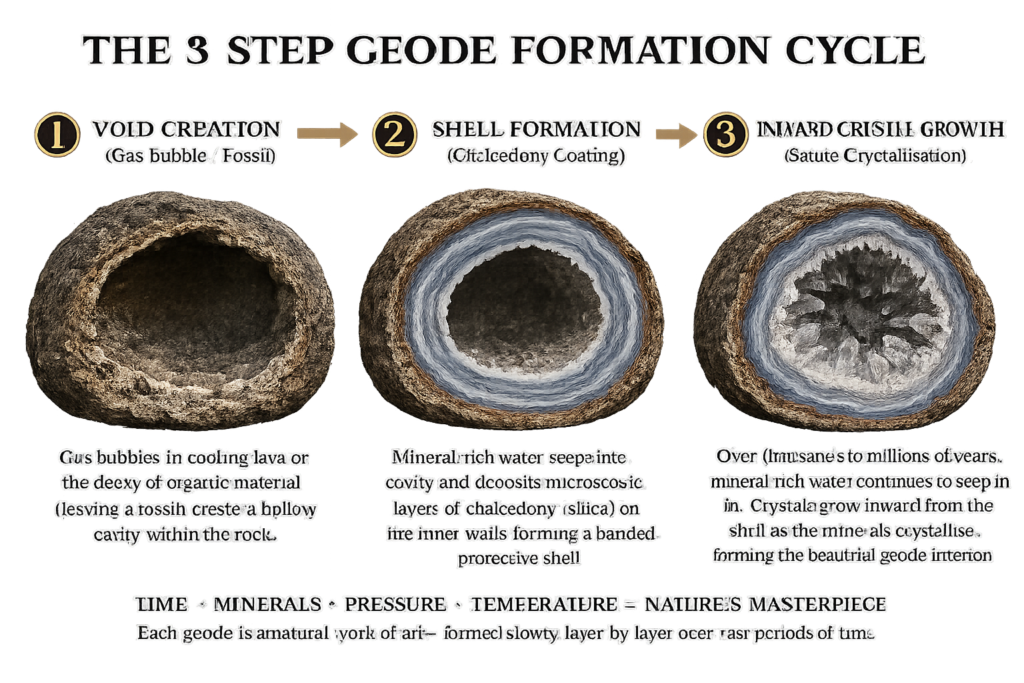
The Core Ingredients of Geode Formation
Regardless of whether a geode develops in volcanic lava or ancient seafloor limestone, all geodes require three fundamental geological conditions to form:
- A Pre-existing Cavity: An isolated void within a host rock that remains stable long enough without collapsing under lithostatic pressure.
- An Impermeable Outer Shell: A dense, weather-resistant outer boundary (typically microcrystalline chalcedony silica) that acts as a protective container and seals the cavity.
- Mineral-Rich Hydrothermal or Groundwater Solutions: Dissolved mineral solutes—predominantly silicon dioxide ($\text{SiO}_2$), calcium carbonate ($\text{CaCO}_3$), or strontium sulphate ($\text{SrSO}_4$)—moving through porous rock layers over thousands to millions of years.
1. Volcanic Geodes: Born of Fire and Trapped Gas
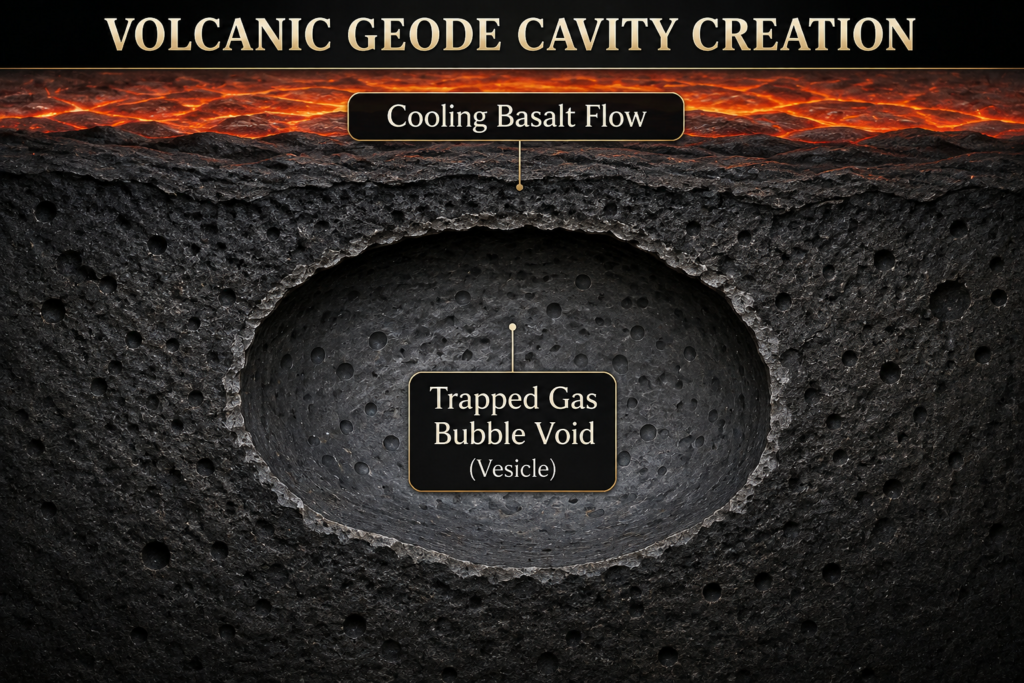
Volcanic geodes including the world-famous, giant amethyst cathedrals of Brazil and Uruguay—form within cooling basalt and rhyolite lava flows.
Step 1: Bubble Trapping (Vesicle Creation)
When a volcano erupts, molten lava pours across the landscape at temperatures exceeding 1,000°C (1,832°F). As the lava flows, super heated volatile gases (mostly water vapour, carbon dioxide, and sulphur dioxide) expand and form gas bubbles. As the lava cools and thickens, these gas pockets become trapped inside the solidifying rock matrix, leaving behind smooth, rounded voids known as vesicles.
Step 2: Silica Shell Deposition
As volcanic activity cools, thermal fluids saturated with dissolved silica percolate through fractures in the surrounding cooling basalt. The sudden drop in fluid temperature and pressure causes fine-grained silica (chalcedony) to coat the walls of the bubble. This creates an impermeable, weather-resistant chalcedony shell that separates the internal void from the host basalt.
Step 3: Centripetal Crystal Growth
Over extended cooling periods, groundwater containing trace iron, manganese, and silica enters the sealed void through microscopic pores in the outer shell. As the fluid saturates, mineral crystals begin to precipitate out, growing centripetally (inward from the outer walls toward the empty centre).
- If iron is present during crystal growth and subjected to natural background radiation from surrounding rocks, the quartz turns violet, forming an amethyst geode.
- If the fluid supply drops or the temperature shifts before the cavity is filled, a hollow space remains at the core, creating a classic geode.
2. Sedimentary Geodes: Born of Water, Mud, and Dissolution
Sedimentary geodes—such as the famous Keokuk geodes found in Iowa, Missouri, and Illinois—form through a completely different geological process. Rather than originating from cooling lava gas, they form in marine muds, shales, and limestone beds.
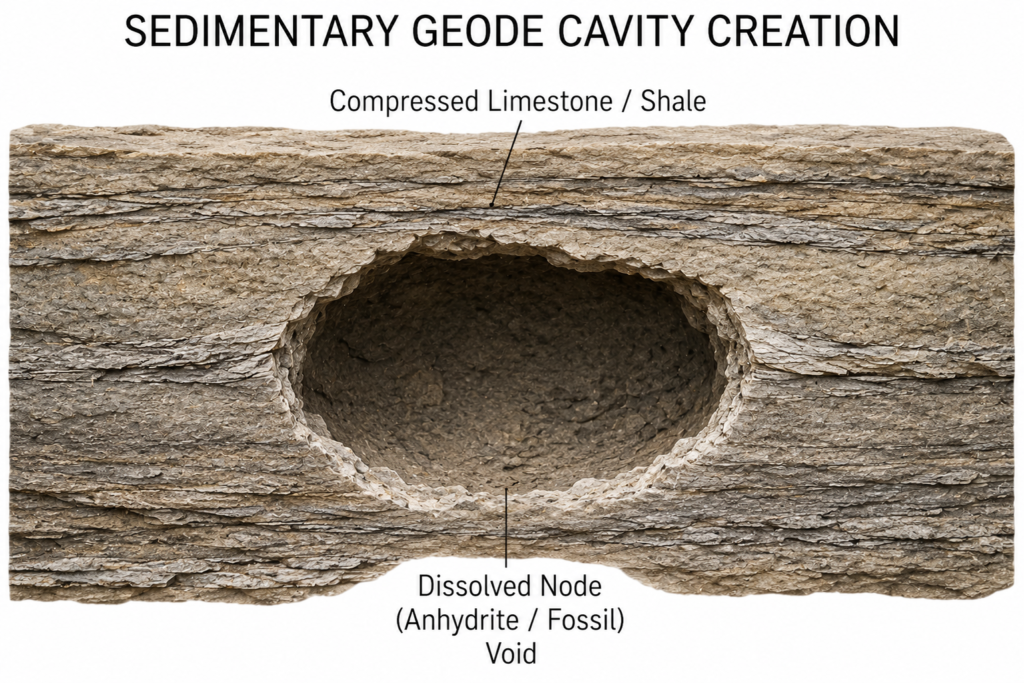
Step 1: Organic and Evaporite Cavity Creation
Instead of volcanic gas bubbles, sedimentary cavities form through dissolution:
- Organic Dissolution: Marine organisms, mud balls, or plant debris become buried in soft carbonate sediment. As the organic material decays, it leaves behind an open void.
- Evaporite Node Dissolution: Spherical nodules of soluble evaporite minerals (such as anhydrite or gypsum) form in shallow, warm sea beds. As seawater chemistry changes over geological time, groundwater dissolves the anhydrite, leaving a spherical void in the surrounding limestone or shale.
Step 2: Expansion and Hardening
Unlike igneous vesicles, which form in solidifying lava, sedimentary cavities must resist collapsing under the weight of accumulating sediment layers. As silica-saturated pore waters enter the cavity, they deposit a rigid shell of microcrystalline quartz along its inner surface. This shell acts as a structural arch, protecting the void from collapsing as surrounding sediments compress into hard limestone or mudstone.
Step 3: Secondary Mineralisation
Groundwater continuously circulates through the porous limestone bed, carrying dissolved silica, calcite, dolomite, or barite. As the solution conditions shift, these minerals precipitate inside the rigid cavity walls.
Because groundwater temperatures in sedimentary environments are significantly lower than hydrothermal volcanic fluids, crystal growth occurs slowly over millions of years, often yielding highly defined quartz, golden calcite, or pink dolomite crystals inside.
Volcanic vs. Sedimentary Geodes: Key Geological Differences
| Feature | Volcanic Geodes | Sedimentary Geodes |
| Primary Host Rock | Basalt, Rhyolite, Andesite | Limestone, Dolomite, Shale |
| Cavity Origin | Trapped Volcanic Gas Bubbles (Vesicles) | Dissolved Fossils, Mud Balls, Anhydrite Nodes |
| Typical Minerals | Amethyst, Agate, Celestite, Smoky Quartz | Clear Quartz, Calcite, Dolomite, Pyrite, Barite |
| Outer Crust | Dark, heavy, iron-rich weathered basalt | Grey, tan, or white limestone / chalcedony crust |
| Geological Scale | Can form massive caverns (e.g., Uruguay Amethysts) | Typically smaller (tennis ball to basketball size) |
| Growth Rates | Faster (driven by cooling thermal fluids) | Slower (driven by ambient groundwater percolation) |
Why Geodes Weather Out Intact
One of the most remarkable properties of geodes is their ability to weather out of solid rock entirely intact.
This occurs because the chalcedony outer lining of a geode is chemically composed of pure silica ($\text{SiO}_2$), which is exceptionally resistant to mechanical abrasion and chemical weathering. In contrast, the surrounding host rocks (such as limestone or basalt) contain carbonate minerals or weathered feldspars that break down when exposed to rain, ice, and acidic groundwater.
Over millions of years, as the surrounding cliff or bedrock erodes away, the hard, spherical geodes remain intact, washing down into creek beds, quarries, and alluvial gravel deposits where collectors discover them today.
Frequently Asked Questions
What is a geode and how do geodes form in general?
A geode looks like a lump of stone on the outside, but when cracked open it reveals a hollow interior lined with glittering crystals. Geodes form when three conditions are met: a pre‑existing cavity in the host rock, an impermeable outer shell, and mineral‑rich solutions that slowly deposit crystals inside the cavity over thousands to millions of years.
How do volcanic geodes differ from sedimentary geodes in origin?
Volcanic geodes form inside cooling lava flows as gas bubbles become trapped and later fill with silica‑rich fluids, creating a silica shell and inward-growing crystals. Sedimentary geodes form later in marine sediments when dissolved minerals and organic matter leave voids, which are then filled by minerals through groundwater percolation, producing crystals over long timescales.
What are the three core ingredients required for geode formation?
The three core ingredients are a pre‑existing cavity, an impermeable outer shell of chalcedony silica, and mineral‑rich hydrothermal or groundwater solutions that slowly deposit minerals inside the cavity.
Why do geodes weather out of rock intact, and where are they typically found?
Geodes weather out intact because their outer lining of pure silica chalcedony is highly resistant to weathering, while surrounding rocks such as limestone or basalt break down. Over millions of years, geodes can be eroded out of cliffs and bedrock and are often found in creek beds, quarries, and alluvial deposits.
What minerals are commonly found inside volcanic versus sedimentary geodes?
Volcanic geodes commonly host minerals such as amethyst, agate, celestite, and smoky quartz, whereas sedimentary geodes often contain clear quartz, calcite, dolomite, pyrite, and barite, reflecting the different formation environments and fluid chemistries.