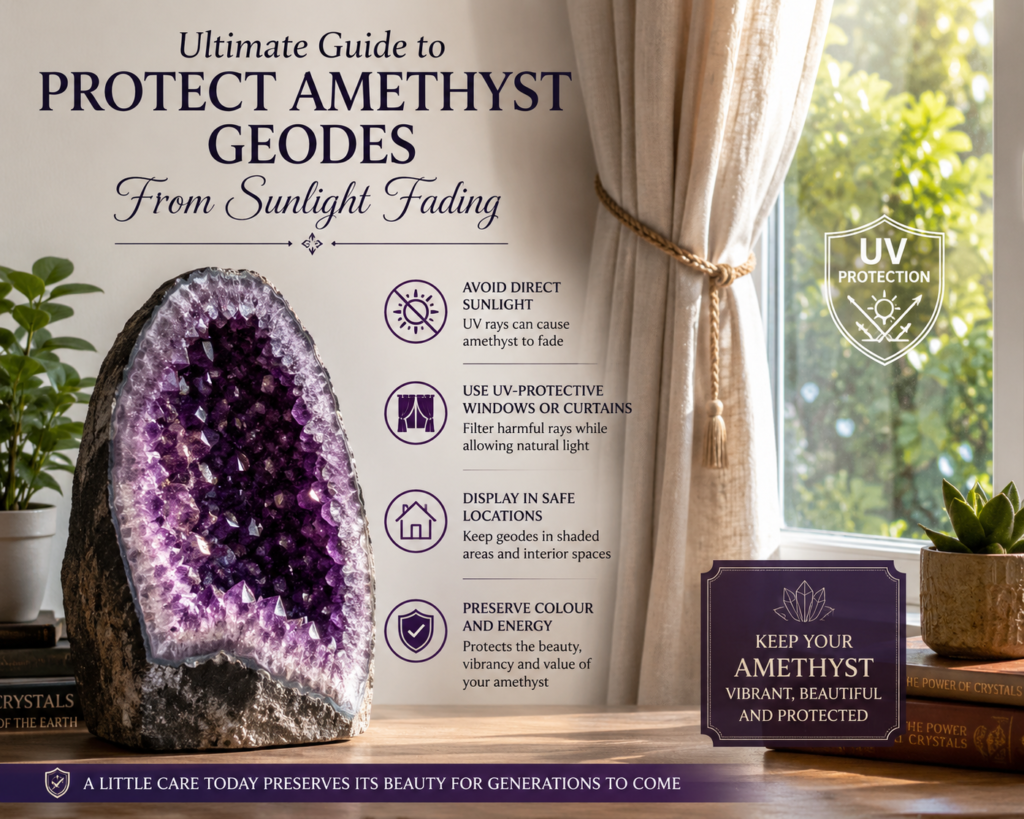
Amethyst geodes are prized globally for their rich violet and royal grape purple hues. Whether displayed as free-standing cathedral geodes in a living room, placed on a sunlit window sill, or set upon a meditation altar, their deep colour draws immediate attention.
However, many collectors and home decor enthusiasts discover a tragic surprise after months or years of display. Their vibrant purple Amethyst Geodes Fade in Sunlight geode has gradually turned into a dull, washed-out lavender, cloudy grey, or pale milky white.
This colour loss is not a surface stain or a layer of dust—it is an irreversible chemical degradation of the crystal’s internal atomic structure caused by exposure to ultraviolet (UV) radiation and direct sunlight.
This comprehensive guide explains the exact atomic chemistry behind why amethyst geodes fade, how fast solar degradation occurs, how to protect your specimens, and how to safely display amethyst in your home or collection.
1. The Chemistry of Amethyst Colour: How Purple Is Created
To understand why sunlight destroys amethyst’s purple hue, one must first examine how the colour was created deep within the Earth millions of years ago.
Pure quartz ($\text{SiO}_2$) is completely colourless and transparent. Amethyst is a colour altered variety of quartz created by a specific combination of trace element substitution and natural radiation:
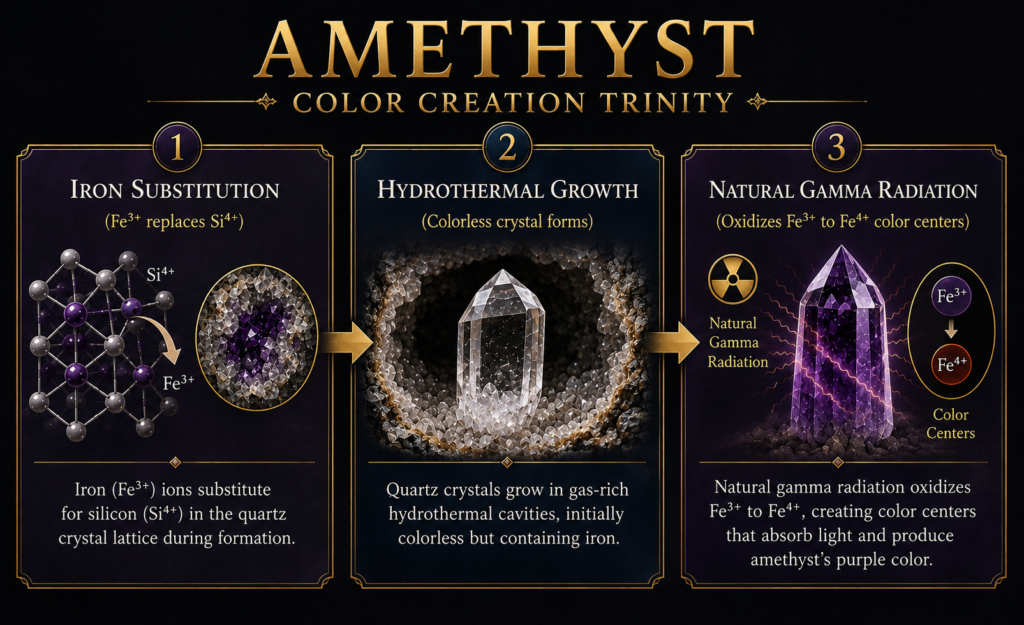
- Atomic Substitution: As quartz crystals grew inside cooling volcanic basalt cavities, trace amounts of ferric iron ($\text{Fe}^{3+}$) substituted for silicon ions ($\text{Si}^{4+}$) within the crystal lattice. At this stage, the quartz was still completely colourless.
- Radiative Oxidation: Over millions of years, low levels of natural gamma radiation emitted by radioactive isotopes (such as potassium-40, thorium, and uranium) in surrounding volcanic rocks bombarded the quartz lattice.
- Colour centre Formation: This natural radiation ejected an electron from the ferric iron ion, converting it from $\text{Fe}^{3+}$ to $\text{Fe}^{4+}$. These $\text{Fe}^{4+}$ ions act as colour centres (F-centres) that absorb light in the yellow-green spectrum while transmitting rich violet light to the human eye.
2. The Photochemical Reaction: What Sunlight Does to Amethyst
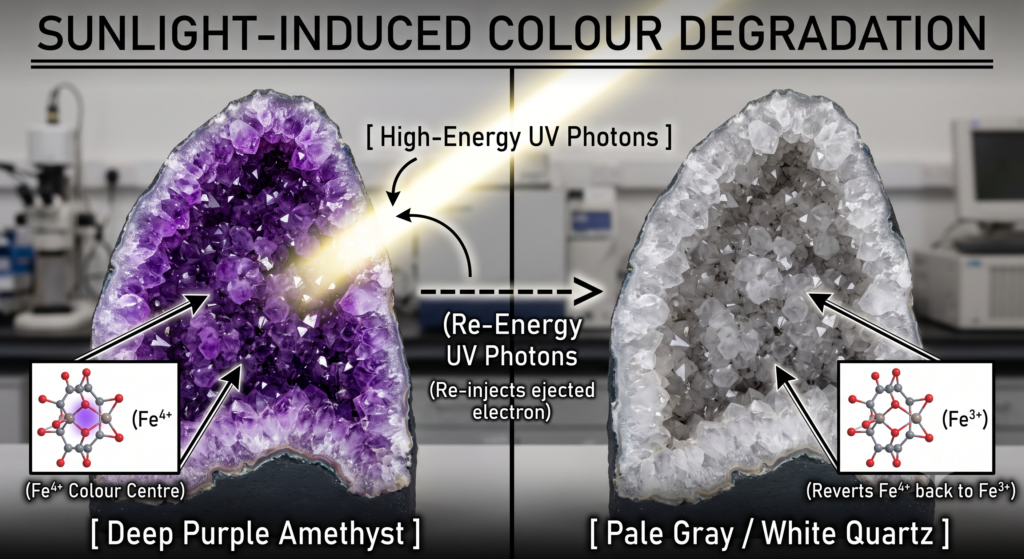
When an amethyst geode is exposed to direct sunlight or strong ultraviolet (UV) radiation, a reverse photochemical reaction takes place at the atomic level.
The Electron Re-Capture Process
- High-energy UV photons in sunlight penetrate the quartz crystal lattice.
- This photon energy excites trapped electrons and forces them back into the $\text{Fe}^{4+}$ colour centres.
- By gaining an electron, the iron ion is reduced back to its ground state: $\text{Fe}^{4+} \longrightarrow \text{Fe}^{3+}$.
- Once the $\text{Fe}^{4+}$ colour centres are destroyed, the crystal loses its ability to absorb yellow-green light, and the purple colour disappears permanently.
Crucial Fact: Fading caused by solar UV radiation is irreversible under ambient conditions. Once the Fe4+ colour centres are broken down by sunlight, no amount of dark storage, water soaking, or moonlight charging can restore the original deep purple colour.
3. How Fast Does Amethyst Fade? Exposure Factors
The rate at which an amethyst geode loses its colour depends on three primary environmental factors:
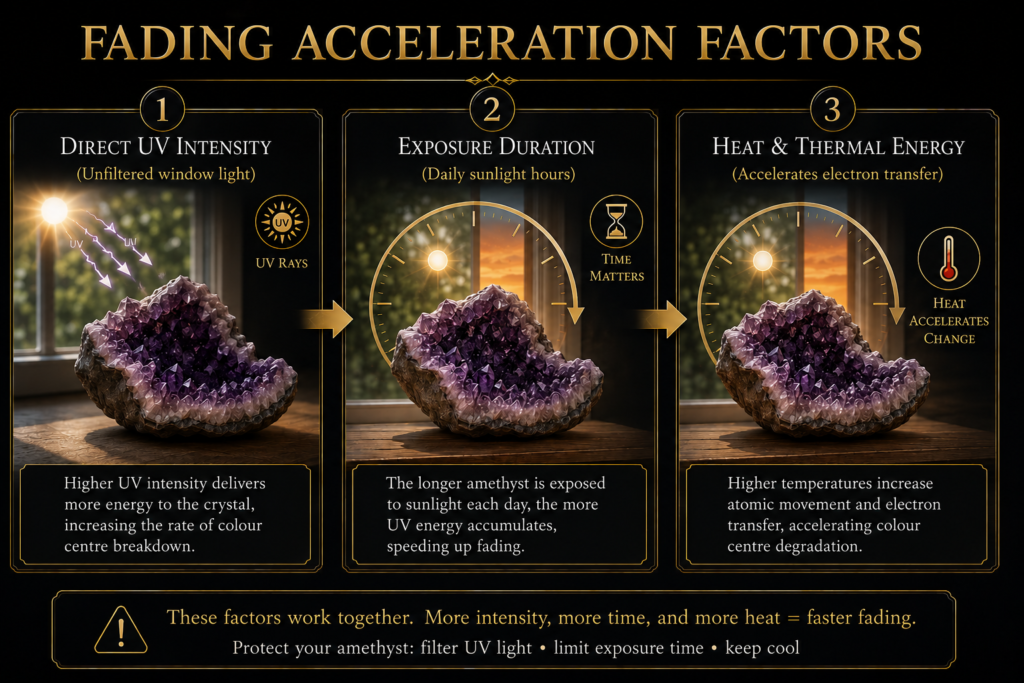
Direct Sunlight (Window Sills): A purple amethyst geode on a sunny window sill receives 3–5 hours of direct sunlight daily. It can show noticeable colour fading in as little as a few months to one year. Thus, this illustrates Amethyst Geodes Fade in Sunlight.
Indirect Natural Light: In a brightly lit room away from direct window rays, colour degradation occurs at a slower rate. It takes decades to show visible fading.
Thermal Heat Acceleration: Heat accelerates photochemical reactions. Amethyst geodes exposed to direct sunlight and heat fade exponentially faster because thermal energy frees trapped electrons.
4. How to Protect Your Amethyst Geodes: Display & Care Rules
Protecting your investment in a high-grade Uruguayan or Brazilian amethyst geode requires controlling light exposure and ambient temperature in your display space.
Protocol 1: Strategic Placement (The 6-Foot Window Rule)
Never place natural amethyst geodes on window sills, sun porches, or tables directly in the path of incoming sunbeams. Position specimens at least 6 to 8 feet away from direct window light, or along interior walls that receive diffused, ambient room light only.
Protocol 2: Apply UV-Blocking Window Film
If your display space has large south- or west-facing windows, install transparent UV-blocking window film. High-quality museum-grade window films block up to 99% of harmful ultraviolet rays without significantly darkening the room, allowing you to enjoy natural light while preserving your minerals.
Protocol 3: Use Museum-Grade LED Lighting
Lighting brings out the glittering brilliance of an amethyst geode cavity, but traditional halogen or incandescent bulbs emit both heat and UV radiation.
- Use Cool LED Spotlights: Display lighting should consist exclusively of cool-temperature LED bulbs. LEDs emit virtually zero UV radiation and generate minimal heat, making them completely safe for long-term mineral illumination.
Protocol 4: Outdoor Event Protection
If displaying amethyst geodes at outdoor rock shows, farmers’ markets, or garden altars, always set up under a UV-blocking pop-up canopy or shade cloth. Never leave amethyst specimens uncovered in direct sun during peak UV hours (10 AM to 4 PM).
5. Summary Matrix: Lighting Safety for Mineral Geodes
Not all geodes react to light in the same way. Use this reference guide to manage light exposure across your collection:
| Geode Variety | Sensitivity to Sunlight | Photochemical Effect | Recommended Display Environment |
| Amethyst Geodes | VERY HIGH | Fades from deep purple to pale lavender/white | Interior display away from direct windows; cool LED lighting |
| Celestite Geodes | HIGH | Sky-blue hue fades to dull grey/white | Low-light interior shelves; protect from direct sun |
| Smoky Quartz Geodes | MODERATE | Dark smoky grey/brown fades over long exposure | Diffused indoor lighting; avoid sunny window sills |
| Clear Quartz Geodes | NONE | Unaffected (Contains no iron colour centres) | Safe in bright natural light |
| Agate Geodes (Natural) | LOW | Highly stable; natural iron-stained bands resist fading | Safe in indirect natural light |
| Dyed Geodes (Artificial) | VERY HIGH | Chemical dyes bleach rapidly under UV light | Keep out of natural light entirely |
Summary Checklist for Amethyst Care
- The Cause: UV radiation in sunlight destroys $\text{Fe}^{4+}$ colour centres, converting purple iron ions back to colourless $\text{Fe}^{3+}$.
- Is It Reversible? No—fading from UV sunlight is permanent.
- Golden Display Rule: Keep amethyst at least 6 feet away from direct window sunlight and use cool LED lighting for display illumination!
Frequently asked questions
Why does amethyst geode colour fade when exposed to sunlight?
Sunlight causes a reverse photochemical reaction that destroys the Fe4+ colour centres in amethyst, converting Fe4+ to Fe3+. Once these colour centres are broken down, the crystal cannot absorb yellow-green light, so the deep purple colour fades permanently to pale lavender or grey.
How fast does amethyst fade and what factors influence the rate of fading?
The rate depends on direct sunlight duration, ambient light, and temperature. Direct sun on a window sill with 3–5 hours of daily exposure can cause noticeable fading in months to a year, whereas indirect light degrades colour much more slowly over decades, and higher heat accelerates the fading process.
What display practices help protect amethyst geodes from fading?
Never place amethyst geodes in direct window light; keep them at least 6 to 8 feet away from direct sun or on walls with diffused light. Use UV-blocking window film for sunlit spaces, illuminate with museum-grade cool LED lighting, and when showing outdoors, use a UV-blocking canopy or shade cloth to protect from peak UV hours.
Are all amethyst geodes equally sensitive to sunlight as shown in the article’s guidance?
Amethyst geodes are categorised as VERY HIGH in sensitivity to sunlight, and other geode varieties have different levels of sensitivity with corresponding photochemical effects and display recommendations. This means amethyst generally fades much more readily under UV exposure than some other minerals.
Is the fading of amethyst geodes reversible, and can fading be restored later?
No. The fading caused by UV sunlight is irreversible under ambient conditions; once Fe4+ colour centres are destroyed, they cannot be restored by dark storage, water soaking, or moonlight charging.