
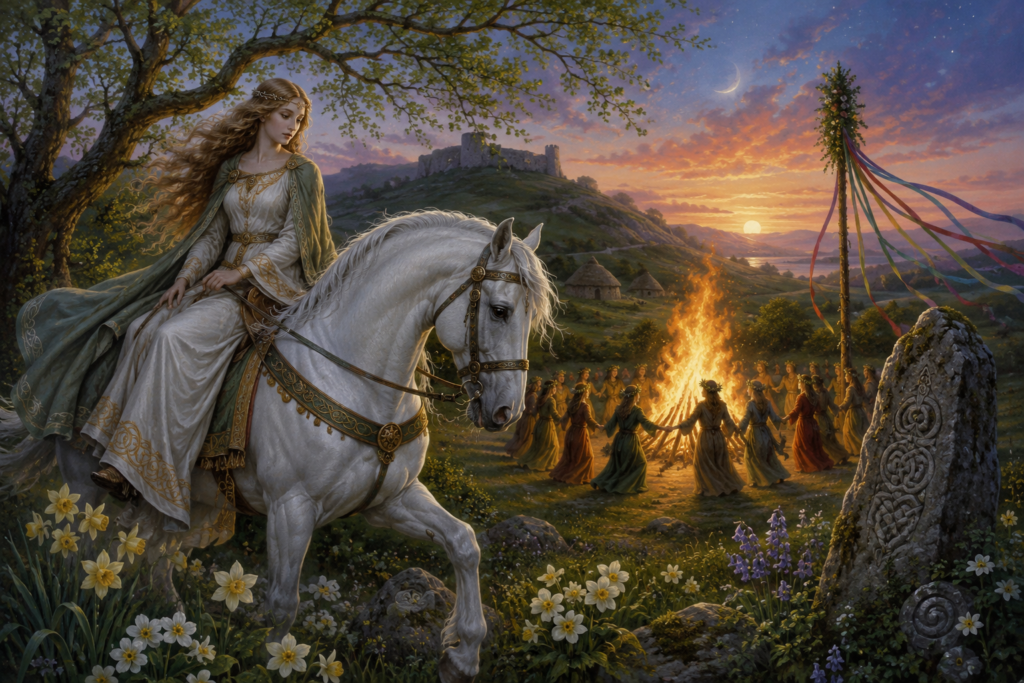
he connection between the Welsh May Day (Calan Mai) and the legendary goddess Rhiannon stems from one of the most famous tales in the Mabinogion (the ancient collection of Welsh myths). In Welsh tradition, Calan Mai is not just a seasonal marker—it is the exact calendar date when Rhiannon’s magical narrative unfolds.
The story connects deeply with the spiritual energy of the festival.
The Mysterious Lady on the White Horse
The tale begins at Gorsedd Arberth, a sacred mound in Pembrokeshire. It was believed that any noble who sat upon this mound would either receive a severe wound or witness a profound wonder. On May Eve (Nos Galan Haf), Pwyll, the Prince of Dyfed, sat upon the mound and witnessed the wonder.
He saw a beautiful woman dressed in shining gold silk, riding a great white horse at a slow, majestic pace.
Pwyll sent his fastest horsemen to pursue her, but a strange enchantment was at play. No matter how fast Pwyll’s riders sprinted, they could never gain a single inch on her—even though her white horse never broke its calm, walking pace.
Finally, out of sheer exhaustion, Pwyll cried out to her: “Lady, for the sake of the man you love most, stay for me!”
Rhiannon immediately stopped, turned to him, and wittily replied: “I will gladly stay, and it would have been better for your horse had you asked me sooner.”
She revealed she had escaped her home to avoid an unwanted arranged marriage because she was deeply in love with Pwyll. They agreed to wed exactly one year later, on Calan Mai.
The Calan Mai Tragedy: The Loss of Pryderi
A year passed, they married, and Rhiannon eventually gave birth to a son. However, the most haunting connection to Calan Mai occurs on the night of the boy’s birth, which took place on May Eve a few years later.
While Rhiannon slept, the six maids assigned to watch the newborn baby fell into a deep slumber. When they woke in the early hours of May Day, they discovered the cradle was empty—the baby had vanished.
Terrified of being executed for their negligence, the maids concocted a horrific lie. They slaughtered a puppy, smeared its blood on the sleeping Rhiannon’s face and hands, and threw the bones by her bed. When Rhiannon awoke, they accused her of killing and devouring her own child.
The Penance of Rhiannon
Despite her innocence, Pwyll had to issue a royal penance. For seven years, Rhiannon was forced to sit by the horse-mounting block outside the gates of Arberth palace. She had to tell her alleged crime to every traveling stranger and offer to carry them on her back into the courtyard like a beast of burden. She bore this humiliation with immense grace, quiet dignity, and supernatural patience.
The Parallel Wonder: Teyrnon’s Mare
Miles away in Gwent, a noble named Teyrnon owned the most beautiful mare in Wales. Every single year on May Eve, the mare gave birth to a magnificent foal, and every single year, an unknown force stole the foal before morning.
Determined to stop this, Teyrnon stayed awake inside the stable on May Eve. Just as midnight struck:
- A massive, clawed arm reached through the stable window and grabbed the newborn foal by its mane.
- Teyrnon drew his sword, hacked off the monstrous arm, and ran outside into the dark to pursue the beast.
- Hearing a cry behind him, he returned to the stable to find the monster gone, but a beautiful, glowing baby boy left behind on the stable floor.
Teyrnon and his wife adopted the boy. As the child grew at an impossibly fast rate, they noticed he had an instinctive, supernatural bond with horses. Realising the boy’s striking resemblance to Prince Pwyll, Teyrnon brought him back to Arberth on Calan Mai.
Rhiannon was vindicated, her son was returned, and she declared that her period of grief (pryder) was over. The boy was rightfully named Pryderi, and he grew up to become one of Wales’ greatest mythological heroes.
Why this Myth Matters to the Welsh Beltane
The story of Rhiannon and Pryderi is not just a fairy tale; it acts as a perfect spiritual map for the energies of Calan Mai:
- The Thinning Veil: In Welsh lore, May Eve is when the physical world and the supernatural world (Annwn) collide. This is why the monster could reach into Teyrnon’s stable, and why Rhiannon’s horse could defy the laws of physics.
- The Sovereign Earth Goddess: Scholars view Rhiannon as a manifestation of the ancient Celtic horse goddess Epona. Her association with horses, birds, and profound fertility links her directly to Beltane’s celebration of the earth’s raw creative power.
- The Cycle of Loss and Rebirth: The theft of the child on May Eve represents the final cold grip of winter stealing life away, while his triumphant return on May Day mirrors the joyful rebirth of the land and the absolute victory of summer.
