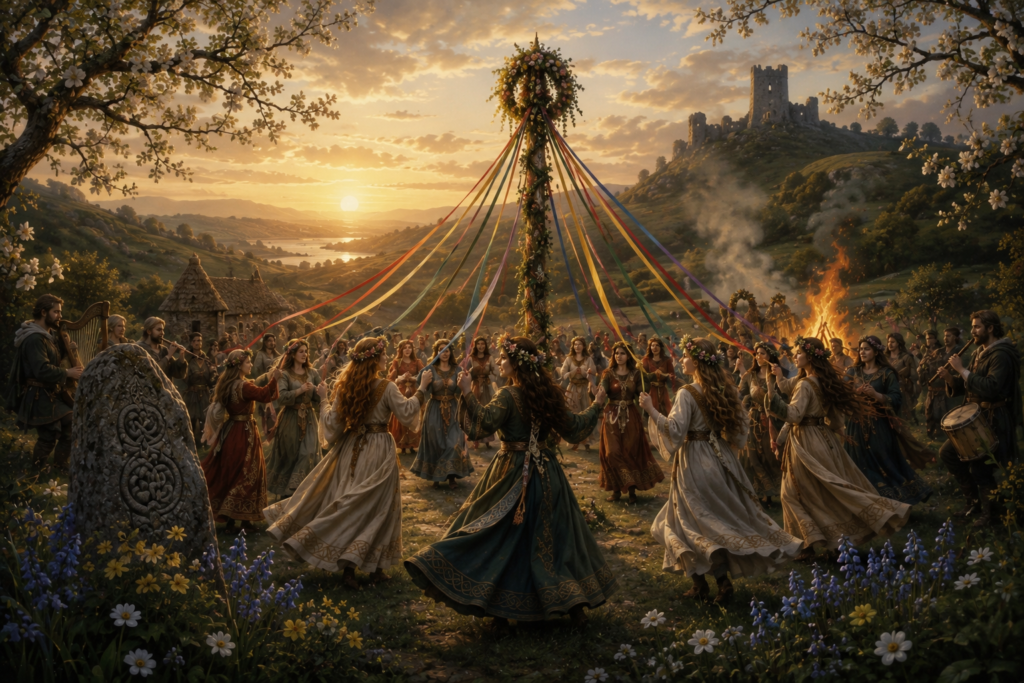
In Wales, the Celtic festival of Beltane is known as Calan Mai (the first day of May) or Calan Haf (the first day of summer). While it shares identical ancient roots with the Gaelic Beltane—focusing on fire, the awakening of the land, and livestock fertility—the Welsh tradition has its own distinct, beautiful, and sometimes brilliantly eccentric customs.
The unique historical and contemporary traditions of Wales’ own Beltane are outlined below.
1. Nos Galan Haf: The “Spirit Night”
The celebrations actually begin on May Eve (30th April), known in Welsh as Nos Galan Haf. In Welsh mythology, this is one of the three great Ysbrydnos (Spirit Nights), alongside Halloween (Calan Gaeaf).
The Welsh believed that on this night, the veil between our world and the Otherworld (Annwn) grew so thin that spirits walked freely and divination was highly powerful. To ward off negative entities and bad luck, communities would gather to light massive bonfires (coelcerth), and families would decorate the outside of their windows and doors with protective sprigs of hawthorn (draenen wen) and rowan.
2. The Great Ritual of the Nine Men’s Fire
The lighting of the Welsh Beltane bonfire was deeply ritualistic. In regions like Glamorgan and Montgomeryshire, the fire was lit using an ancient method known as a need-fire:
- The Rule of Nine: Nine men would gather branches from nine different species of sacred trees.
- The Cleanse: Before friction was used to spark the wood, all men had to strip their pockets of any metal coins or items, ensuring the ritual remained untainted by modern commerce.
- The Harvest Leap: Once blazing, oatmeal cakes were thrown into a bag. Whoever pulled out a burnt or marked piece was required to leap three times through the flames or run three times between two side-by-side bonfires to ensure a bountiful harvest for the village.
3. The Mock Battle of the Seasons
One of the most theatrical Welsh traditions is the dramatic reenactment of the turning of the year: a literal mock battle between the forces of Winter and Summer.
| The Winter King | The Summer King |
| Wore heavy clothing, carried a shield covered in white wool (to represent snow), and wielded a stick of blackthorn (draenen ddu). | Adorned with vibrant ribbons, garlands of fresh spring flowers, and carried a willow-wand (helygen). |
| The Battle: Winter’s army would pelt the opposing side with straw and dry underbrush. | Summer’s army retaliated by striking back with fresh green birch branches and young ferns. |
The battle was fixed—Summer always won. Following Winter’s defeat, the Summer King and Queen were crowned, officially opening the season of warmth, dance, and feasting.
4. The Bedwen Fai (May Birch) and the Twmpath
While many countries use a standard pine pole, the traditional Welsh maypole is specifically a Bedwen Fai (May Birch).
The youth of the village would harvest a tall birch tree, strip its lower branches, decorate it with ribbons, and erect it on the village green, known as the Twmpath Chwarae (the “play mound”).
The Twmpath was a physical mound on the green where the village harpist or fiddler would sit, elevated above the crowd, playing traditional tunes late into the evening. The festival was notoriously lively, featuring the singing of Carolau Mai (May Carols)—which were often quite bawdy, explicit, and joyful songs celebrating love and fertility.
5. The “Cadi” and the Straw Man
Welsh May Day features a highly unique folk character called The Cadi (the Fool), who led the village processions. The Cadi was typically a man with a blackened face or mask, wearing a woman’s petticoat combined with a man’s waistcoat, acting as a chaotic master of ceremonies to bring laughter to the crowd.
Meanwhile, a more romantic (and competitive) tradition involved the Gŵr Gwellt (Straw Man). If a local young man had lost his sweetheart to a rival, he would craft a life-sized man out of straw, pin a mocking note to it, and hang it near the girl’s house on May Eve. This routinely resulted in massive, dramatic fistfights between the two men at the local May Fair the following afternoon!
Modern Celebrations in Wales
Today, Calan Mai is undergoing a fantastic revival across Wales. Modern Welsh pagans, druids, and cultural societies blend these ancient Brythonic myths—such as the romantic tales of the goddess Rhiannon from the Mabinogion—with community fun.