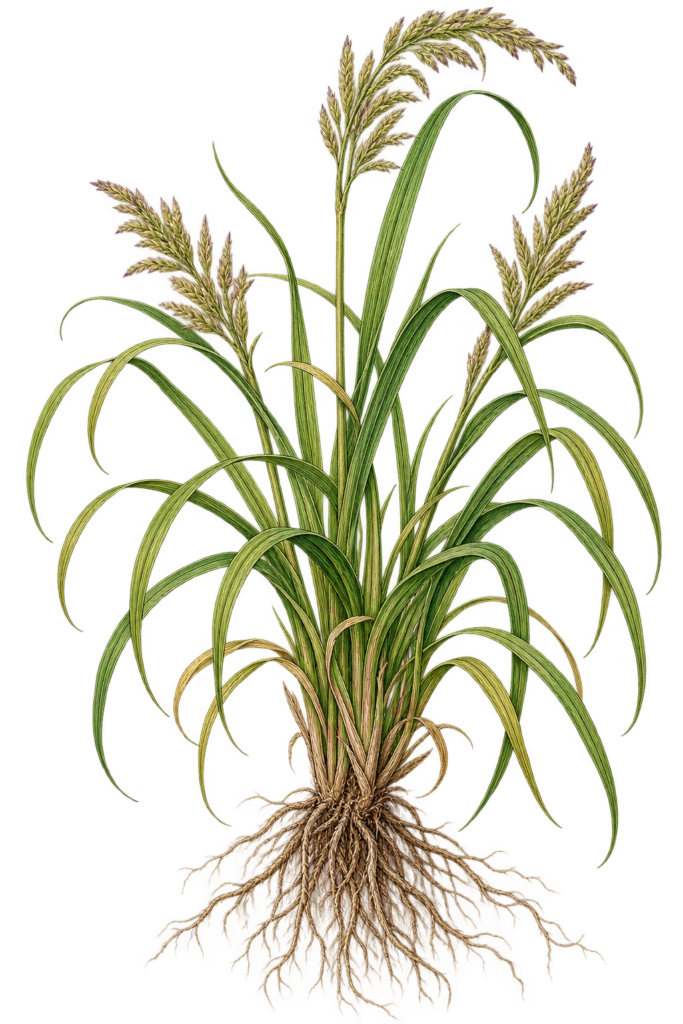
Sweetgrass (Hierochloe odorata, also classified as Anthoxanthum nitens) is an aromatic, perennial cool-season grass belonging to the true grass family, Poaceae. Renowned for its distinctive, lingering scent of fresh vanilla and newly mown hay, it is native to northern temperate regions across North America and northern Eurasia.
- Morphology: The plant grows to heights of 30–70 cm. Its basal leaves are long, flat, and slender (often reaching 30–60 cm in length), with a glossy, deep-green upper surface and a dull, paler underside. The base of the leaf sheaths frequently displays a characteristic reddish-purple hue.
- Reproduction & Growth: Unlike clump-forming bunchgrasses, sweetgrass spreads primarily via vigorous, creeping underground rhizomes, forming expansive horizontal sod mats. It produces loose, open pyramidal panicles of bronze-to-golden spikelets in early spring (May–June), though seed viability is notably low; natural propagation relies almost entirely on vegetative rhizome division.
- Aroma Chemistry: The signature scent stems from coumarin (1,2-benzopyrone), a naturally occurring aromatic organic compound stored as a glycoside in living tissue and released in abundance as the plant dries and wilts.
Key Species & Regional Distinctions:
Northern Sweetgrass (Hierochloe odorata / Anthoxanthum nitens): The quintessential holy grass native to North American wetlands, prairie meadows, and northern European bogs.
Alpine Holy Grass (Hierochloe alpina): A smaller, arctic-alpine circumpolar relative adapted to rocky tundra and subalpine zones.
Southern Sweetgrass (Muhlenbergia sericea / Sweetgrass of the American Southeast): A fine-textured coastal marsh grass used extensively by Gullah Geechee artisans for coiled basketry, distinct from coumarin-rich Hierochloe.
Sweet Vernal Grass (Anthoxanthum odoratum): A common European meadow grass that also produces coumarin and sweet vanilla notes, but forms tufts rather than creeping rhizomatous mats.
Ancient Origins & Antiquity
Sweetgrass holds an ancient, dual heritage spanning both circumpolar Indigenous traditions in North America and pre-Christian spiritual practices in Northern and Central Europe.
- Indigenous Creation Histories: For the Haudenosaunee (Iroquois), Anishinaabe (Ojibwe, Odawa, Potawatomi), Cree, and Blackfoot nations, sweetgrass is revered as the first plant to grow on Turtle Island. In Robin Wall Kimmerer’s recording of the Skywoman creation story, Skywoman brought sweetgrass from the Skyworld and planted it into the mud on the turtle’s back, establishing the plant as a foundational gift of life.
- The Hair of Mother Earth: Across North American ceremonial cosmology, the long green blades represent the physical hair of Mother Earth. Harvesting sweetgrass is approached with reverence, gratitude, and an offering of tobacco (semaa), with the leaves braided in three strands to honour body, mind, and spirit.
- European Strewn Herb: In pre-industrial Europe—spanning Scandinavia, the British Isles, and the Baltic regions—sweetgrass was gathered and strewn across the stone floors of dwellings, castles, and public gathering spaces. When walked upon, the bruised blades released coumarin, purifying the air, masking foul odours, and deterring vermin.
- The Medieval “Holy Grass”: Following the Christianisation of Europe, sweetgrass (Hierochloe, literally translating from Greek as “sacred holy grass”) was adopted by the Church. It was strewn across the steps and doorways of churches on major saints’ days and festival mornings so that worshippers would crush its fragrance underfoot as they entered sacred ground.
Folklore, Superstition & Cultural Traditions
Sweetgrass is woven into ritual protective practices and social customs across both continents.
- The Tradition of the Three-Strand Braid: While sweetgrass grows as solitary blades, it is traditionally harvested in midsummer and woven into three-strand braids. In Indigenous teachings, these three strands carry deep symbolic meanings:
- Mind, Body, and Spirit
- Peace, Kindness, and Love
- The Past (Ancestors), the Present (Community), and the Future (The Unborn Seven Generations)
- Threshold & House Wards: In Scandinavian and Celtic folk traditions, bundles of dried sweetgrass were hung over doors, lintels, and bedframes to bar malevolent spirits, promote peaceful sleep, and invite good domestic fortunes.
- Hospitality and Reconciliation: Among Plains and Woodland nations, burning sweetgrass preceded treaties, councils, and personal reconciliations. It was understood that no one could speak deceitfully or harbour ill intent while the sweet smoke lingered in the room.
Therapeutic & Medicinal Applications
Traditional herbalism and modern ethnobotanical studies highlight sweetgrass for both internal relief and atmospheric purification.
- Insect Repellent & Phytochemistry: Recent agricultural research by the USDA confirmed traditional knowledge: sweetgrass contains potent natural mosquito and arthropod repellents, specifically phytol and coumarin, which rival synthetic repellents like DEET in laboratory trials.
- Respiratory Inhalations: Traditional North American medicine utilised sweetgrass steam infusions and smoke to soothe coughs, ease sore throats, open congested bronchial passages, and relieve head colds.
- Postpartum & Cleansing Tonics: Infusions of sweetgrass roots and leaves were administered by traditional midwives to assist in stopping postpartum bleeding, expediting afterbirth delivery, and easing abdominal cramping.
- Skin Rinses & Hair Washes: A steeped wash made from boiled sweetgrass leaves was historically used to treat chapped windburned skin, soothe eye irritations, and condition hair with an enduring sweet scent.
Astrological and Mystical Correspondences
| Category | Correspondence | Esoteric Context |
| Planetary Ruler | Venus ($\female$) & Moon ($\leftmoon$) | Governs harmony, sweet attraction, peace, maternal protection, and emotional equilibrium |
| Elemental Alignment | Earth ($\triangledown$) & Air ($\triangle$) | Grounding, nourishing physical connection balanced with communicative, elevating aromatic smoke |
| Zodiac Sign | Taurus ($\♉$) & Cancer ($\♋$) | Earthly abundance, domestic comfort, maternal devotion, and sanctuary |
| Chakra Association | Heart (4th) & Crown (7th) | Compassion, emotional restoration, divine connection, and spiritual receptivity |
| Polarity / Energy | Feminine / Receptive (Yin) | Welcoming, nurturing, restoring, pacifying |
| Deities & Entities | Mother Earth, Skywoman, Freyja, Brigid, Virgin Mary | Maternal creators, earth mothers, domestic protectors, and goddess archetypes |
Culinary & Domestic Uses
While not a staple edible vegetable due to its high fibre and coumarin levels, sweetgrass serves specialised culinary, craft, and preservative functions.
- Flavoured Spirits & Liqueurs: In Central and Eastern Europe—most famously in Poland and Belarus—sweetgrass (żubrówka) is steeped into rye vodka to produce Żubrówka (Bison Grass Vodka). It imparts a pale yellowish-green tint and a rich flavour profile of vanilla, almond, woodruff, and coconut.
- Basketry & Coiled Crafts: The flexible, durable leaves of sweetgrass have been harvested for centuries to weave scented baskets, trays, mats, and storage pouches. As ambient humidity shifts, these handwoven items continue to emit their sweet fragrance for decades.
- Aromatic Infusions & Syrups: Craft mixologists and modern herbal cooks occasionally infuse simple syrups or dairy bases with small amounts of dried sweetgrass to add a subtle meadow-vanilla note to desserts, custards, and botanical cocktails.
- Linen & Wardrobe Freshener: Tucking dried sweetgrass braids or sachets into drawers, linen closets, and cedar chests infuses textiles with a fresh scent while naturally deterring clothing moths.
Spiritual, Energetic & Metaphysical Properties
In energetic disciplines and ceremonial smudging, sweetgrass occupies a specific role: attracting positive energy and benevolence.
    [ White Sage / Cedar ]                 [ Sweetgrass ]
    Banishing / Cleansing       ──►      Attraction / Blessing
   "Clears the heavy energy"           "Invites the good spirits in"
- The Counterpart to Sage: Where sage, cedar, or mugwort are used to banish negativity, clear stagnant energy, and expel discordant influences, sweetgrass is traditionally burned afterwards to invite in benevolent spirits, loving intentions, and peaceful vibrations.
- Prayer Delivery: The sweet, upward-drifting smoke is believed to carry personal prayers directly to the Creator and the spirit world, serving as an aromatic bridge between physical and spiritual realms.
- Aura Soothing & Heart Healing: Energetically, working with sweetgrass or inhaling its unlit fragrance calms frayed nerves, releases grief, and re-anchors the emotional subtle body to the stabilising heartbeat of the Earth.
- Ritual Smudge Method: Sweetgrass is typically not burned in large flames. Instead, the tip of a braid is lit, gently blown out, and allowed to smoulder slowly in a heat-resistant shell or bowl, releasing a continuous stream of thin, sweet smoke.
Fun Facts
- Bison Grass Connection: In Poland’s Białowieża Forest, wild European bison (żubr) graze on sweetgrass, giving rise to its popular regional name “Bison Grass” and its signature association with wildlife conservation.
- The Scent That Outlives the Plant: Dried sweetgrass braids can retain their scent for 20 to 30 years. If the fragrance fades, lightly dampening the braid with a mist of warm water will reactivate the coumarin and renew the aroma.
- Honorable Harvest Protocol: Indigenous harvesting protocols teach that sweetgrass should never be pulled up by the roots. Harvesters carefully cut or pluck the outer blades above the root collar, leaving the rhizomes intact so the patch returns thicker the following spring.
- Banned in Pure Form: Because pure coumarin acts as a mild anticoagulant and can cause liver toxicity at high pharmaceutical doses, the US FDA regulates coumarin as a food additive, requiring distillers of Bison Grass vodka to use coumarin-free flavour extracts for the US market.
Frequently Asked Questions
How does sweetgrass differ from white sage in smudging rituals?
White sage is primarily used for deep spiritual purification and expelling heavy, negative, or stagnant energies. Sweetgrass is used afterwards to attract blessing, peace, healing, and positive spirits into the freshly cleansed space.
Can I grow sweetgrass in my own garden?
Yes. Sweetgrass is cold-hardy (down to USDA Zone 3) and thrives in full sun with consistently moist, rich soil. Because seeds have very low germination rates, it is best established using root plugs or rhizome cuttings. Be aware that its creeping rhizomes will spread rapidly if not contained.
Why is sweetgrass braided rather than bundled straight?
Braiding honours traditional cultural teachings that view the grass as the sacred hair of Mother Earth. The three strands represent the harmonious union of body, mind, and spirit, as well as reverence for past, present, and future generations.
Can you use sweetgrass as a daily tea?
While occasional, light traditional sips were used medicinally, sweetgrass is not recommended for heavy or daily consumption. Coumarin, when consumed in substantial quantities over time, can thin the blood and place stress on the liver.