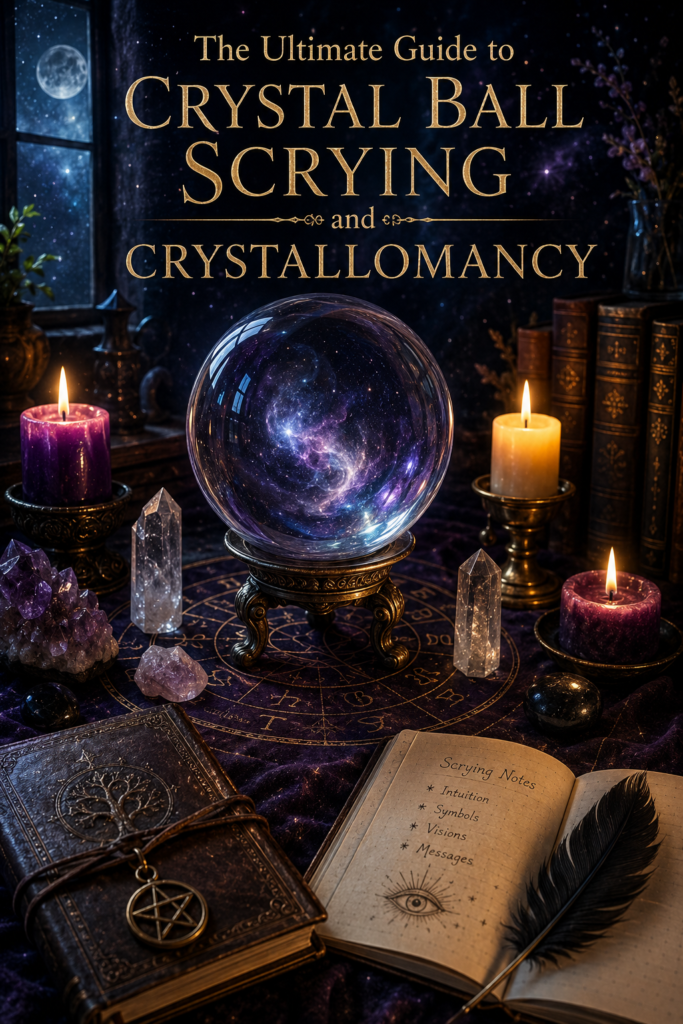
Crystallomancy, the ancient art of gazing into a crystal sphere to receive intuitive visions, symbolic insights, and spiritual guidance, is one of the most recognisable forms of scrying in global esoteric traditions. By focusing visual attention into the optical depth of a clear stone or glass orb, the practitioner lowers their brainwave activity from an alert Beta state into a quiet, receptive Alpha or Theta trance state.
This physiological shift quiets the chatter of the analytical ego, allowing subconscious metaphors, repressed memories, and subtle intuitive frequencies to surface onto the visual plane as clouds, shadows, or vivid symbolic imagery. Crystal Ball Scrying
Far from being a mere theatrical prop, a crystal ball acts as a multidimensional conduit and a physical focal point that steadies mental concentration. Whether formed from natural clear quartz, obsidian, or optical lead crystal, the sphere refracts light to soften the eye’s focus, reduce visual resistance and invite deep introspection.
The History of Crystal Ball Scrying
The evolution of crystallomancy spans several millennia. It transitions from ancient spiritual rites to Renaissance court magi, Victorian seances, and modern intuitive practices.
- Ancient Roots & Druids: The earliest documented usage of polished crystalline spheres for divination dates back to the Celtic Druids of Britain, Ireland, and Gaul during the Iron Age. Known as specularii, Druidic seers utilised natural polished beryl—a sea-green mineral and clear quartz spheres to read atmospheric conditions, predict events, and communicate with nature spirits.
- Medieval Amulets: In 7th century Anglo-Saxon England, small crystal spheres set in silver wire suspensions were buried in the graves of high status women across Kent, functioning as symbols of authority, protective talismans, and conduits for magic.
- Renaissance Esotericism: During the 16th century, crystallomancy shifted from folk tradition to scholarly occultism. Naturalists and ceremonial magicians recognised crystal gazing as an avenue for systematic exploration of the subconscious mind and divine realms.
- Victorian Spiritualism & Stage Magic: The 19th and early 20th centuries saw a massive resurgence in crystal gazing. It became a cornerstone of Victorian spiritualist seances, private consultations, and popular stage mentalism acts (known as “C.G.” or Crystal Gazing performances).
Famous Practitioners Throughout History
Throughout history, several notable figures have shaped the legacy of crystal ball divination:
| Practitioner | Era / Context | Key Contribution & Legacy |
| Dr. John Dee & Edward Kelley | 16th Century (UK) | Advisor to Queen Elizabeth I, Dr. John Dee used crystal “shew stones” alongside scrier Edward Kelley to channel angelic communications and develop the Enochian magical system. |
| Ada Goodrich-Freer (“Miss X”) | Victorian Era (UK) | Author of Essays in Psychical Research, she systematised crystal gazing techniques for psychological study, demonstrating how crystals help retrieve forgotten subconscious memories. |
| Alexander “The Crystal Seer” | Early 20th Century (USA) | Claude Alexander Conlin was one of the world’s most famous stage mentalists, popularising the iconic turbaned crystal gazer persona across global theatre tours. |
| Jeane Dixon | 20th Century (USA) | Famous American psychic and astrologer who used a clear quartz crystal ball to deliver predictions to high-profile politicians and U.S. Presidents. |
Types of Crystal Balls
Selecting the appropriate material dictates the energetic resonance, optical properties, and visual field of your scrying practice.
1. Natural Clear Quartz Spheres
- Description: Mined quartz crystal carved into a sphere, featuring natural internal veils, fissures, inclusions, and rainbow refractions.
- Best Used For: High-vibration spiritual work, mental clarity, and energetic amplification. The internal inclusions serve as excellent focal anchors for the eye.
2. Optical Clear Glass / Lead Crystal
- Description: Manufactured glass or leaded crystal ground into a completely flawless sphere, free of internal inclusions.
- Best Used For: Practitioners who prefer a seamless visual depth field without internal distractions, allowing pure atmospheric “misting” to form inside the void.
3. Obsidian Spheres
- Description: Pitch-black volcanic glass spheres that absorb light rather than refracting it.
- Best Used For: Deep shadow work, absorbing negative energy, subconscious integration, and grounding during trance work.
4. Coloured Quartz Variants (Amethyst, Smoky, Rose Quartz)
- Description: Spheres carved from semi-precious quartz stones carrying specific colour spectra.
- Best Used For: * Amethyst: Stimulates the Third Eye and Crown chakras, enhancing intuition while easing eye strain.
- Smoky Quartz: Provides strong energetic grounding and mental stability.
- Rose Quartz: Focuses on emotional healing, self-compassion, and heart-centred intuition.
Step-by-Step Crystal Ball Scrying Techniques
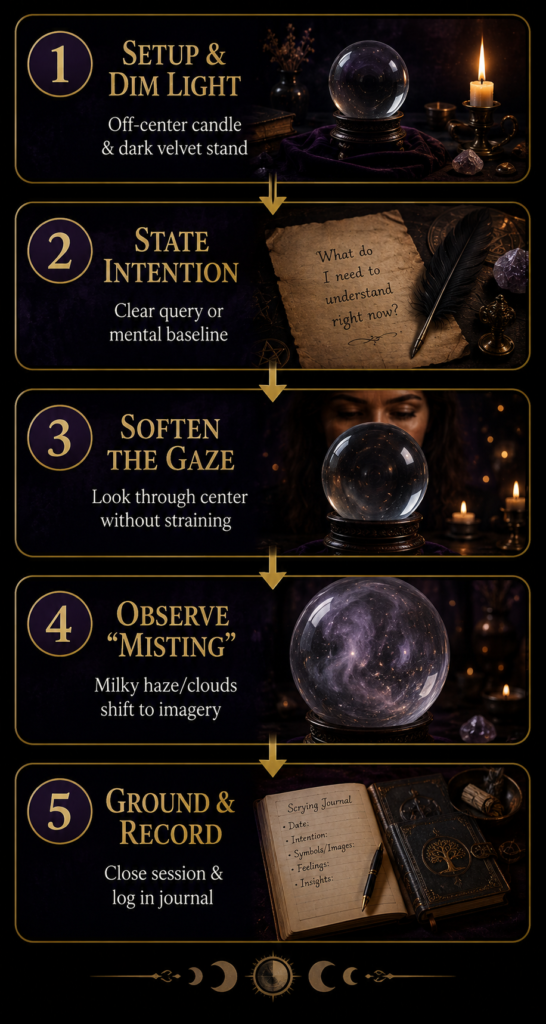
Environment Setup: Place your crystal ball on a stable dark stand or velvet cloth upon an unlit table. Dim the room entirely. Position a single candle slightly behind or off to the side of the sphere so its ambient glow illuminates the space without creating direct glare or flame reflections inside the ball.
Body centring: Sit comfortably with your spine straight and feet flat on the floor. Take five slow, deep breaths—inhaling for four counts and exhaling for six—to transition your nervous system into a relaxed state.
State Your Intention: Before gazing into the sphere, state a clear intention or query aloud or mentally (e.g., “I invite clear intuitive guidance regarding my next steps”).
The Scrying Gaze: Soften your eyes and gaze through the centre of the sphere rather than focusing directly on its outer glass surface. Blink naturally—do not strain your eyelids.
Closing & Disengaging: Limit initial sessions to 10–15 minutes. To end, deliberately break eye contact, look down at your hands, extinguish the candle, and cover the crystal ball with a cloth.
- Environment Setup: Place your crystal ball on a stable dark stand or velvet cloth upon an unlit table. Dim the room entirely. Position a single candle slightly behind or off to the side of the sphere so its ambient glow illuminates the space without creating direct glare or flame reflections inside the ball.
- Body centring: Sit comfortably with your spine straight and feet flat on the floor. Take five slow, deep breaths—inhaling for four counts and exhaling for six—to transition your nervous system into a relaxed state.
- State Your Intention: Before gazing into the sphere, state a clear intention or query aloud or mentally (e.g., “I invite clear intuitive guidance regarding my next steps”).
- The Scrying Gaze: Soften your eyes and gaze through the centre of the sphere rather than focusing directly on its outer glass surface. Blink naturally—do not strain your eyelids.
- Recognising the Misting Phase: After 3 to 5 minutes, you may notice the interior of the sphere appear to fill with a fine milky haze or cloudy mist. This is the optical sign that your logical visual filter is lowering and intuitive imagery is beginning to form.
- Closing & Disengaging: Limit initial sessions to 10–15 minutes. To end, deliberately break eye contact, look down at your hands, extinguish the candle, and cover the crystal ball with a cloth.
Critical Safety Protocols & Warnings
⚠️ Physical Fire Hazard: Natural quartz and glass crystal balls act as powerful optical lenses (magnifying glasses). Never leave a clear crystal ball uncovered near direct sunlight or open windows. They can easily focus solar rays onto furniture, curtains, or wooden surfaces and start a devastating house fire within minutes. Always cover your sphere with a dark velvet cloth when not in use.
Psychological & Energetic Boundary Protocols
- Avoid Eye Strain: Never attempt to force visions by refraining from blinking. Straining causes eye dryness and physical headaches, which disrupt the trance state.
- Maintain Emotional Baseline: Do not engage in crystal scrying when feeling acute panic, severe emotional distress, or extreme physical exhaustion.
- Ground Immediately Post-Session: To prevent post-scrying disorientation (“scrying hangovers”), always ground your energy immediately after closing: drink room-temperature water, eat a small snack, wash your hands under cold water, and record raw impressions into a journal.
Frequently Asked Questions
Is a natural quartz ball better than a glass crystal ball?
Neither is universally superior; it depends on your visual preference. Natural quartz features internal inclusions and veils that provide immediate focal points for visual imagery. Flawless lead crystal or glass offers a uniform, unobstructed void ideal for observing pure atmospheric misting.
Why does the crystal ball look like it is filling with smoke or mist?
The appearance of a milky haze or “misting” inside the sphere is a well-documented optical and physiological phenomenon in crystallomancy. It indicates that your optical nerves have relaxed and your mind is shifting into a receptive Alpha/Theta trance state, preparing to project subconscious symbols.
How do I energetically cleanse my crystal ball?
You can cleanse your crystal sphere by passing it through sacred purifying smoke (such as Frankincense, Sandalwood, or Cedar resin), placing it near a piece of Selenite, or letting it rest under full moonlight. Avoid using hot water or harsh chemical cleaners on natural quartz or mineral spheres to prevent cracking.