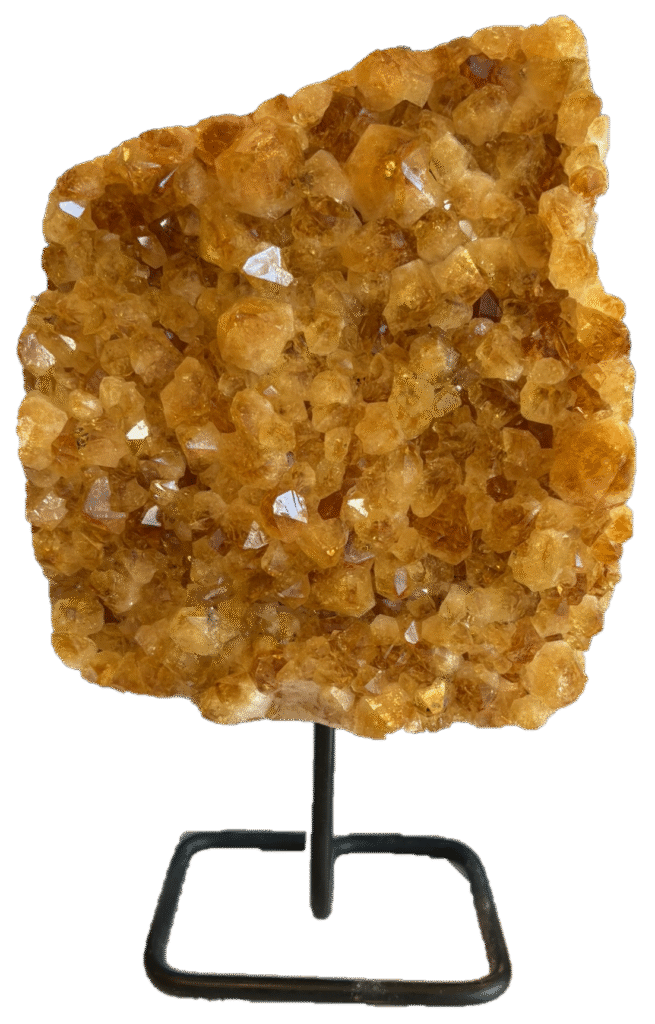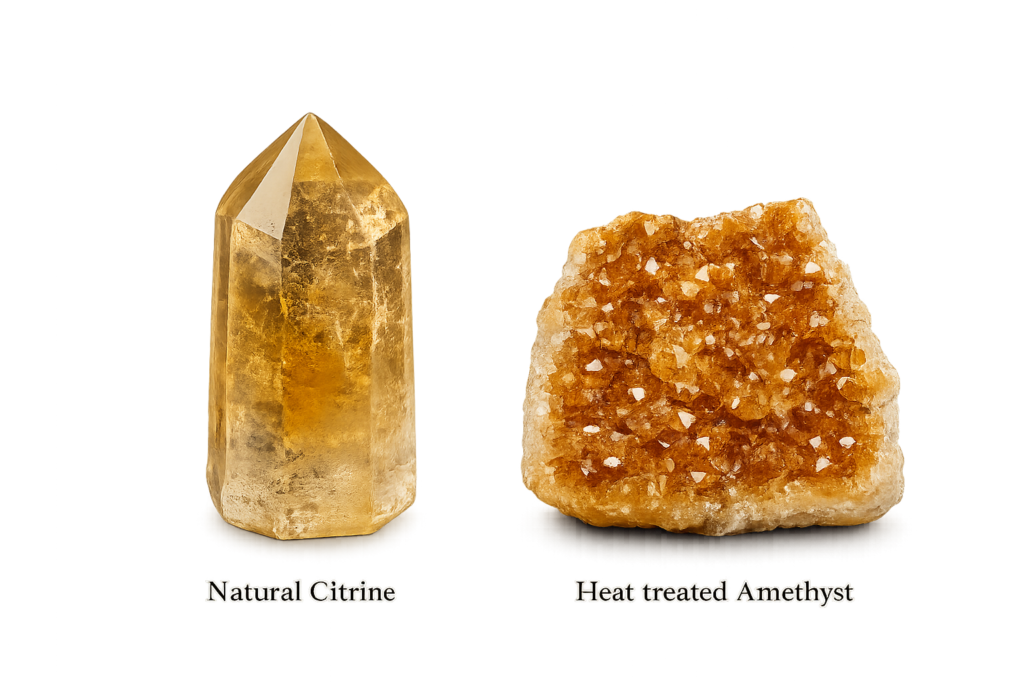
When comparing natural citrine to heat-treated amethyst (HTA), the key differences lie in their colour origin and visual characteristics. True natural citrine is rare and expensive, formed over millions of years by geothermal heat to produce uniform, pale yellow, honey, or champagne tones from root to tip. Conversely, abundant and affordable heat-treated amethyst is created by baking amethyst in human-made ovens. This process results in an intense, uneven “burnt sugar” orange or deep amber hue, typically featuring bright orange tips contrasted against a stark, chalky white base.
While they visually they are completely different they share the same basic DNA (both are quartz, $SiO_2$), how they got their colour makes a massive difference in their look, value, and energy. Here is how you can tell them apart like a pro.
Quick Comparison Table
| Feature | Natural Citrine | Heat-Treated Amethyst (HTA) |
| Colour Origin | Natural geothermal heat + trace iron over millions of years. | Human-made oven baking (around 800°F to 900°F). |
| Colour Shade | Pale yellow, champagne, smoky honey, or greenish-yellow. | Bright orange, burnt amber, or reddish-brown. |
| Colour Distribution | Uniform and consistent throughout the crystal. | Uneven; often bright orange tips with a stark white base. |
| Clarity | Usually very clear with fewer internal fractures. | Often contains internal fractures that look “crinkly” or chalky. |
| Rarity & Price | Rare; significantly more expensive. | Abundant; very affordable. |
Visual Tell-Tale Signs
The “Burnt Sugar” Colour
- Heat-Treated Amethyst: Think of a dark, burnt orange or a deep amber. Because amethyst turns orange when superheated, the resulting colour is usually very saturated and intense.
- Natural Citrine: Think of a glass of white wine, honey, or pale lemon. It is rarely bright orange. If it looks like a neon sunrise, it’s almost certainly treated.
The White Base Test
- Amethyst grows in geodes, starting from a cloudy white quartz base before turning purple at the tips. When baked, that white base stays white, while the purple tips turn bright orange.
- If your crystal has a solid white, chalky bottom and a bright orange top, it’s heat-treated amethyst. Natural citrine grows in uniform color from root to tip.
Pleochroism (The Light Trick)
- Natural Citrine is pleochroic, meaning if you rotate it under different angles of light, you might see subtle shifts in the yellow/champagne tones.
- Heat-Treated Amethyst loses this property during the baking process; it will look the exact same shade of orange from every single angle.
Why It Matters
A Note on Value: There is absolutely nothing wrong with buying heat-treated amethyst—as long as it is priced and labelled honestly! Sellers often label HTA simply as “Citrine,” charging natural citrine prices for a gem that should cost a fraction of the price.
From a crystal-working perspective, many practitioners feel that Natural Citrine carries a gentle, constant amplifying energy (often called the “Merchant’s Stone” for manifestation). Heat-Treated Amethyst, on the other hand, is believed to retain its original amethyst properties but with a punchier, fire-infused energy from the heating process.
Are you looking at a specific piece of jewellery or a crystal cluster right now? Tell me what it looks like, and I can help you figure out which one it likely is!
Natural Citrine v Heat Treated Amethyst
How do they differ in how they are made?
- Natural Citrine: Formed naturally deep within the Earth over millions of years by geothermal heat and trace iron.
- Heat-Treated Amethyst: Created by humans baking abundant amethyst crystals in ovens or kilns at temperatures around 800°F to 900°F to artificially change the purple colour to orange.
Is there a big difference in rarity and price?
Yes, a massive difference. True natural citrine is highly rare and significantly more expensive. Because of this, the vast majority of “citrine” available on the commercial market is actually heat-treated amethyst, which is highly abundant and very affordable.
Is it bad or wrong to buy heat-treated amethyst?
Not at all—there is absolutely nothing wrong with buying heat-treated amethyst, provided that sellers label and price it honestly. The main issue in the marketplace is that sellers frequently label HTA simply as “Citrine,” incorrectly charging premium, natural citrine prices for a gemstone that should cost a fraction of the price.
Do they have different metaphysical or crystal-working energies?
Yes, crystal practitioners notice a distinct difference in their properties:
- Natural Citrine: Believed to carry a gentle, constant amplifying energy and is traditionally referred to as the “Merchant’s Stone” for manifestation.
- Heat-Treated Amethyst: Thought to retain its foundational amethyst properties but infused with a punchier, fire-infused energy brought on by the high-heat manufacturing process.
These are my personally selected and curated Citrine products