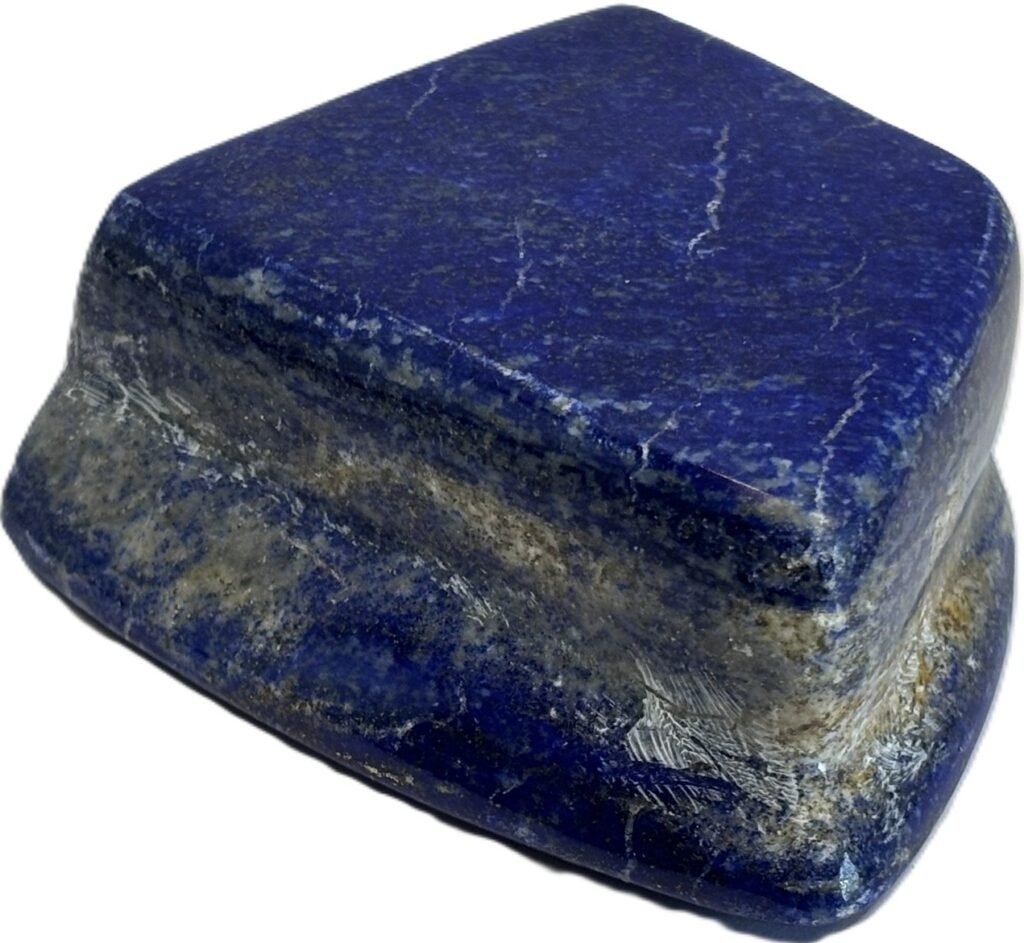
Understanding the proper techniques for cleansing and recharging lapis lazuli is essential for maintaining both the energetic vitality and the physical integrity of this ancient stone. Renowned for over six millennia as a talisman of truth, mental clarity, and spiritual awareness, lapis lazuli regularly absorbs dense vibrational static during intense meditation and daily wear. However, standard crystal care advice—which often recommends soaking stones in water or resting them in coarse sea salt—proves disastrous for this delicate metamorphic mineral.
Because lapis lazuli is composed of a complex matrix of soft calcite, porous silicates, and oxidisable iron pyrite, moisture exposure breaks down its internal structure, dissolves its natural polish, and turns its golden inclusions to rust. Preserving your specimen requires abandoning liquid-based methods entirely in favour of safe, non-destructive alternatives.
This guide outlines the exact dry protocols—from acoustic resonance and botanical smoke to selenite plates and moonlight charging—needed to reset and restore your lapis lazuli safely without causing a trace of water damage.
The Mineral Chemistry: Why Water Destroys Lapis Lazuli
Lapis lazuli is not an impervious single crystal like quartz ($\text{SiO}_2$). It is a polymineralic metamorphic rock composed of varying proportions of lazurite, calcite, and pyrite. When water enters this matrix, it attacks the stone on multiple fronts:
| Mineral Component | Chemical Composition | Reaction to Water Immersion | Long-Term Consequence |
| Calcite | $\text{CaCO}_3$ (Calcium carbonate) | Dissolves slowly in water, especially mildly acidic tap or filtered water. | Matrix degrades, leaving pitted, porous surfaces and microscopic fissures. |
| Pyrite | $\text{FeS}_2$ (Iron disulphide) | Oxidises when exposed to moisture and dissolved oxygen: $2\text{FeS}_2 + 7\text{O}_2 + 2\text{H}_2\text{O} \to 2\text{Fe}^{2+} + 4\text{SO}_4^{2-} + 4\text{H}^+$ | Golden flecks turn brown or dull green, rust spreads, and structural bonds weaken. |
| Lazurite | $(\text{Na,Ca})_8[\text{AlSiO}_4]_6(\text{SO}_4,\text{S},\text{Cl})_2$ | Contains trapped trisulphur radical anions ($\text{S}_3^-$) vulnerable to prolonged moisture ingress. | Loses natural colour depth and surface lustre; edges turn chalky. |
| Surface Waxes & Polishes | Microcrystalline wax / Resins | Stripped by hot or standing water. | High vitreous shine disappears, exposing rough, dry stone underneath. |
The Salt Trap
Dry salt baths are equally destructive. Because lapis lazuli sits at a modest 5.0 to 5.5 on the Mohs hardness scale and possesses a micro-porous calcite network, fine grains of sodium chloride ($\text{NaCl}$) scratch polished cabochon surfaces. Over time, microscopic salt crystals work into internal hairline cracks, drawing ambient moisture from the air (hygroscopic action) and expanding, which leads to internal fracturing and crumbling.
Five Safe, Dry Methods to Cleanse Lapis Lazuli
Cleansing clears stagnant or absorbed energetic residue without risking mineral degradation. The following five techniques involve zero liquids and keep your stone entirely dry.
Herbal Smoke Cleansing (Fumigation)
Smoke cleansing is one of the oldest, gentlest ways to neutralise built-up energetic static.
- Botanicals to Use: Dried white sage, sweetgrass, garden sage, mugwort, or rich botanical resins like frankincense and myrrh.
- The Technique: Ignite your herbal bundle or resin charcoal until it produces a steady stream of smoke. Hold your lapis lazuli roughly 20 to 30 cm above the flame source, passing the stone through the dense smoke plume for 30 to 60 seconds.
- Safety Tip: Avoid using damp herb bundles that spit hot moisture, and never let the stone heat up directly over an open flame, as sudden thermal shock causes calcite inclusions to crack.
Acoustic Resonance & Sound Frequencies
Sound waves pass cleanly through physical matter without friction, making acoustic clearing ideal for delicate, porous stones and intricate jewellery settings.
- Instruments: A 741 Hz or 528 Hz metal tuning fork, a quartz crystal singing bowl, Tibetan bronze singing bowls, or a clear-toned tingsha bell.
- The Technique: Place your lapis lazuli on a soft, padded surface (such as a cotton cloth or velvet tray). Strike your tuning fork or sound bowl, holding the vibrating instrument within 5 to 10 cm of the stone. Allow the sustained acoustic resonance to wash over the mineral. Repeat 3 to 4 times.
- Why It Works: The 741 Hz frequency is traditionally aligned with throat chakra balancing and releasing expression blocks—making it the ideal acoustic match for lapis lazuli.
Selenite or Satin Spar Contact Cleansing
Selenite (gypsum, $\text{CaSO}_4 \cdot 2\text{H}_2\text{O}$) acts as a self-clearing mineral filter that absorbs and dissolves heavy vibrational residue from adjoining stones.
- The Technique: Lay your lapis lazuli directly atop a polished, completely dry selenite charging plate, bowl, or ruler.
- Duration: Leave it undisturbed for 4 to 12 hours (or overnight).
- Precaution: Ensure your selenite is completely dry. Both stones are soft; gently lay them down rather than dropping them to avoid surface scuffs.
Clear Quartz Cluster Embedding
Clear quartz ($\text{SiO}_2$) possesses a high-frequency, piezoelectric framework that refracts and realigns the electromagnetic field of neighbouring minerals.
- The Technique: Rest your lapis lazuli inside the natural hollow of a raw clear quartz geode or atop a dense bed of quartz cluster points.
- Duration: Allow the stone to rest for 6 to 8 hours. The multiple prismatic points disperse dense vibrational residue cleanly back into the environment.
Breathwork and Focused Visualisation
For an immediate cleanse in the field or prior to meditation, use conscious breath and focused intent.
- The Technique: Hold the lapis lazuli between the palms of your hands. Close your eyes and inhale deeply through your nose. As you exhale firmly through pursed lips over the surface of the stone, visualise a luminous, cool white light sweeping away all stagnant, grey energetic static. Repeat three times with deliberate focus.
Safe Methods to Recharge Lapis Lazuli
Once cleansed of stagnant energy, lapis lazuli needs to be recharged to restore its vibrant, outward frequency.
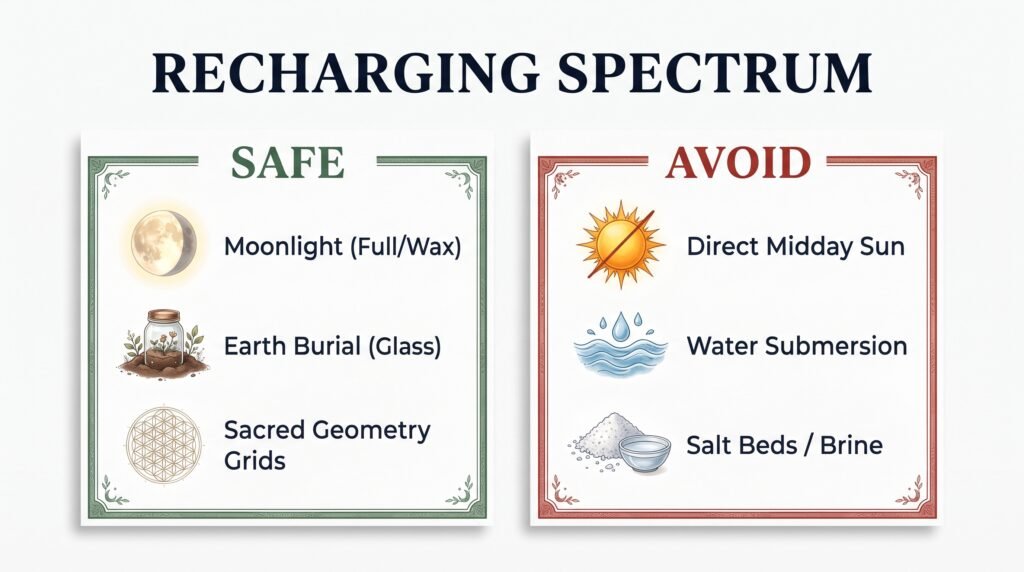
Moonlight Absorption (The Cold Light Method)
Lapis lazuli responds exceptionally well to the cool, reflective light of the moon. Unlike sunlight, moonlight carries zero thermal heat and will not fade natural dyes, dry out protective waxes, or cause thermal expansion.
- The Phase: The night of the Full Moon or the Waxing Gibbous phase delivers peak intensity.
- Placement: Set your stone on an interior windowsill that receives direct moonlight, or place it outdoors inside a dry, covered glass cloche or enclosed lantern to protect it from overnight dew and rain.
- Timing: Collect the stone in the early morning before harsh, direct sunlight strikes the glass.
The Indirect Earth Burial Technique
Reconnecting lapis lazuli with the subterranean earth grounds and stabilises its electrical field. However, burying raw or polished stone directly into moist garden soil introduces moisture, corrosive humic acids, and abrasive sand.
- The Safe Protocol:
- Wrap your lapis lazuli securely in clean, unbleached linen or natural cotton cloth.
- Seal the wrapped bundle inside a dry, airtight glass container (such as a Kilner jar or snap-top mason jar).
- Bury the jar roughly 10 to 15 cm deep in dry soil, under healthy plant life or beneath an oak or pine tree.
- Leave it buried for 24 hours. The glass creates an impenetrable moisture barrier while allowing telluric magnetic currents to reset the mineral.
Sacred Geometry Grids
To activate your lapis lazuli specifically for public speaking, study, or intuitive exploration, place it at the centre of a sacred geometry grid (such as the Flower of Life or Metatron’s Cube) printed on wood, paper, or slate.
Grid Arrangement: Surround the central lapis lazuli with alternating points of clear quartz (pointing inwards to feed clarity) and haematite or black tourmaline (pointing outwards to draw off mental fatigue). Leave the grid active on your desk or altar for 24 hours.
Daily Physical Cleaning Without Liquids
While energetic cleansing removes subtle static, daily handling leaves human skin sebum, cosmetic lotions, and airborne dust across the stone’s surface, dulling its natural shine.
To clean lapis lazuli physically without moisture damage:
Use an Optical-Grade Microfibre Cloth: Keep a plush, dry microfibre cloth dedicated solely to your lapis. After every wear or meditation session, gently wipe down the entire surface using light circular motions. The microscopic split fibres lift oils and skin acids without scratching the 5.0 Mohs surface.
Dusting Intricate Carvings: If your specimen features rough natural pockets or intricate carvings, use an ultra-soft, dry camel-hair or goat-hair cosmetic brush to sweep away dust particles from deep within crevices.
Emergency Spot Cleaning: If your stone encounters sticky dirt or sticky residues that dry wiping cannot remove, lightly dampen the corner of a cotton bud with purified water (squeezing out any excess until it is barely moist). Dab the specific spot immediately, then dry the stone thoroughly with a fresh cloth. Never leave residual moisture to air-dry naturally.
Quick Reference Summary
- Water: Never immerse, wash, or soak lapis lazuli.
- Salt: Keep away from loose salt beds and saline solutions.
- Sunlight: Avoid prolonged midday sun exposure to preserve natural binders and polish.
- Best Cleanse: 741 Hz sound frequency, herb smoke, or dry selenite contact.
- Best Recharge: Full moonlight or indirect, dry-jar earth burial.
- Daily Care: Wipe clean with a dry, plush microfibre cloth after every use.