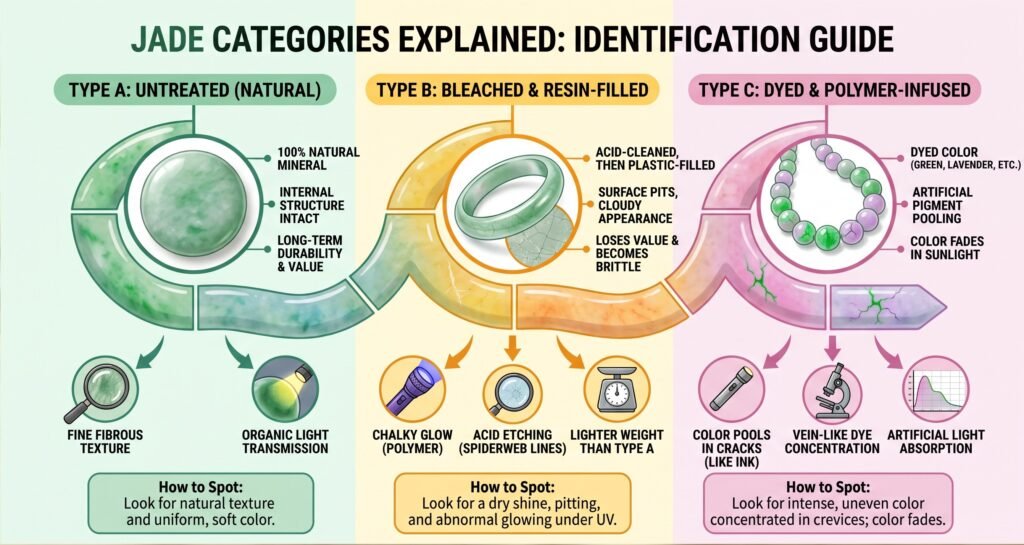
When buying jade, the most important factor determining its value and authenticity is in which of the jade categories the the stone should belong to, The industry grading scale is based on how much the stone has been chemically altered. While factors like rich colouration, translucency, and the finesse of a lapidary’s carving dictate a piece’s immediate aesthetic appeal, they mean very little if the stone beneath the polish has been structurally compromised. In today’s market, appearances are frequently engineered in a laboratory rather than formed over millennia in the earth.
To navigate the gemstone trade safely, collectors and casual buyers alike must look past surface beauty and understand the standard classifications
Jade Categories
| Grade | What It Is | How It’s Treated | Everyday Value & Durability |
| Type A | 100% Natural | None, except a light coat of surface wax to buff it smooth. | The gold standard. High investment value, durable, and won’t discolour over time. |
| Type B | Bleached & Plastic-Filled | Soaked in acid to remove ugly stains, then injected with clear liquid plastic under vacuum. | Brittle, loses value, and may turn yellow or cloudy after several years. |
| Type C | Dyed | Injected with artificial green, purple, or orange dyes. | Low value; colours often fade when exposed to sunlight or body oils. |
| Type B+C | Bleached, Plastic-Filled & Dyed | Acid-bleached, injected with plastic, and dyed all at once. | Lowest value; fragile and chemically unstable over time. |
Knowing these categories is essential not just for assessing market price, but for ensuring durability. While a natural Type A heirloom can endure for generations, polymer-filled and dyed stones are prone to yellowing, dulling, and becoming brittle over time. Learning how to read these grades—and spotting the physical clues that separate genuine minerals from treated simulants is the single best defence against overpaying for chemically masked stone.
How to Tell Them Apart: What Experts Look For
While a definitive verdict requires a gem lab, you can look for several telltale visual signs using bright light and a magnifying loupe:
- The “Spiderweb” Texture (Type B): Natural jade polishes to a smooth, glass-like shine. Because Type B jade is eaten away by acid and patched with softer resin, its surface shows tiny sunken grooves under reflected light, resembling a dried riverbed or a faint spiderweb.
- Mismatched Shine (Type B): Under a focused lamp, Type B jade often looks shiny and glassy on the real mineral parts, but dull or greasy over the plastic-filled micro-cracks.
- Colour Pooling (Type C): In real jade, colour lives inside the mineral crystals. In dyed jade, the dye cannot penetrate solid crystals, so it gathers in cracks and fissures like food colouring caught in crushed ice.
- The UV Light Glow (Type B): When exposed to a long-wave torch, untreated Type A jade stays dark or shows only a faint, dull chalkiness. The plastic glue inside Type B jade often glows a bright yellow-green or bluish-white.
- Weight in the Hand (Type B): Natural jadeite is dense and heavy for its size. Stones heavily hollowed out by acid and pumped full of lightweight plastic feel subtly lighter than a genuine Type A piece of identical volume.
How Certified Labs Confirm the
When visual inspection isn’t enough, professional labs rely on specialised infrared scans:
- Infrared Laser Testing (FTIR): This test shoots an infrared beam through the stone to read its chemical fingerprint. Real jade leaves a clean baseline, while plastic-filled Type B jade triggers unmistakable spikes that register artificial resins and adhesives.
- Light Spectrum Testing: To catch artificial dye, gemologists pass light through the stone to see which colour wavelengths it absorbs. Natural emerald-green jade absorbs light in crisp, distinct lines, while synthetic green dyes produce broad, blurry smudges.
Simple checks you can do yourself
Carry three basic tools when inspecting jade in person: a 10× jeweller’s loupe, a bright penlight (or your phone torch), and a pocket 365 nm UV torch.
Use this step by step checklist to evaluate pieces on the spot.
Step 1: The Touch & Heft Test (Weeding Out Glass and Plastic)
- Initial temperature: Real jade feels noticeably cool to the touch and warms slowly against skin. Glass and plastic warm up almost immediately.
- Density / heft: Real jadeite has a high specific gravity (~3.33). Gently balance it in your palm; it should feel surprisingly dense and heavy for its size compared to glass, plastic, or serpentine.
- Sound (for bangles or beads): Tapping two real jade pieces together produces a clear, resonant chime. Plastic-filled Type B or imitation resin produces a dull, plastic “thud” or click.
Step 2: Loupe Surface Inspection (Detecting Type B Acid Etching)
- Reflected light angle: Tilt the jade under a single overhead light source while inspecting the surface at an angle through your loupe.
- Look for “spider webbing“: Type B jade shows fine, interconnected sunken grooves or micro-channels where acid dissolved minerals and softer resin wore away during polishing. Natural Type A jade has a uniform, vitreous polish with a subtle, natural dimpling called an “orange peel” texture, rather than sunken riverbed cracks.
- Check for air bubbles: If you see any spherical air bubbles trapped inside the material, it is glass or cast resin, not natural stone.
Step 3: Transmitted Light Inspection (Detecting Type C Dye)
- Back light the stone: Place the penlight directly against the back or side of the stone so the beam shines through the body.
- Examine colour distribution: Natural jade colour comes from within the interlocking crystal matrix, showing soft transitions, fibrous grains, and cloud-like variations.
- Spot the dye pooling: In dyed Type C jade, artificial pigments cannot penetrate dense mineral grains. Look for colour accumulating unnaturally along fractures, vein lines, and surface crevices like food colouring in cracked ice.
Step 4: The 365 nm UV Torch Check (Catching Polymer Resin)
- Fluorescence check: Shield the stone from ambient daylight and shine the 365 nm torch directly onto it.
- The glow: Natural Type A jadeite remains inert or emits a very faint, chalky response. Polymer-infused Type B and B+C pieces frequently fluoresce with a distinct chalky bluish-white or lime-green glow where resin has seeped into fractures.
Step 5: The Retail Common Sense Filter
- The “too perfect” trap: Vibrant emerald green, vivid lavender, or uniform translucency in natural Type A jade commands thousands to tens of thousands of pounds. If a piece looks like top-grade “Imperial Jade” but is priced at £50–£300, it is virtually guaranteed to be Type B+C, dyed quartzite, or serpentine.
- Paperwork: Reputable dealers selling high-value pieces will specify “Type A” or “Natural Jadeite (Untreated)” on the invoice and provide a certificate from a recognised gemological laboratory (e.g., GIA, Mason-Kay, NGTC). Avoid certificates that only say “Real Jade” or “100% Genuine,” as treated jade is technically still “real stone.”