
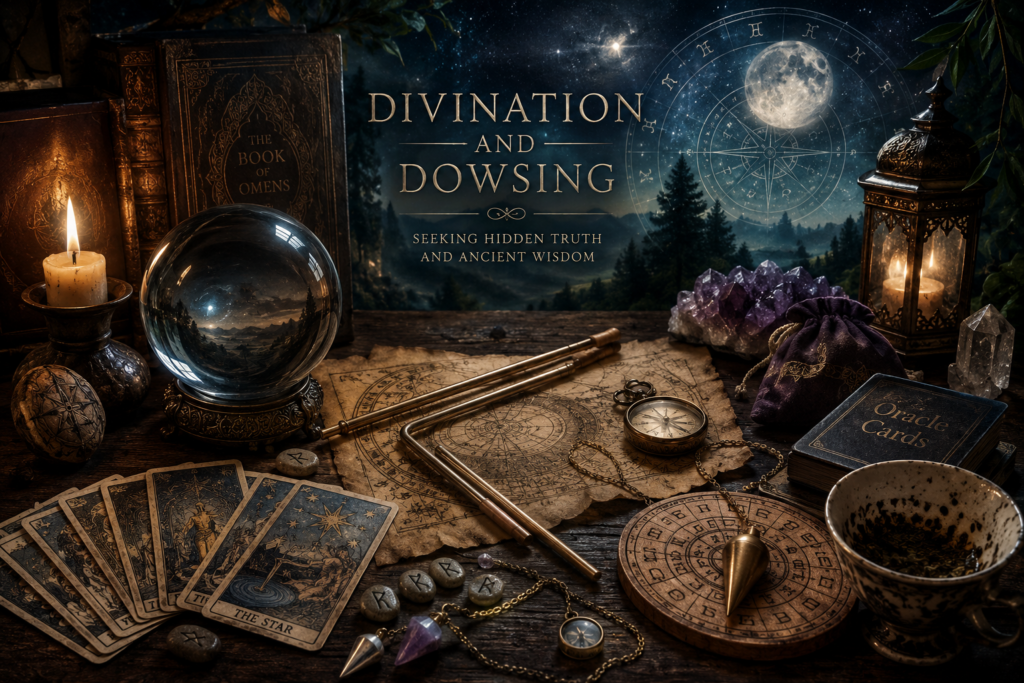
What Are Divination and Dowsing?
Throughout human history, people have sought ways to gain insight into the unknown. Two of the oldest and most widely practised methods are Divination and Dowsing. While these terms are often used interchangeably, they are distinct practices with different purposes, methods, and traditions.
Divination is the broad practice of seeking knowledge, guidance, or answers through symbolic interpretation and spiritual insight. Dowsing, on the other hand, is a specific technique used to locate hidden objects, energies, water sources, minerals, or answers through physical tools and intuitive responses.
Both practices have been found in cultures worldwide and continue to be used by spiritual practitioners, researchers, and enthusiasts today.
The Difference Between Divination and Dowsing
What is Divination?
Divination is the practice of obtaining information about the past, present or future through symbolic systems, spiritual guidance, or intuitive interpretation.
The purpose of divination is often to:
- Gain personal insight
- Seek spiritual guidance
- Explore possible future outcomes
- Understand life situations
- Connect with higher wisdom or divine energies
Divination typically relies on interpreting symbols, patterns, or messages received through specific tools or practices.
Common Divination Methods
- Tarot Cards
- Oracle Cards
- Astrology
- Numerology
- Rune Casting
- Crystal Ball Scrying
- Tea Leaf Reading (Tasseography)
- Palmistry
- Pendulum Divination
- I Ching
- Bone Throwing
What is Dowsing?
Dowsing is a method used to locate hidden objects, energies, water, minerals, lost items, or obtain yes/no answers through the movement of specialised tools.
Unlike many forms of divination, dowsing is often focused on discovering something specific rather than interpreting symbolic messages.
Dowsers believe that subtle energies, subconscious awareness, or intuitive perception influence the movement of dowsing tools.
Common Dowsing Uses
- Finding underground water
- Locating minerals or ores
- Discovering lost objects
- Energy balancing
- Geopathic stress detection
- Spiritual investigation
- Answering questions
- Map dowsing
- Property and land assessment
The History of Divination
Divination is one of humanity’s oldest spiritual practices and evidence of divination dates back thousands of years:
Ancient Egypt Egyptian priests used dream interpretation, astrology and sacred rituals to communicate with the gods.
Mesopotamia Babylonians practised extensive forms of divination, including examining animal organs, celestial observations and interpreting omens.
Ancient China The I Ching, or Book of Changes, originated over 3,000 years ago and remains one of the oldest divination systems still in use.
Ancient Greece The famous Oracle of Delphi provided prophetic guidance to rulers and citizens alike. Priests and priestesses interpreted messages believed to come from Apollo.
Ancient Rome Roman augurs interpreted bird movements, lightning, and natural signs to guide political and military decisions.
The History of Dowsing The origins of dowsing are more difficult to trace but are believed to be equally ancient.
Early Evidence Some researchers suggest that cave paintings in North Africa dating back several thousand years may depict forked-stick dowsers, although this remains debated.
Medieval Europe Dowsing became widely known throughout Europe during the Middle Ages. Miners in Germany used forked branches to locate underground ore deposits and water sources.
By the 16th century, dowsing was documented in mining manuals and was commonly employed by prospectors.
The Modern Era
During the 19th and 20th centuries, dowsing expanded beyond water and mineral searches to include:
- Archaeological surveys
- Energy healing
- Spiritual investigations
- Lost object searches
- Agricultural applications
Today, dowsing is practised worldwide by individuals interested in intuitive exploration and alternative methods of discovery.
Folklore and Legends of Divination
Throughout history, divination has been surrounded by mystery and legend.
The Oracle Traditions Ancient cultures believed certain individuals could receive messages directly from gods, spirits, or ancestors.
The Wise Woman and Cunning Folk Across Britain and Europe, village wise women and cunning folk used cards, herbs, dreams and omens to offer guidance and predictions.
Crystal Gazing Crystal balls became associated with seers and mystics who could perceive visions beyond ordinary sight.
The Three Fates Greek mythology described the Moirai, three divine beings who controlled the destinies of all mortals.
Folklore and Legends of Dowsing Dowsing has its own rich collection of stories and traditions.
The Water Witch In Britain and North America, dowsers were often called “water witches” due to their reputed ability to locate underground water.
The Divining Rod The forked hazel rod became one of the most iconic symbols of dowsing. Folklore claimed the rod would twist or dip when passing over hidden water or treasure.
Lost Treasure Legends Many stories tell of dowsers locating buried treasure, ancient artefacts, and forgotten burial sites using rods or pendulums.
Sacred Wells In Celtic traditions, dowsing was sometimes associated with locating sacred springs believed to possess healing powers.
Tools Used in Divination
Tarot Cards A symbolic deck of 78 cards used for guidance, reflection, and spiritual insight.
Oracle Cards Flexible card systems focused on themes, messages, or personal development.
Runes Ancient Germanic symbols cast and interpreted for guidance.
Crystal Balls Used for scrying and visionary practices.
Astrology Charts Planetary positions are analysed to gain insight into personality and life cycles.
Pendulums Weighted objects suspended from chains used to answer questions or locate energies.
Tea Leaves Patterns formed by tea leaves are interpreted symbolically.
Tools Used in Dowsing
Dowsing Rods Usually L-shaped metal rods that react through subtle movements.
Y-Rods Traditional forked branches, often made from hazel, willow, or fruitwood.
Pendulums One of the most popular dowsing tools, used for yes/no answers and energetic assessments.
Bobbers Small weighted tools suspended from a thread, commonly used in advanced dowsing.
Dowsing Charts Charts containing letters, numbers, percentages, or categories to assist in obtaining detailed information.
Map Dowsing Tools Maps, plans, and photographs can be used alongside pendulums or rods to identify locations remotely.
Divination and Dowsing in Modern Times
Today, divination and dowsing continue to attract interest from people seeking spiritual growth, self-discovery, and alternative ways of understanding their environment.
Many practitioners use these methods for:
- Personal guidance
- Meditation
- Spiritual development
- Energy work
- Decision-making support
- Environmental assessments
- Finding lost objects
- Exploring intuition
While scientific opinions varyF regarding their effectiveness, both traditions remain important cultural and spiritual practices with devoted communities worldwide.
For more information see my other posts
How to choose Divination cards
Divination cards Tarot, Oracle & Astrology
Starting in the world of divination
FAQ
What is the main difference between divination and dowsing?
Divination seeks insight through symbolic interpretation, while dowsing uses physical tools to locate hidden information or answer questions.
What tools are most commonly used for divination?
Tarot cards, oracle cards, runes, astrology charts, crystal balls, tea leaves, and pendulums are among the most popular divination tools.
What tools are used in dowsing?
Dowsing rods, Y-rods, pendulums, bobbers, and dowsing charts are commonly used.
Can anyone learn divination?
Many practitioners believe that intuition can be developed through study, practice, and experience.
Can anyone learn dowsing?
Most dowsers believe the ability can be learned by anyone willing to practise and develop sensitivity to subtle responses.
What is traditionally used for dowsing rods?
Hazel is one of the most traditional woods used in Britain, although willow, apple, and other woods have also been used.
Copper rods is one of the best metals to use although some people have excellent results with just a bent coat hanger!
Is there scientific proof for dowsing?
Scientific studies have generally produced mixed or inconclusive results. Despite this, many practitioners report successful experiences using dowsing methods.
Is divination connected to religion?
Divination has appeared in many religious and spiritual traditions throughout history,. Although some religions discourage the use of divination as it is believed to go against the will of their deity. Aalthough modern practitioners may approach it spiritually, psychologically, or symbolically.
Are pendulums used for both divination and dowsing?
Yes. Pendulums are one of the few tools commonly used in both practices.
