

Dowsing rods, also known as divining rods or witching sticks have long captured the imagination of those seeking hidden knowledge. Whether used to locate underground water, minerals, or spiritual energies, these simple tools have journeyed through centuries of belief, scepticism, and revival. This article explores their origins, forms, folkloric associations, and their modern renaissance in metaphysical and alternative circles.
Historical Origins of Dowsing
- Ancient Roots: Dowsing practices trace back over 5,000 years, with early forms appearing in ancient Egypt, China, and Mesopotamia. These early diviners used forked sticks or pendulums to locate water and minerals.
- European Emergence: The practice gained traction in 16th-century Germany, particularly among miners in the Harz Mountains. Georgius Agricola’s De Re Metallica (1556) includes one of the earliest illustrations of a dowser using a forked twig.
- Religious Opposition: The Catholic Church and Protestant reformers like Martin Luther condemned dowsing as occultism. In 1701, the Inquisition forbade its use in legal matters.
- Colonial Spread: German miners brought dowsing to Cornwall during Elizabeth I’s reign, where it became embedded in local mining traditions.
Forms of Dowsing Rods
Dowsing tools have evolved into several distinct forms, each with unique characteristics:
| Type | Description | Materials | Use Case |
| Y-Rods | Traditional forked branch held with both hands | Hazel, willow, peach wood | Water and mineral dowsing |
| L-Rods | Two L-shaped metal rods held loosely in each hand | Copper, brass, steel | Energy fields, spirit communication |
| Pendulums | Weighted object suspended from a chain or string | Crystal, metal, wood | Yes/no questions, map dowsing |
| Biotensors | Flexible rods with a spring-like mechanism for subtle energy detection | Lightweight metal or plastic | Energy healing, chakra diagnostics |
| Crystal Rods | Rods incorporating crystals to amplify energetic sensitivity | Quartz, amethyst, obsidian | Metaphysical and healing applications |
Dowsing Folklore and Superstition
Dowsing is steeped in rich folklore, particularly in Europe and North America:
- Water Witching: In the UK and US, dowsers were often called “water witches.” In Wiltshire, rods had to be cut at sunrise while facing east to be effective.
- Magical Materials: Hazel was favoured for its fairy associations, while elder was avoided due to its link with witchcraft and protective spirits.
- Lunar Timing: Some traditions required rods to be cut during a new moon or on holy days to enhance potency.
- Seventh Son Lore: In parts of Europe, only a seventh son of a seventh son could craft a truly powerful dowsing rod.
- Spiritual Guidance: Many believed that fairies or spirits guided the rod’s movement, especially when searching for water or treasure.
Scientific Scrutiny
Despite its enduring popularity, dowsing remains controversial:
- Ideomotor Effect: Scientists attribute rod movement to unconscious muscle actions rather than external forces.
- Mixed Results: Controlled studies often show dowsing performs no better than chance, yet anecdotal success stories persist.
- USGS View: The U.S. Geological Survey acknowledges that in water-rich areas, it’s hard not to find water—dowsing or not.
Modern Renaissance
In recent decades, dowsing has experienced a revival, particularly in spiritual and holistic communities:
- Energy Healing: Practitioners use rods to detect auras, chakras, and geopathic stress zones.
- Environmental Use: Some use dowsing to locate ley lines or earth energies for land healing and sacred site alignment.
- Alternative Medicine: Biotensors and pendulums are employed in vibrational medicine and intuitive diagnostics.
- Workshops & Courses: Dowsing is taught in metaphysical schools and featured at holistic fairs across Europe and North America.
- Cultural Continuity: In rural areas, especially in Wales, Cornwall, and Appalachia, dowsing remains a respected folk tradition.
More information on Dowsing and Divination
How to choose Divination cards
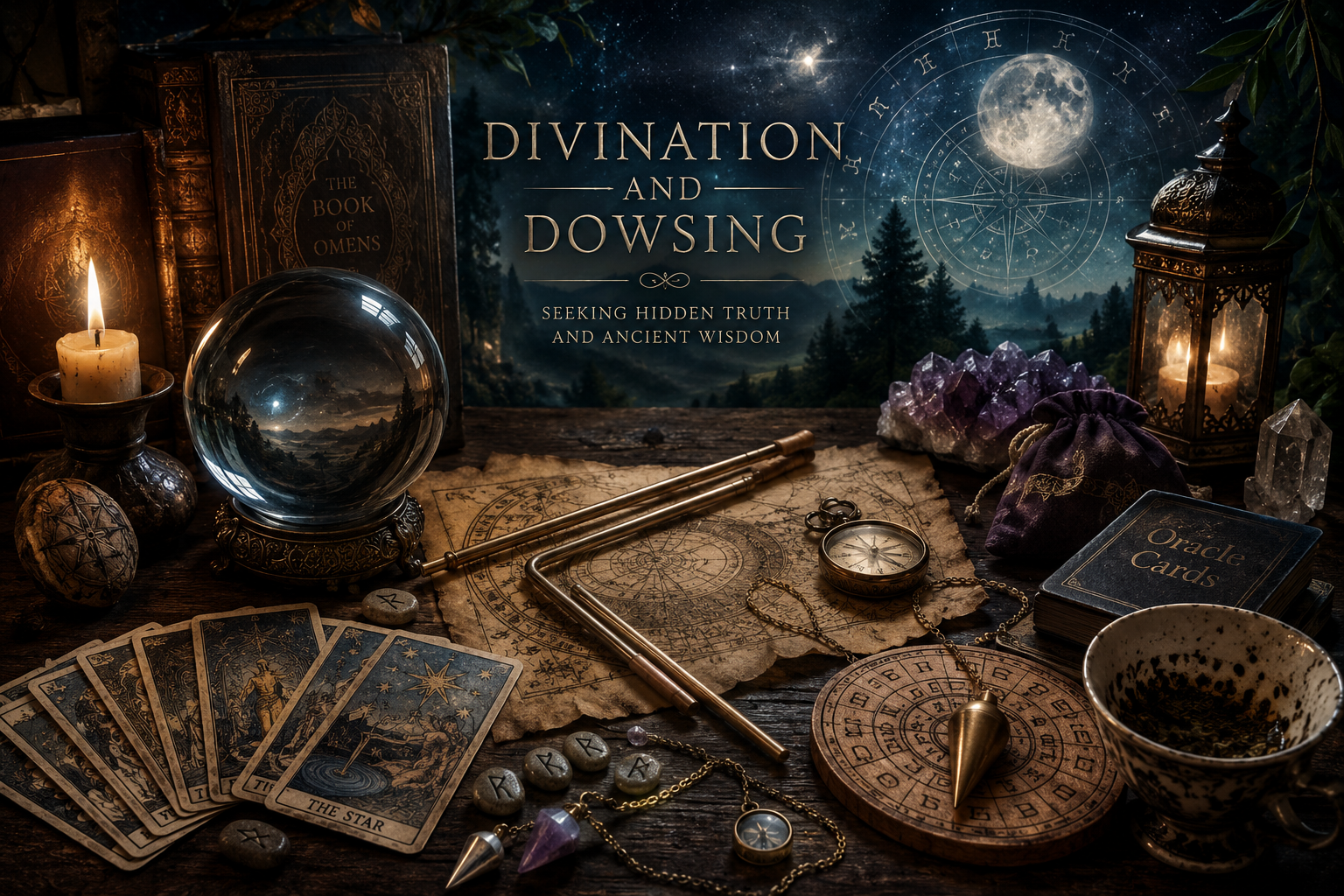
How to choose divination cards
FAQ’s
Is dowsing scientifically proven?
No. Controlled scientific tests and double-blind studies, such as the major Munich experiments in Germany, have repeatedly shown that dowsing success rates are no better than random chance.
How do practitioners explain the movement?
While practitioners believe they are tapping into unseen earthly energies, scientists attribute dowsing reactions to the ideomotor effect. This is a psychological phenomenon where a person’s muscles make unconscious, involuntary movements based on their expectations.
Can anyone learn to dowse?
Proponents of the art claim that anyone with patience, focus, and a receptive mindset can learn to dowse. It is frequently explored as a recreational hobby rather than a formal science.
What tools can I use to start?
You don’t need to purchase specialised equipment; many beginners make simple, L-shaped dowsing rods at home by bending two wire coat hangers.
Why is it still practised today?
Dowsing persists due to a mix of strong cultural traditions and confirmation bias. Because groundwater is a widespread resource that can be struck by drilling almost anywhere, anecdotal successes often keep the Folklore of Dowsing and traditional beliefs very much alive.
