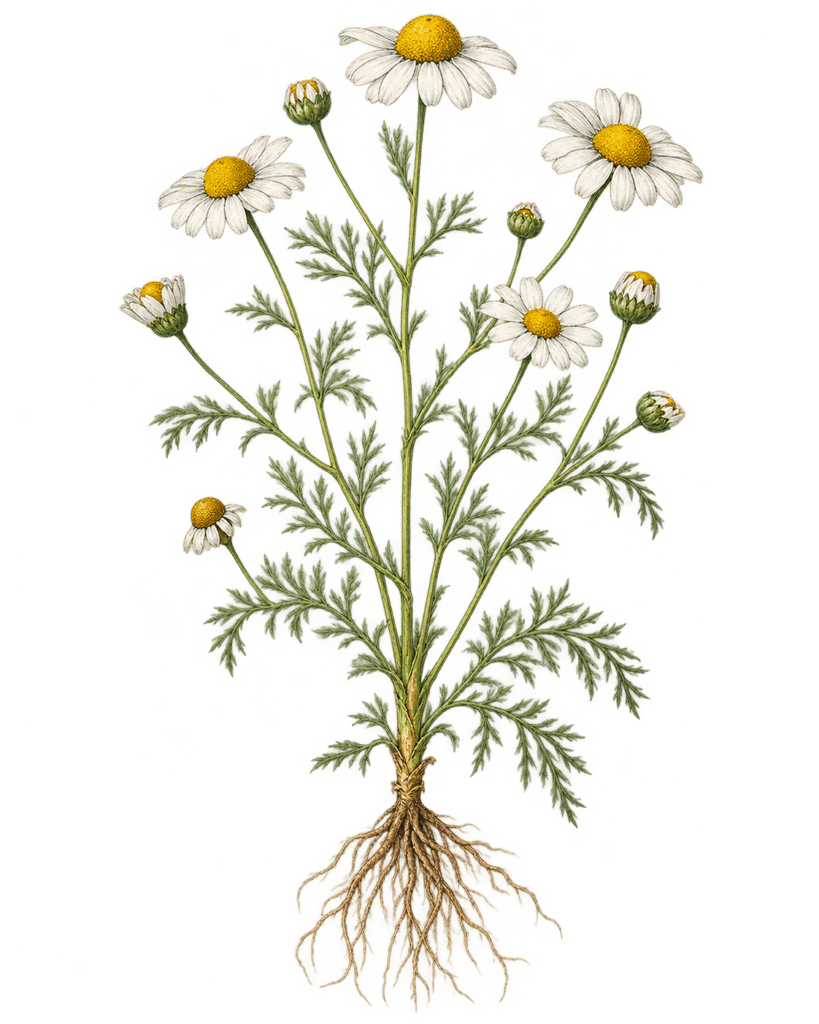
Chamomile belongs to the Asteraceae (daisy) family and is characterised by daisy-like flower heads featuring central golden disc florets surrounded by delicate white ray florets, set against feathery, pinnately divided foliage. While several plants share the common name, traditional herbalism and modern pharmacology centre primarily on two distinct botanical species:
- German Chamomile (Matricaria chamomilla / Matricaria recutita): An erect, sweet-smelling annual reaching 30 to 60 cm in height. Its most distinguishing botanical feature is a hollow receptacle (the cone-shaped central disc), which separates it from lookalikes upon dissection. German chamomile yields a deep ink-blue essential oil during steam distillation due to high concentrations of chamazulene.
- Roman Chamomile (Chamaemelum nobile, formerly Anthemis nobilis): A creeping, hardy perennial that rarely exceeds 15 to 30 cm in height, frequently used as a fragrant ground cover or lawn alternative. Unlike its German counterpart, Roman chamomile possesses a solid receptacle and hairy stems, carrying a fragrance closer to crisp, fresh apples.
| Trait | German Chamomile (M. chamomilla) | Roman Chamomile (C. nobile) |
| Life Cycle | Annual | Perennial (creeping) |
| Flower Receptacle | Conical and hollow | Flat/convex and solid |
| Height | 30–60 cm | 10–30 cm |
| Aroma Profile | Sweet, herbaceous, slightly straw-like | Bright, fruity, distinctly green apple |
| Key Compound | High chamazulene, α-bisabolol | Angelates, tiglates, pinocarvone |
Ancient Origins & Antiquity
Chamomile’s etymology traces to ancient Greece: chamaimēlon translates directly to “earth apple” (chamai = on the ground, mēlon = apple), named for its low-growing habit and apple-scented foliage.
- Ancient Egypt: Chamomile was dedicated to Ra, the sun god, due to the flower’s sunburst form and its reputed power over fevers and sunstroke. It was frequently used in embalming mixtures, with chamomile oil and residue detected on the mummy of Pharaoh Ramesses II.
- Classical Greece & Rome: The physician Dioscorides detailed chamomile in De Materia Medica for easing menstrual cramps, liver complaints, and gastrointestinal irritation. Galen and Pliny the Elder prescribed it widely as a cooling, anti-inflammatory tisane and a cure for venomous stings and headaches.
Folklore, Superstition & Cultural Traditions
Throughout European history, chamomile occupied a dual identity as both a practical household herb and an amulet of good fortune:
- The “Plant’s Physician”: Traditional companion planters noted that sick, wilting, or insect-infested plants recovered when chamomile was sown adjacent to them. Modern agricultural science confirms that chamomile extracts deter specific fungal pathogens and attract beneficial predatory insects.
- Anglo-Saxon “Nine Herbs Charm”: In the 10th-century Lacnunga manuscript, chamomile (referred to as Maythe) is recorded as one of nine sacred herbs given to humanity by the god Woden to counteract infection and “flying venom.”
- Victorian Floriography: In the Victorian language of flowers, gifting a posy of chamomile meant “energy in adversity” or “patience in trial”, derived from the plant’s habit of bouncing back stronger when trodden underfoot.
- Superstitions: Sprinkling a chamomile infusion around the perimeter of a home was believed to keep malicious witchcraft and misfortune away. Gamblers in early modern Europe rinsed their hands in chamomile water to attract luck and steady their nerves at dice tables.
Therapeutic & Medicinal Applications
Modern pharmacological research supports many traditional uses of chamomile, linking its effects to a synergistic blend of flavonoids and volatile terpenes:
- Neuro-Sedative & Sleep Quality: Chamomile’s calming action is largely driven by apigenin, a bioflavonoid that binds to central benzodiazepine receptors in the brain, reducing excitability and inducing mild sedation without significant dependency risks.
- Gastrointestinal Relief: Chamomile acts as an antispasmodic and carminative. Compounds such as α-bisabolol inhibit gastric acid production and relax intestinal smooth muscle, helping mitigate dyspepsia, reflux, infant colic, and irritable bowel syndrome.
- Dermatological & Wound Healing: Topical ointments standardised to chamomile terpenes accelerate tissue granulation and reduce erythema. Chamazulene and bisabolol inhibit cyclooxygenase (COX) and lipoxygenase pathways, delivering localised anti-inflammatory effects comparable to mild topical hydrocortisone in select clinical trials.
Astrological & Mystical Correspondences
In Western esoteric and Hermetic traditions, chamomile bridges planetary currents of vital energy and deep, restorative cooling:
- Primary Planetary Ruler:The Sun (due to the radiant dis c florets, gold colouring, and historical solar dedications). Some medieval grimoires designate Roman chamomile under the Moon for its hypnotic, nocturnal, and menstrual associations.
- Zodiac Alignment:Leo (for vitality, authority, and solar heart warmth) and Cancer (for soothing, stomach healing, and maternal comfort).
- Elemental Correspondence:Water (in emotional and energetic soothing) and Fire (in solar vibrancy and fever dispensation).
- Tarot Association:The Sun (XIX) (vitality, clarity, joy) and The Star (XVII) (hope, renewal, nervous restoration).
Culinary & Domestic Uses
- Infusions & Syrups: Beyond standard hot tisanes, cold-brewed chamomile flowers create floral syrups that pair with lemon, peach, gin, and bourbon in craft cocktails.
- Baking & Confectionery: Dried flowers are steeped into creams, custards, and shortbreads. The gentle honey-apple aroma complements stone fruits, goat cheese, and sponge cakes.
- Domestic Living:
- Natural Lawn: Non-flowering dwarf cultivars of Roman chamomile (Chamaemelum nobile ‘Treneague’) create drought-tolerant, fragrant lawns that release sweet scent when walked on.
- Hair Care: German chamomile rinses are widely used as a natural, mild brightener for blonde and light brown hair, driven by apigenin pigments attaching to the hair cuticle.
- Textile Dyeing: Boiled flower heads yield earthy yellow, olive, and gold pigments for natural wool and linen fibres.
Spiritual, Energetic & Metaphysical Properties
- Abundance & Prosperity: In folk magic, chamomile is categorised as a “money-drawing” plant. Placing dried flowers in wallets or washing cash registers with chamomile tea is practised to ensure steady financial inflow.
- Emotional Decompression: Energetically, chamomile works on the solar plexus and throat chakras. It softens reactive anger, quiets obsessive internal loops, and eases tension stored in the upper digestive tract.
- Dream Work & Ward Boundary: Sachets of chamomile placed inside pillowcases ward off nightmares, promote restful dream cycles, and establish protective boundaries against psychic exhaustion.
Fun Facts
- Sky-Blue Oil: While chamomile flowers are purely white and yellow, the essential oil distilled from German chamomile is an intense, inky cobalt blue. This transformation occurs because heat converts the precursor matricin into the vibrant blue hydrocarbon chamazulene during steam distillation.
- Peter Rabbit’s Medicine: In Beatrix Potter’s The Tale of Peter Rabbit (1902), after Peter barely escapes Mr. McGregor’s garden with a chill and a lost jacket, his mother puts him straight to bed with a medicinal dose of chamomile tea while his siblings feast on bread, milk, and blackberries.
- Mead Sweetener: Before the widespread cultivation of hops, brewing traditions across Northern Europe routinely used dried chamomile flowers to balance malt sweetness with mild, aromatic bitterness.
Chamomile Frequently Asked Questions
Which chamomile is best for tea?
German chamomile (Matricaria chamomilla) is the standard choice for drinking tea. It has a sweeter, less bitter profile when steeped. Roman chamomile (Chamaemelum nobile) can become aggressively bitter if leaves and stems are included or if brewed for more than a few minutes.
Can chamomile cause allergic reactions?
Yes. Because chamomile belongs to the Asteraceae/Composite family, individuals with known allergies to ragweed, chrysanthemums, marigolds, or daisies can experience cross-reactivity, ranging from mild skin dermatitis to systemic allergic reactions.
Is chamomile safe for pets?
Use caution. While dilute extracts are sometimes used by veterinary herbalists for calming, the concentrated plant contains bisabolol, chamazulene, and volatile oils that can cause contact dermatitis, vomiting, diarrhoea, and prolonged bleeding tendencies in cats and dogs if consumed in volume.