Telling the difference between an original masterpiece of Mother Nature and an enhanced imitation is surprisingly straightforward once you know what to look for. While many people think of gemstone treatment as a modern deception, agate altering actually boasts an ancient pedigree. Because agate is highly porous and composed of billions of microscopic, fibrous quartz crystals packed together it absorbs liquids like a sponge. Capitalising on this geological quirk, artisans have dyed agate since the Roman Empire.
In his first-century text Naturalis Historia, the Roman scholar Pliny the Elder documented how local lapidaries boiled dull grey stones in honey and organic mixtures for days, then treated them with sulphuric acid to bake deep, rich blacks and browns into the rock’s porous bands.
When evaluating a specimen today, it helps to understand that you are navigating three entirely different tiers of authenticity:
- Naturally Coloured Agate: Pure, untouched gemstone where mineral impurities (like iron, copper, or manganese) naturally seeped into the volcanic rock cavities millions of years ago, creating earthy, pastel, or fiery bands.
- Dyed Agate: A genuine, naturally formed agate that was structurally dug from the earth, but subsequently soaked in modern chemical dyes or metal salts to turn its dull grey bands into vivid, artificial hues.
- Synthetic (Fake) Agate: An outright counterfeit. This material has never seen the inside of a geological pocket; it is simply glass, resin, or plastic mass-produced in a factory and painted or moulded to mimic gemstone banding.
By understanding the physics of how real quartz handles heat, weight, and light, you can easily unmask these imitations and ensure your collection contains the real deal.
1. Spotting Dyed Agate (Real Stone with Artificial Colour)
The infusion of chemical dyes produces a distinct look. While natural agates can be beautifully colourful, their tones are earthy or pastel.
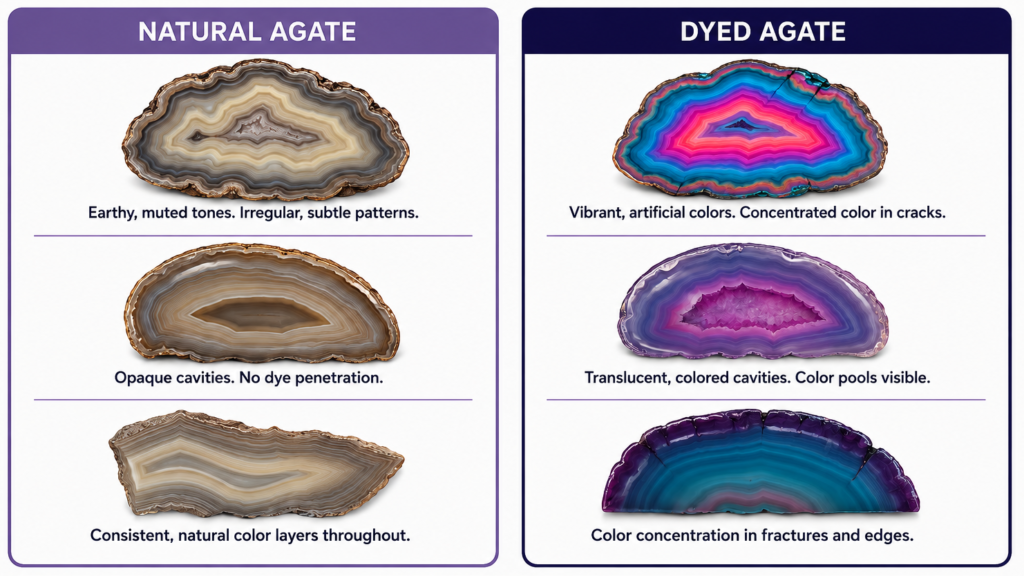
- The “Neon” Warning: If the stone is an incredibly intense, uniform neon pink, bright purple, electric blue, or lime green, it has almost certainly been dyed.
- Look for Pigment Pooling: Hold the agate under a bright light or magnifying glass. Look at the tiny fractures, micro-cracks, and quartz boundaries. In a dyed stone, the liquid dye pools in these pockets. You will see darker, hyper-concentrated lines of colour snaking through the rock, whereas natural agate colouration is consistently bound inside the crystalline structure itself.
- The Matrix Check: The rough, rocky outer layer (matrix) of a natural agate slice is usually a dull brown or grey. If the rock crust on the very outside matches the bright pink or blue of the inside bands, the entire piece was submerged in a dye bath.
2. Spotting Synthetic Agate (Glass or Resin Fakes)
If a specimen isn’t dyed rock, it might not be rock at all. Glass and plastic/resin imitations are highly common online.
1. The Temperature Test:.
Real agate is a silicate mineral with high thermal conductivity. When you pick it up, it will feel distinctly cold in your hand and take a while to warm up to your body heat. Plastic or resin imitations feel instantly warm or neutral to the touch.
2.The Weight and Sound Test:Simple physical check.
Agate is quite dense. If you gently clink two pieces of real agate together, they make a sharp, crystalline “clink” sound. Plastic fakes will feel suspiciously lightweight for their size and make a dull, hollow plastic “thud” when tapped.
3.The Bubble Check
Using a magnifying glass examine the translucent bands closely under a bright light. If you see tiny, perfectly round air bubbles trapped inside the material, it is glass. Natural geological processes do not trap round air bubbles inside solid quartz layers.
4.The Scratch Test
Agate sits at a tough 6.5 to 7 on the Mohs hardness scale. Try scratching an inconspicuous area with a steel pocket knife or a copper coin. A steel blade will easily slice or gouge plastic or resin and will lightly scratch common glass, but it will slide right off genuine agate without leaving a mark.