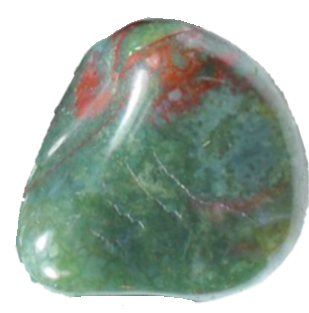
The mineral more commonly known as Bloodstone is a captivating aggregate officially called Heliotrope, a name derived from the Greek words hḗlios (meaning Sun) and trépein (meaning to turn). This striking gemstone is a distinct microcrystalline mixture of quartz that occurs mostly as an opaque jasper or sometimes as a translucent chalcedony.
The “classic” Bloodstone is instantly recognisable by its deep, opaque green body speckled with vibrant red inclusions of hematite (iron oxide). Because these red inclusions heavily resemble spots of real blood, the mineral earned its popular name. In historical and esoteric circles, it is also occasionally referred to as Christ’s Stone due to its deep-rooted associations with early Christian lore.
Composition, Physical Characteristics, and Varieties
Bloodstone is essentially a dark green base variety of chalcedony containing distinctive red inclusions of iron oxide or red jasper. It ranks between 6.5 and 7 on the Mohs hardness scale, making it a durable stone with a smooth, distinctly waxy lustre when polished.
In the gemological community, there are two primary varieties of this mineral:
- Classic Bloodstone: Features a rich, deep forest-green background scattered with prominent, eye-catching red speckles and streaks.
- Plasma: A much deeper, uniform green variety that features very few or completely lacks any red inclusions.
Global Sources: Where is Bloodstone Found?
Bloodstone forms within low-temperature geological environments, typically precipitating from silica-rich groundwater inside rock fractures and cavities. Significant global deposits are actively mined in the following regions:
- India: Notably in the region of Gujarat, which serves as a major global exporter of premium-grade specimens.
- Brazil and Madagascar: Renowned for yielding massive blocks with intensely saturated green tones.
- Australia and China: Producing excellent varieties popular in both commercial lapidary work and carvings.
- United States: Mined across historically rich volcanic and metamorphic districts in California and Oregon.
- Scotland: Host to ancient deposits wrapped in local heritage.
Historical Significance and Archaeological Finds
For centuries, Bloodstone has bridged the worlds of fine craftsmanship, ancient medicine, and spiritual protection. Archaeological excavations reveal its extensive use across prominent ancient civilisations:
Ancient Mesopotamia and Greece
Early Babylonian and Mesopotamian cultures carved Bloodstone into intricate seals, signet rings, and protective amulets designed to enhance an individual’s physical strength and resilience. The ancient Greeks and Romans wore the stone to attract fame, secure good fortune, and safeguard themselves against the venomous bites of wild creatures.
Furthermore, Roman and Greek athletes carried Bloodstone as a powerful lucky charm to ensure victory during athletic games. Roman soldiers strongly believed the stone possessed the metaphysical ability to slow or stop bleeding entirely, carrying it into battle for immediate first-aid protection.
Asian Indian Traditions
In traditional Indian culture and medicine, a very similar belief persists regarding Bloodstone’s ability to staunch bleeding. Practitioners would cool the stone in icy water and place it directly onto open wounds. Scientifically, the combination of cold temperature and localized pressure naturally halts haemorrhaging, while the stone’s high iron oxide content acts as an effective natural astringent. Within Indian heritage, Bloodstone has also historically been considered a potent aphrodisiac.
Textual Lore and Magical Beliefs
The famous Leyden Papyrus, a Greek manuscript dating back to the 3rd century CE, lauds the extraordinary power of Bloodstone. It states that the gemstone will grant the wearer whatever they request, declaring: “Whatever the wearer says, he will be believed. Whoever bears this stone, which is a gem, and pronounces the name engraved upon it, will find all doors open, while bonds and stone walls will rent asunder.”
Ancient scholars also attributed bizarre magical properties to Heliotrope. The Roman historian Pliny the Elder documented that ancient magicians used it as a stone of literal invisibility. Similarly, the writer Damigeron wrote of its power to summon rain, cause sudden solar eclipses, preserve youth, and aid in accurate divine prophecy.
Historical and Evolving Medical Uses
Throughout history, Bloodstone has been deeply intertwined with traditional medical practices. Powdered Bloodstone mixed with honey was a highly praised historical elixir used to treat physical tumours, draw out lethal snake venom, and stop massive haemorrhages. Ancient records even claimed it could clear the putrefaction of painful abscesses within a single day, and simply gazing at the stone was thought to prevent eye diseases entirely.
During the Middle Ages, physicians regularly prescribed it to aid blood circulation, while Renaissance alchemists routinely incorporated it into complex potions designed to prolong youth and vitality. In modern times, Bloodstone remains a staple piece in contemporary jewellery, meditation tools, and holistic alternative healing practices.
Folklore, Legends, and Tales
Rich cross-cultural myths have continuously added to the global mystique of Bloodstone:
- The Christian Crucifixion Legend: The most famous Western story states that during the crucifixion of Jesus Christ, his blood dripped onto the dark green earth beneath the cross, permanently staining the stones. This sacred lore gave birth to the stone’s red flecks and its alternate title, “Christ’s Stone”.
- Divine Armour Inclusions: Roman and Greek myths recount legendary warriors embedding polished Bloodstones directly into their protective shields, weapons, and body armour to secure divine protection mid-battle.
- The Persian Storm God: In ancient Persian folklore, Bloodstone was believed to directly harness the chaotic power of the atmosphere, allowing weather-wizards to summon life-saving rain during devastating droughts.
- Medieval Ward Against Nightmares: During the medieval era, placing a raw piece of Bloodstone underneath a pillow was believed to banish terrifying nightmares and guarantee a deep, restful sleep.
Metaphysical and Healing Properties
In modern crystal healing, Bloodstone is treated as an energetic powerhouse designed to vitalise both the mind and the body.
1. Physical Healing
True to its name, Bloodstone is primarily used to energetically support the circulatory system, cleanse the blood, and aid in physical detoxification. It is thought to boost the immune system and revitalise the physical body when dealing with severe exhaustion or motivational slumps.
2. Emotional and Spiritual Healing
Emotionally, Bloodstone acts as a grounding anchor that dispels chaotic negative energy, fosters deep inner courage, and enhances emotional resilience. Carrying or wearing the stone increases mental clarity, assists in swift decision-making, strengthens personal intuition, and realigns an individual’s overall aura.
Astrology, Chakras, and Anniversaries
Cosmic and Astrological Links
- Aries: Bloodstone heavily resonates with Aries, beautifully amplifying their natural courage, vitality, and fierce determination while keeping their fiery tempers safely grounded.
- Pisces: It offers a vital balancing counterweight to Pisces, anchoring their deep emotional waves with steady, earthly security.
Chakra System Connections
- Root Chakra (Muladhara): Bloodstone deeply stimulates the Root Chakra at the base of the spine, promoting physical stability, security, and raw survival strength.
- Heart Chakra (Anahata): Because of its unique green and red composition, it simultaneously bridges energy up to the Heart Chakra, encouraging profound emotional balance, heartbreak recovery, and courageous love.
Birthstone and Anniversary Traditions
Bloodstone is celebrated as a traditional birthstone for the month of March, offering strength to those born in early spring. It is also the designated gemstone used to commemorate the 14th wedding anniversary, beautifully symbolising endurance, marital resilience, and relationship renewal.
Crystal Pairings: Combinations to Choose and Avoid
To get the absolute most out of your Bloodstone, it helps to understand which crystals work in harmony with its grounding, iron-rich vibration and which combinations create uncomfortable energetic friction.
Best Crystals to Pair with Bloodstone
Clear Quartz (The Amplifier): Clear Quartz magnifies Bloodstone’s physical vitality and circulatory healing properties, turning it into an absolute powerhouse for overcoming physical exhaustion.
Hematite or Red Jasper (The Ultimate Root Anchor): Since Bloodstone already contains inclusions of haematite and jasper, pairing it with pure Haematite or Red Jasper dramatically intensifies your connection to the Earth, making it perfect for deep grounding and boosting raw physical stamina.
Carnelian (The Motivation Booster): If you are suffering from a severe creative or professional slump, pairing Bloodstone with Carnelian sparks a massive wave of courage, passion, and creative drive.
Rose Quartz (The Heart Healer): This combination beautifully targets the Heart Chakra. Bloodstone provides the inner strength needed to face past emotional traumas, while Rose Quartz fills that newly cleared space with gentle self-compassion.
Crystal Pairings to Avoid
Moldavite: Moldavite possesses an incredibly high-vibrational, erratic, and celestial energy designed for rapid, destabilising cosmic transformation. Pairing it with the dense, earth-bound, and fiercely protective grounding energy of Bloodstone creates an intense energetic clash that can leave you feeling dizzy, irritable, or stuck.
Selenite: Selenite operates on an exceptionally ethereal, crown-focused frequency meant for spiritual cleansing and upper chakra work. Pairing it simultaneously with Bloodstone can confuse your energetic field, as one stone tries to pull your consciousness upward while the other pulls it heavily downward.
Amethyst (For Active Energy): Do not pair Bloodstone with Amethyst if your primary goal is physical vitality or sports performance. Amethyst’s calming, deeply sedative, and meditative properties will actively work against Bloodstone’s desire to pump vitality and physical drive into your system.
Frequently Asked Questions (FAQ)
Is Bloodstone a real stone?
Yes, Bloodstone is a 100% natural, authentic gemstone. It is an aggregate variety of chalcedony quartz and jasper. While it is widely available, high-grade specimens featuring a perfectly balanced dark green body and distinct, bright red dots are highly prized by collectors.
Can Bloodstone go in water?
Yes, Bloodstone is durable and generally safe for brief exposure to water due to its solid hardness rating of 6.5 to 7 on the Mohs scale. However, because it contains rich iron oxide (hematite) inclusions, you should avoid soaking it in water for prolonged periods, and keep it completely away from abrasive saltwater or harsh chemical cleaners, which can erode the stone’s waxy lustre over time.
How do I cleanse and charge Bloodstone?
Because Bloodstone actively absorbs environmental stress and negative energies, frequent cleansing is highly recommended. You can cleanse your stone by running it under lukewarm tap water for a few minutes, smudging it with sage or incense smoke, or placing it on a Selenite charging plate. To recharge its physical vitality, place it in direct sunlight for a couple of hours (recalling its ancient name, Heliotrope), or bury it in clean soil overnight to reconnect it with Earth’s grounding frequencies.
Can I wear Bloodstone every day?
Absolutely. Due to its natural hardness, Bloodstone is highly resistant to everyday scratches and standard wear. Wearing it daily as a ring, bracelet, or pocket stone keeps its protective shield active within your energetic field, continuously supporting your physical stamina and mental clarity throughout the day.
Can I sleep with Bloodstone under my pillow?
Yes, Bloodstone can be kept under your pillow or on a nearby nightstand. According to ancient medieval folklore, it is highly effective at absorbing chaotic mental energy to prevent nightmares and ensure a restful night’s sleep. However, because it is a highly revitalising stone, some individuals may find it too stimulating for sleep. If you experience unusually vivid dreams or restlessness, simply move it out of the bedroom at night.
How can I tell if my Bloodstone is real or fake?
Genuine Bloodstone will always feel distinctly cool to the touch and carry a noticeable physical weight. Counterfeit versions made of cheap plastic or resin will feel warm almost instantly and lack significant weight. Furthermore, a real Bloodstone exhibits a smooth, waxy lustre when polished, and its red spots are completely unique, irregular inclusions trapped within the stone—if the red dots look perfectly uniform, stamped on, or symmetrical, it is highly likely a synthetic glass or plastic imitation.
These are my personally selected and curated Bloodstone products